Cursos de Desarrollo
Los mismos datos para todos, vengan de Udemy o de Coursera: precio, valoración, duración e idioma. 1.285 cursos encontrados. Afinar la búsqueda

Google Cloud IAM et mise en réseau pour les utilisateurs professionnels d'Azure
Il s'agit du premier cours d'une série de quatre destinés aux architectes et ingénieurs cloud possédant déjà des connaissances sur Azure. Il compare les solutions Google Cloud et Azure, et guide les professionnels dans leur utilisation. Ce cours est consacré à Identity and Access Management (IAM) et à la mise en réseau dans Google Cloud. Les participants mettront en application leurs connaissances de la gestion des accès et de la mise en réseau dans Azure pour explorer les similitudes et les différences avec la gestion des accès et la mise en réseau dans Google Cloud. Ils s'entraîneront également à créer et gérer des ressources Google Cloud.
Preprocessing Unstructured Data for LLM Applications
Enhancing a RAG system’s performance depends on efficiently processing diverse unstructured data sources. In this course, you’ll learn techniques for representing all sorts of unstructured data, like text, images, and tables, from many different sources and implement them to extend your LLM RAG pipeline to include Excel, Word, PowerPoint, PDF, and EPUB files. 1. How to preprocess data for your LLM application development, focusing on how to work with different document types. 2. How to extract and normalize various documents into a common JSON format and enrich it with metadata to improve search results. 3. Techniques for document image analysis, including layout detection and vision transformers, to extract and understand PDFs, images, and tables. 4. How to build a RAG bot that is able to ingest different documents like PDFs, PowerPoints, and Markdown files. Apply the skills you’ll learn in this course to real-world scenarios, enhancing your RAG application and expanding its versatility.

تنميط متقدم بتصميم سريع الاستجابة
كان من المعهود فيما مضى أن يرى كل شخص صفحات إنترنت على شاشة لها نفس الحجم تقريبًا. ولكن مع انبثاق ثورة استعمال الهواتف الذكية للدخول إلى شبكة الإنترنت، تغير عرض التصاميم كليًا. يتوقع الأفراد في الوقت الراهن أنها ستعمل بصرف النظر عن المنصة (هاتف ذكي أو جهاز لوحي أو جهاز حاسوب محمول أو جهاز حاسوب مكتبي). ويُطلق على تلك الإمكانية المتعلقة بالاستجابة لأي منصة التصميم سريع الاستجابة. وسيتعمق هذا المساق في المعارف الأساسية للغة CSS3 ليحوي موضوعات من قبيل الإطارات السلكية والتصميم السلس واستعلامات الوسائط واستخدام نماذج التنميط الحالية مثل بوتستراب. بعد الانتهاء من دراسة المساق، سيتمكن الدارسون من: إيضاح نموذج الجوال أولًا وأهمية الإطارات السلكية في مرحلة التصميم واستخدام إطارات التصاميم الحالية مثل بوتستراب. هذا هو المساق الرابع في تخصص تصميم مواقع الويب للجميع. يُتوقع أن تحظى بإلمامٍ جوهريٍ للغتي HTML وcss عند الالتحاق بهذا المساق. ينصب تركيز المساقات الأخرى على زيادة التفاعل مع لغة البرمجة جافاسكريبت وإنجاز مشروع ختامي.
4. ツールを使いこなす:Linux と SQL
Google サイバーセキュリティ プロフェッショナル認定証の 4 つめのコースです。各コースでは初級サイバーセキュリティの職に必要なスキルを身につけることができます。 このコースでは、サイバーセキュリティ アナリストとして実際に業務で使用するコンピュータ スキルを探求します。まず、サイバーセキュリティの職種でよく使われるオペレーティング システム(OS)である Linux の使い方を学びます。例えば、Bash シェルによる Linux のコマンドラインを使って、ファイル システムの操作や管理、ユーザー認証を実行します。そして、データベースと通信するために SQL を使う方法についても学びます。 サイバーセキュリティの分野で働いている現職の Google 社員が最適なツールやリソースを使って一般的なサイバーセキュリティの業務を遂行する実践的な方法を指導します。また就職活動への準備も手助けします。 この認定プログラムを修了すると、エントリーレベルのサイバーセキュリティの職に応募できるようになります。過去の業務経験は不要です。

MLOps and LLMOps: Deploying and Scaling AI in Production
This intermediate course equips ML engineers, data scientists, and software engineers with the practical skills needed to design, deploy, and scale production AI systems. You’ll learn how to architect reliable ML and LLM applications, including model serving patterns, feature stores, and retrieval-augmented generation (RAG) components. The course walks through reproducible training and experimentation pipelines with tools like MLflow and Weights & Biases, from experiment tracking and model registration to production deployment. You will configure CI/CD workflows tailored to ML and LLM systems, covering data, model, and prompt versioning, automated testing, and safe rollback strategies. The course emphasizes security, privacy, and compliance best practices, including access control, secrets management, and safe handling of user and training data. You’ll design scalable serving infrastructure using containers, Kubernetes, and autoscaling, and apply deployment patterns such as canary, blue-green, shadow, and A/B testing to introduce changes safely. Finally, you’ll build automated evaluation and observability for production AI. This includes automated evaluation pipelines (e.g., LLM-as-a-judge) wired into CI/CD gates, defining and tracking key quality and performance metrics like hallucination rate, latency, throughput, and cost per request, and implementing robust logging, metrics, distributed tracing, and telemetry. You will also detect and monitor data and model drift, bias, and degradation over time using tools such as Arize Phoenix, design alerting strategies, and collaborate with product and reliability teams to establish incident response, runbooks, and continuous improvement processes for AI systems at scale. Disclaimer: This is an independent educational resource created by Board Infinity for informational and educational purposes only. This course is not affiliated with, endorsed by, sponsored by, or officially associated with any company, organization, or certification body unless explicitly stated. The content provided is based on industry knowledge and best practices but does not constitute official training material for any specific employer or certification program. All company names, trademarks, service marks, and logos referenced are the property of their respective owners and are used solely for educational identification and comparison purposes.

UX / UI: Fundamentos para o design de interface
Aprenda com uma das maiores startups do Brasil, a Taqtile sobre com criar a melhor experiência para o seu usuário, formas de gerar ideias, princípios básicos de design e como desenvolver interfaces de aplicativos e sites, esse curso introdutório é composto de aulas teóricas com exemplos práticos de aplicação de cada assunto abordado. Neste curso serão abordados os seguintes temas: Como conhecer o seu usuário Usabilidade e Prototipação rápida Arquitetura de informação e wireframe Princípios de design Acessibilidade e multi plataforma Elementos de interface do usuário Linguagem da empresa, lidando com o cliente e copyright Monitoração, Mensuração e Teste Ao final desse curso, esperamos que você esteja familiarizado com os principais conceitos, ferramentas e metodologias de criação de interfaces e experiência de usuário. Não deixe de ver as perguntas frequentes antes de se inscrever Conheça os nossos outros cursos: - Criação de Startups: Como desenvolver negócios inovadores https://www.coursera.org/learn/criacao-startups - Consolidando empresas: Estrutura jurídica e financeira https://www.coursera.org/learn/consolidando-empresas - Marketing Digital https://www.coursera.org/learn/estrategia-marketing-digital - Inove na gestão de equipes e negócios: o crescimento da empresa https://www.coursera.org/learn/gestao-equipes-negocios - Marketing e vendas B2B: fechando novos negócios https://www.coursera.org/learn/marketing-vendas-b2b
Quantum Computing with Qiskit and Advanced Algorithms
Updated in May 2025. This course now features Coursera Coach! A smarter way to learn with interactive, real-time conversations that help you test your knowledge, challenge assumptions, and deepen your understanding as you progress through the course. Quantum computing is revolutionizing the tech world, and this course is designed to guide you through this emerging field. You’ll begin with foundational concepts, exploring classical and quantum gates, entanglement, and circuit creation using Qiskit. These hands-on exercises will give you the skills to build and run quantum circuits on simulators and real IBM quantum computers. As the course progresses, you’ll delve into some of the most important algorithms that define quantum computing's potential. Learn about teleportation, superdense coding, and algorithms such as Bernstein-Vazirani, Deutsch, and Grover’s, implementing each in Qiskit. This step-by-step journey builds your understanding of how these algorithms work and how they outperform classical counterparts. Finally, the course wraps up with Shor’s algorithm and Quantum Fourier Transform, preparing you to apply quantum computing in real-world problem-solving scenarios. By the end of the course, you’ll be equipped to navigate the future of quantum technologies and contribute to cutting-edge research or applications. This course is aimed at professionals and students with a foundational knowledge of linear algebra and classical computing. Experience with Python is recommended, as Qiskit relies heavily on Python programming.

Platform Product Essentials
Delivering a platform solution for your business in a “clicks not code environment” seems easy. However the drag and drop interface of the technology isn’t the hard part. This is a course that will help you focus on the real difficulty in platform implementation, the structure of your business and its people. We will explore the benefits of low-code application development vs no-code development and how these tools are surpassing traditional development as the gold standard for custom applications. Our classes will showcase the low-code app development on the google platform and show you how to leverage LC/NC apis to leverage the functionality of tools like Zapier to connect your platform applications. All with little to no coding knowledge. This fun and engaging course will take a foundational look at the necessary elements to successfully transform your business with the right platform. Starting with establishing a foundational understanding of LCNC tools and taking a look at the landscape of platforms in the market. Participants will get a taste of how citizen developers and professional developers can collaborate to build productive low-code applications. We will then introduce the four pillars model as a tool that will provide clarity for all of the critical elements that are involved in your implementation. We will also highlight some real world use cases where LC/NC applications have been built successfully and where application development has failed. Historically, traditional implementation models utilize project management techniques to deliver solutions. Throw your PMBOK (project management body of knowledge) out the window. We are no longer running a project. Our platform is now a product and you are on the road to your digital transformation.

Bases y primeros pasos en R
En este curso basado en un proyecto y de 1,5 horas de duración, aprenderás las bases de R, aprenderás desde cero cómo comenzar a trabajar con R, los distintos tipos de datos, funciones, ciclos, entre otros temas. A lo largo del proyecto realizaremos distintos ejemplos, los cuales puedes seguir en tiempo real, además de repetirlos hasta que lo comprendas a cabalidad. Este es un curso de bases, por lo cual no necesitas tener conocimientos previos de R.

Introduction to Image Generation - Deutsch
In diesem Kurs werden Diffusion-Modelle vorgestellt, eine Gruppe verschiedener Machine Learning-Modelle, die kürzlich einige vielversprechende Fortschritte im Bereich Bildgenerierung gemacht haben. Diffusion-Modelle basieren auf physikalischen Konzepten der Thermodynamik und sind in den letzten Jahren in der Forschung und Industrie sehr beliebt geworden. Dabei stützen sich Diffusion-Modelle auf viele innovative Modelle und Tools zur Bildgenerierung in Google Cloud. In diesem Kurs werden Ihnen die theoretischen Grundlagen der Diffusion-Modelle erläutert und wie Sie diese Modelle über Vertex AI trainieren und bereitstellen können.

Automated Reasoning: Symbolic Model Checking
The Automated Reasoning: Symbolic Model Checking course presents how the properties of acting systems and programs can be verified automatically. The basic notion is a transition system: any system that can be described by states and steps. We present how in CTL (computation tree logic) properties like reach-ability can be described. Typically, a state space may be very large. One way to deal with this is symbolic model checking: a way in which sets of states are represented symbolically. A fruitful way to do so is by representing sets of states by BDDs (binary decision diagrams). Definitions and basic properties of BDDs are presented in this course, and the algorithms to compute them, as needed for doing CTL model checking.

AWS Generative AI and Foundation Models
Learn to build generative AI solutions on AWS by working hands-on with Amazon Bedrock, Retrieval Augmented Generation pipelines, Amazon Q Developer, and open-source LLM toolchains. You will apply tokenization concepts to understand model pricing and context windows, construct RAG pipelines grounded in your own knowledge bases, and use the Bedrock SDK in Rust and Python to invoke foundation models programmatically. The course covers Amazon Q Developer for AI-assisted code generation, security scanning, and documentation workflows across VS Code and IntelliJ. You will compile llama.cpp with parallel build optimizations informed by Amdahl's Law, package models in the GGUF quantization format, and deploy open-source LLMs on AWS EC2 GPU instances. The course also introduces SageMaker Canvas for no-code visual machine learning and the UV Python packaging tool for dependency management. By completing this course, you will be able to evaluate trade-offs between managed AWS services, open-source toolchains, and no-code platforms for production generative AI workloads.
PyTorch: Advanced Architectures and Deployment
Advance your PyTorch skills by building sophisticated deep learning models and preparing them for deployment. You’ll design custom architectures that go beyond Sequential models, exploring Siamese Networks, ResNet, and DenseNet to understand how modern systems handle complex data. You’ll build Transformer architectures and explore how attention mechanisms power modern language models. You’ll also learn how diffusion models generate realistic images by reversing noise. Along the way, you’ll visualize model behavior using saliency maps and class activation maps, and prepare models for deployment with ONNX, MLflow, pruning, and quantization. By the end, you’ll be ready to create efficient, interpretable, and deployable PyTorch models for real-world deep learning tasks.

Agile Project Management
In this comprehensive Agile Project Management course, you’ll learn the essentials of Scrum, from foundational concepts to advanced techniques for managing project deadlines effectively. The course is designed to guide you step by step through Scrum methodologies, showing you how to manage projects using Agile practices like Sprint Planning, Release Planning, and working with User Stories. You will explore how to establish stakeholders, craft effective product backlogs, and lead successful retrospectives. Whether you're new to Agile or looking to refine your skills, this course provides real-world examples to reinforce learning. Throughout the course, you will participate in activities such as creating and prioritizing user stories, conducting Sprint reviews, and refining your backlog management. Additionally, you’ll explore the importance of metrics like velocity and release burn-down charts in tracking your project’s progress. By the end, you will have practical knowledge on using Agile tools and principles in everyday project management. This course is ideal for project managers, product owners, and Scrum practitioners. No prior experience with Agile or Scrum is required. If you’re aiming to elevate your project delivery with real-time insights and hands-on practice, this course is for you.

Design, Compare and Analyze LLM Architectures
Selecting the appropriate architecture for a large language model (LLM) application is a critical decision for any technical team, influencing costs, performance, and security. The course "Design, Compare and Analyze LLM Architectures" is tailored for engineers, architects, and technical leads involved in these pivotal "build vs. buy" assessments. It offers a structured approach to designing and justifying system architectures. Learners will learn to enhance their visual communication skills by creating sequence diagrams that illustrate the trade-offs between synchronous and asynchronous processing flows. The course also emphasizes strategic analysis of deployment options, comparing self-hosting an open-source model with utilizing a managed API. Key skills developed include calculating Total Cost of Ownership (TCO), evaluating latency, and understanding data privacy implications, enabling participants to make informed, business-focused recommendations. By the end of this course, you will be able to confidently design, defend, and document your architectural choices to any stakeholder.

Intermediate Rust Programming and Advanced Concepts
Updated in May 2025. This course now features Coursera Coach! A smarter way to learn with interactive, real-time conversations that help you test your knowledge, challenge assumptions, and deepen your understanding as you progress through the course. Advance your Rust programming journey with this in-depth course designed for developers seeking to master more complex concepts and real-world applications. Begin with an exploration of Rust modules and crates, learning how to create, manage, and publish packages. Dive into the essential Cargo tools for visualizing module hierarchies and streamline your code with techniques like re-exporting. Progress to the critical topic of smart pointers, essential for advanced memory management in Rust. Understand the basics and applications of various smart pointers, such as Box, Rc, and RefCell. Build and refine data structures like singly and doubly linked lists, and learn to avoid common pitfalls like reference cycles that can lead to memory leaks. This section ensures you can handle sophisticated memory management challenges with confidence. In the final segments, tackle advanced Rust programming techniques and real-world problem-solving scenarios. Master macros, testing, and effective code optimization methods. Apply your knowledge to build practical applications, from search result algorithms to data storage solutions using advanced data structures, like binary search trees. This hands-on approach solidifies your understanding and prepares you for professional Rust development. This course is ideal for developers with a basic understanding of Rust who want to advance their skills. Fundamental knowledge of Rust programming concepts and syntax is recommended.

Robot Localization with Python and Particle Filters
In this one hour long project-based course, you will tackle a real-world problem in robotics. We will be simulating a robot that can move around in an unknown environment, and have it discover its own location using only a terrain map and an elevation sensor. We will encounter some of the classic challenges that make robotics difficult: noisy sensor data, and imprecise movement. We will tackle these challenges with an artificial intelligence technique called a particle filter. By the end of this project, you will have coded a particle filter from scratch using Python and numpy. Note: This course works best for learners who are based in the North America region. We’re currently working on providing the same experience in other regions.
Introduction to On-Device AI
As AI moves beyond the cloud, on-device inference is rapidly expanding to smartphones, IoT devices, robots, AR/VR headsets, and more. Billions of mobile and other edge devices are ready to run optimized AI models. This course equips you with key skills to deploy AI on device: 1. Explore how deploying models on device reduces latency, enhances efficiency, and preserves privacy. 2. Go through key concepts of on-device deployment such as neural network graph capture, on-device compilation, and hardware acceleration. 3. Convert pretrained models from PyTorch and TensorFlow for on-device compatibility. 4. Deploy a real-time image segmentation model on device with just a few lines of code. 5. Test your model performance and validate numerical accuracy when deploying to on-device environments 6. Quantize and make your model up to 4x faster and 4x smaller for higher on-device performance. 7. See a demonstration of the steps for integrating the model into a functioning Android app. Learn from Krishna Sridhar, Senior Director of Engineering at Qualcomm, who has played a pivotal role in deploying over 1,000 models on devices and, with his team, has created the infrastructure used by over 100,000 applications. By learning these techniques, you’ll be positioned to develop and deploy AI to billions of devices and optimize your complex models to run efficiently on the edge.
Advanced Python: Object-Oriented Programming
This course will be useful to anyone who has programming experience with Python and would like to take a deeper dive into the language. You will learn how to design object-oriented applications. You will also learn how to use apply object-oriented design to Python applications using classes and methods. This is the first course in a multi-course Specialization. All of the courses in this Specialization require that you use the provided virtual machine, which includes an installation of Python. The course setup instructions provided in the first module of this course go into more detail about the hardware and software requirements.

Building and Training Neural Networks with PyTorch
Updated in May 2025. This course now features Coursera Coach — your interactive learning companion that helps you test your knowledge, challenge assumptions, and deepen your understanding as you progress. Master the power of neural networks with this hands-on deep learning course built entirely in PyTorch. Designed for data scientists, AI practitioners, and developers, this course guides you step by step through building, training, and evaluating models for image, audio, and sequence-based tasks using one of the industry’s most popular frameworks. You’ll begin by exploring classification models, learning how to handle binary and multi-class problems, interpret confusion matrices, and analyze ROC curves. Through practical exercises, you’ll prepare data, design dataset classes, and build your own neural network architectures to solve real classification challenges. Next, you’ll move into Convolutional Neural Networks (CNNs), where you’ll develop both image and audio classification systems. You’ll learn how CNN layers work, implement preprocessing pipelines, and construct models for binary and multi-class image tasks. You’ll also extend these skills to audio classification, giving you a broader understanding of how CNNs apply across domains. From there, you’ll dive into object detection, mastering accuracy metrics, labeling formats, and the YOLO (You Only Look Once) algorithm. Hands-on coding sessions walk you through data preparation, training, and inference so you can build complete, end-to-end detection workflows. In the final modules, you’ll explore neural style transfer, transfer learning with pre-trained networks, and sequence modeling using RNNs and LSTMs — gaining the skills to tackle advanced deep learning applications. By the end of this course, you will have: - Built and evaluated neural network models for binary and multi-class classification. - Designed and trained CNNs for image and audio data. - Implemented object detection workflows using YOLO. - Applied neural style transfer and leveraged pre-trained models for transfer learning. - Developed RNN and LSTM models for sequence-based tasks. - Gained the confidence to use PyTorch for real-world deep learning projects. This course is ideal for learners with experience in Python and a foundational understanding of machine learning and deep learning concepts who want to advance their skills in building neural networks with PyTorch.
C Programming for Hardware
This course gives you the opportunity to extend your C programming experience into firmware development, writing code that talks straight to a processor. Building, running, and debugging real code, you'll discover how a variable and an address in the memory map are the same idea seen from two directions. Along the way, you'll explore processor, bus, and memory architecture; learn how C data types map to physical memory; and safely interface with memory-mapped registers. You'll manipulate individual bits to drive real peripherals, write interrupt-safe code, and master pointers, type casting, and function-pointer callbacks. Whether you're reinforcing skills or meeting these ideas for the first time, the course's hands-on, self-assessed structure turns understanding into lasting ability. Each lab runs on the same emulated silicon you'd use in practice, so the behavior you observe is the behavior the chip produces. By the end, you'll be ready to pick up an unfamiliar microcontroller, open its reference manual, and start writing real, well-organized code against its hardware.

Architecting Google Kubernetes Engine: Foundations in italiano
"In questo corso, ""Architecting with Google Kubernetes Engine: Foundations"", troverai un ripasso del layout e dei principi di Google Cloud, seguito da un'introduzione alla creazione e alla gestione dei container software, nonché all'architettura di Kubernetes. Si tratta del primo corso della serie Architecting with Google Kubernetes Engine. Dopo il completamento di questo corso, iscriviti al corso Architecting with Google Kubernetes Engine: Workloads."

Integrate and Optimize AI Services Seamlessly
"Integrate and Optimize AI Services Seamlessly" is an applied, intermediate-level course designed for engineers and ML practitioners who want to build reliable, production-ready AI systems. Across focused, hands-on lessons, the course explores how real-world services communicate using APIs, message queues, and structured serialization formats. Learners gain practical experience integrating prediction services with gRPC and protobuf, improving consistency, performance, and cross-language compatibility. The course also guides participants through deployment health essentials, including interpreting Prometheus metrics, spotting early warning signs during canary releases, and making safe decisions to stabilize or roll back new versions. Through real scenarios, interactive activities, and expert-led demos, students develop the confidence to ship AI services that are fast, resilient, and operationally sound in modern distributed environments.
AI Python for Beginners
AI Python for Beginners is designed to help you leverage the power of Python programming, even if your goal isn’t to become a software developer or AI engineer. This four-part course that teaches you to code practical AI applications from day one, even if you've never programmed before. You’ll learn with support from an AI chatbot that can help you get immediate feedback, quickly fix bugs, and keep you on track while learning new skills. You'll gain a foundational understanding of Python while building AI-powered tools like custom recipe generators, smart to-do lists, and vacation planners, and learn essential programming concepts such as variables, functions, loops, and data structures. By the end of this course, you'll be able to write Python scripts that interact with large language models, automate tasks, analyze your own data, and even create simple AI agents - skills that are increasingly valuable across industries from tech and finance to healthcare and creative fields. Accelerated learning with AI: Experience a new kind of learning with AI chatbot integration. This intelligent assistant helps you write, test, and debug code, providing instant feedback and personalized guidance, making sure you’re never coding alone. With the rise of AI tools, the effort and time required to learn helpful coding skills has significantly decreased, making it more accessible and beneficial for everyone.

XML Practical - Schemas
Learn how to design, implement, and validate structured XML documents using XML Schema (XSD) through a practical, example-driven learning experience. This course guides you from the fundamentals of XML Schema to advanced schema design techniques, helping you create reliable, reusable, and standards-compliant XML structures. You will begin by exploring the limitations of Document Type Definitions (DTDs) and understanding how XML Schema enhances XML with strong data typing, extensibility, and validation capabilities. As you progress, you will define elements, attributes, and complex types, then apply reusable groups, occurrence constraints, and restrictions to model structured XML data. Through hands-on schema implementation exercises, you will build, test, and validate XML documents while reinforcing best practices for schema design. Designed for XML developers, data integrators, and technical professionals, this course emphasizes practical application rather than theory alone. Each module builds progressively, enabling you to confidently construct XML Schemas, enforce validation rules, and create scalable schema components for structured data systems. If you want to strengthen your XML Schema (XSD) skills and gain practical experience designing and validating XML documents, this course provides a structured path from foundational concepts to advanced schema implementation.

Oracle Performance: Exadata, Enterprise Manager Mastery
Oracle Performance: Exadata, Enterprise Manager Mastery platform is designed to run Oracle Database workloads of any scale with very high performance, scalability, availability and security. Oracle Exadata has been engineered with many unique database-aware optimizations to run transactional, analytical, AI and mixed workloads faster. This course will introduce the learner to the key optimization features of Oracle Exadata, best performance practices for running databases on Exadata and configuring an Exadata Database Machine to be managed using Oracle Enterprise Manager Cloud Control. This course is designed for database administrators and database developers who are looking to enhance their expertise in Oracle Exadata. It caters to professionals responsible for managing and optimizing Oracle databases, ensuring high performance, scalability, and availability. The course will be particularly beneficial to those overseeing complex database systems who are eager to leverage Exadata's powerful optimization features for improved efficiency and performance. Participants should have a strong understanding of Oracle Database Administration, RAC, ASM, and Oracle Clusterware, along with familiarity with the Oracle Exadata Database Machine architecture and Oracle Enterprise Manager Cloud Control. This knowledge will help learners effectively engage with the course and apply the concepts to real-world scenarios. By the end of this course, learners will be able to identify the key features of Oracle Exadata that significantly enhance database performance. They will also be able to demonstrate best practices for configuring Oracle databases running on Exadata to optimize efficiency and reliability. Finally, participants will learn to implement steps for configuring Oracle Enterprise Manager Cloud Control, enabling them to monitor and manage Oracle Exadata Database Machines effectively.

Microsoft PowerPoint with ChatGPT & Gamma AI 2026
Discover how to elevate your PowerPoint presentations by integrating ChatGPT and Gamma AI. Learn essential design principles, create visually engaging slides, and leverage AI tools for enhanced productivity and creativity. This course is your comprehensive guide to mastering Microsoft PowerPoint with the help of generative AI tools like ChatGPT and Gamma AI. In the first part, you will dive deep into the fundamentals of PowerPoint, from creating slides and managing layouts to adding multimedia and inserting charts. Learn the core design principles with the LAVA framework to ensure your presentations are visually appealing and well-structured. Next, you will explore advanced PowerPoint features such as slide masters, motion paths for animations, and using accessibility options to make your presentations more inclusive. With the integration of ChatGPT, you will discover how AI can assist you in crafting slide content, formatting designs, and even generating images, making the entire process more efficient and creative. The course culminates in a capstone project where you apply your knowledge to create a fully customized presentation. You will bring together all the elements learned, from designing the title slide to animating timelines, while utilizing AI tools for maximum impact. Whether you're a beginner or an experienced PowerPoint user, this course will elevate your presentation design skills to a new level. This course is perfect for business professionals, marketers, educators, and designers looking to enhance their presentation skills using advanced design techniques and AI-powered tools. No prior experience with PowerPoint is required, but basic knowledge of the software will be helpful. This course uses a hands-on approach with video tutorials, practical examples, and a final project to reinforce learning. You’ll progress from basic slide creation to mastering AI-assisted tools, ensuring you can confidently apply the concepts to real-world scenarios. This course is based on Microsoft PowerPoint with ChatGPT & Gamma AI 2026, by KultureHire, Kadhiravan Jayachandiran. This course is licensed and distributed by Packt. All rights reserved. Packt is one of the world's most prolific publishers of cutting-edge technical content. For over two decades we've made it our mission to curate and publish the knowledge of only the very best technical experts. We focus on real-world courses that help our customers get the job done, with coverage that extends across a wide range of established and cutting-edge technical topics. If you're an individual or an organisation that embraces learning by doing, Packt is the perfect fit for you.

Git Fundamentals - A Beginner's Guide to Managing Your Code
This course features Coursera Coach! A smarter way to learn with interactive, real-time conversations that help you test your knowledge, challenge assumptions, and deepen your understanding as you progress through the course. In this beginner-friendly course, you’ll learn Git essentials for managing code efficiently. You will start by setting up Git on your machine, understanding its purpose, and differentiating between Git and GitHub. Throughout the course, you’ll work with key Git concepts like cloning repositories, staging changes, committing, pushing, and pulling code. You will also explore more advanced Git commands like git log, git stash, and git revert to streamline your workflow. As you progress, you will dive into GitHub-specific workflows, like forking, pull requests, and code reviews, which are essential for collaboration. You'll also master branching to manage features and fixes independently, along with learning how to exclude files using .gitignore. The course equips you with the fundamental tools and skills needed to manage code and collaborate effectively in a team environment. This course is perfect for beginners who want to learn Git for version control and collaboration. No prior experience with Git or GitHub is required. By the end of the course, you will be able to set up Git, manage code repositories, collaborate with others using GitHub, and implement advanced Git commands for efficient version control.

Introduction to UX/UI Design
With user experience now a top priority, the UX/UI design market is growing fast (Global Growth Insights). Talented UI/UX designers are in high demand! This course gives you the essential skills to confidently take your next step in learning UX/UIdesign. During the course, you’ll learn the basics of user experience (UX) and user interface (UI) design and discover how they work together to create effective, user-friendly products. From websites and mobile apps to emerging technologies like AR/VR, you’ll see how UX/UI shapes the way we interact with digital experiences. You'll also explore how UX/UI fits into the product development process and learn about core technical skills, including wireframing, prototyping, user research, and interaction design. You’ll learn about tools used by UX/UI designers such as Figma, and learn how to select the right tools for different design tasks. You’ll also gain hands-on experience developing a prototype using Figma. By the end, you’ll have a clear understanding of potential career paths and the skills needed to take your next step in UX/UI design. Whether you're exploring design for the first time or looking to build your UX/UI skillset, enroll today and start your UX/UI journey.

Principles of Secure Coding
This course introduces you to the principles of secure programming. It begins by discussing the philosophy and principles of secure programming, and then presenting robust programming and the relationship between it and secure programming. We'll go through a detailed example of writing robust code and we'll see many common programming problems and show their connection to writing robust, secure programs in general. We’ll examine eight design principles that govern secure coding and how to apply them to your own work. We’ll discuss how poor design choices drive implementation in coding. We’ll differentiate between informal, formal, and ad hoc coding methods. Throughout, methods for improving the security and robustness of your programs will be emphasized and you will have an opportunity to practice these concepts through various lab activities. A knowledge of the C programming language is helpful, but not required to participate in the lab exercises.

Vertex AI と Flutter による 生成 AI エージェントの構築
このコースでは、Google のポータブル UI ツールキットである Flutter を使用してアプリを開発し、そのアプリを Google の生成 AI モデル ファミリーである Gemini と統合する方法について学びます。また、AI エージェントとアプリケーションを構築、管理するための Google のプラットフォームである Vertex AI Agent Builder も使用します。

Building AI Applications with Haystack
In Building AI Applications with Haystack you will learn a high-level orchestration framework that helps ensure your applications are flexible, extendible, and maintainable, even as the technology stack changes, user needs arise, and new features are added. Using a framework can provide common features out of the box that significantly speeds up the development process. Haystack offers robust and flexible architecture and framework for building AI applications. It manages complexity and helps you focus more on developing your application at a higher level of abstraction. Throughout the course, you will develop several projects, including a RAG app, a news summarization app, a chat agent with function calling, and a self-reflecting agent with loops. What you’ll do: 1. Learn about the core abstractions and unique building blocks of the Haystack framework and see how these elements can be combined for various AI use cases. 2. Build a RAG pipeline by using Haystack components, pipelines, and document stores. 3. Create custom components in your pipeline by building a Hacker News summarizer that extends your app’s ability to access APIs. 4. Use conditional routing to create a branching pipeline with a fall back to web-search when the LLM does not have the context needed to fully respond to the user’s query. 5. Build a self-reflecting agent for named entity recognition with a Haystack pipeline that is able to loop using an output validator custom component. 6. Create a chat agent using OpenAI’s function-calling capabilities which allow you to provide Haystack pipelines as tools to the LLM, enhancing that agent’s capabilities. Start building exciting LLM applications and optimizing your development workflow using Haystack.
Machine Learning Fundamentals
This course provides a brief introduction to the theory and practice of supervised machine learning, the discipline of teaching computers to make predictions from labeled data. We begin with a well-known model of linear regression, moving from fundamental principles to the advanced regularization techniques essential for building robust models. We then transition from regression to classification, exploring two major paradigms for separating data: discriminative models and generative models. The course concludes in learning how to critically evaluate and compare classifier performance using industry-standard tools such as the ROC Curve. Upon completion, you will have a strong command of the core principles that underpin modern predictive modeling.

Optimizing Generative AI on Arm Processors
AI models are becoming increasingly powerful—but also increasingly demanding. As Generative AI moves from cloud data centers to mobile phones, autonomous systems and embedded IoT devices, the need to optimize performance across diverse hardware environments has never been more critical. Arm-based processors power more than 300 billion devices globally, from smartphones to hyperscale cloud servers, making them a key foundation for efficient AI deployment across the compute landscape. To meet this growing demand, learners need the skills to translate machine learning models into real-time, hardware-aware implementations across Arm-based platforms. Optimizing Generative AI on Arm Processors: from Edge to Cloud is designed for intermediate machine learning practitioners who want to bridge the gap between model design and deployment efficiency. Rather than revisiting ML fundamentals, this course dives straight into performance engineering for Generative AI on Arm-based platforms, including mobile, edge and cloud environments. You’ll explore real-world constraints, Arm architecture features, and software techniques used to accelerate AI inference—including SIMD (SVE, Neon), low-bit quantization, and the KleidiAI library. Each concept is taught using concise, interactive notebooks and narrated examples, enabling you to measure, tweak, and iterate on actual hardware like the Raspberry Pi 5 or AWS Graviton3 cloud instances.

React Native - Complete Guide + E-Commerce + Interview Q&A
This course features Coursera Coach! A smarter way to learn with interactive, real-time conversations that help you test your knowledge, challenge assumptions, and deepen your understanding as you progress through the course. This comprehensive guide to React Native is perfect for anyone looking to master mobile development using this powerful framework. You will build everything from core components to advanced topics like Firebase CRUD operations, HTTP with Axios, and integrating Stripe for payments, while enhancing your skills for real-world applications. Along the way, you will create a fully functional E-Commerce app and learn essential tools to succeed in interviews. The course begins with an introduction to React Native, guiding you through the basics of project setup, structure, and running apps on Android and iOS. You will progress into understanding core components, state management, and navigation in React Native, followed by real-world examples such as building an Address Book app. The course continues with modules on error handling, platform-specific modules, and HTTP requests with Firebase. The course is ideal for developers looking to expand their skills and build mobile apps with React Native, particularly those interested in creating E-Commerce applications. No prior experience with React Native is required, but familiarity with JavaScript will be beneficial. The course caters to all levels, making it suitable for both beginners and intermediate learners. By the end of the course, you will be able to design and develop React Native applications, manage app states and components effectively, implement complex navigation patterns, and integrate third-party services like Firebase and Stripe for backend functionality and payments.
Research and Strategy for Effective Information Architecture
Information architecture (IA) is essential for creating user-centered digital products. This course teaches the research and strategic planning processes required for designing IA that aligns with user and business needs. Through UX research methods, content analysis, and organizational goal alignment, you'll learn how to create robust IA strategies that enhance usability and efficiency. You will explore various UX research techniques and content classification systems, helping you structure information effectively. The course also covers best practices for labeling and mapping IA, enabling you to translate research findings into actionable strategies that meet both user needs and business objectives. What makes this course unique is its focus on real-world applications and practical frameworks, ensuring learners can implement IA strategies in real-world projects. You'll gain valuable insights into how to research, design, and optimize IA for digital environments, making complex content and data accessible and intuitive. This course is perfect for UX designers, product managers, and information architects looking to deepen their understanding of IA research and strategy. A basic understanding of UX design or digital product development is recommended. This course is part two of a three-course Specialization designed to provide a comprehensive learning pathway in this subject area. While it delivers standalone value and practical skills, learners seeking a more integrated and in-depth progression may benefit from completing the full Specialization.

AI Foundations and Secure AI Fundamentals
This course features Coursera Coach! A smarter way to learn with interactive, real-time conversations that help you test your knowledge, challenge assumptions, and deepen your understanding as you progress through the course. Build a strong foundation in artificial intelligence while learning to secure AI systems, aligned with the CompTIA SecAI+ certification. The course covers AI types, machine learning, statistical learning, transformers, deep learning, and their applications in AI security. Explore NLP, large and small language models, GANs, and model training techniques, including supervised, unsupervised, and reinforcement learning. Learn data security, prompt engineering, and AI data structures to strengthen secure AI practices. Finally, discover Retrieval-Augmented Generation, embeddings, AI lifecycle management, and human-centric design to deploy AI systems safely. Hands-on exercises ensure practical understanding of securing AI models throughout their lifecycle. By the end of the course, you will be able to apply AI fundamentals, secure AI workflows, perform prompt engineering, manage AI data and models, implement RAG workflows, and maintain AI systems safely.
Static Website Hosting and Cross-Region Replication
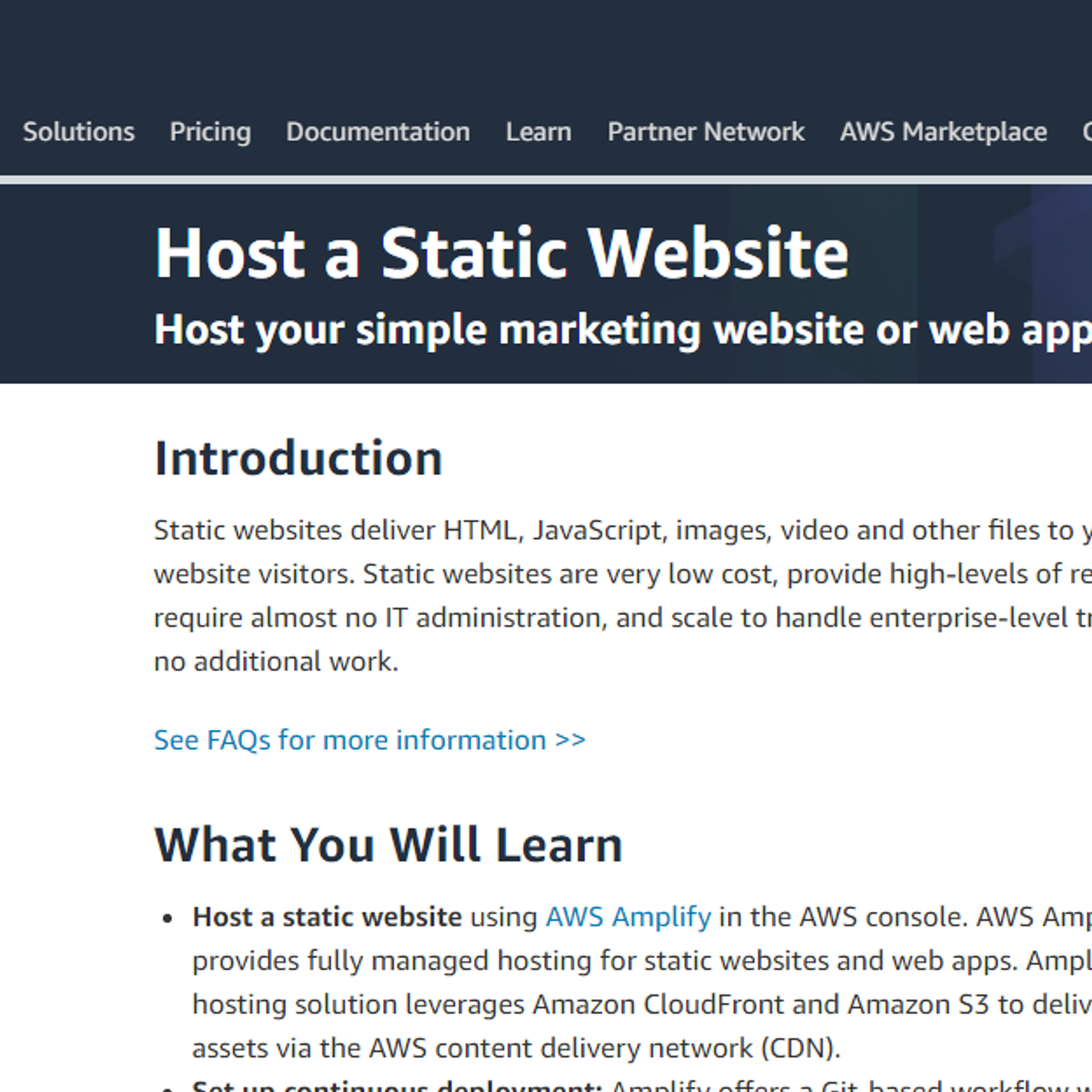
Have you ever wonder about a scenario, where you want to share data with your friend for a limited periode of time? Do you want to architect a design to host a website and maintain it at a very low cost? Are you confident enough of build an architecture in cloud, where your webiste wont face anydown time? Do you know how to recover your data from any form of Disaster? If so, then this is the right porject for you. I can provide you an apt solution for all these problems using Amazon Cloud. AWS Cloud is making everything that was imposiible at one time to reality. Don't let any disaster to shut your data down. In this 2 hours project, you will learn how to host a 'static website' and to enable 'Cross-Region Replication' as a part of 'Disaster Recovery'. I am introducing a relatively new feature in AWS Cloud, called "CLOUD SHELL" in this project, where you will get a practical experience of some common usages of generating 'Pre-Signed URL' and allowing access for any users in public Internet. Note: This course works best for learners who are based in the North America region. We’re currently working on providing the same experience in other regions.

Create attractive infographics with Creately
This project allows you to discover Creately, an online software to design Infographics. You will understand the various features of the platform and be able to create personalized and professional infographics for your business. You will have all the basic skills to use Creately easily and quickly to create infographics for your brand.

Comprehensive Guide to Server-Side Logic and Development
Course Description: This course offers a comprehensive understanding of server-side development, focusing on the creation of robust back-end logic, efficient database management, and seamless API integration. It covers key server-side technologies, including Node.js and Express.js, providing learners with practical knowledge to set up development environments and build scalable server applications. The course also delves into database fundamentals, comparing SQL and NoSQL databases, and demonstrates how to use MongoDB with Node.js for advanced data handling. Additionally, it explores RESTful API design, authentication, and authorization methods, equipping participants with the skills to build secure and efficient server-side applications. Through hands-on video lessons and practical examples, learners will gain the expertise needed to develop, manage, and secure server-side logic in modern web applications. Learning Objectives: 1. Understand and apply core server-side technologies and programming languages. 2. Set up and manage databases, perform CRUD operations, and handle advanced database concepts. 3. Design, build, and implement RESTful APIs using modern web development frameworks. 4. Apply authentication and authorization techniques to secure web applications. 5. Integrate and consume APIs effectively in front-end and back-end applications. Target Audience: This course is ideal for aspiring full-stack developers, back-end developers, software engineers, and anyone interested in building robust server-side applications. It is suitable for beginners who want to learn server-side programming and professionals looking to deepen their understanding of back-end development and API integration. Prerequisites: Basics of html, css, javascript and familiarity with front end frameworks. Disclaimer: This is an independent educational resource created by Board Infinity for informational and educational purposes only. This course is not affiliated with, endorsed by, sponsored by, or officially associated with any company, organization, or certification body unless explicitly stated. The content provided is based on industry knowledge and best practices but does not constitute official training material for any specific employer or certification program. All company names, trademarks, service marks, and logos referenced are the property of their respective owners and are used solely for educational identification and comparison purposes.

Redux in JavaScript and React
This course introduces you to the core concepts of Redux, a powerful state management library, through both plain JavaScript and React integrations. You'll start with foundational knowledge of Redux, exploring key concepts such as actions, reducers, and store creation. Through hands-on practice, you'll learn how to manage complex state and implement Redux in real-world applications. Later, the course transitions to using Redux in a React environment, covering essential patterns such as connect(), useSelector(), and useDispatch(). By the end of the course, you’ll have practical experience coding with Redux to efficiently manage state.

KI-Infrastruktur: Bereitstellungsarten
Dieser Kurs bietet einen umfassenden Leitfaden zum Bereitstellen, Verwalten und Optimieren von KI- und HPC-Arbeitslasten (Hochleistungs-Computing) auf Google Cloud. In einer Reihe von Lektionen und praktischen Demonstrationen lernen Sie verschiedene Bereitstellungsstrategien kennen – von hochgradig anpassbaren Umgebungen mit der Google Compute Engine (GCE) bis hin zu verwalteten Lösungen wie der Google Kubernetes Engine (GKE). Dabei lernen Sie, wie Sie Cluster erstellen und GKE für Inferenzprozesse bereitstellen.

Gemini for Security Engineers - Português Brasileiro
Neste curso, você vai entender como o Gemini, um colaborador com tecnologia de IA generativa do Google Cloud, ajuda a proteger seu ambiente e recursos de nuvem. Você vai aprender a implantar exemplos de cargas de trabalho em um ambiente no Google Cloud, identificar e corrigir configurações incorretas de segurança com o Gemini. No laboratório prático, você vai aprender como o Gemini aprimora sua postura de segurança na nuvem. A Duet AI agora é o Gemini, nosso modelo de última geração.

Canva Design Essentials Pt. 1: Core Tools & Layouts
Jumpstart your creative journey with Canva Design Essentials Pt. 1: Core Tools & Layouts, led by award-winning designer and educator Dan Scott. This beginner-friendly course is your foundation for mastering Canva, equipping you with essential tools, design principles, and layout strategies to create stunning visual content with confidence. By the end of the course, you’ll know how to: - Navigate Canva’s interface like a pro - Work with images, shapes, text, and layers - Mix colors, pair fonts, and align design elements - Export your designs for print, web, or social media You’ll follow along with Dan’s practical, hands-on lessons to create real-world projects like social media posts, banners, and branded visuals. With step-by-step guidance, even absolute beginners will feel empowered to design with clarity and purpose—no prior experience required. Whether you're a small business owner, student, or aspiring designer, this course gives you the creative skills to start producing polished, professional content right away. All you need is a free Canva account and basic computer skills—Dan will guide you every step of the way. Let’s get started on your path to becoming a Canva Hero! Instructor bio: Daniel Walter Scott is a digital designer, Adobe Certified Instructor, and founder of Bring Your Own Laptop (BYOL). With over 14 years of teaching experience, he has helped thousands of learners worldwide master design and creative software across print, web, video, and now 3D. Daniel is an Adobe Certified Expert and Adobe Certified Instructor who combines industry expertise with a teaching style that’s practical, engaging, and memorable. Originally from New Zealand, Daniel has lived and taught across Australia, Ireland, and beyond—sharing his skills with a truly global creative community. He’s passionate about helping students build real-world skills they can carry into their careers and creative projects. When he’s not teaching, Daniel enjoys life with his Irish wife and kids. He brings this personal, down-to-earth perspective into his courses, making complex tools feel approachable and fun to learn.

cPanel Basics: Configure, Manage & Optimize
Build practical cPanel skills to configure, manage, and optimize a website hosting environment with confidence. Designed for beginners, aspiring web administrators, entrepreneurs, and students, this course provides a step-by-step introduction to the cPanel interface and essential website administration tasks. You’ll begin by exploring the cPanel dashboard and learning to identify and interpret its key features. You’ll then configure domain registration, hosting accounts, and name server connections to establish a functional online presence. As you progress, you’ll customize dashboard settings, update account details, manage users securely, and use cPanel’s File Manager and Image tools to control website files and media. By the end of the course, you’ll be able to navigate cPanel, connect domains to hosting accounts, maintain account settings, and manage files and images for smoother website deployment and maintenance. What makes this course distinctive is its structured progression from hosting fundamentals to practical account and file management. Theory, focused demonstrations, and lesson objectives based on Bloom’s Taxonomy help you understand not only how cPanel tools work, but also how to apply them to real-world hosting needs. Enroll to develop the practical skills needed to manage your hosting environment more independently and reduce reliance on technical support.

Graphic design: pop your Linkedin with 3D effect using Canva
By the end of this project, you will learn how to use Canva to create a simple 3D effect for a customised cover image to enhance your Linkedin profile. Canva is a graphic design platform, used to create visual contents such as social media graphics, presentations, posters, documents...The users can create their own graphic or choose from many templates ready to use. The platform is free to use with optional paid subscriptions for additional functionality. LinkedIn is the largest business and employment-oriented online service that operates via websites and mobile apps. The platform is structured as a social platform mainly used for professional networking, and allows job seekers to post their CVs and employers to post jobs. Being largely used by recruiters and sales professionals, LinkedIn allows members (both workers and employers) to create profiles and "connect" to each other in an online social network which may represent real-world professional relationships.

Design and Implement a Source Control Strategy
This is the second course of the Exam Prep AZ-400: Microsoft DevOps Engineer Expert Specialization. This course assists learners with developing the ability to create effective branching strategies that align with team workflows and ensure efficient source code management. Gained expertise in setting up and organizing repositories to enable seamless collaboration and version control across teams. Also, learners will be able to learn to manage repository settings, permissions, and integrations to maintain secure and efficient source code workflows. This course is divided into two modules with multiple Lessons and Video Lectures further segment each module. This course facilitates learners with approximately 2:00-3:30 Hours of Video lectures that provide both Theory and Hands-On knowledge. Also, Graded and Ungraded assignments are provided with every module to test the ability of learners. Module 1: Design and implement branching strategies for the source code Module 2: Configure and manage repositories By the end of this course, a learner will be able to; 1. Understand Source Control and Azure Repos 2. Develop Branching Strategies and Workflows 3. Master Deployment Strategies and Traffic Management The course is for - DevOps Engineers - System Engineers - Cloud Developers

ROS 2 from Scratch
In the world of robotics, ROS 2 is the backbone for creating scalable, efficient systems that interact with physical and virtual environments. This course provides an in-depth look at ROS 2, from the basics to more advanced concepts, preparing you to develop robust robotic applications. Through this course, learners will gain hands-on experience with the key components of ROS 2, including node creation, message passing, and service handling. By exploring real-world applications like robot simulation and TFs, you'll strengthen your understanding and gain practical skills. What sets this course apart is its combination of theory with interactive, real-world exercises. From building and sending messages between nodes to simulating robots in Gazebo, this course provides a comprehensive learning experience. This course is perfect for robotics enthusiasts and professionals looking to dive into ROS 2. While prior programming experience is helpful, no specific robotics knowledge is required to start.

Working with Data in Android
Learn how to work with web technologies and persistent data on Android applications even after you close or restart an app. There is a focus on web communication and developer tools and you will discover how Kotlin applications communicate over the web. You’ll learn how data formats and web protocols work in relation to Kotlin apps. Furthermore, you will practice applying asynchronous programming techniques using Kotlin. Learn the core functionality and uses of the SQLite database management system (DBMS). Learn about web clients and databases by adding connections from your app to other languages to access custom-built web application programming interfaces (APIs) and database management systems. To complete this course, it is recommended that you have an advanced understanding of Kotlin programming, along with a functional knowledge of operating Android Studio to complete this course. By the end of this course, you will be able to: • Identify some of the most useful tools and packages available to a Kotlin developer • Apply Kotlin coroutines in Android applications • Apply the general principles of using Room • Integrate code from other languages into Kotlin • Build a data driven Android app

Data Structures & Algos: Software Development Skills
This course will guide you through the essential principles of algorithms and their significance in computational problem-solving. You'll begin by exploring what an algorithm is, its core characteristics, and how it applies to real-world scenarios—from simple everyday tasks to complex computing challenges. As you progress, you will learn about the critical role algorithms play in improving efficiency and scalability across various fields. We’ll break down key concepts such as algorithmic complexity, helping you evaluate the efficiency of different approaches, which will ultimately guide your decision-making.