Cursos de Humanidades y sociales
Los mismos datos para todos, vengan de Udemy o de Coursera: precio, valoración, duración e idioma. 724 cursos encontrados. Afinar la búsqueda

Learn Marathi - Complete Marathi Course for Beginners
If you are looking for a well-structured approach to learning Marathi, along with immersion into the language & culture, this is the course for you! This Marathi language course focuses on real-world spoken Marathi, through rich contextual examples, and stories - using principles of comprehensible input method of learning languages. All of this is delivered through interactive and visually immersive video lessons. The concepts are explained step by step with sufficient background for an absolute beginner. The spoken Marathi section is taught using both the English alphabet and Devanagari script (Marathi script). Hence, no prior knowledge of reading Marathi is required. This course is designed to be approachable for Indians and non-Indians alike, and no prior knowledge of Indian languages or script is required. We start from the absolute basics of Marathi! So whether you are a foreigner looking to visit India, or a person of Indian-origin connecting back with your heritage language of Marathi, or an Indian moving to Mumbai, Pune or anywhere else in Maharashtra for work or studies, you will easily be able to pick up Marathi. Our goal is to provide you with the toolkit to enter into the world of Marathi, because the most effective language learning happens when you immerse yourself into the language. This is a 4-week complete Marathi course for absolute beginners, that starts from Spoken Marathi basics to intermediate conversational fluency in Marathi and finally you learn the Marathi alphabet / Marathi Script (called the Devanagari script) in order to read and write Marathi. We at Bhashafy teach by incorporating 'Comprehensible Input' into our Marathi lessons, with immersive stories, high-quality visual input, context-based examples, and interactive lessons. The course is designed such that you can start forming simple Marathi sentences from Day 1, and progress to Marathi conversations by the end of a month. We give special importance to having relevant examples & practice exercises so that you can first build a Marathi vocabulary that's relevant to your own life & aspirations. That way the language learning is more sticky and memorable! We focus on spoken Marathi and primarily use the English/Latin alphabet to write the Marathi parts. So it is not mandatory to learn the Marathi script for this course. There are lessons to learn the Marathi script (Devanagari script) in the last section of the course. So it is your choice if you want to learn to read Marathi, or concentrate only on spoken Marathi. Why buy this course to learn Marathi? · This Marathi language course is delivered by a native Marathi speaker with full proficiency in English, and designed by polyglots with expertise in the mechanism of learning a new language. · Beginner level to Advanced. We start from complete basics and advance to compound sentences and formats · High-quality Audio/Video. Visually immersive Input, images, and Interactive lessons · We use the English alphabet to write Marathi for easy readability for English-speaking learners. Learning to read Marathi is not mandatory · Marathi script lessons are provided in the final section of the course if you want to learn to read and write Marathi alphabet/ Marathi script · Fun Practice Exercises and Relevant Examples from Day to Day life · Examples on learning Marathi through stories and conversations to immerse yourself into Marathi culture · Focus on Pronunciation with innovative tips and techniques to improve pronunciation · Hundreds of basic Marathi words and Marathi phrases are covered in dedicated vocabulary builder lessons · Cultural nuances of formality and politeness are explained to provide holistic background about Marathi language usage. If you have ever wondered how to learn Marathi quickly or how to learn Marathi easily or how to improve your Marathi (in case you have already studied Marathi in the past), this is the most comprehensive Marathi learning Course to learn the language of Maharashtra effectively. The course also contains multiple Marathi Vocabulary builder lessons to learn Marathi words and learn Marathi phrases for travel in Maharashtra or learn enough Marathi language to interact with native Malayali Marathi speakers. Marathi Speaking is made easy through relevant and effective examples, delivered with a high focus on quality as well as audio/video clarity. We at Bhashafy love languages! The word "Bhasha" means "language" in many Indian languages including Hindi, Marathi, Telugu, Bengali, Tamil, Sanskrit among others. Bhashafy is run by polyglots with a know-how in the mechanism of effectively learning a language from scratch. We have two key mantras: 1. Language education through the life story of the learner - Our examples always start with YOU, not arbitrary sentences. 2. Learn through comprehensible input - Your beautiful human brain is a language learning machine - we unlock its potential to learn language through context and visualizations.

Assessment for Learning
For several decades now, assessment has become an increasingly pressing educational priority. Teacher and school accountability systems have come to be based on analysis of large-scale, standardized summative assessments. As a consequence, assessment now dominates most conversations about reform, particularly as a measure of teacher and school accountability for learner performance. Behind the often heated and at times ideologically gridlocked debate is a genuine challenge to address gaps in achievement between different demographically identifiable groups of students. There is an urgent need to lift whole communities and cohorts of students out of cycles of underachievement. For better or for worse, testing and public reporting of achievement is seen to be one of the few tools capable of clearly informing public policy makers and communities alike about how their resources are being used to expand the life opportunities for their children. This course is an overview of current debates about testing, and analyses the strengths and weaknesses of a variety of approaches to assessment. The course also focuses on the use of assessment technologies in learning. It will explore recent advances in computer adaptive and diagnostic testing, the use of natural language processing technologies in assessments, and embedded formative assessments in digital and online curricula. Other topics include the use of data mining, learning analytics and artificial intelligence in learning management systems and educational technology platforms. Participants will be required to consider issues of data access, privacy and the challenges raised by ‘big data’ including data persistency and student profiling. -------------------------------- Recommended Background -------------------------------- This course is designed for people interested in the future of education and the "learning society," including people who may wish to join education as a profession, practicing teachers interested in exploring future directions for a vocation that is currently undergoing transformation, and community and workplace leaders who regard their mission to be in part "educative." -------------------------------- Related Resources -------------------------------- Online resources are available here: https://newlearningonline.com -------------------------------- Join our Online Communities! -------------------------------- CGScholar (Create an account and join the New Learning community) https://cgscholar.com/community/community_profiles/new-learning/community_updates Facebook https://www.facebook.com/newlearningonline Twitter https://twitter.com/neolearning -------------------------------- Take this Course for Credit at the University of Illinois -------------------------------- This course has the same content and anticipates the same level of contribution by students in the Assessment for Learning course offered to graduate certificate, masters, and doctoral level students in the Learning Design and Leadership Program in the College of Education at the University of Illinois. Of course, in the nature of MOOCs many people will just want to view the videos and casually join some of the discussions. Some people say that these limited kinds of participation offer evidence that MOOCs suffer from low retention rates. Far from it – we say that any level of engagement is good engagement. On the other hand, if you would like to take this course for credit at the University of Illinois, you will find more information about our program here: https://ldlprogram.web.illinois.edu/overview/ And you can apply here: https://education.illinois.edu/epol/programs-degrees/ldl -------------------------------- The Learning Design and Leadership Series of MOOCs -------------------------------- This course is one of a series of eight MOOCs created by Bill Cope and Mary Kalantzis for the Learning Design and Leadership program at the University of Illinois. If you find this MOOC helpful, please join us in others! e-Learning Ecologies: Innovative Approaches to Teaching and Learning for the Digital Age https://www.coursera.org/learn/elearning New Learning: Principles and Patterns of Pedagogy https://www.coursera.org/learn/newlearning Assessment for Learning https://www.coursera.org/learn/assessmentforlearning Learning, Knowledge, and Human Development https://www.coursera.org/learn/learning-knowledge-human-development Ubiquitous Learning and Instructional Technologies https://www.coursera.org/learn/ubiquitouslearning Negotiating Learner Differences: Towards Productive Diversity in Learning https://www.coursera.org/learn/learnerdifferences Literacy Teaching and Learning: Aims, Approaches and Pedagogies https://www.coursera.org/learn/literacy-teaching-learning Multimodal Literacies: Communication and Learning in the Era of Digital Media https://www.coursera.org/learn/multimodal-literacies

The complete course on Quantitative Aptitude
This course develops the essential numerical and analytical skills needed for competitive exams, campus placements, and professional assessments. It covers a wide range of topics such as arithmetic, algebra, number systems, percentages, ratios, time and work, speed and distance, and probability. Through structured lessons, practice exercises, and test-style questions, students learn to solve problems quickly and accurately. The course focuses on building strong fundamentals, improving calculation speed, and developing logical reasoning alongside quantitative skills. By the end of the course, students will be able to approach quantitative problems with confidence, apply shortcut methods where appropriate, and manage time effectively during exams. Key Features: • Comprehensive coverage of core quantitative topics • Step-by-step explanations with practical examples • Tips and shortcuts to improve speed and accuracy • Regular quizzes and mock tests for self-assessment • Suitable for competitive exams, placements, and aptitude tests 1. Vedic Mathematics (Speed Maths Techniques) • Multiplication with series of 9's • Multiplication with series of 1's • Two-digit and three-digit multiplication • Squaring numbers • Square roots of perfect squares • Square roots of non-perfect squares 2. Number System • Decimal to fraction conversion • Factorials • Divisibility rules • Unit digit concepts • Remainder theorem • Positive and negative remainders • Cancellation rule • Remainders involving factorials 3. LCM & HCF • LCM concepts • HCF concepts • Same remainder problems • Different remainder problems • Product of two numbers property • HCF & LCM of fractions • Largest and smallest n-digit numbers • Real-life applications 4. Average • Basic concepts • Average calculations • Weighted average • Increase and decrease in average • Replacement problems • Wrong entry and error in data • Miscellaneous questions 5. Percentage • Percentage fundamentals • Comparison-based problems • Successive percentage changes • Percentage error • Budget-based questions • Exam-oriented problems • Venn diagram applications • Direct and successive distribution • Election-based problems 6. Profit & Loss • Cost price and selling price • Profit and loss calculations • Cost of x items = Selling price of y items • Partial selling problems • Change in cost price and selling price • Same selling price and different cost prices • Profit based on number of articles • Free articles • False weight (Dishonest Shopkeeper) • Discount • Relationship between cost price, selling price and discount 7. Time & Work • Work and efficiency concepts • Work done together • Partial work • Alternate day work • Wages • Negative work • Constructive and destructive work • Chain rule • Variable workforce problems 8. Pipes & Cisterns • Pipe efficiency • Filling and emptying tanks • Partial filling problems • Inlet and outlet pipes • Alternate minute working • Tank capacity problems 9. Time, Speed & Distance • Relationship between speed, time and distance • Speed conversions • Average speed • Fractional speed problems • Early and late arrival • Relative speed • Constant time concept 10. Problems on Trains • Relative speed • Crossing stationary objects • Crossing platforms • Crossing moving persons • Crossing moving trains 11. Boats & Streams • Upstream and downstream concepts • Finding speed and time • Return journey problems • Ratio-based questions 12. Races • Basic race concepts • Relative speed in races • Winning margin problems • Race-based applications 13. Ratio & Proportion • Basic ratios • Compound and combined ratio • Money distribution • Income, expenditure and savings • Partnership • Problems on ages • Practice sets 14. Mixture & Alligation • Ratio method • Replacement method • Addition and removal of liquids • Combined profit and loss • Mixing two or more solutions • Multiple replacement problems • Advanced practice questions 15. Simple Interest & Compound Interest • Simple interest concepts • Changing principal and rate • Amount-based problems • Different interest rates • Doubling and tripling time • Compound interest concepts • Relationship between SI and CI 16. Permutation & Combination • Fundamental principle of counting • Permutation vs Combination • Number arrangements • Word arrangements • Circular arrangements • Rank of words • Distribution problems • Geometry-based combinations • Practice questions 17. Probability • Basic probability concepts • Coin problems • Dice problems • Card problems • Balls and marbles 18. Data Sufficiency • Basic data sufficiency • Advanced data sufficiency techniques 1. Vedic Mathematics (Speed Maths Techniques) • Fast multiplication (by 9’s, by 11, base method) • Squaring shortcuts • Rapid division and finding remainders • Cross-checking answers with digital roots 1. Number System • Properties of numbers (even, odd, prime, composite) • Divisibility rules • Factors and multiples • LCM and HCF • Remainders, unit digit, last digit • Cyclicity and digital sum • 3. Simplification & Approximation • BODMAS operations • Square roots and cube roots • Simplifying fractions and decimals • Approximating quickly for large numbers 4. Ratio, Proportion & Partnership • Direct and inverse proportion • Mixing problems • Partnership and profit sharing 5. Percentages • Basic percentage calculations • Increase/decrease • Comparing quantities using percentages 6. Profit, Loss & Discount • Marked price, cost price, selling price • Successive discounts and gains • False weights problems 7. Simple Interest & Compound Interest • Interest over different time periods • Difference between CI and SI • Annual, half-yearly, and quarterly compounding 8. Time, Speed & Distance • Relative speed • Trains, boats, and streams • Average speed problems 9. Time & Work • Work efficiency and ratios • Pipes and cisterns • Wages and sharing of work 10. Average • Weighted averages • Successive averages 11. Mixture & Alligation • Mixing liquids or solids • Profit & loss in mixtures 12. Algebra • Linear equations • Quadratic equations • Simplifying expressions 13. Geometry & Mensuration • Lines, angles, and triangles • Circles and polygons • Areas, volumes, and surface areas 14. Permutations, Combinations & Probability • Counting principles • Arrangements and selections • Basic probability problems 15. Data Interpretation • Tables, bar graphs, line graphs • Pie charts • Data comparison and analysis 16. Data Sufficiency • Deciding if given data is enough to answer a question 17. Sequences & Series • Arithmetic progression (AP) • Geometric progression (GP) • Special number patterns 18. Statistics • Mean, median, mode • Standard deviation (basic level) 19. Clocks & Calendars • Finding angles between hands of a clock • Time gained or lost by a clock • Odd days and day-of-week problems 20. Miscellaneous / Higher Level • Inequalities • Logarithms • Surds and indices • Simplified equations involving multiple concepts

Ecologie Politique: défi de la durabilité pour les démocraties
De quoi parle-t-on lorsque l’on parle d’environnement ? Existe-t-il une crise écologique ? L’environnement se résume-t-il à la pollution ? Est-on vraiment fondé à parler de risques environnementaux ? L’environnement a-t-il affaire à la politique et si oui pourquoi ? Pourquoi et à partir de quand a-t-on pu parler d’écologie politique ? Quelles en sont les différentes expressions ? Les démocraties et leurs expressions courantes ne suffisent-elles pas à répondre aux problèmes écologiques ? Et si ce n’est pas le cas, quels sont les apports éventuels et potentiels de l’écologie politique ? Ce cours se propose à répondre à ces questions, l’objectif global étant de comprendre les tenants et aboutissants de l’interface écologie et politique. Objectifs pédagogiques du cours : 1. Situer dans l’histoire des idées et de la société ce qu’on entend par écologie politique 2. Maîtriser le lexique de l’écologie et de l’écologie politique 3. Analyser le caractère alternatif des courants de l’écologie politique en se situant dans le mouvement des idées et non sur la scène politicienne 4. Identifier les différents courants et leurs approches 5. Situer de manière critique les réponses que propose l’écologie politique aux difficultés qu’elle pointe 6. Expliquer les fondements de la démocratie et les nouveaux enjeux qu’elle traverse

Mastering Adult Education: Strategies for Effective Teaching
What You'll Learn: • Understand the foundations of adult education and how it differs from traditional K–12 learning • Apply key adult learning theories like andragogy, self-directed learning, and transformative learning • Design effective and inclusive learning experiences for diverse adult learners • Assess adult learning outcomes using practical, relevant strategies • Create engaging online and hybrid learning environments • Use technology and tools to enhance teaching and learning • Implement trauma-informed practices to support student well-being • Empower learners through coaching, mentoring, and community partnerships • Support life and career skill development in adult learners • Reflect on teaching practices and prioritize educator self-care • Complete a final project that demonstrates your instructional design skills Course Description This course is meant to be a complete guide to teaching and supporting adult learners. Whether you're an educator, trainer, HR professional, or community leader, you can benefit from this course! Inside this course you will explore the core - and very relevant - principles of adult education, including how adults actually learn best, how to motivate them and also how to assess them. You will also learn how to create inclusive and effective learning environments, built for them! This course contains practical videos, guided reflections, and real-life scenarios. You will gain the skills to build a transformative adult learning experience, both in-person and online. We’ll also cover often-overlooked but essential topics like trauma-informed teaching, community collaboration, and educator self-care. This is because teaching begins with a healthy, reflective instructor! Who This Course Is For • Adult educators and trainers (new or experienced) • College instructors and faculty teaching nontraditional students • Workforce development professionals • Community educators, mentors, or coaches • Anyone interested in creating meaningful learning experiences for adults Requirements • No prior teaching experience required—just an interest in adult learning • Ideal for educators, trainers, or anyone passionate about supporting lifelong learners

Write Your First Novel
WRITE YOUR FIRST NOVEL From Inc.com - The 30 Most Popular Online Courses of 2020 "Write Your First Novel" made the list at #15 https://lnkd.in/gZqscmn If you’ve ever had the dream, the desire or even just a vague notion that you would like to write a novel, this course is for you. Whether you are a full-time student, have a full-time job, a family to take care of or all of the above, you can do it. Really! And I will help you get there. In this Course, you will write your first novel. Many people say they have often thought about writing a novel and are planning to do it someday, but very few ever actually do. However, in this course, you will do it. You will learn how to form a basic idea, any idea, into a structure and discipline that will allow you to create, write and complete a fully-realized novel ready to submit for publication. If you have any concerns regarding the protection of your original work, Coursera's privacy policy protects the learner's IP and you are indeed the sole owners of your work. Here is a link to a trailer for the course. To view the trailer, please copy and paste the link into your browser. https://vimeo.com/385761391/c5e7f873cf Learner review: "It was a great experience, I really enjoyed it." In Write Your First Novel, you’ll learn to break down your creative endeavor into components and you’ll discover a process that will allow you to do what few have done: produce and complete a full-length work of fiction in the form of a 50,000-word novel. Learner Review: "You teach storytelling like no other teacher. I cannot put in words how much I appreciate it. This daily writing, and the product that comes with it, have been a great mental support during the pandemic time. Art is a support for life, as Stephen King said, and thanks to you I experienced it first-hand during this time. I think I will keep writing 500 words per night for the rest of my life. I owe it to you. You taught me how to write a novel, and it works every time. Huge thanks, and wishing you all the best." I am a proponent of experiential learning (also known as active learning). My lectures are short and to the point, designed in a step-by-step process essential to your success as a writer. I will guide you, I will show you how to get there, hopefully I will inspire you. You will learn through your own activity - which is writing! I firmly believe that the only way to become a writer is to write, write, write! Learner review: "As a published author, I took this course to relearn the skills. I thoroughly enjoyed each and every lecture and quiz. This course was very, very helpful and the videos were very well executed. Cheers!" Writing fiction is a truly beautiful thing. Putting your own words on a page to tell a story which enters your readers minds and allows them to share the thoughts, emotions and lives of your characters is a very satisfying, rewarding experience. Learner review: "BEST TEACHER EVER! LOVE THE COURSE."

Electricity & electronics - Robotics, learn by building
You can open all kinds of doors for advancement in so many careers with a basic understanding of electronics. Think of all of the fields and hobbies that involve electronics to some degree! This "Robotics: Learn by building" series of courses focuses on robotics - which itself is a very diverse field that has application in everything from industry, manufacturing, laboratory work, or military, even in home automation. Updated January 2023 With over 31,000 students enrolled and more than 3,200 five star ratings, students aged 8 to 60+ have enjoyed the course and projects. In this module 1 course, you will build electronic circuits, actually make some electronic components from scratch and use them in your circuits, learn about electricity, soldering skills, and basic analog electronics. You'll need some basic math skills and that's it! No prior knowledge of electricity of electronics is required, and yet by the end of this course you'll have built functioning electronic circuits like light flashers, sound effects, and controlling the robotics engineer's best friend, the servo motor which is a motor that turns to a specific direction at your command. You will have even connected that servo motor up to read electrical impulses from the muscles in your arm to control the motor bionically. All courses have captions for the hearing impaired. Start through the lessons today to begin your personal education journey towards your goals - a horizon now filled with so many more opportunities because of your new-found knowledge. Course materials: You will need electronic parts and a breadboard, which you can purchase as an accompanying kit (the Analog Electronics Kit) or provide your own. The first section of the course (available for free preview) explains what the tools and parts are and what you will need if you are supplying your own electronic parts. Tools needed: a multimeter, soldering iron and solder, wire, This course is the prerequisite for the module II course which is digital electronics where you will work with a computer-on-a-chip and hook that computer up to the real world. In module III you'll learn robotic drive systems and physics, and gain a wide variety of skills in prototyping so you can actually build your own robots and manufacture your own parts. In module IV, you'll culminate all you've learned so far as you build a 3D printer from scratch, hook it up to a desktop computer and make your own plastic parts. The 3D printer is, in effect, a robot which you can then use to make parts for your other robot designs. In module V you can take your robot design and construction skills to the next level with a hands-on approach to autonomous robotic systems: learning about various sensors to know where you are and what your robot is doing, GPS navigation, basic artificial intelligence, powerful microchips known as FPGA's where you literally design a custom circuit on the chip, vision systems and more.

How To Make A Movie Pitch Deck To Finance Your Film Idea
In this course, you’ll learn how to craft a professional and compelling Film Proposal that can help bring your film ideas to life. Taught by filmmaker Olaf De Fleur, who has successfully financed twelve feature films using these methods. This course breaks the proposal process into six essential steps: *creating a logline, * writing a synopsis, * developing a treatment, * crafting your author and visual statements, * defining your audience and marketing approach. By the end of this course, you will be able to clearly summarize your story, develop your characters and plot points, articulate your unique creative vision, and present a polished proposal ready to pitch to investors. Each lesson includes a practical task that allows you to apply these concepts immediately, giving you hands-on experience in creating your own proposal. This course is ideal for aspiring filmmakers, writers, or creative producers who want to secure funding for their projects. To succeed, learners should have a basic understanding of storytelling and a clear film idea they want to develop. Completing this class will equip you with a professional framework to communicate your story effectively and confidently to potential investors. Instructor bio: Olaf de Fleur is an award-winning filmmaker from Iceland with over 20 years of experience and twelve feature films to his name. He has worked with acclaimed actors such as Florence Pugh (Little Women), Jonathan Pryce (Brazil), and Giancarlo Esposito (Breaking Bad). Passionate about teaching the fundamentals of visual storytelling, Olaf helps learners build confidence and develop their creative voice. Alongside directing and writing, he teaches at film schools, speaks publicly, and offers creative coaching — always aiming to make filmmaking approachable, inspiring, and practical.

Health And Wellness Coaching Certification (CPD Accredited)
>>>THIS COURSE IS CPD ACCREDITED. COMPLETE IT AND YOU AUTOMATICALLY EARN YOUR CERTIFICATION & 10 CREDITS<<< Learn How To Become A Health And Wellness Coach, Work With Clients And Grow Your Fitness Coaching Business Hi, I'm Felix Harder, certified nutritionist and health coach. My "Health And Wellness Coach Certification" is designed for anyone who wants to coach others about Health, Wellness and Healthy Living. In this course I will take you through the process of becoming a health expert step by step. You will learn everything you need to know about the fundamentals of good diets, exercise programs and how to design your very own for you or your clients. Researching and gathering all the knowledge you need to coach others takes a lot of time, so I created this course as a complete program to teach you everything there is to know about the 3 pillars of holistic health coaching: - Nutrition (e.g. healthy eating and meal planning) - Exercise (e.g. cardio and strength training) - Mental Health (e.g. reducing stress and building healthy habits) >>>Here Is What's Inside The Program<<< PART I: NUTRITION COACHING Nutrition Fundamentals • Everything You Need To Know About Calories, Protein, Carbs & Fat • How To Determine Your Optimal Calorie Intake • Energy Metabolism • Protein, Carb & Fat Digestion Diet Trends Explained: • Gluten Free • Low Carb • Paleo Dieting • Intermittent Fastin • Vegan Dieting • Ketogenic Diets PART II: EXERCISE COACHING • Strength Training vs Cardio • How To Build A Beginner Gym Workout • How To Build A Beginner Cardio Workout • Progressive Overload • How To Monitor Your Heart Rate During A Workout PART III: WELLNESS COACHING • Why Habits Matter • How To Build Healthy Habits • How To Stack Habits On Top Of Each Other • How To Quickly Improve Sleep Quality • 6 Tips To Fall Asleep Faster • How To Make Your Memory Age Proof BONUS: COACHING TOOLS • The Grow Coaching Model • Creating Your Coaching Persona • Learn To Listen Correctly • How To Ask The Right Questions • How To Be More Empathetic AND MUCH MORE.... This course will give you all the tools you need to help others achieve their health goals, be it to build muscle, lose fat or simply life a more active life. If you want to build up your online coaching business, be it online or in person it’s important you equip yourself with the knowledge of how to correctly work with your stundents and understanding their painpoints. The health coaching course and health coaching certification is designed to develop both your personal and professional life. That means it’s not just for professionals but also for beginners who want to imporve their own health and fitness. You don’t have to have to be a health coach / work in the healthcare field or have any students yet. All you need is an interest in the field to get started. The program is made up of multiple downloadable worksheets, eBooks and other printable resources. If you sign up you get access to all of them so you can study anywhere and at anytime. So If You Want To Coach Others And Make Health Your Career, This Is The Right Course For You Remember, there is a 30-day 100% money-back guarantee. There is no reason to hesitate. Enroll now, see if you enjoy the course, and start learning today!
Creating a Token Board with Microsoft PowerPoint
By the end of this project, you will have created a Token Board to use with your students. As teachers, we are always looking for ways to keep our students motivated and engaged. For students with special needs, a token board is a wonderful tool to provide the independence and choice they need in order to succeed. By using a token board, students can break tasks down into manageable parts and celebrate each step they accomplish through a reward that is suited to their interests. Throughout this project, we will work together to create a template that you can use as is or modify to meet the unique needs of your students and we will learn how to implement it with your students.

Master Systems Thinking for Leaders, CEOs, & Professionals
Welcome to Master Systems Thinking for Leaders, CEOs, and Professionals Would you like to improve your leadership and management skills instantly? The only course you need to learn how to think like a systems expert, a leader, a star CEO, systems engineer, and anyone who deals with complex problems. This course provides you with a comprehensive introduction to the fundamental principles and tools of systems thinking; systems thinking approach, definition, and systems thinking examples. Whether you are in business, an entrepreneur, policy maker, and or a decision-maker, this course is designed to help you think more holistically and develop the skills to analyze complex problems and systems dynamics, make informed decisions, and create effective solutions. In the first part of the course, you will learn about the core principles of systems thinking, including elements, relationships, inputs, outputs, processes, and interrelationships. You will also explore advanced systems thinking frameworks such as complexity, the butterfly effect, chaos theory, emergent behavior, and feedback loops. With practical examples, you will develop a holistic perspective and learn how to distinguish between analysis and synthesis. In the second part of the course, you will dive deeper into systems thinking tools such as fishbone diagrams, causal loop models, and systems archetypes. You will learn how to apply these tools to analyze and solve complex problems, and how to identify and leverage the power of feedback loops to achieve big impacts like creating wealth or avoiding disastrous outcomes. The course covers various popular and most common archetypes such as Drifting Goals, Shifting the Burden or Addiction, Success to Successful, Escalation , and Accidental Adversaries archetypes with plenty of real-life scenarios and examples. By completing this course, you will develop the skills to think like a leader or CEO, make informed decisions, and create effective solutions in both their personal and professional lives. Whether you are looking to advance your career or simply broaden your understanding of systems thinking, Master Systems Thinking Art: From Chaos to Clarity is the course for you. Enroll today and start your journey to clarity and success! Here is the Course Outline: Section 0: Introduction 1- Delusion, Story of a Tragedy 2- What is Systems Thinking? 3- Why Systems Thinking is Important? 4- What is a System? Section 1: Systems Thinking Fundamentals 5.1- Holism and Interconnectedness 5.2- Chaos Theory and Butterfly Effect 5.3 Synthesis Vs Analysis 5.4 Feedback Loops 5.4.1 How to Create Wealth by Employing Feedback Loops 5.4.2 More Examples of Feedback Loops 5.5 Causality 5.6 Complexity in Systems 5.6.1 Is Complexity Good or Bad 5.7 Emergent Behavior 5.8 Stock and Flow 5.9 Delays 5.9.1 More on Delays 5.10 System Dynamism, Adaptation and Change 5.11 Bottlenecks and Theory of Constraints 5.12 Two Types of Systems Error Section 2: Systems Thinking Tools 6. Systems Thinking Tools 6.1 Double Q or Fishbone Diagram 6.2- Dynamic System Thinking Tools - Causal Loop & Behavior Over time models 6.3- A causal loop diagram with Delay 6.4. Systems Archetypes 6.5- Shifting the Burden- Addiction Archetype 6.6 Drifting Goal Archetype 6.7- Escalation Archetype 6.8- Success to Successful Archetype 6.8.1 Success to Successful Archetype Examples 6.9- Tragedy of Commons Archetype 6.10- Limits to Success Archetype 6.11- Accidental Adversaries Archetype

Write Dreamy, Heartfelt Poetry - Creative Writing
Listen to music that lets your soul flourish and sets it aflutter. We come across music every day: in our cars, gyms, and our leisure. The music we listen to has lyrics, and those lyrics create imagery inside us, and that imagery and ideas live inside us. It's up to use which music, imagery, and ideas we consume because it affects our quality of life. In fact, music is a tool to enrich your life and improve your quality of life. In this course, you'll learn how to read into music lyrics and decipher whether the lyrics are well-written or not. You'll also grow your taste for quality in music and art. After all, the music you listen to affects your soul. Don't allow commercial, corporate-made music erode your soul. Only feed your soul beautiful music that sets your soul aflutter. RESPONSIVE AND CARING INSTRUCTOR: WORLD-CLASS STUDENT SUPPORT If you have questions, know that I am here to help! I answer 99% of student questions within 24 hours. Many students tell me that other instructors don't respond. Well, I do because 1) I care about my students. 2) I feel a responsibility to make sure that students get their money's worth from the course. Invest in your future. Enroll now.

Complete Mathematics Masterclass: College & University Level
This course is for everyone who wants to learn applied mathematics on a college and university level! It is a complete course containing all relevant topics like Calculus, Algebra, Statistics & Stochastics. Advanced mathematics is relevant in many fields: Programming & IT, Engineering, Science (Physics, Chemistry, Biology, Pharmacy, ...), Business & Economics. This course will teach you all you have to know in 24 hours. You are kindly invited to join this carefully prepared course in which we derive the following concepts from scratch. I will present examples and give you exercises (incl. solutions) for all topics. College-level mathematics (10 hours) • Limits of functions • Derivatives & Integrals in 1 dimension • Vectors in cartesian coordinates • Stochastic & Probability distributions University-level mathematics (14 hours) • Sequences & Series • Taylor expansions • Complex numbers • Derivatives & Integrals in multiple dimensions • Alternative coordinate systems • Differential equations • Matrix algebra • Fourier transforms & Delta distribution Why me? My name is Börge Göbel and I am a postdoc working as a scientist in theoretical physics. I have refined my advisor skills as a tutor of Bachelor, Master and PhD students in theoretical physics and have other successful courses here on Udemy. I always had a passion for the mathematical side of science. Still today, I use the concepts of this course on a daily basis when I am programing on the PC or when I have to solve mathematical problems analytically on a sheet of paper. I hope you are excited and I kindly welcome you to our course!

Contemporary Issues in World Politics
This course is part of the IPSAMOOC project, a joint venture Federica Weblearning - IPSA, the International Political Science Association. With the collapse of the World Order established following the Second World War, World Politics has entered a period of turmoil. After a short euphoria during which Central and Eastern Europe was incorporated into NATO and the European Union, and a slightly longer-lived American preponderance in the international system, developments of both a regional and global nature have emerged to challenge world peace and order. The course will start with a review of the driving forces of international Politics, followed by a description of the post-World War II international order, then move to its breakdown and will continue with the analysis of the events coming after the end of the Cold War culminating in the transformation of Central and Eastern Europe, the breakup of the Soviet Union and a short-lived uni-polar American domination of the international system. Attention will then be turned to various challenges and problem areas in contemporary World Politics including disorders in the Balkans resulting from the collapse of Yugoslavia, the rise of China and the return of Russia as a major actor in the world stage, the humanitarian disasters in Bosnia and Kosovo where the West intervened; and Rwanda, Kenya etc. where it did not. Continuing with an analysis of the Arab Spring where democratic aspirations mainly failed and the resulting dislocations fanned the expansion of radical Islam and the associated wave of global terrorism. Next the course will examine frozen conflicts such as the Arab-Israeli and Myanmar (Rohingya) conflicts and conclude by looking at the problems of the global commons such as climate change, pollution, pandemics and the growing problem of refugees. After having completed the course, the students would be expected to develop factual and historical knowledge of World Politics, identify the main issues and trends that affect World politics, and reflect critically on the salient World political issues of the day. The update videos on the latest developments in world politics have been created using artificial intelligence.

Systematic Review: A step-by-step guide
We'll show you step-by-step how to perform a systematic review, from defining your topic through to submitting to peer-reviewed journals. Our students have amazing results, thanks to the innovative combination of 1. focused how-to videos, 2. live demonstration sessions showing you what to do, and 3. research worksheets where it's your turn to complete each step. We also provide community access so you can reach out to course instructors directly and never feel stuck. You will also get access to academic writing training and instruction on how to use properly reference manager tools - foundational skills that will be invaluable to research now and into the future. The course builds on the Professors' experience at Harvard, Cambridge and Oxford, optimising the course to save time and avoid frustration. It has helped 100s of students publish papers and kickstart their academic careers, as well as researchers who just want to complete their literature review for their Master's or PhD thesis. This course is for anyone who wants to publish a high-impact paper or finish their thesis fast, and assumes zero background research knowledge or experience. It also employs open-access tools and resources, specifically designed to enable students even without university access or in a university in developing countries to publish without purchasing costly tools
Leaders in Citizen Security and Justice Management
This course is aimed at actors and public officials working in the area of citizen security in Latin American and Caribbean countries who are responsible for the design, management and evaluation of public policies for coexistence and citizen security.

PSYCHOLOGY: ADVANCED LEVEL (Fully Accredited)
Welcome to 'Advanced Psychology' course! Have you ever wondered why some people behave in a very different or even 'odd' way? What makes us all 'different' from one another? Have you ever wondered what psychological disorders are? Does Psychology fascinate you? Then you might be ready for this comprehensive Advanced Level Psychology course! In this course you will learn: • What is perception, attention, and thinking • Why we conform to other people and authorities • How we judge other people • How children develop in various ages • What is anxiety, depression, and other emotional disorders • How to treat 'abnormal behaviour' • and so much more! P.S. This course is now fully accredited by the International Association of Therapists (IAOTH). P.P.S. At the end of the course you will see the instructions on how to obtain your certificate of completion About Instructor: Elmira Strange, MPhil - is a research psychologist and online instructor with experience of over 10 years, of teaching Psychology, Self Development, Mental Health, and Coaching. Elmira taught thousands of students all over the world via international schools and is planning to publish several books underpinning her teachings. Her book 'How to be Happy' has been published when Elmira was recovering after life-saving surgery and is available online.

Freelance Editor Marketing: Attract Your Ideal Clients
Standout amongst the crowd by learning how to market yourself and your unique brand through your online presence. There are a lot of things Ryan Kao wishes he had known before starting his career as a freelance video editor and cinematographer. From learning editing essentials to finding his distinctive visual style to properly managing client projects and marketing himself on social media, developing skills like these have helped Ryan go on to secure opportunities with brands like Nike, Adidas, and IKEA as well as cultivate a community of almost 250K across YouTube and Instagram. Now, Ryan wants to share everything he’s learned about marketing himself as a video editor through social media and a high-quality portfolio. In this class, you’ll learn how to strategize what you share online, optimize your online presence to act like a digital business card, and improve your portfolio to gain clients and confidence around your brand. With Ryan as your guide, you’ll: - Discover how to use Instagram to share client work, network, and build community - Optimize your YouTube channel to give your client an insider’s look at your work - Utilize spec pieces to grow your portfolio - Attract new clients and differentiate yourself from the competition Plus, you’ll get a behind the scene’s look at Ryan’s social media and how he has gained over 210K subscribers on YouTube and almost 40K followers on Instagram. Whether you have been trying to market yourself online for years but haven’t found what works for you or you're building your online presence from scratch, you’ll leave this class with an actionable digital marketing strategy and a strong idea of how you want to show up online. Basic video editing knowledge and experience will be helpful when taking the class. You’ll need access to your social media profiles to get started. You can also bring pen and paper to take notes. Instructor bio: Ryan Kao is a cinematographer and video editor based in Los Angeles. What started as a simple childhood hobby over 15 years ago has grown into a thriving and transformative career as a full-time freelancer in the video industry. With cinematography and post-production work ranging from commercial, documentary, and narrative pieces. He is proud to say that his work has taken him all over the world. Making and learning from mistakes along the way has allowed him to discover some unique perspectives and strategies over the years. He's also been so honored to share his knowledge and experiences on YouTube with an audience of over 200,000 subscribers. This creative community has fueled his career beyond anything he could ever imagine possible, and he's beyond excited to share even more with you, here on Skillshare! Clients include Nike, Adidas, Alo, Trip Advisor, Hennesey, and more.

Data Center Essentials: Mechanical & Cooling
In the next section of the Data Center Essentials courses, we cover the mechanical cooling systems that support data centers and prevent them from overheating. As the data center power and density has increased every year, the need to remove the heat generated has become a more important factor for the design and operation of the facility. Because the cooling systems are a major consideration when aiming for efficiency, we will cover many of the diverse solutions that have been successfully implemented to save energy and water. We will start with the common terminology, standards, guides and operating conditions for data centers before moving on to more complex components, operations, and controls. And whether you are walking through a data center every day or only once in a while it is important to understand how the cooling and mechanical systems are operating to keep the internet up and running. During these five lectures we will cover: • Concepts, definitions, operating conditions - the typical mechanical terms, cooling operations, and redundancy levels • Air cooling solutions - air cooling and operating parameters for typical and atypical data centers • Computational Fluid Dynamics - what it is, how these tools are used, and what to look for when analyzing a data center flow model • Water cooling solutions - water cooling components, circulation, and typical arrangements for modularity and redundancy • Water system operations - operating the data center cooling systems efficiently and effectively, including water cooled servers and immersion cooling

Landscape Photography: Capture the Beauty of Planet Earth
Love taking photos outside? Join travel photographer Sean Dalton in Bali, Indonesia where he shows you how to capture beautiful photos of the world around you. In this 120 minute course, Sean takes you to some of Bali's most beautiful locations where he covers all the most essential information on landscape photography. In this course you will learn: How to find beautiful locations to capture landscape photos * The best gear for landscape photography * How to compose landscape photos * How to choose the best camera settings in any scenario * Tips for shooting at sunrise, sunset, and blue hour * How to edit your landscape photos following a simple editing workflow * ...Plus plenty of other tips and tricks that will help you capture beautiful landscape photos. This course is for: * Anyone that enjoys the outdoors and wants to learn how to better capture its beauty more effectively * Anyone that has a sense of adventure and wants to experience more of our beautiful planet! Instructor bio: Sean Dalton is a travel and lifestyle photographer passionate about storytelling through emotion and light. Originally from San Francisco, he has spent the past several years capturing stories across Asia and exploring a wide range of photography styles. Sean shares his expertise in travel and lifestyle photography, helping learners improve their craft and find their creative voice.

The Ultimate OFF-GRID Solar Energy Course. Updated 2026!
The Ultimate OFF-GRID Solar Energy Course. Become a Pro! Is the only OFF-GRID Solar course that combines theory with practical examples and REAL FIELD EXPERIENCES for you to become a Pro! Updated to 2025. Enrol now to go through a deep dive into the most Complete OFF-GRID Solar course on UDEMY. As your instructor, I will share with you more than 10 years of experience in Solar Energy to guide you step by step through the beginner to advanced level and beyond. You will start with the basics, building a solid foundation that will set the bases as you progress into intermediate and advanced topics. Once you complete this course and finish the quizzes you will have mastered the art of designing your own Off-Grid PV system and come out with confidence to complete any project with efficiency and grace. Below are just a few of the topics that you will master: • Size the Off-Grid Solar array. • Size the Inverter/charge controller/Battery Bank. • Interconnect all the components of the Off-Grid PV system. • How to select the components of the Off-grid PV system. • Learn the Off-Grid fundamentals and best practices. • PV Modules • Off-Grid Inverters • Junction Boxes • Battery Types/Comparison/Technical specs • Charge Controllers • PowerConcept and Units • PeakSun Hours • Advantages & Disadvantages This is the only course taught by an Environmental Engineer I will be permanently updating content so you can be Up-To date with the industry! Consider it as a never-ending source of information. I was involved in the installation of 200+ Solar PV systems in Australia & the U.S. I've been were you are right now and this course includes everything I wish I had when I first started in this industry. Who was this course designed for: • This course was designed for anyone who wants to know the ins and outs about OFF-GRID Solar PV Energy • It is perfect for complete beginners, with zero Solar experience • It is also awesome for experienced Solar Professionals who want to enhance their Skills and increment knowledge. So don't wait any longer and jump start your career to become an OFF-GRID Pro!
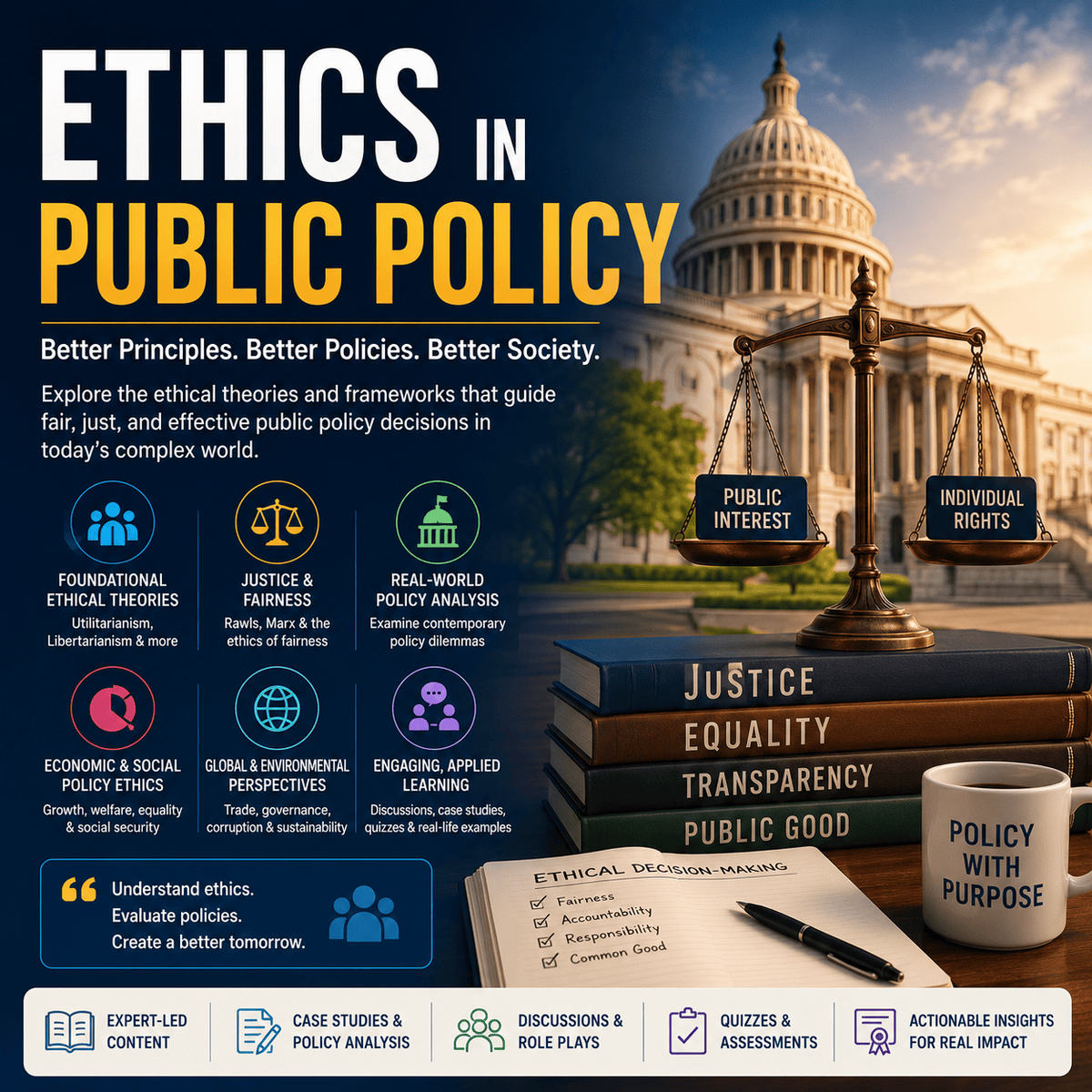
Ethics in Public Policy
How do you make public policy decisions when rights, welfare, equality, economic growth, and social responsibility are in conflict? Ethics in Public Policy gives you the frameworks and practical perspective to evaluate difficult policy choices and understand their real-world consequences. Designed for aspiring policymakers, public administrators, governance professionals, social science students, and anyone interested in ethical decision-making, this course explores the principles behind responsible public policy. You’ll examine utilitarianism and libertarianism, justice and fairness, ethical economic policy, social security, equality, and global governance—and learn how these ideas shape real policy decisions. Go beyond theory through policy dilemmas and contemporary examples, including affirmative action, school funding, social security, healthcare rationing, COVID-19 policy, international trade, corruption, and environmental ethics. You’ll develop the ability to analyze public policies through ethical frameworks, assess fairness and equality, understand policymakers’ responsibilities, and evaluate how ethical governance can promote sustainable growth and development. Enroll today and strengthen your ethical reasoning, policy analysis, and public decision-making skills—so you can contribute to policies that are not only effective, but fair and responsible.

The Complete Train the Trainer Bootcamp (Part 1): All Levels
This program dives deeply into the strategies and techniques you need to be an effective trainer. You’ll not only discover how to motivate adult learners, keep them interested, deal with challenging participants, and maximize learning, but you will actually do it yourself. When You Finish This Training, You’ll Have a Proven Plan For: TRULY ENGAGING, APPLICABLE CLASSROOM TRAINING …That Doubles Learner Retention in Half the Time with Curriculum You Already Have (Even If It’s Boring) Ineffective training costs money. According to Grovo, the total loss to a business from ineffective training is a staggering: $13.5M Per Year per 1,000 employees. Not surprisingly, if you ask most trainers and managers about their training efforts, their responses are typically less than enthusiastic… “Our learning programs aren’t doing a good job meeting our learner’s needs.” “I’m not achieving my full potential at work due to lack of developmental opportunities.” “I don’t know how to apply the skills from the training I received on the job.” Or the always-popular… “Training is boring.” Say what you will about classroom training, but the fact is… There’s Nothing Boring About DOUBLING Your Retention Without Having To Increase Your Training Time Ordinary trainers may think classroom training is “boring”… …but smart trainers know better. Smart trainers know that, when executed properly, there’s no faster, easier or more cost-effective way to engage employees to reach their full potential than classroom training. But how do you do it the right way? Specifically, • How do you get your employees excited about your training to attend a class or listen to a lesson so they take the desired action? And then, when they attend… • How do you get your class engaged (even the difficult learners) and keep them motivated to listen and learn ALL DAY? And once they’re engaged? • How do you make sure the learning sticks and they can apply the skills from the training they receive to their job? (Their real jobs…not the “Theory” job and DEFINITELY NOT the “Recycle” bin.) Then… • How do you measure the entire process so that all your new trainers and employees are skilled and you’re not spending more money and time on retraining? These are the questions every classroom trainer must be able to answer… More importantly, these are the questions every MANAGER must be able to answer if they want to fully maximize their training efforts (without having to replace employees as a result of turnover.) So if you want to make sure that your employees not only are engaged… …but also are highly motivated, retaining and applying their learning and (most importantly) achieving their full potential (and sticking around because of it), then you need to work on these critical steps. But how do you do it? Fortunately, that’s exactly what you’re about to learn… FACT: Businesses Need Effective Classroom Trainers (…Who Actually Know What They’re Doing) I’m not going to sell you on the importance of classroom training. If you’re here, you already know it’s an essential aspect of any training strategy, because effective classroom training: • Is one of the highest ROI activities in your business… • Engages employees who are disengaged to achieve their full potential at work resulting in higher retention rates and less labor turnover… • Makes the workplace a lot more fun and inspiring translating into less money spent on retraining and development. In other words, effective classroom training on-boards, engages and retains quality employees…and it can save money as a result. So that’s why businesses need effective classroom trainers. There’s just one problem: Most so called “classroom trainers” aren’t as effective as employees would like them to be. That’s where you come in. As a Certified Classroom Training Specialist, you are uniquely qualified to help business onboards, engages and retains quality employees through effective classroom training. More specifically, in this master class, you’ll learn: • How to create TRUST with each trainee before class even starts… (Do this right and you’ll see participants crave your class and want only YOU as their trainer!) • How to captivate them within the first five minutes … (HINT: have a “less than amazing opener” and their excitement and enthusiasm will suffer.) • How to use proven techniques to generate MORE credibility and MORE rapport and get them in the palm of your hand by the first break… • Which questions and techniques you should be engaging them on a lesson-to-lesson basis so their minds never wander… • “Attention CPR”…How to help them follow along and make sure they stay on track and get them listening and participating again! • The “lightbulbs” concept attainment strategy (and why applying these 5 simple steps will practically ensure they “get it” – even for the most challenging concepts.) • Using Non-Verbals: 6 body language and tone of voice techniques to get you’re your trainees to listen, learn, follow, understand and apply what you say. • FOUR Q&A steps that actually work and ensure you’re only the perfect questions! (This is how to answer any question, even if you haven’t got an answer) • The two most important things to do with ANY challenging trainee to minimize distractions (Get this wrong the negative, inattentive and apathetic employees will take control) • Amazing Ending: The perfect way to end the class and show it was worthwhile to move them to respond with enthusiasm and apply what they learned to the real world. • Benchmark Assessing: How to ensure each learner has mastered key objectives (so you always know who’s ready to move forward even after class is done). • The 9 sneaky tricks that triple your classroom fun and enjoyment (and when to use them) • Lesson Plan Creation: The exact steps to prepare and practice your own irresistible training that you can be certain they will crave everything you have to teach. • 3 must-use tools to organize your material deliverability (and visuals that make sure complex ideas are clearer and more memorable) • …and much, MUCH more! In short, Certified Classroom Training Specialists (a.k.a. “Training Masters”) are able toeffectively motivate any trainees,while simultaneously increasing engagement and retention in less time. If you’re interested in becoming such a “Training Master,” then I have one question for you… Are You A “Doer”…or Just a “Talker?” (or…Why You Might Want To Get Certified) Let’s face it: Training Experts are a dime a dozen. So how do you separate those who “walk the talk” from the ones who merely… …talk? And at Rule the Room, it was our problem, too. You see, we don’t just teach training best practices, we actually DO TRAINING for businesses that we ACTUALLY OWN, CONSULT, or WORK FOR. We aren’t researchers. We aren’t journalists. We’re business owners training employees (and training trainers to train employees) to achieve their full potential at work, convert belief into practice, and make retaining our employees a priority. In other words: WE ACTUALLY DO THIS STUFF… …so we know how hard it is to find truly skilled trainers who know what they’re talking about. And that’s why we created the “Classroom Training Mastery” course and certification. We built this certification to train our own trainers, but in the spirit of “open sourcing” our business (which is what Rule the Room is all about) we’re now making this certification and training available to the world. In short, we’re making it available to YOU… The Complete Trainer Bootcamp Classroom Training Mastery Course Details This three-part, 16-hour program dives deeply into the strategies, techniques, and tools you need to be an effective trainer. You’ll learn how to motivate adult learners, keep them interested, deal with challenging or disgruntled participants, maximize learning and retention, and you will actually do it yourself! Part 1: Open Convincingly (YOU ARE HERE) · Make them feel safe before class · Start with an amazing opener · Build credibility and rapport · Open convincingly practice · Open convincingly project Part 2: Teach Effectively · Open convincingly assessment · Keep them engaged · Help them follow along · Ensure they understand · Use effective body language and tone · Teach effectively practice · Teach effectively project Part 3: Manage Trainees · Teach effectively assessment · Answer any question · Minimize distractions · Show it was worthwhile · Ensure Individual Success · Manage trainees practice · Manage trainees assessment · Mange trainees project · Prepare an irresistible training PLUS 3 quizzes, 1 for each lesson, to make sure you are understanding all of the material What You’ll Get With All Three Parts of This Program... When you enroll today, you’ll receive instant access to: • The Classroom Training Mastery Course • 18 Core Modules • 47 Video Lessons • 310 Page Classroom Training Mastery Learner Workbook • 12 Review Quizzes • 18 Practical “Your Turn” Assignments • 3 Review Projects About Your Instructor Jason Teteak is the Founder and CEO of Rule the Room Train the Trainer. Jason first made a reputation in the medical training industry, where he was known as “the Epic trainer of trainers.” In response to many requests, he began to offer personalized services and quickly developed a following as a private training coach and training consultant whose clientele includes elite institutions, universities, and top corporations. In 20 years of working as a trainer and a trainer coach, he has helped more than 15,000 training professionals to “Rule the Room” and has appeared before more than 200,000 people. He’s won praise and a wide following for his original methods, his engaging style, and his knack for transferring training skills via practical, simple, universal and immediately actionable techniques. Or as he puts it “No theoretical fluff”. He founded Rule the Room Train the Trainer with a mission to DOUBLE the impact of 10,000 training professionals in the next 5 years. The Rule the Room Train the Trainer team, under Jason’s management, has flipped the model and changed the approach to great training and instruction for even the most seasoned veterans. Rule The Room Trainer Bootcamp Is Different Sure, you can probably find other “train-the-trainer” trainings and certifications that cover similar topics, but a Rule the Room Trainer Bootcamp is unique because it’s built and taught by real trainers who actually write and train their own classes and observe, coach and train thousands of trainers to mastery. In other words, we aren’t “researchers” sharing “theoretical fluff”. We’re in-the-trenches trainers who despise untested theory and believe that the best way to learn training techniques is to actually get up and teach in front of a real classroom. If that sounds like something that fits you, then welcome! You’re in the right place. Trainer Bootcamp Course: Reviews "These techniques have been extremely valuable to me as a trainer. The training tools are taught in such a way that you can walk away from the program and start implementing change in your classroom immediately. I've become better at answering questions and more confident in my teaching style." Kara McCaffrey - Software Trainer “Jason’s methods set the standard by which other trainers measure themselves. When I experience a problem in class or another trainer asks me for advice, the first thing that goes through my mind is, what would Jason do in this situation?” Bren Mochocki - Software Trainer & Corporate Trainer Coach “Jason is an engaging teacher who is not only knowledgeable about this field, but is intensely passionate about it. This course not only gave me the knowledge, insight, and skills to excel in this new role, but the confidence to implement these new skills and to share this knowledge with others.” Lorielle Ouimette - Physician Software Trainer “Jason’s passion for helping trainers is so contagious. When I work with him, not only do I want to be a better trainer, I want to be able to help others the way that he helped me.” Sarah Gernetzke - Corporate Trainer at Epic “You taught me and many, many other trainers here how to not only survive in the classroom, but how to thrive. We owe you a big thanks.” Paul Mellon - Software Trainer “This is Kelly Markowski from your Trinity Health bootcamp that ended yesterday (11/19). I just wanted to send a quick note of thanks for the great tools. I am constantly seeking to improve my training skills, both to have something better to offer trainees, as well as to increase my own comfort level with it, and I know that I will be using a lot of your material to do both! I think it's important to express genuine gratitude, so I just wanted to let you know that the bootcamp was very beneficial for me.” Kelly Markowski - MHSA, RHIT - Consultant, Program Excellence - Trinity Health “So many of us have become better presenters/trainers/etc. as a result of your tips and in turn helped our customer trainers grow in their presentation skills as well.” Lauren Wons - Training Team Lead “Jason’s experience with teaching and working with our trainers and trainees has given him an unmatched knowledge of how to best train adult learners. During our sessions, he not only helped me develop the techniques to be a great presenter, but he told me exactly why those techniques work and why they are important to my audience. I was quickly able to incorporate many of his tried-and-true methods, such as standing in the “sweet spot” and making eye-contact with everyone every few minutes, and IMMEDIATELY saw an improvement with my class engagement and understanding. His genuine and passionate interest in training is apparent and contagious-Jason truly embodies what it means to be a great trainer and inspires those around him to do the same.” Leanne Britton - Software Trainer Frequently Asked Questions Q: “How will this Complete Trainer Bootcamp Mastery course help me?” A: It depends on who you are….. If you’re a business owner, this course is a great way to learn classroom training yourself. It’s also a great way to train and certify members of your own team and get them up to speed in half the time on the latest classroom training trends and best practices. If you’re a consultant, this course is a practical way to show that you are a Classroom Training Specialist, which could help you attract better, higher-paying clients, boost their ROI and efficiency, and lower turnover, safety and security concerns. If you’re a student, this course can set you apart from other graduates who may have a business or education degree, but don’t have the specialized skills that employers today are looking for. If you’re an employee or training professional, this coursecan make you more valuable to your company, which can get you that raise or promotion you may deserve (but don’t have a reason to request). Q: “How valuable is this Classroom Training Mastery course?” A: The course itself is highly valuable if your goal is to set yourself apart from the competition. What’s even MORE valuable than any course is the knowledge and understanding you’re going to gain when you take this class and pass all the tests. You will know classroom training. Q: “When do I have to finish the class?” A: You can go at whatever pace suits you best! You’ve got a lot of other things going on in your life, so just because you enroll in the workshop doesn’t mean you need to complete it right away. In fact, you can start and finish the workshop whenever you want. Either way, we’re going to be there with you every step of the way to ensure you’re successful and can get certified. Q: “How soon can I finish the class?” A: The Classroom Training Mastery class is in three parts. You will need the three courses on Udemy to complete the 16 hours of video training, so if you are dedicating yourself full time to it, you could probably finish in 3 days, but we don’t recommend that. Instead, we recommend you take 7 – 14 days (if you can give your full attention to the material. If you only have a little bit of time each day, then you should dedicated 4 – 6 weeks to finish it up and take the test. Q: How hard is the course? A: You can liken our courses to the story of “goldilocks and the three bears” – not too hot and not too cold. In other words, they’re hard enough that you need to study and know your stuff, but we don’t make them intentionally hard just to be difficult. We make them as hard as they need to be to make sure you know how to “Rule the Room”. We believe learning doesn’t happen until a behavior change occurs, so to preserve the integrity of this course, we have made the course challenging and the questions specific to our proprietary Rule the Room Train the Trainer techniques, methodologies and recipes. Don’t expect to pass the course just because you have taken other trainings or certification courses in the past. This training is different, and the courses will reflect those differences. Q: Do you offer grants or financial aid for your programs? A: At this time, no grants or financial aid programs are available. The good news is that we have priced all our workshops and trainings so that they are affordable to everyone, especially compared to similar train-the-trainer programs and workshops.
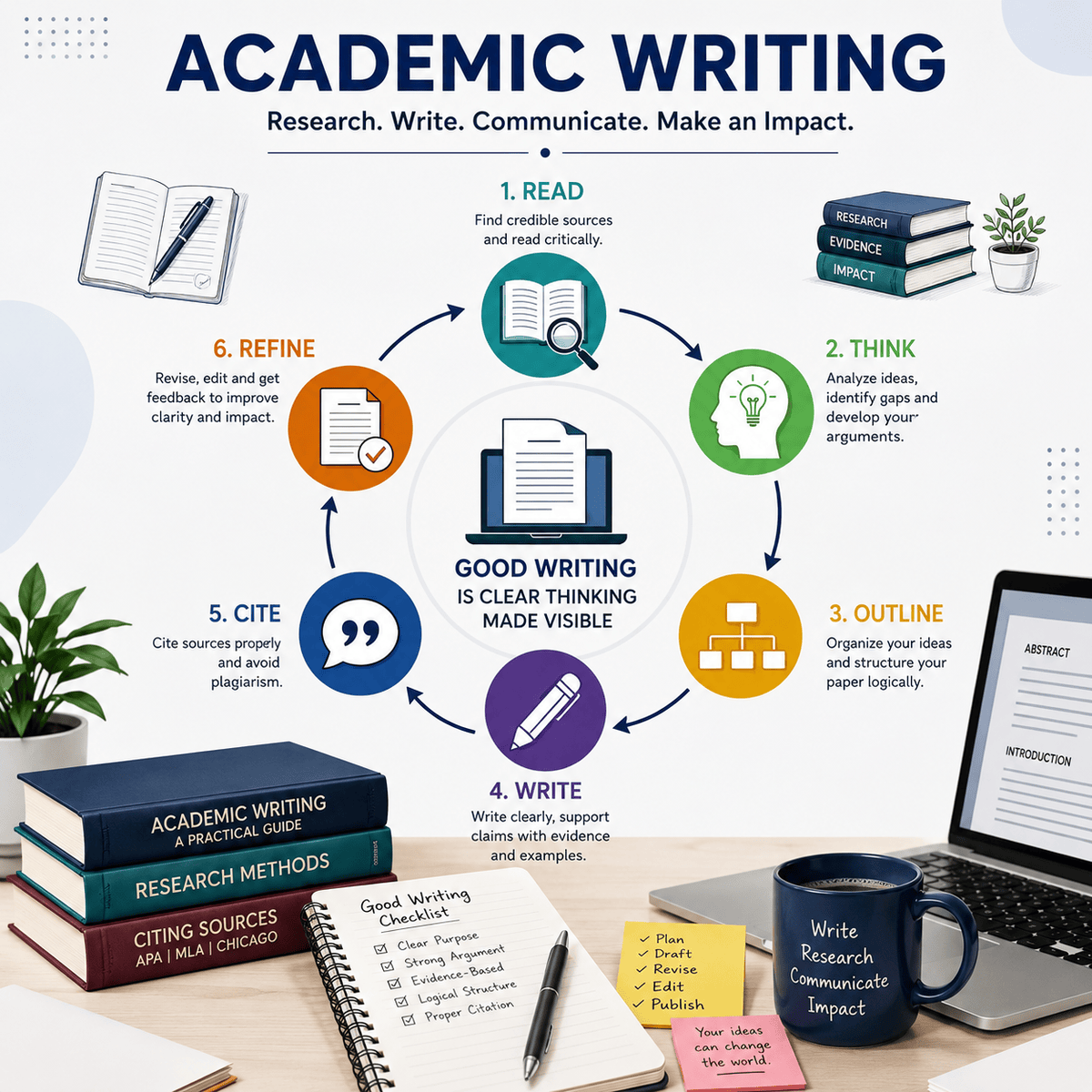
Introduction to Academic Writing
Introduction to Academic Writing is designed for students, researchers, and aspiring academics who want to strengthen their academic writing and learn how to approach different forms of research-based communication. You’ll learn how to read and analyse academic texts, identify claims and evidence, structure an academic paper, and develop persuasive arguments. The course also covers literature reviews, summarising research, annotated bibliographies, referencing and citations, and avoiding plagiarism. Go beyond traditional academic essays by learning how to write policy briefs, op-eds, and blog posts for different audiences. You’ll also explore dissertation writing, from developing a research question and organising your research to structuring chapters and understanding guidelines for journal publication. Through practical assignments, peer reviews, readings, and hands-on activities, you’ll apply what you learn and build confidence in academic and research writing. Whether you’re preparing essays, conducting research, writing a dissertation, or planning for academic publication, this course will help you become a more confident, critical, and effective academic writer.

Petroleum Refining - Complete Guide to Products & Processes
The main scope of the course is to create strong basis and fundamentals regarding the processes in the Petroleum Refining. We take a look to the Oil&Gas Industry briefly and continue directly with the Refining Process. We then make a focus in each individual unit operation in the refinery. Learn about: • Oil& Gas Industry • Difference between Petroleum Refining vs. Petrochemical Industry • Overview of the most important operations and products • Market insight (supply/demand) as well as (production/consumption) • Several Petroleum Refineries around the World Unit Operations & Processes • Refining and Fractionation • Atmospheric Distillation Column • Vacuum Distillation • Hydrotreating (Hydrogenation) • Blending • Reforming • Isomerization • Alkylation • Steam Cracking • Fluid Catalytic Cracking • Gas Sweetening (Hydrodesulfurization) • Coking Components: • Fuel Gas / Natural Gas • Liquified Petroleum Gases (LPG) • Propane, Butane • Sulfur / Hydrogen Sulfide • Gasoline / Automotive Gas Oil • Naphtha Cuts (Light/Heavy) • Kerosene • Diesel • Gasoil • Lubricants • Vacuum Residues • Asphalt • Coke NOTE: This course is focused for Process Simulation At the end of the course you will feel confident in the Petroleum Refining Industry. You will know the most common Process & Unit Operations as well as their distribution, production and importance in daily life.
Igualdad de género y derechos humanos
Reconocer los casos en los que es necesario aplicar la perspectiva de género en los derechos humanos, concretamente en sus principios: dignidad, libertad, justicia e igualdad, así como en el derecho al libre desarrollo de la personalidad, e identificar situaciones concretas en las que es importante que se amplíen y modifiquen los derechos para garantizarlos a todas las personas, en especial a grupos cuyos derechos han sido históricamente vulnerados, como las mujeres, las personas de identidades sexogenéricas diversas y las masculinidades diferentes a la hegemónica.

Japanese for Beginners | The complete course
Welcome to Japanese for Beginners Course This course is designed for those learning Japanese for the first time. Therefore, we will first learn how to read and write the two writing system of Japanese - Hiragana and Katakana. Our systematic approach to learning the Japanese writing system means that you will learn how to read Japanese effortlessly. In our lessons on learning Hiragana and Katakana, we will... • show you how to write the characters • guide you through systematic speaking practice to retain what you are learning in the long term Our lessons also come with individual writing sheets so that you can practice writing Japanese. Once you have learned how to read and write Japanese, we will help you to develop your speaking skills. We will develop your speaking skills step by step, and with our systematic approach to learning Japanese, you will be able to communicate in Japanese in no time. In all of our lessons, you will learn grammar and vocabulary, improve pronunciation, and truly learn how to use Japanese language. Along the way, you will also learn about Japanese culture. We have carefully crated all of our lessons to help you learn Japanese and we look forward to seeing you in the first lesson!

Instructional Design Foundations and Applications
This course, Instructional Design Foundations, introduces learners to the conceptual and theoretical foundations of instructional design as well as the analysis aspect of instructional systems design in order to create an innovative instructional solution to performance problems in organizations. This particular course also introduces learners to concepts covered in the Instructional Design MasterTrack Certificate. Upon successful completion of this course, you will be able to: ●Describe the major concepts of instructional systems design ●Describe the major learning and instructional theories ●Describe the process of instructional design and instructional design models ●Describe various analysis activities for instructional design

Train the Trainer Masterclass - 3 Courses in 1!
If you've been launched into classroom training with no preparation whatsoever, I've got you covered. Struggle no more! This course will present you with the frameworks, tools and techniques to help you find the joy that this work can bring. No more nightmares about people walking out, no more disruptive participants, no more questions you don't know how to respond to. I've worked with hundreds of trainers in dozens of multinational companies over the last 10 years, and have even published a book on how to design and deliver practical training. And in this masterclass course I am bringing you 3 of my courses condensed into one. You will learn how to: • Present with Impact • Design PRACTICAL Training • Develop your Training and Facilitation skills These 3 skill sets combined will help you feel in control of what you're doing. They'll help you truly help your audience. PLUS this course includes a FREE copy of my massive book "Shaping Paths - How to Design and Deliver PRACTICAL Training" to serve as a handbook for whenever you need it! Here's what people have to say about these courses: "This course is amazing! I have been training for over 10 years, and I am still learning from this instructor. He is also very good at keeping his audience engaged. Nice job!" "A very useful course for beginners as well as for advanced students. - My highest recommendation!" "The course is designed in a very efficient way with the tools to help a trainer design a training and can be used vastly in many fields and is very practical with tools for execution." "A great course that explains how to make your training engaging. Everything is broken down into easy chunks and a great trainer!" "Highly recommend to any person who wish to upgrade his game when involved to train other people." "Very well thought out course. Well broken up into the various parts. Great delivery and additional resources too!" "Very useful and inspiring content. This is not Google-Knowledge - this is well reflected personal experience shared. Thank you."

SUGAR. Software Unificado para la Gestión Arqueológica
¿Te imaginas poder gestionar todo lo trabajo arqueológico, del campo al laboratorio, con una sola herramienta digital? En este curso aprenderás a utilizar SUGAR (Software Unificado para la Gestión Arqueológica), un programa que llevamos desarrollando desde la Universitat Autónoma de Barcelona durante más de dos décadas. A lo largo del curso adquirirás habilidades para crear bases de datos eficientes, analizar materiales y visualizar información arqueológica. Cada módulo te mostrará herramientas que transformarán tu manera de registrar e interpretar el registro arqueológico. Aprenderás a estructurar datos con precisión, trabajar con diccionarios relacionales y generar informes e inventarios. ¿Te interesa mejorar tu perfil para futuros proyectos de excavación o investigación? Este curso te ofrecerá competencias clave para formar parte de la generación de arqueólogos que liderará la digitalización del patrimonio

Climate Change Explained: Causes, Consequences and Solutions
A short and informative course on the hot topic of climate change: • In this course, we will address the climate change phenomenon from many angles and we will discuss its causes, consequences, and solutions. • Greenhouse gases are the reason behind this phenomenon. These gases, mainly carbon dioxide, methane, and nitrous oxide, have increased in concentration in recent years in the atmosphere because of fossil fuel combustion, agriculture and livestock, and deforestation. • These gases hold solar radiation and increase the earth's temperature, which leads to global warming which eventually causes climate change. • Climate change generates a lot of unwanted effects on many levels such as extreme weather event intensification like floods and droughts, melting of ice caps and glaciers, propagation of diseases and pests, habitat destruction, coral bleaching, and many social and economic impacts. Thus, this course is made of three parts : • Part one: discusses direct causes of climate change, mainly fossil energy, agriculture, and deforestation, and indirect causes like capitalism, corporate lobbying, cryptocurrency, and science deniers. It also explains greenhouse gases' origins and the concepts of global warming and climate change. • Part 2: details some of climate change consequences, such as : • Extreme weather and natural disasters • Ice Melting • Disease carrier and pest propagation • Habitat destruction and wildlife loss • Coral reef destruction • Economic and social consequences • Part 3 is dedicated to solutions to stop climate change, which includes solutions on governmental and individual levels, renewable energy, and transport electrification. I hope you enjoy the course!
Cloud Computing Law: Transactions
Have you ever wondered what’s in the small print of cloud contracts? Or who owns the information you upload to the cloud? And who can access and control it? If so, then this course is for you! You’ll learn to identify the legal risks involved in cloud computing transactions - and to suggest possible solutions. To understand how cloud computing works, we’ll first describe different kinds of cloud services and explain how they differ from in-house IT in terms of control, access, and cybersecurity. To understand how the law applies to cloud computing transactions, we’ll focus on the contracts between cloud providers and their customers. You’ll learn to identify and interpret key contract terms and to assess whether customers might negotiate better terms with providers. Finally, we’ll explain how English law protects trade secrets and copyright works stored in the cloud. If you’re a lawyer, this course will be your guide to cloud infrastructure and supply chains. If you have a technical or commercial background, this course will introduce you to key legal issues in contracts and intellectual property. In short, if you’re interested in how the law applies to cloud computing, this course is for you.

Mental Math - Best Techniques To Speed Up Your Mathematics
The quantitative section is an essential part of most competitive exams. A lot of times, calculators are not permitted during them and even if they are permitted, a lot of time is wasted while typing the numbers on them. This course teaches you techniques by which, just by observing the question, you will be able to find the right answer. It can help you utilize that time for further questions since we have limited time during the exams. It has 65+ lectures spanning 8+ hours of on-demand videos that are divided into 22 sections. Each topic is explained extensively - by solving multiple questions along with the student during the lectures. The students are also provided and encouraged to solve practice questions & quizzes provided at the end of each topic. Techniques covered in the course: • Addition by Dropping Ten’s method • Addition by Grouping method • L-R Addition (world’s fastest technique to add any digit numbers) • Subtraction (using the world’s fastest technique) • Left to Right Subtraction using Nikhilam Sutra • Multiplying any digit number by 11, 22 and 33 • Finding remainder when any big digit number is divided by 9 without actually dividing • Multiplying any digit number by 9; 99; 999; 9999999 etc. • Multiplying two large numbers of the same digits below the base 1000; 10000; 100000 etc. • Multiplying two numbers of the same digits above the base 1000; 10000; 100000 etc. • Multiplication of numbers (one above the base and the other less than the base) • Vertically and Crosswise Techniques of multiplication • Multiplying any digit number by 5, 25, and 125 within 2 seconds • Division by 9 with super easy techniques • Division by Nikhilam Sutra of Vedic Maths • Straight Division by Vedic Math • Squaring numbers that end in 5 (faster than the calculator) • Squaring any two/ three-digit number • Finding cubes of numbers • Fastest methods of finding square roots of perfect square numbers • Finding the approximate value of Square roots of non-perfect square numbers • Fastest methods of finding cube roots of perfect cube numbers • Finding the approximate value of cube roots of nonperfect cube numbers • ‘Digital Sum’ technique • Finding Day of the week Here's what some students say about the course: • "You give clear and pretty straightforward explanations as you don't skip any passage making my learning process much more easier! I feel content, confident and this is very important for my coming gmat exam. So, for these reasons massive thanks!" - Stefano L. • "Theres some quite neat techniquest, that might not be that useful for your daily purposes, but defintly good for sharpening your brain, or just simply helping you too look from different angle at common things. Study new thing, whatever it can be, is always incredible! :)" - Artyom Nikolayev • "See numbers in a whole new way to gain mastery over them" - Kaywan Joseph Mansubi • "This is the best course for ever, I am glad to have this. It boost mathematics knowledge and speed to get answer" - Jigar Prajapati • "I am totally amazed at how incredible fast, using these techniques, the answers appear!" - Lou Charon • "An amazing course which helps me improve my computing speed a lot. A lot of tips and tricks you can apply immediately into your jobs, tests, or any cases in real life. Highly recommend!" - Linh Nhan With this course you'll also get: • Full lifetime access to the course • Complete support for any question, clarification or difficulty you might face on the topic • Udemy Certificate of Completion available for download • 30-day money-back guarantee Feel free to contact me for any questions or clarifications you might have. I look forward to seeing you in the course! :)

Public Health in Humanitarian Crises 1
This course, Public Health in Humanitarian Crises 1, introduces discussions about the public health approach to problems experienced by people affected by disasters, both natural and related to conflict. The course discusses the many changes which occur in people’s lives when they are uprooted by a disaster, ranging from changes in disease patterns, access to health care, livelihoods, shelter, sanitary conditions, nutritional status, etceteras. We will explore what humanitarian interventions could look like if we want to mitigate the effects of disasters. The course content is a mix of theoretical knowledge and many practical examples from recent disasters. We think this course is unique because it contains so many practical ‘real-life’ examples and is taught by instructors and guest lecturers who together have over 200 years of experience in this field. The course consists of 10 modules totaling approximately 9-10 hours of delivered content with an additional 2-3 hours of self-work (quizzes and writing and evaluating a short peer-review assignment) as well as lively discussions forums. The course has been designed in a way that each module builds on the lessons of previous modules. However, you may do the modules in any order and some can be done separately. You do not have to pay for this course if you choose to enroll without a certificate. Sometimes referred to as auditing, enrolling without a certificate means that you will have access to all of the videos, quizzes, assignments, and discussions. The only difference is that you will not receive a certificate upon completion. Click the Enroll Without a Certificate link to sign up and begin the course. Even if you enroll in a session that has yet to begin, you may access most of the course materials right away by clicking the Preview Course Materials link. However, you will have to wait for the session to begin before posting your comments on the discussion forum or accessing the final peer-reviewed assessment. Visit the Learner Help Center for details about session schedules. If you want to learn more, there is a second course which follows this one entitled, Public Health in Humanitarian Crises 2. We welcome you to take this. The course has a similar set-up and discusses additional topics, such as infectious disease outbreaks, disease epidemiology, maternal and newborn health, mental health, humanitarian project design, humanitarian principles, and many other topics.

Water Treatments of Cooling Systems
This course is designed to give a basic understanding of the main water treatment principles used for cooling systems. The course gives you first the classification of cooling systems as • Closed Cooling Systems • Open Cooling Systems • Integrated Cooling Systems • Once through Cooling Systems This classification is followed by a basic explanation of water chemistry parameters that should be known when you operate a cooling system including • Water Properties • Water pH • Electrical Conductivity (EC) • Total Dissolved Solids (TDS) • Water Hardness • Water Alkalinity • Salts Solubility in Water • Total Suspended Solids (TSS) • Langelier Saturation Index (LSI) Note: if you already have good water chemistry knowledge, you can override this chapter. However, it is worth always refreshing your chemistry knowledge. Then, we discuss important topics related to cooling systems which include • Heat Exchangers • Cooling Towers • Chillers • Water Mass Balance • Definitions • Calculations for Cooling Systems Finally, we are going to highlight the most common problems found in cooling systems and their method of control including Corrosion Control in Cooling Systems Scaling Control in Cooling Systems Biofouling Control in Cooling Systems Finally, we will conclude the course together and discuss a summary, and then you deserve to get the certificate. Always I will be close to you during the learning sessions, and ready to answer all your concerns and questions through the Q and A part or through private messages. Hope you enjoy the course .. Best Wishes ..

The Sustainable Development Goals – A global, transdisciplinary vision for the future
In 2015, the UN launched the 17 Sustainable Development Goals (SDGs). Adopted by 193 member states, the goals represent an important international step in setting humanity on a trajectory towards sustainable development. Within this course, you will get a historical overview of how sustainability has been understood, as well as a thorough introduction to the SDGs – what they are, how progress can be measured, and how the SDGs are relevant for the management of the global systems supporting humanity. The course will examine how various societal actors are responding to and implementing the SDGs. While all of the SDGs are essential to sustainable development, SDG 13, Climate Action, is usually perceived as the most urgent in terms of the need for a swift implementation on a global scale. Therefore, particular focus is given to this SDG. Through the course, you will gain up-to-date knowledge of the current understanding of human impacts on the Earth at the planetary level. Progress towards establishing global management of human interactions with the climate system within the United Nations Framework Convention on Climate Change (UNFCCC) is also discussed. The course is designed and taught by Professor Katherine Richardson, who is a member of the 15-person panel appointed by the UN General Secretary in 2016 to write the 2019 Global Sustainable Development Report. In each lecture, Katherine interviews experts who provide insights relevant to the topic at hand.

Fundamentals of Reinforcement Learning
Reinforcement learning is one of the most exciting branches of modern artificial intelligence. It came to the public consciousness largely because of a brilliant early breakthrough of DeepMind: in 2016, they utilised reinforcement learning to smash a benchmark thought to be decades away in artificial intelligence - they beat the world’s greatest human grandmaster in the Chinese game of Go. This was so exceptional because the game tree for Go is so large - the number of possible moves is 1 with 200 zeros after it (or a “gargoogol”!). Compare this with chess, which has only 10^50 nodes in its tree. Chess was solved in 1997, when IBM’s Deep Blue beat the world’s best Gary Kasparov. Deep Blue was the ultimate example of the previous generation of AI - Good Old-fashioned AI or “GOFAI”. A team of human grandmasters hard-coded opening strategies, piece and board valuations and end-game databases into a powerful computer which then crunched the numbers in a relatively brute-force way. DeepMind’s approach was very different. Instead of humans hard-coding heuristics for how to play a good game of Go, they applied reinforcement learning so that their algorithms could - by playing themselves, and winning or losing millions of times - work out good strategies for themselves. The result was a game playing algorithm unbounded by the limitations of human knowledge. Go grandmasters to this day are studying its unique and creative moves in its series against Lee Sedol. Since then, DeepMind have shown how reinforcement learning can be practically applied to real life problems. A reinforcement learning agent controlling the cooling system for a Google data centre found strategies no human control engineer had thought of, such as to exploit winter temperatures to save heater use. Another of their agents applied to an experimental fusion reactor similarly found superhuman strategies for controlling the highly complex plasma in the reactor. So, reinforcement learning promises to help solve some of the grand problems of science and engineering, but it has a whole load of more immediately commercial applications too - from the A/B testing of products and website design, to the implementation of recommender systems to learn how to match up a company’s customers with its products, to algorithmic trading, where the objective is to buy or sell stocks to maximise a profit. This course will explain the fundamentals of this most exciting branch of AI. You will get to grips with both the theory underpinning the algorithms, and get hands-on practise implementing them yourself in python. By the end of this course, you will have a fundamental grasp these algorithms. We’ll focus on “tabular” methods using simple NumPy arrays rather than neural networks, as one often gets the greatest understanding of problems by paring them down to their simplest form and working through each step of an algorithm with pencil and paper. There is ample opportunity for that in this course, and each section is capped with a coding assignment where you will build the algorithms yourself From there, the world is your oyster! Go solve driverless cars, make bajillions in a hedge fund, or save humanity by solving fusion power!
The Beauty of Kunqu Opera
This course will focus on the historical and cultural background, literary aesthetics, music, and performance of Kunqu, China’s classical opera. After viewing the lecture videos presented by scholars and renowned maestros in the field of Kunqu, students’ understanding and appreciation of Chinese performing arts, classical literature and traditional culture will be enhanced.

Cambridge C1 Exam Preparation Course (CAE)
The Cambridge C1 Exam is the benchmark for advanced English across the world. This course gives you the opportunity to get this prestigious qualification for yourself! Cambridge C1 Advanced (formerly CAE) is accepted by all the major universities of the world as proof of your English level. So, you can both demonstrate your exceptional English level and open up your academic future with this one qualification, without needing any other certificates such as IELTS. Whenever someone says "I passed Cambridge C1", it communicates something extra to the world. It says "I have truly mastered English". It is impossible to do well on the C1 test without a high level of English. However, you might not get the result you deserve if you don't understand the exam or prepare properly for the test. That's where this course comes in. I have taught English up to the most advanced levels for over 25 years and, in that time, I have led many students to success on the Cambridge C1 examination. I have taught in-depth courses to real students, and I have seen them pass this assessment with "flying colours". So I know what I have prepared for you on this course is going to have a positive impact on your journey to achieve this wonderful and powerful qualification. ** The features of this course that are particularly going to help you are: - Detailed preparation for each individual task type in C1 Advanced - Advice on what to do before and during each stage of the examination - Language lessons designed to focus your study on the areas likely to make the biggest impact on your grade - Strategies to make you quicker, more accurate and more efficient with your time - Explanations on what you should be doing in the writing and speaking tests in detail - My special "exam walkthroughs", where I show you taking the test myself and explain what I did to get the highest possible marks so that you can learn from my example - Vital "dos and don'ts" and essential tips ** And don't forget: *you can send me one example of your writing and speaking, and I will give you my opinion on your level + how you can reach the next level *you can write to me on the Q&A section about anything to do with C1 Advanced, and I will answer as soon as I can (usually within 3 days) *there's a 28 day money back guarantee if you change your mind about the course I look forward to welcoming you onto the course and helping you achieve the highest C1 Advanced score that you can!! *Note: All content on this course is entirely my own personal work based upon 25 years of experience, and is not the official work of the Cambridge exam board.

Power and Foreign Policy in International Relations
How do global powers shape world politics—and why do countries make the foreign policy choices they do? In this course, you’ll explore the relationship between power and foreign policy in international relations and learn how a country’s position in the international system influences its strategies, alliances and decisions. You’ll build a practical understanding of hard power, soft power, smart power, national interest, international power configurations and changing world orders. Go beyond theory through contemporary case studies of the United States, India and Qatar, representing great, middle and small powers. Examine how the US has responded to shifts from the Cold War and unipolarity towards an emerging multipolar order; how India has evolved into a rising power and strategic actor in the Indo-Pacific; and how Qatar has used energy resources, diplomacy and soft power to expand its influence beyond its size. You’ll also apply your knowledge through discussions, quizzes, peer review and hands-on activities that connect international relations theory to real-world foreign policy decisions. By the end of the course, you’ll be better equipped to analyse geopolitical developments, understand why states behave differently, evaluate foreign policy strategies and anticipate how changing power dynamics may reshape the international order. Whether you’re studying international relations, political science, diplomacy, global affairs or security studies, or simply want to understand the forces shaping world politics, this course gives you a structured foundation for analysing foreign policy and global power.

The Complete English Megacourse: From Zero to Conversational
Introducing the The Complete English Megacourse: From Zero to Conversational—your ultimate gateway to mastering the English language! This dynamic and engaging online English course is designed for complete beginners who want to rapidly elevate their English language skills to the intermediate level of spoken English, in the shortest time possible. Why this course Stands Out as the Best English Course: - Comprehensive English Learning: Unlike other basic courses, it's a full, beginner-to-intermediate English language program that focuses on practical, real-world English skills. You'll be prepared to use English confidently in your everyday life. - Fun and Interactive: This is a 100% animated, interactive spoken English course, making learning not just effective, but fun and exciting! - Intensive Practice: With over 77 hours of spoken English language practice, each lesson lasts about 1.5 hours. You'll speak English constantly, using more than 2,000 words per lesson. - Focus on Fluency: I'm obsessed with your fluency. I don't just teach you isolated words or phrases— this course designed to ensure you can speak English confidently and naturally. Fluency is my top priority! - Simple Grammar: English grammar is broken down in an intuitive, easy-to-understand way, with loads of examples and hours of speaking and listening practice. - Multilingual Support: All English vocabulary and grammar explanations are translated into English, Spanish, Brazilian Portuguese, and Hindi, ensuring you fully grasp each concept. Whether you're starting from zero or aiming to improve your fluency fast, this Intensive English Mastery Course is the ultimate tool to supercharge your English language journey!

Foundations of Neuroscience
The course "Foundations of Neuroscience" delves into the neural and biological foundations of influence and persuasion, providing a comprehensive understanding of how the brain processes sensory, emotional, and cognitive information. You will explore key brain regions and their role in decision-making, memory, attention, and emotion, essential for effective communication strategies. By gaining hands-on experience with neuroscience measurement techniques, you will learn to assess the impact of influence campaigns through implicit and explicit methods. What sets this course apart is its focus on bridging neuroscience with practical applications in neuromarketing. By studying real-world case studies, you will gain the skills to evaluate and design more effective influence strategies. Whether you're in marketing, advertising, or behavioral science, this course equips you with the knowledge to better understand consumer behavior and tailor marketing efforts for maximum impact. You'll leave with a deep understanding of how to apply cutting-edge neuroscience principles to real-world influence campaigns, making this course a unique and invaluable resource for anyone in the field.

Teach Anybody Anything: Reach Any Learner Anywhere
If you’ve taught a class and one learner said, “That was amazing!” but another said, “You missed me entirely,” you have seen the result of different learning styles. Learn the tools you can use to engage all four learning styles every time you teach or train and save your company thousand of dollars and hundreds of hours by getting it right the first time. In this 2 hour program you will learn what universities and training teams nationwide are just beginning to understand about effective adult learning. A Proven System to Reach Any Learner Anywhere 12-tool system you can use to pick the right teaching tool, discover how your students really learn, and be certain your training will reach every learner (before you train it) Discover exactly how adults learn and how you can use twelve amazing tools to ensure every one of them leaves your room with the understanding you wanted to get across. A Step-By-Step Process To Teach All Four Learning Styles You probably know Bloom’s domains of learning: cognitive, affective, psychomotor. But are you aware of the four new adult learning styles: the step learner, the research learner, the talk learner and the create learner? If you’ve taught a class and one learner said, “That was amazing!” but another said, “You missed me entirely,” you have seen the result of different learning styles. Find out how to reach all your learners at the same time! All 12 Of Our Training Research Techniques In One Program Just follow along with these 12-easy-to-use teaching tools in our 2 hour video training and 39-page learner workbook and you’ll know exactly what to look for and what tools to use when training your next class. Learn How To Engage And Teach Styles Different From You When you understand what your learners really want, you’ll have the knowledge you need to create high-impact training and curriculum. Plus, you’ll also learn how to deliver that training so that you have a bigger advantage to reach people who don’t learn like you do! What’s Inside The Teach Anybody Anything Program? Discover How Adults Learn • A simple 5-step model that unravels the mystery of how adults learn, and how you can apply this theory to easily reach every learner you work with • The crucial components of each adult learning style, and why you absolutely MUST know them to successfully reach every learner • Why most trainers are only able to teach others using their own learning style, and how to be sure you aren’t missing the other 75% of learners in your classroom • How adults learn differently than children and the reason why that difference will change your entire approach to teaching and training Capture Every Learner Immediately • The secret to discovering what trainees REALLY want to know about your material without them even knowing you did it • How to use the “Big Picture” technique: A simple tool that demonstrates to trainees why current subject matter is so important because of how it fits in with what is to come • The REAL keys to successfully “break the ice” in your classroom including the things you must avoid to do it well • The #1 reason trainees dread group work, and an EASY method to turn the table and get them to enjoy it Keep Every Learn Engaged • A proven method for HOOKING your trainees that makes them think your class has been tailored to THEIR needs • An easy, effective method called “Application Questions” for KEEPING trainees engaged and participating in your class at all times • A simple “directional method” to get EVERYONE in the room following along simultaneously without ever getting lost • 3 ways to make your teaching CAPTIVATING so they can’t wait to hear what you have to say next Bonus! You’ll receive a 37 page workbook to follow along with the video program and an instrument to determine your learning style (because that’s the style in which you naturally teach). You'll also get practical tools to effectively engage and teach all of the other styles. If you want to improve your results and save valuable time, you have found what you’re looking for. This Stuff Works…See What Our Customers Have To Say! "I attended this two-hour workshop (Bullseye) where Jason demonstrated the principles of his Rule the Room approach for teaching adults. Jason did an excellent job of demonstrating the difference in adult learning styles and how it's possible for both non-educators and educators plus those with presentation experience to fulfill an educational role with adult students. His material has great application possibilities for a wide variety of situations--classes, presentations to adult audiences, interviews--his work is terrific!" - Sondra Retzlaff - Senior Marketing Coordinator and Copy Crafter at Mead & Hunt "It's pretty simple. Jason Teteak walks the talk. In this day and age, finding a true thought leader amongst many is the key to getting to new levels. Listening to Jason and benefitting from his teachings will take you to that new level you seek. He is cutting edge, extremely practical and connects in a way that is motivating, informing and memorable. Some of the biggest benefits received from Jason are tactics, ideas and methods that are immediately implementable. Watch Jason’s program before your competition does." - Al Lautenslager - Best-selling Author, Guerrilla Marketing in 30 Days “The most important take-away I had from your class was learning about my own style. Knowing how I like to learn influences how I will teach, facilitate meetings, and grow my staff. It also made me cognizant of learners who prefer different styles than my personal preference. Overall, that made me a more effective presenter since I knew exactly what I needed to work on to capture the attention of those learners—who are diametrically different from my personal learning/teaching style.” “What I like most is that you emulate all the exercises we should do. In the back of my mind, I know that you have a personal learning/teaching style that you prefer—but you’re able to cultivate those skills so that you can adapt to your audience. That’s my ultimate goal as I move to the Training role: to be a chameleon of the classroom/meeting room." - Brittany Crosby - Project Manager & Corporate Trainer About Your Instructor Jason Teteak is the Founder and CEO of Rule the Room Train the Trainer. Jason first made a reputation in the medical training industry, where he was known as “the Epic trainer of trainers.” In response to many requests, he began to offer personalized services and quickly developed a following as a private training coach and training consultant whose clientele includes elite institutions, universities, and top corporations. In 20 years of working as a trainer and a trainer coach, he has helped more than 15,000 training professionals to “Rule the Room” and has appeared before more than 200,000 people. He’s won praise and a wide following for his original methods, his engaging style, and his knack for transferring training skills via practical, simple, universal and immediately actionable techniques. Or as he puts it “No theoretical fluff”. He founded Rule the Room Train the Trainer with a mission to DOUBLE the impact of 10,000 training professionals in the next 5 years. The Rule the Room Train the Trainer team, under Jason’s management, has flipped the model and changed the approach to great training and instruction for even the most seasoned veterans.

U101: Understanding College and College Life
College can be confusing and intimidating, but U101 can help. If you were just admitted to college and are nervous about what the next step in life might look like, this course is for you. If you are the parent of a newly admitted college student and curious about what college life is like, this course is also for you. While your specific college will, no doubt, provide additional orientation material, we wanted to give some basic information about what life might be like at a large American University. You might be years away from college or enrolled right now; either way, U101 has some excellent advice from college students, professors, administrators, and staff. At the conclusion of the course, learners should: 1. Understand the basics of how colleges and universities operate. 2. Identify and describe what faculty are looking for in college-level academic work. 3. List some effective study strategies. 4. Identify some strategies for exploring and selecting a major. 5. Identify the various types of grants and scholarships available and describe the steps involved in applying to these. 6. Discuss the college life, with special attention to the benefits/limitations of living on or off campus. 7. Identify some strategies for getting the most out of campus life activities (investigating student clubs, fraternities, sororities, etc.). The course is divided into 4 weeks/8 lessons, which provide an overview of the different aspects of college life. If you were just watching the videos and looking at some of the links, the whole course would take about 4-5 hours. Week 1 Lesson 1. Welcome to U101! Lesson 2. Understanding the Nature of College Week 2 Lesson 3. Succeeding as a Student Lesson 4. Building Your Major Week 3 Lesson 5. Financing Your Education Lesson 6. Living On and Off Campus Week 4 Lesson 7. Getting Involved in Campus Life Lesson 8. Conclusion Please join us for a short exploration of modern American Colleges. Hopefully, this course can help demystify your upcoming college experience.

STAAD Pro: The Ultimate Beginner's Guide
STAAD Pro: The Ultimate Beginner's Guide Are you ready to master the art of structural design? Enroll in "STAAD Pro: The Ultimate Beginner's Guide" and transform your skills from novice to expert. This course is your gateway to the world of structural analysis and design, no prior experience is required. We start from the very basics and take you step-by-step to advanced levels, ensuring you grasp every concept with ease. Our systematically arranged lessons make learning STAAD Pro intuitive and enjoyable. By the end of this course, you will have the confidence and knowledge to design and analyze any building structure. Whether you aim to become a professional structural designer or want to handle your own projects, this course is your perfect starting point. Why Choose This Course? • Comprehensive Learning: Covering all aspects of STAAD Pro, from the basics to advanced techniques. • No Experience Needed: Designed for absolute beginners, making it accessible to anyone interested in structural design. • Expert Instruction: Learn from experienced professionals who make complex concepts easy to understand. • Hands-On Practice: Practical exercises and real-world examples ensure you can apply what you learn immediately. • Career Boost: Gain a valuable skill set that opens up opportunities in structural design and analysis. What is STAAD Pro? STAAD Pro (Structural Analysis and Design Program) is the industry-leading software from Bentley Systems, designed for the professional analysis and design of structures such as buildings, bridges, tunnels, and more. The V8i version of STAAD Pro is celebrated for its intuitive, interactive, incredible, and interoperable features. Trusted by engineers worldwide, STAAD Pro supports a wide range of materials, including steel, concrete, timber, aluminum, and cold-formed steel. Bentley's investment of over a billion dollars in this software ensures it remains at the forefront of structural design technology, making it an indispensable tool for sustaining infrastructure. Enroll Now Don't miss this opportunity to elevate your structural design skills. Enroll in "STAAD Pro: The Ultimate Beginner's Guide" today and take the first step towards becoming a proficient structural designer!

Politics and Ethics of Data Analytics in the Public Sector
Deepen your understanding of the power and politics of data in the public sector, including how values — in addition to data and evidence — are always part of public sector decision-making. In this course, you will explore common ethical challenges associated with data, data analytics, and randomized controlled trials in the public sector. You will also navigate and understand the ethical issues related to data systems and data analysis by understanding frameworks, codes of ethics, and professional guidelines. Using two technical case studies, you will understand common ethical issues, including participation bias in populations and how slicing analysis is used to identify bias in predictive machine learning models. This course also serves as a capstone experience for the Data Analytics in the Public Sector with R Specialization, where you will conduct an applied policy options analysis using authentic data from a real-world case study. In this capstone exercise, you will review data as part of policy options analysis, create a visualization of the results, and make a recommendation. All coursework is completed in RStudio in Coursera without the need to install additional software. This is the fourth and final course within the Data Analytics in the Public Sector with R Specialization. The series is ideal for current or early-career professionals working in the public sector looking to gain skills in analyzing public data effectively. It is also ideal for current data analytics professionals or students looking to enter the public sector.

Adobe Captivate Classic Fundamentals 2019
Captivate 2019 is Adobe's latest edition to its powerful eLearning authoring tool. Captivate makes it easy to create responsive eLearning content and software simulations. In this course we will cover everything you need to know to get started with Captivate 2019 and along the way we will be building a fully featured sample course that you can use to demo your Captivate skills. First we will start out getting to know the usr interface and how create pages within our Captivate project. We will then talk about different types of layouts we can create in Captivate and different designs, followed by working with external media which includes video, audio and your own images. Then we will get into responsive page layouts and how to design for mobile and desktop at the same time. We will also cover all the animation capabilities in Captivate, quizzes, making content interactive and then get into more of the advance content like variables, conditions and loops. Finally we wrap up by talking about virtual reality projects and publishing your course to a learning management system. In this Captivate master class, we cover everything you need to know to get the most out of Adobe Captivate 2019.

DaVinci Resolve 19 Masterclass: Audio & Visual Polish
Take your video editing to the next level by mastering the art of audio and visual refinement in DaVinci Resolve 19. This intermediate course, taught by instructor Adi Singh, focuses on polishing your projects with professional-grade tools and techniques. You’ll learn how to clean up audio using tools like voice isolation and music remixer, and enhance clarity with audio transcription and retime scaling features. Then, step into the powerful Color Page to explore core grading tools like node trees, color wheels, curves, white balance, and primary corrections for vibrant, cinematic visuals. We’ll also walk through how to apply targeted adjustments using tools like the qualifier and power windows, plus you’ll learn to color grade footage from Sony, Canon, and Apple log profiles. By the end, you’ll elevate an edited video by applying both audio corrections and professional color grading techniques in a cohesive, hands-on project. If you want your videos to look and sound like they were made by a pro—this course is for you. Instructor bio: Adi is a videographer, content creator, and educator whose journey began in 2015 with a camera purchased to document travels in New Zealand. What started as a passion quickly grew into a career — today, Adi runs a video production company and a thriving YouTube channel, sharing creative knowledge with a global audience. Having built his own filmmaking career through online learning and self-teaching, Adi is passionate about giving back by teaching others. His courses are designed to make videography approachable and practical, helping learners gain the skills and confidence to create professional-quality content.

SAS Programming - Learn SAS from Beginner to Advanced
Legal notice: This course uses a commercial license from WPS SAS Programming. Anyone interested in full information, visit our disclaimer at the bottom. Thank you! Course Updated for 2024! SAS Programming all in One Package This SAS Programming course combines 3 different courses. SAS Programming 101 - An Introduction to SAS SAS Programming 102 - Intermediate Level SAS SAS Programming 103 - Advanced Level SAS Master SAS Programming SQL and Macro programming Material recorded in WPS SAS but works in SAS Base, SAS University Edition, and SAS Enterprise Edition. Enroll now to go through a deep dive of the most popular statistical analysis tool in the market, SAS. You can get a SAS Programming Certification. Multiple real-work projects will help you practice what you learn in the course! Students Love This Course This course is taught by an HSBC Insurance Analyst on SAS Base Programming and will equip you with skills to become a SAS Analyst. This is the most comprehensive, yet straightforward, course for the SAS software on Udemy! Whether you have never programmed before, already know basic syntax, or want to learn about the advanced features of SAS, this course is for you! We will teach you the SAS syntax and practice your skills in real-world case studies! Why This Course is Enjoyed by Students? Fast and clear explanations. This course teaches you the SAS programming skills that are absolutely necessary. Hands on experience. This course use more than 5 real-world projects so you can learn how to apply SAS programming in practice. Taught by expert. I draw from my work experience as an Analyst, and teach you what SAS procedures are the most important ones. So, what are you waiting for, enroll now and take the next step in mastering SAS and go from SAS Newb to SAS Guru! DISCLAIMER We are not in any way affiliated or associated with SAS Institute. We do not provide, nor do we endorse, a download of SAS University edition for your learning purposes, nor do we personally use SAS software, or SAS logos. We do not link to SAS website, nor do we link to any SAS content, nor do we have screen shots of any of their assets, nor do we distribute it, nor do we suggest it's ours. We use a commercial license from WPS. The system I use, WPS, is in no way associated with SAS System. Furthermore, whenever you see the phrases "SAS", "SAS Language" and "language of SAS" used in the course content this refers to the computer programming language. If you see phrases like "program", "SAS program", "SAS language program" used in my course, this is used to refer to programs written in the SAS language. These may also be referred to as "scripts", "SAS scripts" or "SAS language scripts".

Grundlagen des Grafikdesigns
Grafikdesign ist präsenter als je zuvor! Wörter und Bilder – die Bausteine des Grafikdesigns – sind die Elemente, die den größten Teil des Inhalts der digitalen wie auch der gedruckten Welt beinhalten. Da Grafikdesign in unserem Leben sichtbarer und vorherrschender wird, wird Grafikdesign als Praxis in unserer Kultur immer wichtiger. In diesem Kurs lernen Sie anhand visueller Beispiele die Grundprinzipien des Grafikdesigns kennen: Bildgestaltung, Typografie, Komposition, Arbeiten mit Farbe und Form... Grundkenntnisse, die in allen Bereichen der Grafikdesignpraxis üblich sind. Ziel ist nicht, dass Sie sich nur ein Video von jemandem ansehen, der über Design spricht, stattdessen möchte ich, dass Sie Design MACHEN! Wenn Sie Designer werden möchten, müssen Sie Macher und Kommunikator sein. Dieser Kurs bietet Ihnen daher viele Möglichkeiten, um sich bei Übungen und praktischeren Projekten die Hände schmutzig zu machen. Am Ende dieses Kurses haben Sie gelernt, wie Sie die visuelle Darstellung durch eine Reihe von Bildgestaltungstechniken untersuchen und analysieren können. Sie werden die Grundprinzipien des Arbeitens mit Form, Farbe und Muster verstehen und sich mit den Begriffen und den Fähigkeiten der Typografie auseinandergesetzt haben; Außerdem verstehen Sie die Prinzipien der Komposition und des visuellen Kontrasts und haben diese angewandt. Wenn Sie den Kurs zusammen mit den optionalen (aber sehr empfohlenen) Aufgaben abschließen, verfügen Sie über grundlegende Fähigkeiten im Bereich Grafikdesign, die Sie auf Ihre eigenen Projekte anwenden oder einsetzen können, um einen speziellen Bereich des Grafikdesigns genauer zu untersuchen. Um diesen Kurs erfolgreich zu absolvieren, benötigen Sie Zugriff auf einen Computer. Sie können diesen Kurs zwar auch ohne Computer absolvieren, aber dann ist er schwieriger. Der Zugriff auf und Grundkenntnisse im Zusammenhang mit Adobe Creative Suite-Programmen wie Illustrator, Photoshop und InDesign sind hilfreich, insbesondere wenn Sie die optionalen Aufgaben absolvieren möchten.