Cursos de Humanidades y sociales
Los mismos datos para todos, vengan de Udemy o de Coursera: precio, valoración, duración e idioma. 724 cursos encontrados. Afinar la búsqueda

ASL | First 500+ Basic Signs | American Sign Language
IN THIS COURSE, you're going to learn, practice, review, and master over five hundred (500+) basic and fundamental signs in ASL. The 500+ signs are divided into the following fourteen (14) useful categories: • Starter Signs (32) • Family Signs (40) • Emotion Signs (40) • Color Signs (30) • Home Signs (40) • Personality Signs (40) • Question Signs (20) • Verb Signs (50) • Common Things (40) • Place Signs (50) • Time Signs (52) • Occupation Signs (50) • Number Signs (#s 0-100) • Food Signs (50) WITHIN each category, you’ll learn the signs in groups of ten. Each vocabulary sign is taught individually in its own video lesson. We’ll thoroughly explore handshape, hand position, and hand motion for each sign. AFTER you’ve learned ten signs, we’ll do a two-part review: 1) Signing 2) Understanding. We’ll repeat this cycle of learning ten signs + two part review until all of the signs in the category have been learned. ONCE you’ve learned all of the signs in a category, we’ll have a nice, big, juicy test covering everything. Just like the review lessons, you’ll be tested in two parts: 1) Signing 2) Understanding. It’s a great opportunity to show off your new skills. AFTER the big, juicy test, you’ll have fun signing dialogues using what you’ve already learned in the course. You’ll learn to combine signs to form complete questions, statements, and mini-dialogues. *** This course is designed to INCLUDE beginners without any prior knowledge of ASL. IN THIS COURSE: • Students will learn how to sign and understand over five hundred (500+) signs in ASL. • Students will learn handshape, hand position, and hand motion for each individual sign. • Students will be tested on their signing and understanding ability for all 500+ signs in the course. • Students will guarantee improvement with lots of practice, review, and comprehensive tests. • Students will learn to sign question and answer dialogues using vocabulary from the course. • Students will learn basic sentence structures which can be used over and over in unique contexts. AFTER TAKING THIS COURSE: • Students will be able to correctly sign over five hundred (500+) essential ASL signs. • Students will be able to understand and recognize over five hundred (500+) signs. • Students will know how to correctly sign and understand YES/NO and WH questions in ASL. • Students will be able to use vocabulary and sentence structures to create their own ASL sentences. • Students will be more confident signing and understanding with other signers and the Deaf community. QUESTIONS: What is the main focus of this course? • This course focuses on learning many basic but essential signs in American Sign Language. After taking this course, students will be able to sign and understand over five hundred vocabulary signs, sign WH and YES/NO questions, create ASL statements and questions, and sign mini dialogues. Do I need to have prior knowledge or experience with ASL before taking this class? • No. This course is designed to include complete beginners without any prior knowledge of ASL. All necessary signs are taught step by step in the course. Will this course test me on what is taught? • Yes. This course contains multiple review and testing sections where students have the opportunity to demonstrate their ASL signing and recognition skills. ABOUT THE INSTRUCTOR: • Hello! My name is Michael. When I was three years old, my younger brother became sick with spinal meningitis. In the process, my brother became deaf with an almost complete hearing loss. This difficult situation provided a unique opportunity for my family and I to become fluent in American Sign Language (ASL). My brother was not sent away to a deaf or hard of hearing school. He grew up with us, his hearing family, and we were active in the deaf community. • As a police officer and federal investigator, I often used ASL to communicate with and serve the Deaf community. I decided to create ASL courses because it’s a useful and practical skill to have. Like learning any language, it opens your mind and creates the ability to communicate with a whole new group of people. Sign. Smile. Be Delighted.
Deliver Confluence Training
Delivering effective Confluence training starts with understanding how teams actually work. In this short, hands-on course, you’ll learn how to design and deliver focused Confluence training that helps teams find information faster and use the tool with confidence. Through practical scenarios and guided activities, you’ll practice planning 45-minute lunch-and-learns, demonstrating high-impact search and navigation workflows, and recording sessions for onboarding reuse. You’ll also learn how to evaluate post-training feedback, identify meaningful patterns, and make targeted improvements to training materials and methods. Designed for technical support and enablement professionals, Deliver Confluence Training builds your confidence in creating practical training that supports real adoption and reduces repeat questions.

CST Antenna Design FSS & RFID Simulation Masterclass [New]
Unlock the full potential of CST Studio Suite with this hands-on course designed to take you from beginner to advanced in CST Antenna Design, Frequency Selective Surfaces (FSS), and Chipless RFID systems. Whether you're an RF engineer, researcher, or student, this course will walk you through real-world simulations, practical antenna design, and powerful CST tools for EM analysis. You’ll begin with the fundamentals—exploring CST Studio Suite's interface, key RF parameters, and essential concepts like S11, VSWR, gain, and efficiency. As you progress, you’ll design a variety of antenna types including square, rectangular, circular, H-shaped, and advanced slotting shapes—all inside CST. Dive deep into patch antenna design, parametric sweeps, and analytical modeling using equations. Then expand your skills into modern applications by building and analyzing Bandstop, Bandpass, and Wideband FSS structures. Finally, transition into the rapidly growing field of Chipless RFID—simulating unit cells, performing dual polarization analysis, and understanding oblique wave angles. What You’ll Learn • CST Antenna Design for real-world RF applications • Design and simulate Frequency Selective Surfaces (FSS) • Perform parametric and oblique incidence wave analysis • Develop chipless RFID tags and multi-resonator structures • Calculate S11, gain, efficiency, and VSWR in CST • Use analytical equations and sweeps for design automation Course Features • 47 detailed lectures across 10 structured sections • Step-by-step projects for antennas, FSS, and RFID • Beginner-friendly introduction + advanced simulations • Ideal for engineering students, researchers, and RF designers By the end of this course, you’ll be able to confidently simulate and validate RF systems using CST Studio Suite—and apply these skills to academic projects, industry R&D, or commercial antenna and RFID development.

Musicianship: Tensions, Harmonic Function, and Modal Interchange
After a tremendous response from learners on Coursera, Berklee Online has created a Developing Your Musicianship specialization, and this course is the third course in the series. If you have a general understanding of music theory or if you have completed Developing Your Musicianship I and II, this course will continue to help you understand musical concepts, enabling you to create and perform contemporary music. Taught by Berklee College of Music professor George W. Russell, Jr., the course includes four lessons that delve into an intermediate level of harmony and ear training. The course will introduce you to new key signatures, and explore how they are constructed. You will continue to train your ear, learning to differentiate between the various intervals and chords that were explored in Developing Your Musicianship I and II. You will learn how to borrow chords from parallel tonalities (modal interchange), and how to write more common chord progressions. The course culminates with an assignment that asks you to compose and perform a composition using popular chord progressions. As with Developing Your Musicianship I and II, this course is designed to share the joy of creating music.

Ultimate Electrical Circuits for Electrical Engineering
"Ultimate Electric Circuits Course from A to Z for Beginners" This is the only course with everything you need to know about the basics of electric circuits for complete beginners without any previous knowledge. This course starts with the basic concepts of electricity, to the level where you will be very familiar with circuits. Throughout the course, you will get: • Basic concepts of electric circuits: This will help you understand the very basic definitions of electricity, including voltage, current, power, and more. • Basic laws of electric circuits: This part will teach you about the branches, nodes, KVL, KCL, Ohm's law, and Delta-Wye transformations. • Methods of analysis: You will learn how to analyze electric circuits using nodal analysis and mesh analysis. • Circuit theorems: In this part, you will learn more advanced circuit analysis techniques such as the superposition theorem, source transformation theorem, Thevenin theorem, Norton theorem, and maximum power transfer. • Operational amplifiers: You will be introduced to operational amplifiers, including inverting, non-inverting, summing, difference, and cascaded amplifiers. These amplifiers are helpful in inverting, amplifying, or adding or subtracting different input signals. • Capacitors and inductors: These components are important in the electrical system and other applications. You will find inductors as a representation of electrical machines and capacitors that can be used in power factor correction. • First-order RL, RC, and second-order RLC circuits: These circuits are composed of resistors and inductors or resistors and capacitors. We will understand how to analyze them in the free and forced responses. • Basics of AC circuits: AC power, or alternating power, is the one which we have in our homes. We will learn about them and what the difference is between them and AC circuits. • Analysis of AC circuits: In this part, we will start analyzing our AC circuits with the different theorems that were discussed at the beginning of the course. • Resonant circuits: In this part, we will discuss both series and parallel resonant circuits. These circuits have a crucial effect on electric circuits and have practical applications. • Electric circuit simulations using MATLAB: We will learn the simulation of many electric circuits in the well-known simulation program MATLAB Simulink. This will be a fun part that will increase your knowledge about electric circuits. All of these topics are in step-by-step lessons with many solved examples. Bonus Gift: You will also find the slides for the Ultimate Electric Circuits Course Bundle for those who are interested in them or have them as a revision for themselves: • 497 Pages of Electric Circuits Course Slides • 95 Pages of Electrical Resonance Course Slides Take this bundle if you've been looking for ONE COURSE BUNDLE with in-depth insight into the basics of electric circuits.

International Security Management
In this MOOC you will learn about the colorful and diverse international security landscape, and gain insights into challenging topics including Open Source Intelligence, serious organised crime and illicit trade. You will also meet stakeholders from different sectors and backgrounds. We recorded our videos at different locations in Europe to also give you an insight into the original environment of our contributing experts. You will realize that the style and focus of the various presentations will differ from one week to the other. We feel that this is a big asset! And yes, we also have men in suits and uniforms...

Complete German A1: Best Method for Beginners (A1.1, A1.2+)
Welcome to the Complete A1 German Course, your one-stop solution to mastering the German A1 level with ease created by a native speaker and professional with over ten years of experience as a university lecturer and content creator. Do you want to develop from zero knowledge to a confident speaker in German? Then this course is absolutely designed for you and I will guide you all the way to mastering the A1 level! What's included? You will learn everything you need to pass an A1 exam. You will learn to understand basic spoken and written German and speak and write it yourself! This course contains 24 lessons with over 240 video lectures, exercises at the end of each section, real life examples, tips and tricks, traps to avoid and pronunciation tips. We will dive deep into ALL aspects essential to mastering the basics of German: vocab, grammar concepts, listening comprehension, pronunciation, reading and writing - all of which is taught through real-life scenarios. You will see your confidence sky-rocket so that you can finally reach your goals. How does this course work? Each lesson starts with a text - mostly a dialog. You will listen to it first, read by professional speakers. Then, I will guide you through the text, explaining all new concepts in an easy-to-understand way. This will provide you with a clear understanding of what is being said. This will then be followed by several more video lectures where we will analyze all new grammar and vocab topics much deeper with lots of real-life examples. You will then have a much clearer understanding of how to actually use the new concepts. At the end of each lesson, it will be time to test your knowledge: you will get lots of interactive exercises in various formats to accelerate your progress and activate the new phrases and forms even more. Who is this course for? Our course was created specifically for A1 learners, with the needs of absolute beginners in mind. It is also suitable for re-starters and those who have failed with other methods in the past. Do you have a busy schedule? You can learn 100% at your own pace, as fast or as slowly as you like. Do you need to pass the A1 exam? After finishing this course, you will be able to do so with ease! If you are serious about learning German and are looking for an intuitive, efficient and natural learning method, join me now, and let’s unlock your potential together! Start now! So, if you’re ready to learn German and change your life, join me now, I will see you inside the course!

La science forensique au tribunal: témoin digne de foi ?
L’objectif de ce cours est d’encourager la réflexion critique en ce qui concerne la « science forensique », également appelée police technique et scientifique ou criminalistique. À l’heure actuelle, de manière générale, la plupart des gens sont fascinés par les possibilités techniques qu’offre la police scientifique. Ils sont bercés par une certaine illusion que les preuves de la science forensique sont infaillibles et fournissent des résultats factuels sûrs à 100 %. Ce cours – dispensé par des spécialistes du domaine – dépasse l’image conventionnelle véhiculée par des séries télévisées comme « Les Experts ». Il alerte (sans alarmer) le public sur les limites des techniques afin de promouvoir une bonne gestion administrative de la science forensique dans le système de justice pénale. Il permet aux participant·e·s de comprendre l’importance du raisonnement probabiliste en sciences forensiques, car l’incertitude fait partie intégrante de celle-ci. Le cours s’articule autour d’une série de causes célèbres qui auraient pu ou ont mené à des erreurs judiciaires. Certaines de ces affaires ont fait partie des études de cas réalisées à l’École des sciences criminelles de l’Université de Lausanne.

Theoretical Classical Mechanics: From Beginner to Expert
This course is for everyone who wants to learn about classical mechanic: Beginners to experts! A bit of college mathematics (basic derivatives, integrals & vectors) is all you need to know! Classical mechanics is the foundation of all disciplines in physics. It is typically at the very beginning of the university-level physics education. But that does not mean the classical physics is always super easy or even boring. Things become extremely complicated quickly and can lead to unexpected solutions. We can describe classical mechanics on different levels. I can guarantee that you will learn a lot no matter what your current skill level is. You are kindly invited to join this carefully prepared course in which we derive the following concepts from scratch. I will present examples and have prepared quizzes and exercises for all topics. [Level 1] Beginner: Kinematics (3 hours) • Overview & mathematical basics (derivatives, integrals, vectors) • Kinematics: Position, velocity & acceleration [Level 2] Intermediate: Dynamics (9 hours) • Mathematics (Coordinate systems, multidimensional derivatives & integrals) • Dynamics: Forces & related quantities (work, potentials, energy, momentum) • Dynamics of the circular motion (torque, angular momentum) [Level 3] Advanced: Theoretical mechanics (3.5 hours) • Lagrange’s approach (Constraints, action, Noether's theorem) • Hamilton’s approach & beyond (Legendre transformation, Hamilton's equations of motion) [Level 4] Expert: Differential equations (8 hours) • Advanced mathematics (Complex numbers & matrices) • Differential equations: Analytical solution • Numerical solution with Python3 Why me? My name is Börge Göbel and I am a postdoc working as a scientist in theoretical physics. Therefore, I use theoretical classical mechanics very often but I have not forgotten the time when I learned about it and still remember the problems that I and other students had. I have refined my advisor skills as a tutor of Bachelor, Master and PhD students in theoretical physics and have other successful courses here on Udemy. I hope you are excited and I kindly welcome you to our course!

Privacy in Europe
Explore the intricacies of European privacy law in this focused course, designed as a follow-up to "Privacy in the Western World." This course places a strong focus on the European legal framework, which bases its privacy protection on seminal human rights treaties such as the UN Declaration on Human Rights. You'll gain insights into the historical context that shaped Europe's approach to privacy, beginning with economic cooperation initiatives set up to prevent another conflict after the devastating effects of World War II. As you progress, you'll learn how this cooperative framework expanded to address critical issues, including the paramount importance of respecting human rights and, increasingly, the protection of individual privacy—a subject that has attracted substantial global attention. Dive into the legal elements that have played a key role in formalizing the notion of privacy and its legal protection. Specifically, you will examine the rules governing the exchange of personal data between the USA and Europe and delve into the foundational legal components that make up the General Data Protection Regulation (GDPR). Upon completing this course, you'll have a thorough understanding of both the key legal elements and the historical context that led to the development of privacy protection in Europe. Ready to expand your knowledge and become proficient in European privacy law? Enroll now to ensure you don't miss this opportunity.

Calculus 1 with the Math Sorcerer
This is literally the ULTIMATE Calculus 1 Course!!! Basically just, 1) Watch the videos, and try to follow along with a pencil and paper, take notes! 2) Try to do the problems before I do them(if you can!) 3) Try to complete the assignments. Solutions are included to every single assignment and in some cases the solutions are very detailed. 4) Repeat! If you finish even 50% of this course you will know A LOT of Calculus 1 and more importantly your level of mathematical maturity will go up tremendously! Calculus 1 is an absolutely beautiful subject. I hope you enjoy watching these videos and working through these problems as much as I have:) Note this course has lots of very short videos with assignments. If you are trying to learn calculus then this format can be good because you don't have to spend tons of time on the course every day. Even if you can only spend time doing 1 video a day, that is honestly better than not doing any mathematics. You can learn a lot and because there are so many videos you could do 1 video a day. Good luck and I hope you learn a lot of math.

Terrorism and Counterterrorism: Comparing Theory and Practice
Delve into the research behind terrorism as you unpack the assumptions and impacts of both terrorism and counterterrorism. Terrorism has arguably been one of the defining factors of our age. It frequently makes headlines, threatening or attacking governments, private businesses, and ordinary citizens. In many parts of the world, it has been one of the most important threats to peace, security, and stability – but what does this mean exactly? On this six-week course from Leiden University, you’ll explore the essence of terrorism and discover why it is so difficult to define. Unpacking its history and the theory of the waves of terrorism, you’ll analyse both the theoretical approaches and practical applications of terrorism and counterterrorism in the real world. There are many assumptions that cloud the subjects of terrorism and counterterrorism. These myths are often created and intensified by individual bias, the government, and the media. On this course, you’ll discover different assumptions about terrorist identities and motivations, as well as the efficiencies of various counterterrorism efforts. You’ll then compare this with academic research to investigate the truth behind these assumptions. In your exploration of the impact of terrorism, you’ll delve into the culture of fear created by terrorism, as well as the success of counterterrorism policies to limit and manage its impact on society. In the final stage of this course, you’ll reflect on trends and developments in terrorism and counterterrorism. You’ll assess current academic research as well as what could be studied in the future to help.

AMCI Introduction to Medical Coding - i2MC (Part 1)
Absolute medical Coding Institute (AMCI) lead instructor, Mrs. Jay who is also the AMCI curriculum director, will provide students with basic instruction on ICD-10-CM, CPT, and HCPCS Level II Coding. Upon completion of this course, students should have a good foundation to build a solid understanding of medical coding. Also, upon completion of this course, students are ready to begin preparation for the national medical coding exams. Learn the fundamentals from one of the industry's best. In this course you will learn: ICD-10-CM coding with basic ICD-10-CM guidelines, CPT Coding with basic CPT coding guidelines, and HCPCS level II with basic HCPCS level II guidelines. All code sets will give students opportunities to apply to practice. Finally, this course includes basic medical terminology. This is a comprehensive fundamentals course. *AMCI students have among the highest medical coding exam passer rating in the country, however this is course is an introduction course. This course is not comprehensive enough for coding certification exam preparation for the leading medical coding certifications. Students will need advanced medical coding training to sit for the CPC or CCS coding certifications. The US bureau of labor statistics projects medical billing and coding profession is growing at a faster rate than most professions, and likely to continue growing over the next 10 years. Who Should Take the Introduction to Medical Coding Course (i2MC)? • Individuals interested in entering the field of medical coding. • Those seeking to explore if medical coding is the right career path for them. • Beginners in medical coding looking to establish foundational knowledge. • Individuals in need of a refresher course at the beginner's level. The following textbooks are required for this course, we recommend used texts if you are just trying to determine if medical coding is for you: ICD-10-CM ( 2022 - 2025) CPT (2022-2025 HCPCS Level II (2022-2025)

AI for Course Design
AI for Course Design is designed for instructional designers and educators and focuses on practical skills in working with generative AI for course development. Throughout the course, you'll learn to define and differentiate between AI concepts, navigate various AI models, and utilize AI tools for course creation. The course also covers ethics and limitations of AI in education, enabling you to effectively incorporate AI into your teaching methods. The course logo was generated using Runway's text to image generator.

Italian for Beginners A0-A1-A2 | Complete Grammar + Writing
Are you looking for a course of Italian for Beginners? Then look no further! Il mio nome è Marco! My name is Marco, and I have been teaching Italian online since 2017. Working with students from all over the world, I have developed what I consider a solid and grammar focused curriculum, specifically designed to take absolute beginners to speaking through the understanding of grammar basics. I designed a pdf for all students, developed and improved over years of teaching online, containing all the grammar and many exercises. In this A0 to A2 course, I start from the very beginning and take you all the way to the beginning of an intermediate level. This course is designed for absolute beginners who are at their first shot with another language. GOAL: If you finish the course and practice along the way, by the end you will be able to have a simple conversation in Italian. Level A0: • Basic nouns of family and food • Sentence structure • Articles, and how to use them • Gender and number of nouns • Present tense of all conjugations • Essere, Avere e Stare (to be, to have, to stay) Level A1: • Numbers • Vocabolary: items of clothing, name of days&months, the house • The plural of nouns • Adjectives and how to use them • Introduction to Adverbs • Irregular verbs: Fare, Andare, Potere, Dovere, Volere • Italian culture: songs, the Constitution • The Passato Prossimo (most used past tense) • Possessive Adjectives and Pronouns • Simple Prepositions Level A2: • Vocabulary: weather, objects, travelling, Italian holidays, the human body, politics, names of buildings and shops • Gerund (-ing verbs) • Imperfetto (another past tense) • Imperativo (to give orders) • Present Conditional (I would) • Simple Future (I will) • Verbi Incoativi • Preposizioni Articolate • Direct and Indirect Pronouns • NE and CI particles • Comparisons In this course, the focus will be on learning a few simple phrases, and the basic structure of sentence creation, creating the blueprint that will allow you to later add new words, tenses and idioms. The grammar will be rather basic at the beginning, but it is important to follow along the course carefully. It will get harder as you progress, and Italian is quite a bit harder than English grammar-wise. You don't want to get lost. This course targets English speakers and it is entirely in English. However, I also speak Spanish and French, and reference them at specific points during the course so to help students who should know these languages. Here is what you get with this course: • Over 60 classes covering the basics of Italian • PDFs of each class, including the grammar topics covered • Exercises in order to practice: translation of sentences, composition of texts increasing in complexity • Many external, free resources to maximize your learning efficiency • Possibility to interact with myself and the other students to create a great community! Pronto a imparare italiano?

The New Digital Workplace
This course, co-developed by Goodwill Industries International and World Education, is for anyone who wants to understand what it means to work in the 21st Century Workplace and support individuals who want to navigate our complex digital landscape and help others to safely engage in online activities and flourish in a technology-driven landscape. The second course in the Digital Navigator Specialization Certificate will equip you with the skills and knowledge to assess navigation service needs, define your role in the service plan, and guide individuals through the digital divide.

Complete neural signal processing and analysis: Zero to hero
Use your brain to learn signal processing, data analysis, and statistics... by learning about brains! If you are reading this, I guess you have a brain. Your brain generates electrical signals that can be measured using electrodes, which are like small antennas. These electrical signals are rreeeeeaaallly complicated, because the brain is really complicated! But learning how to analyze brain electrical signals is an amazing and fascinating way to learn about signal processing, data visualization, spectral analysis, synchronization (connectivity) analyses, and statistics (in particular, permutation-based statistics). What do you get in this course? • This course contains over 46 hours of video instruction, plus TONS of MATLAB exercises, problem sets, and challenges. • If you do all the MATLAB exercises, this course is easily well over 100 hours of educational content. • And you get access to the Q&A forum, where you can post specific questions about the course material and I answer as quickly as I can (typically 1-2 days). • By the end of this course, you will have confidence in processing, cleaning, analyzing, and performing statistics on brain electrical activity. What do you need to know before joining this course? I have tried to make this course accessible to anyone who is interested in learning neural signal processing and time series analysis. I believe you can simply start this course without any formal background in neuroscience/biology, and without any background in signal processing/math/statistics. That said, some background in these topics will definitely be helpful. However, I do assume that you have access to MATLAB (or Octave), and that you have some basic MATLAB coding skills (variables, for-loops, basic plotting). If you are a total noob to MATLAB, then please first take an intro-MATLAB course and then come back here. Why should you trust this weird Mike X Cohen guy? I've been teaching this material for almost 20 years. I'm really dedicated to teaching and I work really hard to improve my courses each year. Check out the reviews of this course and my other courses to see what my students think of my teaching style and dedication. I've also written several textbooks on neural data analysis and scientific programming. And there are more books and more courses on the way! ... but you have to watch out for my weird sense of humor. You've been warned...

Neural Basis of Imagination, Free Will, and Morality
This course deals with the neural basis of imagination, free will, and morality. In module one of the course, you will explore the evidence of imagination derived from artifacts. This module examines the brain changes that caused the innovativeness of human imagination. The relation between the first and the second-order desires and free will also be discussed. In the second module, you will learn how we imagine and judge what is right versus what is wrong. You will also learn to differentiate between immoral and amoral acts and explore the origin of morality, evil, and human goodness. While comparing the relationship between science and religion, you'll understand how to realign social, cultural, and governmental structures to serve broad human interests.

Statistics: A Step-by-step Introduction
This course teaches the foundational material of statistics covered in an introductory college course, with a focus on mastering hypothesis testing for proportions, means, and categorical data. The course includes: • 10 hours of video lectures, using the innovative lightboard technology to deliver face-to-face lectures • Supplementary lecture notes with each lesson covering important vocabulary, examples and explanations from the video lessons • 19 quizzes to check your understanding • 9 assignments with solutions to practice what you have learned You will learn about: • Common terminology to describe different types of data and learn about commonly used graphs • Basic probability, including the concept of a random variable, probability mass functions, cumulative distribution functions, and the binomial distribution • What is the normal distribution, why it is so important, and how to use z-scores and z-tables to compute probabilities • Type I errors, alpha, critical values, and p-values • How to conduct hypothesis tests for one and two proportions using a z-test • How to conduct hypothesis tests for one and two means using a t-test • Confidence Intervals for proportions and means, and the connection between hypothesis testing and confidence intervals • How to conduct a chi-square goodness-of-fit test • How to conduct a chi-square test of homogeneity and independence. • An introduction to correlation and simple linear regression This course is ideal for many types of students: • Anyone who wants to learn the foundations of statistics and understand concepts like p-values and confidence intervals • Students taking an introductory college or high school statistics class who would like further explanations and detailed examples • Data science professionals who would like to refresh and expand their statistics knowledge to prepare for job interviews
Learning Experience Design: Development and Evaluation
Development and Evaluation allows you to build on your knowledge of how people learn and use your understanding of learning design frameworks to bring your own learning designs to life! As you conceptualize assessment as a communication tool, you’ll consider the role of diagnostic, formative, and summative assessments. Look at different assessment formats and how learners can use them to show what they know. Using ideas from cognitive science and multimedia theories, explore how to create engaging and effective content for learners. Most importantly, you’ll think about evaluation approaches to understand the efficacy of your designs for learning, including formative, summative, and confirmative. This course includes an immersive activity to give you a taste of what it is like to independently meet with and consult for project stakeholders. At the conclusion of the course and the series, you’ll turn your attention again to cultivating your identity as a learning experience designer and consider how you can showcase your skills through a learning experience design professional portfolio. For teachers in the state of Michigan: This series, "An Introduction to Learning Experience Design (LXD)," is approved in the state of Michigan for a maximum of 44.5 State Continuing Education Clock Hours (SCECHs) for teachers. The successful completion of all 3 courses in the series will be required to claim SCECHs.

ABA Treatment for Parents, Teachers, Psychologists, Students
We invite you to take part in our online training courses, designed to share information and practical knowledge about designing effective treatment programs for children with autism, based on the science of Applied Behavior Analysis. The course consists of 33 episodes that show you, step by step, how to plan, organize, and implement intervention for a child with autism. We have selected the areas of theory and practice that we believe to be the most important and have presented them in a simple, straightforward manner. The series begins by presenting the characteristics and core symptoms of autism spectrum disorders. This is followed by a discussion of the most effective forms of treatment to address those characteristics. You will learn how to determine the deficit areas in your student, design and implement intervention strategies, and verify their effectiveness. Information is presented that will show you how to arrange the teaching space, select teaching materials, and create an effective motivational system. In addition, you will gain information about specific teaching techniques that have been proven to be effective through scientific research. The courses will help you to identify which educational programs you should use at the beginning of intervention and which areas should be developed next. In addition, you will learn strategies for effectively dealing with problem behavior to ensure the child’s success. While this platform is dedicated to specialists working with children with autism, it has a much broader use. The strategies described herein can be applied by not only teachers and therapists, but also parents, grandparents and other family members. Although the course describes intervention with children, the presented methods can be just as effectively used while working with adolescents and adults. Finally, although we are experts in the treatment of children with autism, the applied behavior analysis strategies presented throughout the course can be implemented to achieve the same effective outcomes when treating children and adolescents with other developmental disabilities.

Submission and Final Touches
This course guides authors through the final stages of preparing and submitting a journal article for publication. You'll explore submission requirements, author responsibilities, publication ethics, and the processes that occur after submission. The course also provides practical guidance on preparing supporting materials, meeting ethical requirements, and navigating the production process through to publication.

Robotics & Mechatronics 3: Digital Twin Machines | Unity
What is Digital Twinning? In simple words, it's Creating a Mechanical Machine, and Simulating it, before even Building it to the Real World It's all about Testing your Machine 3D Model, in a Physical Environment to see how it interacts with your Production Line Products. All of this is Possible thanks to Unity! You will learn how to Physically Simulate machines, and Animate them using Unity. We will be digitally twin all the 3D Models from our course Robotics & Mechatronics II. But don't worry, If you never enrolled there, I'm still attaching ALL THE MODEL FILES! Here is what we will be doing: • Learn the basics of Unity and C# (It's recommended that you have pre-knowledge in any C C++ JAVA C# or Python) • Digitally Twin a Conveyor Belt and Physically Interact with Product running over it. • Digitally Twinning a Cartesian Robot • Digitally Twinning a Pick & Place Machine • Digitally Twinning a Feeder Table (Turntable) • Digitally Twinning a Mini-Packaging Line • Digitally Twinning a Series of Conveyors passing Products And more! Where can I apply this? • Test Machines virtually before building them • Product Flow Overview simulations • 3D Machine Commercial Presentation In the World of Industrial Automation and Production Lines, this is probably one of the hottest topics. There are very few people who can actually Digital Twin Machines from scratch without counting on External Pre-made Software, which could prove useless. Because you must learn to Digitally twin ANY MACHINE that your hands falls into, and never use a pre-digitally twinned one. Why? Simple, No two machines are alike . In this course we will focus on Product Physical Interaction and Animation where In our previous course, Robotics & Mechatronics II, we focused on 3D Model Machines from Scratch, to be able to build any machine you have in mind. This is the only course on the whole internet that focuses on This topic, from scratch, without forcing to pay thousands of dollars for Software Subscription, or for training. I hope to see all there! and Please let me know if you have any questions. This course, is a pre-request for Robotics & Mechatronics IV: PLC Virtual Commissioning (Coming Soon)

Advanced Instructional Strategies in the Virtual Classroom
Welcome to Advanced Instructional Strategies in the Virtual Classroom! This course will help you apply strategies to the critical areas of K-12 virtual instruction to significantly impact virtual education. We will examine the pitfalls beginning teachers run into and learn how to overcome them by focusing on the fundamentals that have the greatest impact on student learning in a blended or online environment. By the end of the course, you will be able to empower your students to be voracious learners who are ready to go out and make the world a better place to live. Upon completing this course, you will be able to: • Identify the role of direct instruction within a virtual course. • Establish direct communication and meaningful relationships with your students. • Use instructional strategies that motivate and challenge your students to think more critically. • Define at-risk students and examine effective strategies for teaching this demographic. • Build an inclusive and thriving online community with students, parents, and other teaching professionals.

Linear Algebra and Geometry 1
Linear Algebra and Geometry 1 Systems of equations, matrices, vectors, and geometry [None of our courses are produced using AI; they are all real-human products.] Chapter 1: Systems of linear equations S1. Introduction to the course S2. Some basic concepts You will learn: some basic concepts that will be used in this course. Most of them are known from high-school courses in mathematics, some of them are new; the latter will appear later in the course and will be treated more in depth then. S3. Systems of linear equations; building up your geometrical intuition You will learn: some basic concepts about linear equations and systems of linear equations; geometry behind systems of linear equations. S4. Solving systems of linear equations; Gaussian elimination You will learn: solve systems of linear equations using Gaussian elimination (and back-substitution) and Gauss--Jordan elimination in cases of systems with unique solutions, inconsistent systems, and systems with infinitely many solutions (parameter solutions). S5. Some applications in mathematics and natural sciences You will learn: how systems of linear equations are used in other branches of mathematics and in natural sciences. Chapter 2: Matrices and determinants S6. Matrices and matrix operations You will learn: the definition of matrices and their arithmetic operations (matrix addition, matrix subtraction, scalar multiplication, matrix multiplication). Different kinds of matrices (square matrices, triangular matrices, diagonal matrices, zero matrices, identity matrix). S7. Inverses; Algebraic properties of matrices You will learn: use matrix algebra; the definition of the inverse of a matrix. S8. Elementary matrices and a method for finding A inverse You will learn: how to compute the inverse of a matrix with Gauss-Jordan elimination (Jacobi’s method). S9. Linear systems and matrices You will learn: about the link between systems of linear equations and matrix multiplication. S10. Determinants You will learn: the definition of the determinant; apply the laws of determinant arithmetics, particularly the multiplicative property and the expansion along a row or a column; solving equations involving determinants; the explicite formula for solving of n-by-n systems of linear equations (Cramer's rule), the explicite formula for inverse to a non-singular matrix. Chapter 3: Vectors and their products S11. Vectors in 2-space, 3-space, and n-space You will learn: apply and graphically illustrate the arithmetic operations for vectors in the plane; apply the arithmetic operations for vectors in R^n. S12. Distance and norm in R^n You will learn: compute the distance between points in R^n and norms of vectors in R^n, normalize vectors. S13. Dot product, orthogonality, and orthogonal projections You will learn: definition of dot product and the way you can use it for computing angles between geometrical vectors. S14. Cross product, parallelograms and parallelepipeds You will learn: definition of cross product and interpretation of 3-by-3 determinants as the volume of a parallelepiped in the 3-space. Chapter 4: Analytical geometry of lines and planes S15. Lines in R^2 You will learn: several ways of describing lines in the plane (slope-intercept equation, intercept form, point-vector equation, parametric equation) and how to compute other kinds of equations given one of the equations named above. S16. Planes in R^3 You will learn: several ways of describing planes in the 3-spaces (normal equation, intercept form, parametric equation) and how to compute other kinds of equations given one of the equations named above. S17. Lines in R^3 You will learn: several ways of describing lines in the 3-space (point-vector equation, parametric equation, standard equation) and how to compute other kinds of equations given one of the equations named above. S18. Geometry of linear systems; incidence between lines and planes You will learn: determine the equations for a line and a plane and how to use these for computing intersections by solving systems of equations. S19. Distance between points, lines, and planes You will learn: determine the equations for a line and a plane and how to use these for computing distances. S20. Some words about the next course You will learn: about the content of the second course. Make sure that you check with your professor what parts of the course you will need for your final exam. Such things vary from country to country, from university to university, and they can even vary from year to year at the same university. A detailed description of the content of the course, with all the 222 videos and their titles, and with the texts of all the 175 problems solved during this course, is presented in the resource file “001 Outline_Linear_Algebra_and_Geometry_1.pdf” under Video 1 ("Introduction to the course"). This content is also presented in Video 1.

Philosophy, Science and Religion: Religion and Science
Philosophy, Science and Religion mark three of the most fundamental modes of thinking about the world and our place in it. Are these modes incompatible? Put another way: is the intellectually responsible thing to do to ‘pick sides’ and identify with one of these approaches at the exclusion of others? Or, are they complementary or mutually supportive? As is typical of questions of such magnitude, the devil is in the details. For example, it is important to work out what is really distinctive about each of these ways of inquiring about the world. In order to gain some clarity here, we’ll be investigating what some of the current leading thinkers in philosophy, science and religion are actually doing. This course, entitled ‘Religion and Science’, is the third of three related courses in our Philosophy, Science and Religion Online series. The course will address five themes, each presented by an expert in the area. 1. Science, Religion, and the Origin of the Universe (Professor Tim Maudlin, NYU ) 2. Buddhism and Science (Professor Graham Priest, CUNY) 3. Evolution and Design (Dr Kevin Scharp, St Andrews) 4. Sin Suffering and Salvation: Evolutions Thorny Issues (Dr Bethany Sollereder, Oxford) 5. Human Uniqueness in Science, Theology, and Ethics (Professor David Clough, Chester) The first and second courses in the Philosophy, Science and Religion series, 'Science and Philosophy' and 'Philosophy and Religion' were launched in 2017 and you can sign up to these at any time. It is not necessary to have completed these courses to follow this course. However, completing all three courses will give you a broader understanding of this fascinating topic. Look for: • Philosophy, Science and Religion I: Science and Philosophy - https://www.coursera.org/learn/philosophy-science-religion-1 • Philosophy, Science and Religion II: Philosophy and Religion - https://www.coursera.org/learn/philosophy-science-religion-2 Upon successful completion of all three courses, students will: (1) Understand the main parameters at stake in the current debate between science and religion. (2) Have some familiarity with the relevant areas of science that feature in the debate—including cosmology, evolution, and the neurosciences—and will have begun to engage with them conceptually. (3) Have encountered key philosophical approaches to the interface between science and religion, and will have had the opportunity to engage them in practice. (4) Have embarked constructively in cross-disciplinary conversations. (5) Have demonstrated an openness to personal growth through a commitment to dialogue across intellectual and spiritual boundaries. You can also follow us on Twitter at https://twitter.com/EdiPhilOnline and you can follow the hashtag #psrmooc Learners can apply for Financial Aid directly with Coursera to assist with the cost of accessing the full course and gaining a certificate for successfully completing the course.

Introductory Biology
This course will provide students with a basic understanding of an introductory level biology experience. It will contain video lectures and you will be provided with fill-in lecture notes, as well as end of section quizzes. It is up to you how you would like to experience this course, fast-paced for upcoming test preparation -or more slow-paced for learners that want to take their time. Either way, you'll be building a foundation for further biology topics if you choose to continue your adventure! The course will cover most major aspects of a biology experience in high school or introductory college course. However, It can be useful to students (at any level) looking for additional help or prep in biology topics. The information presented will help you fill your personal science skill set and be applicable to the natural world around you. We will work all the way through what is called "the central dogma of biology", an informational pathway from DNA to molecular products. Don't worry, it will go step by step. I have 25 years of experience teaching biology and chemistry at both the high school and collegiate level. The course will be taught with an appreciation for life's intricate processes and applications to the real world will be integrated into lectures (when possible.) Hopefully, you will complete the course with a better understanding of how cells work and are a key component and building block of the natural world.
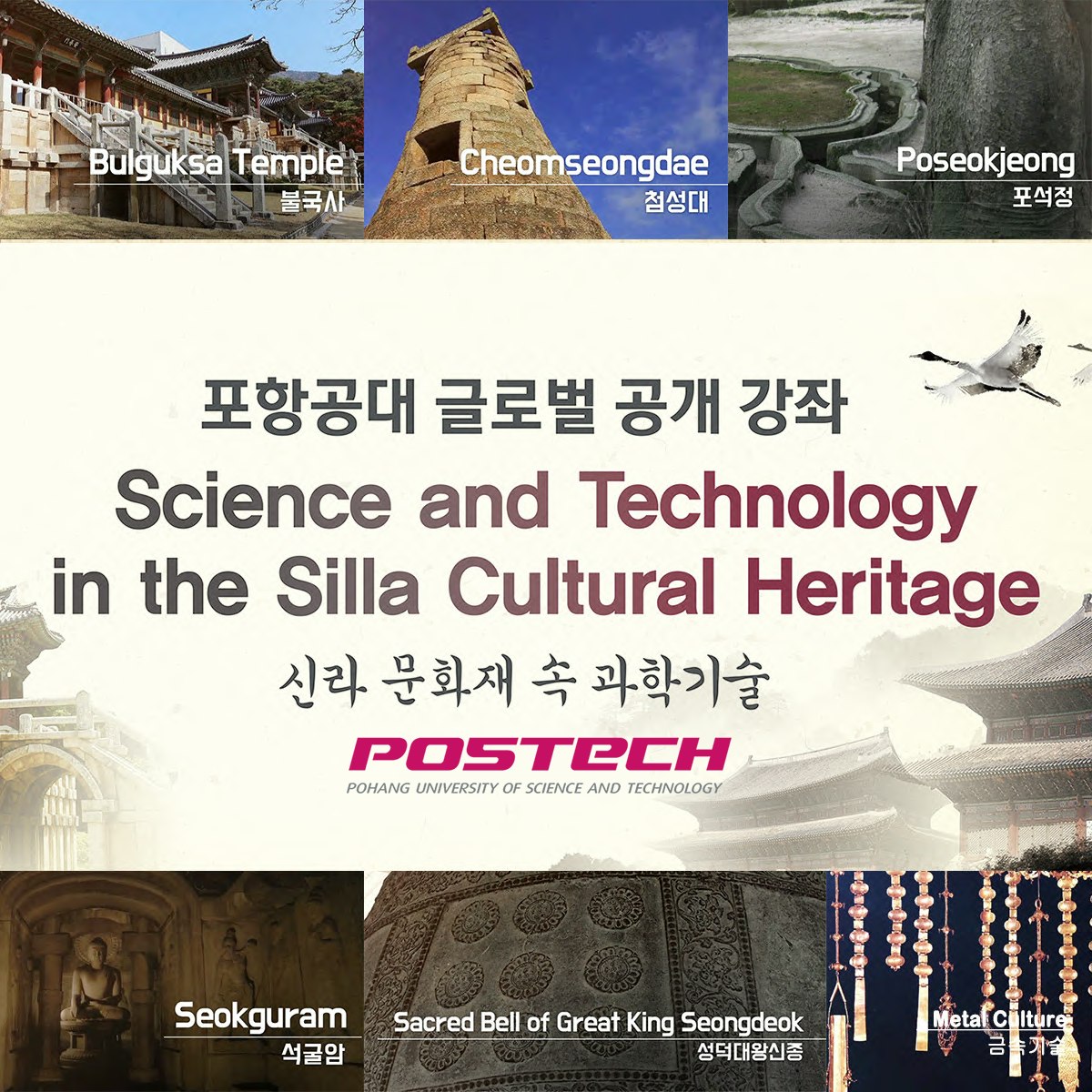
Science and Technology in the Silla Cultural Heritage
Science and Technology in the Silla Heritage The course explores the scientific and technological aspects of the cultural heritage of Silla, an ancient dynasty in Korea, and its relationship with other ancient civilizations in the world. The lecture series will cover major cultural heritage of Silla: Bulguksa, Seokguram, Cheomseongdae, Poseokjeong, the Sacred Bell of Great King Seongdeok, and metallurgy. Modern development in science and technology occurred mostly in the West. But during ancient times,various developments were madein science and technology in many countries outside of the West. In that sense, this series of lectures aims to obtain better understanding of the development in science and technology in the Silla dynasty through scientific and technological analysis of Silla cultural properties.

PTE Academic Exam Preparation: Writing Mastery | SCORE 79+
Why you should take this course in 2026: • Cover multiple Score 90 practice essays and Summarize Written Text tasks, and receive personalised feedback on your writing • Dive deep into English writing and how to improve your PTE writing score through essential grammar, sentence structure, and essay question types • Learn from a an experienced university teacher in Australia who is also a native speaker of English • Gain access to vocabulary lists for the PTE exam, Lesson Summaries for EVERY Module, Lesson Worksheets when tasks are available, quizzes to check understanding after each Module, and sample writing tasks throughout • You will practise the tasks yourself as you progress, learning more than just theory • Use the Q&A/Discussion function to ask questions and receive personalized help as you progress • Enjoy enthusiasm and passion from your teacher as you learn! I’m having a great time so I hope you will too :) The writing section of any English exam is a source of worry for many students, and the PTE is no exception. To achieve your goal of passing the PTE to progress in areas like your work, study, or visa status, you need excellent writing skills. This course will equip you with everything you need to achieve your highest potential in the writing section of the PTE exam, guiding you through each part and providing examples every step of the way. It is not just a quick exam overview - I dive deep into the main question types and take you through my best methods to genuinely improve your writing skills AND learn the exam back-to-front. Based on my 10+ years of English language teaching experience at top schools and universities in New Zealand and Australia, I have created this course to target the most-needed skills to achieve top scores in academic writing in the PTE exam, as efficiently as possible. This includes Score 90 sample answers, PTE vocabulary lists, focused lessons on elements of writing that will improve your writing the fastest, and an emphasis on structure and logic. I am also here with you the entire way to answer questions and help you out - writing is my absolute favourite subject to teach and I love discussing it, so your questions are more than welcome! You will learn: • Fundamentals of word forms and sentence structure, which are essential to writing strong summaries and essays • A 3-step approach to Summarize Written Text, helping you to break this task into manageable stages as we write the task answers together • Recommendations for the easiest ways to include complex structures in your writing to impress the scoring matrix • All of the criteria for both Summarize Written Text and Write Essay to understand how you are scored • Strong essay structure for each essay question type in the PTE exam, complete with sample essay questions and key language to identify question type • A deeper look into developing an essay, from introductions to body paragraphs to conclusions, with walk-through examples and the option to write your own • How to use clause and sentence connectors (linking words) as well as complex language to create logic, cohesion, and sophistication • My top tips for achieving strong academic style in essay writing, with examples of the good and the bad • Sample Score 90 essays will be provided for your reference and analysis throughout the course, exemplifying points taught in each Module • For more advanced students seeking 79+, specific recommendations for essay development and language use are given to bring greater sophistication to your style • At the end of the course, we will test your learning by looking at a full student sample essay to identify errors and problems in the essay, before comparing it to a Score 90 sample of the same topic I am so looking forward to sharing this course with you and hearing about your PTE results - many students have sent through incredible results to me after taking my course, and I love hearing about it. Please feel free to look through some sample lectures and the introductory video to make sure this is the right course for you, and I hope to see you in there soon! Also check out my PTE Speaking course for the Speaking section of the PTE exam!

Evaluating Student Understanding with Socrative
By the end of this project, you be able to evaluate students in real time and provide immediate feedback using Socrative. With Socrative, you can create personalized activities and engage students in games that encourage full participation as they learn. Socrative is a great tool for online learning, but it also allows teachers to save valuable time by letting Socrative to the work of grading and engaging students for you! Let’s get you confident and ready to use Socrative today. *You will need a free Socrative account for this project. You will have the option to upgrade to a Premium account if you choose to use all of Socrative’s features.

The Complete French Course : Daily Life Conversations
Bonjour tout le monde ! My name is Yohann and I will help you learn our beautiful French language. First, If you are a complete beginner, please consider taking my first class : The Complete French Course : Learn French - Beginners. You can find it on my instructor profile. It is a popular course and will probably suit you better if you don't have much knowledge of French. It is followed by my second course : The Complete French Course : Low Intermediate that I would recommend as well if you want a smooth transition towards this Intermediate course. But that’s just a recommendation. This course is perfect for you if you want to advance your French speaking abilities with a course that brings daily French life to your lessons through engaging dialogues, targeted grammar practice and vocabulary. You'll be equipped to live and communicate in France with ease ! How does it work ? The course is divided in 40 lessons (~23 hours of videos and a hundred dialogues) all following a logical progression and exploring all the real-life situations you could encounter in France. Each lesson starts with engaging dialogues on a specific topic, paired with questions to check your understanding. Then we break down each dialogue, highlighting key vocabulary and new grammar. We put all that into practice and finally we finish with a focus on communication, giving you the essential sentences to be able to deal with your daily French situations easily! For the exercise part, don’t forget that you will need a pen and a piece of paper to complete them with me. It's easy, just follow the instructions on the video! And very important ! After each lesson you will have access to the summary of the lesson and a vocabulary list with all the good expressions to use for each communication situation along with the translation and an audio document to ensure a perfect pronunciation ! You will also find bilans or assessments with many exercises through the course. So please, do your homework :) Which level will I reach ? At the end of this course ranging from a A2 to B1 level, you will reach a conversational B1 level. If you want to cover all the grammar required for a B1 level I would recommend you to have a look at my other courses (Master the Past Tenses & The Complete French Course – Low Intermediate) Check out the preview lessons available and see if this course would be a good fit for you. And finally, don't hesitate to contact me, I'm ready to answer any questions you might have ! Ready to start ? See you in class !

Climate Adaptation and Human Rights
Welcome to our Climate Adaptation and Human Rights MOOC. This course will be of interest to professionals and students engaged with social and governance issues relating to climate change adaptation. Government officials at local and national levels, private sector actors, civil society activists, journalists, staff of international organisations, academics and students will all benefit from integrating a human rights and gender equality perspective into their work. The course suits learners interested in moving from theory to practice. Drawing on practical experience from around the world, this course is designed to help you to build proficiency in applying rights-based approaches in contexts relevant to adaptation action at national and local levels. By the end of the course, you will be able to explain why rights-based action on climate is a legal obligation as well as how adoption of this approach can lead toadaptation outcomes that are more sustainable than technocratic approaches. You will also be able to apply the Framework for Integrating Rights and Equality in a variety of practical contexts relevant to action on climate.

SOLIDWORKS Beginner Course: Complete CSWA Preparation
Prepare for the SOLIDWORKS Certified Associate (CSWA) exam and build the core SOLIDWORKS skills used by engineers and designers This course takes you from complete beginner to confident SOLIDWORKS user with a structured, step-by-step learning path covering: - Part Design - Assemblies - Drawings - CSWA exam preparation. This isn't a course where you simply watch videos and hope everything clicks. You'll follow along by creating real SOLIDWORKS models, complete guided exercises, and work through hands-on projects that reinforce every new concept. Each lesson builds on the previous one, helping you develop practical skills that you can apply immediately in your own designs and confidently use during the CSWA exam. You'll go beyond learning which buttons to click. You'll understand how to: - create sketches correctly - build robust parts - assemble components - generate professional engineering drawings - and apply the modeling techniques expected from a SOLIDWORKS Certified Associate. Throughout the course, you'll also complete CSWA-style practice exercises and mock exams so you know not only what to do, but when and why to use each tool and workflow. As a Udemy bestselling SOLIDWORKS instructor, I've helped more than 50,000 students worldwide learn SOLIDWORKS and prepare for industry-recognized certifications. My courses have received thousands of positive reviews because they focus on practical, real-world learning with clear explanations and step-by-step instruction that beginners can easily follow. Enroll today and get instant access to the: - complete course (including hours of on-demand video lessons) - downloadable practice files - guided exercises - CSWA practice exams - lifetime access - and a certificate of completion. Whether your goal is to pass the CSWA exam, improve your CAD skills, or build a strong foundation for more advanced SOLIDWORKS projects, you'll have everything you need to get started today. Student Results Speak for Themselves ★★★★★ “I passed the CSWA in 9 days! The course explains EVERYTHING the exam covers and the practice exercises were perfect.” — Matthew ★★★★★ “I ACED the exam with an hour to spare. If you finish this course, you WILL pass.” — Moises ★★★★★ “Great course!!! After completion, I passed the CSWA exam in the row and obtained 240 out of 240 in 125 min (180min allowed)” — Eric ★★★★★ “This is the best course on SolidWorks ever. I got CSWA with perfect score after one week of following this training" — Khelil

Introduction to 3D with Nomad Sculpt
Are you an artist who wants to expand from 2D to 3D art? If you have an iPad or an Android tablet, you’ll be surprised as to what YOU can create! Welcome to Introduction to 3D with Nomad Sculpt! I’m Dave Reed, and I am completely obsessed with creating 3D art. I say 3D art because there are so many different ways to be creative with 3D; you can render your art as images, dive into 3D printing, you can even create a model in Nomad and further develop it in programs like Blender for rigging, animation, or game assets. This class is geared toward absolute beginners that may have little or no experience at all with 3D or art in general. I know it looks complicated and intimidating, but I really take my time giving direction and create an environment that’s easy to learn in at a pace that's easy to follow. Nomad Sculpt version 1.82 or higher Here are some of the things you'll learn in class: * Opening and preparing our scene. Getting familiar with the Nomad Sculpt UI (User Interface, the program) * Adding primitives to our scene. “Primitive” is just a fancy word for a simple shape. * The idea of using primitives to block out a simple character. “Blocking” is like sketching but with shapes! * General overview of tools and other functions that we will use to help form our character * Voxel remeshing: The process of combining shapes together to form one solid piece * Simple scene lighting * Post Process: This will add the final touches to our character and make it ready to render These terms will make sense as we work our way through the course. There are also multiple ways to achieve things when working in 3D, so as you develop your skills, you will find new and creative ways to get the look you want for your 3D sculpts. What you'll need: * iPad, iPad Pro, or Android Tablet (with Apple pencil or pressure sensitive stylus) * Nomad Sculpt application (iOS / Android) * Snacks (optional) Let's get started! Instructor bio: Dave Reed is a 2D and 3D illustrator and digital creator based in Brooklyn, New York. He holds a BFA in Illustration from the School of Visual Arts in NYC, where he developed his craft in both traditional and digital mediums. With a passion for visual storytelling and design, Dave brings a creative and practical approach to his teaching, helping learners build the skills and confidence to create their own illustrations and digital art.

3 Minute French - Course 1 | Language lessons for beginners
Bonjour et bienvenue :-) My name is Kieran, and I’ve been teaching foreign languages for over eighteen years. I love languages, I love learning and I love teaching. I also love chocolate, but this isn’t really the place to discuss my chocoholism! I created 3 Minute French as a way to make learning French easier than ever before and accessible to anybody, especially people who have tried and failed in the past. My course is perfect for the complete beginner as I break down the French language into tiny chunks that I show you how to build back together again in a logical, simple-to-understand way. You can go from knowing no French at all to putting together your own sentences in just a few minutes. The words and phrases that you'll learn in this course will be useful to you in any French-speaking country. A lot of traditional language courses either start by teaching you an endless list of pronunciation rules, or you learn phrases that aren't too useful for the beginner, such as how to talk about your family or your job. In 3 Minute French, you'll learn the most useful words first. As well as vocabulary, there are some useful grammar points that will be explained to you in bitesized chunks. You'll then be given plenty of opportunities to put them into practice. You'll also be given two Vocabulary Expansion Sheets, which are documents full of useful vocabulary in specific topics ('food & drink' and 'numbers'). These Vocabulary Expansion Sheets give a boost to your French and help to improve your comprehension. Finally, the title... 3 Minute French? Obviously, you can't learn French in just three minutes, but you can learn it in three-minute chunks. As the name suggests, each lesson in this course lasts just three minutes (more or less!). In each lesson, you learn a tiny chunk of French that you can use to build sentences. As you work through the course, you learn more and more little chunks and your sentences will gradually get longer and longer. The chunks that you learn in the first lessons are carried through to the last lessons. This means you don’t have to worry about trying to remember everything; you will get so much opportunity for practice that you will find the words and phrases just sink into your brain. The lessons in this course are focused, practical and effective, and you will build language skills that you can use straight away in real-world situations. You will be able to speak French comfortably and with confidence whenever you’re in a French-speaking country. WHY 3 MINUTES? When you begin learning something new, you tend to start off with lots of excitement and motivation. You might spend a few hours on the first day learning, but then the next day, you can only manage one hour, and then that goes down to half an hour, and then you get bored and you give up. Well, the reason behind the very short lessons is that it helps you to stay motivated and it also enhances the learning process. By keeping your learning to short chunks, you will find three wonderful things start to happen: 1. You will maintain enthusiasm If you want to learn anything, you have to maintain enthusiasm or else you won’t continue. If you limit your study time to just three minutes, you’ll keep French fresh and exciting and you’ll be eager to learn. If you spend hours studying, very quickly you’ll get bored with French and it’ll turn into a chore. 2. You will study more consistently It’s much better to study for just three minutes once a day than to study for three hours once a week. A spare three minutes is relatively easy to find even in the most hectic of schedules. If you make sure you complete at least one three-minute study session every day, it’ll quickly become a habit that you’ll do without thinking. It’s much easier to fit in a daily three-minute habit than a weekly one-hour habit. By doing this, you’ll become a much more consistent learner, and consistency is the key to success. 3. You will remember things better This is my favourite reason as to why you should limit your study to just three-minute chunks. If you study something for just three minutes every day, you’ll trick your brain into memorising the information more quickly than if it were to see the information for hours each day. It’ll think, “I see this information every day so it must be important, but I don’t see it for very long, so I’d better hold onto it and make it into a memory fast!” You’ll be amazed at how much more easily things tend to stay in your brain if you limit yourself to just three minutes a day. So, that’s why I keep the lessons to just three minutes. A METHOD THAT REALLY WORKS I can’t quite believe it, but over 500,000 people in more than 200 countries have now used 3 Minute Languages to learn to speak a foreign language. It still amazes me when I get an email from somebody on the other side of the world telling me how much they have enjoyed learning French with me. Apart from the thrill it gives me to find out people are listening to my voice in places like Mongolia, Peru and even Fiji, it also confirms to me that the 3 Minute Languages courses work well. So, if you want a course that teaches you to speak French you can use in everyday situations using a simple and fun method, then sign up to 3 Minute French today. Merci :-) Kieran
Building Students Math Skills with iKnowit
By the end of this project, you will be fully prepared to use iKnowit with your students to improve their math skills. IKnowit is an interactive math practice site for students in Kindergarten through Grade 5. Through iKnowit, teachers can assign students math activities that are at their ability level. Students then engage in practice that is encouraging and aligned with program goals, while teachers are provided with valuable data on how students are progressing towards curriculum goals. Throughout this project, we will navigate through the various features of iKnowit as we work together to ensure that your account is ready to use with your class. *You will need a free iKnowit account for this project.

Chinese language for beginners : Mandarin Chinese HSK1-HSK3
In this course you can start learning Chinese language from scratch or refresh it if you have learned it long ago and you have forgotten a lot. You don't need any knowledge of Chinese language to attend the course, but you can be on HSK1 or HSK2 level as well (just skip the parts you already know). We have made this course for people who are looking to learn Mandarin Chinese in a simple and easy way. After you finish the course, you'll be able to manage most communication in Chinese when traveling or living in China. Learn Chinese language with lessons made by real teachers. The course includes HSK1, HSK2 and HSK3. HSK (Hanyu Shuiping Kaoshi) or the Chinese Proficiency Test is an international standardized exam which assesses non-native Chinese speakers' Chinese language proficiency. It contains the most common Mandarin Chinese words and sentences. It fits all Chinese language learners, not only people who want to take the exams. You will gain confidence in using most common Chinese language words and phrases learned in this course HSK1 Course includes 150 words, Around 200 sentences, 19 conversations and one HSK1 test. HSK2 Course includes 150 words, Around 300 sentences, 17 long conversations and one HSK2 test. HSK3 Course includes 300 words, Around 900 sentences, 25 stories and one HSK3 test. The course includes flashcards which can help you review and practice words and sentences from the lessons in a easy and funny way. We also added downloadable audio for every lesson (so you can keep learning while driving, running etc.) and PDFs. With all these things learning Chinese will be even easier! This course is easy to follow as it is divided into 3 parts: Part 1: learn new Chinese words and sentences Part 2: learn a conversation or a story Part 3: review and homework The course will help you with: 1. Practicing both speaking and listening 2. Understanding the most useful Chinese grammar rules 3. Learning most useful words and phrases After studying HSK1 course you can understand and use very simple Mandarin Chinese phrases, meet basic needs for communication and possess the ability to further your Chinese language studies After studying HSK level 2 you have an excellent grasp of basic Mandarin Chinese and can communicate in simple and routine tasks requiring a simple and direct exchange of information on familiar and routine matters. After studying HSK3 you can communicate in Chinese at a basic level in your daily, academic and professional life. You can manage most communication in Chinese when traveling or living in China In the course you don't have to learn Chinese characters, but it's strongly recommended to do it. Let’s have some fun and learn Mandarin Chinese together!
Procurement for Governments
This course offers an in-depth exploration into the complexities and strategies of government procurement processes. Participants will gain insights into foundational concepts and frameworks that govern public procurement, moving into specific applications that enhance efficiency, transparency, and value for money. The course context emphasizes the critical role procurement plays in public sector governance and its impact on economic and social outcomes. Through real-world examples and concrete skills development, learners will be equipped to navigate and improve procurement practices within government entities. This course is designed for government procurement officers, policy makers in public finance, legal advisors in the public sector, public administration academics, and NGO advocates for transparency. Each group will gain valuable insights and practical skills to enhance and optimize procurement processes in government settings. Participants should have a basic understanding of public sector operations, familiarity with general procurement processes, an interest in public policy and governance, and introductory knowledge of legal frameworks in public procurement.

Become a Calculus 2 Master
HOW BECOME A CALCULUS 2 MASTER IS SET UP TO MAKE COMPLICATED MATH EASY: This 557-lesson course includes video and text explanations of everything from Calculus 2, and it includes 180 quizzes (with solutions!) and an additional 20 workbooks with extra practice problems, to help you test your understanding along the way. Become a Calculus 2 Master is organized into the following sections: • Integrals • Applications of Integrals • Polar & Parametric • Sequences & Series AND HERE'S WHAT YOU GET INSIDE OF EVERY SECTION: Videos: Watch over my shoulder as I solve problems for every single math issue you’ll encounter in class. We start from the beginning... I explain the problem setup and why I set it up that way, the steps I take and why I take them, how to work through the yucky, fuzzy middle parts, and how to simplify the answer when you get it. Notes: The notes section of each lesson is where you find the most important things to remember. It’s like Cliff Notes for books, but for math. Everything you need to know to pass your class and nothing you don’t. Quizzes: When you think you’ve got a good grasp on a topic within a course, you can test your knowledge by taking one of the quizzes. If you pass, great! If not, you can review the videos and notes again or ask for help in the Q&A section. Workbooks: Want even more practice? When you've finished the section, you can review everything you've learned by working through the bonus workbook. The workbooks include tons of extra practice problems, so they're a great way to solidify what you just learned in that section. HERE'S WHAT SOME STUDENTS OF BECOME A CALCULUS 2 MASTER HAVE TOLD ME: • “Excellent Quality course. I just finished Calculus 1 and wanted to start learning calculus 2. The instructor gives you quick feedback and is very clear on every example she posts. I highly recommend this course for anyone who wants to learn more about integrals.” - Nick Z. • “This is a superior course. I have taken MOOC Calculus courses now through Ohio State, and MIT (also superior). Krista King is an excellent instructor, with superior knowledge, and nails down precisely what one needs to know, and also provides superior supportive notes.” - Snowcrash • “Krista is saving my butt in my Calc2 class. I always review her videos and do practice problems before my quizzes and exams.” - Nye W. • “Krista's energy and thoroughness make sitting through an explanation simple and motivating. There are loads of examples, with quizzes to check your progress, and detailed explanations on ALL the quiz questions. Plus she answers questions quickly and is very professional! Worth every penny, bought her whole series. It will also help with physics and economics, as she includes relevant explanations and exercises for applications in those topics as well. Got an A in calc 1 online because of her calc 1 course, and now I have gotten an A in calc 2 online as a first time student of it and in a summer semester (shortened!) Thank god I have her calc 3 course, I know I will need it next semester!” - Jennifer L. • “I just can't get over how well she teaches her classes. I have now taken all 3 of her Calculus classes and I really do have a strong understanding of calculus concepts. If only more people could teach the way she does. These concepts that seem so hard she has made easy and clear. My favorite part are the quizzes. She has just enough gotcha's to really get you thinking and remembering concepts. I really just cannot say enough good things about this course and the teacher!” - Morgan G. • “The instructor goes through every little step no matter how minor. It makes learning the material fun! Thank you so much for this wonderful and detailed course!” - Immanuel W. • “This is the second of three courses I have purchased from Krista and she does an incredible job of breaking down the complicated concepts into easy to understand steps. Her courses are very thorough and include a variety of different methods of instruction. Well thought out course. Thank you Krista!!!” - John C. YOU'LL ALSO GET: • Lifetime access to Become a Calculus 2 Master • Friendly support in the Q&A section • Udemy Certificate of Completion available for download • 30-day money back guarantee Enroll today! I can't wait for you to get started on mastering calculus 2. - Krista :)

Challenging Forensic Science: How Science Should Speak to Court
The aim of this course is to promote critical thinking with regard to forensic science. Today, in general, most people are dazzled by the technical possibilities offered by forensic science. They somewhat live in the illusion that forensic evidence is fool proof and brings factual findings with 100% certainty. This course – given by specialists in the field – goes beyond the conventional image that is promoted through TV series such as CSI. It alerts (without alarming) the public on the limits of the techniques in order to promote a sound administration of forensic science in the criminal justice system. It allows participants to understand the importance of probabilistic reasoning in forensic science, because uncertainty is a constitutive part of forensic science. The course is constructed as a series of causes célèbres that could or have led to miscarriages of justice. Some of these cases have been part of case reviews carried out at the School of Criminal Justice of the University of Lausanne. ****************** Special thanks to our translators, in particular the University of Lausanne and the School of Criminal Justice sincerely thank Massimiliano Stabile (forensic biologist), Francesco Zampa (forensic chemist) and Giampietro Lago (forensic biologist) for the Italian translation of the course.

CRIMINAL PSYCHOLOGY: Personality Disorders & Dangerous Minds
Criminal Psychology: Personality Disorders & Dangerous Minds Psychopathy, Narcissism, Manipulation, Violence & Crime Explained Why do some people become violent, manipulative, or dangerous — while others don’t? Is criminal behaviour driven by personality, trauma, mental illness, or situational pressure? And can we actually predict or prevent serious crime? This course explores the psychological foundations of criminal behaviour with a clear, evidence-based focus on personality disorders, dangerous traits, and extreme offending. Rather than relying on myths or sensationalism, you’ll learn how psychologists and researchers understand the links between personality, aggression, manipulation, violence, and crime — and where those links are often misunderstood. What you’ll explore in this course: • How personality traits and disorders relate to criminal behaviour • The psychology of aggression, violence, and emotional dysregulation • Antisocial Personality Disorder, psychopathy, narcissism, and criminal risk • Borderline Personality Disorder, bipolar disorder, schizophrenia & crime — facts vs fear • Attachment styles, trauma, and antisocial development • Sexual offending, stalking, coercive control, and obsession • Murder, serial killing, and mass violence: psychological patterns and motivations • Whether “ordinary” people are capable of extreme violence • Risk factors, early warning signs, and the limits of criminal prediction You’ll also examine critical questions such as: • Is mental illness really linked to violence? • Are psychopaths born or made? • Can criminal behaviour be predicted or prevented? • Where does psychology end — and ethics begin? Who this course is for: • Psychology students and enthusiasts • Therapists, counsellors, and mental health professionals • Criminology and forensic psychology learners • Anyone interested in criminal behaviour, personality, and the darker side of the human mind No prior knowledge is required — concepts are explained clearly and accessibly, while remaining academically grounded and professionally relevant. Course features: • Short, focused video lectures (8–12 minutes each) • Mini quizzes after each section • Final assessment and certificate of completion • Recommended reading, research references, and additional resources P.S. This course is accredited by the International Association of Therapists (IAOTH). P.P.S. If you want to understand criminal minds beyond stereotypes — with psychological depth, clarity, and nuance — enrol now and I’ll see you inside the course.

Adapting to the Effects of Climate Change on Quality of Life
This course addresses global climate change mitigation and adaptation, focusing on urban impacts and preserving Quality of Life (QoL). It is for urban planners, civil engineers, environmental scientists, and policymakers. You will learn about climate change effects on living comfort, industry, urban structures, land use, and transportation systems. We examine QoL definitions, climate risks in agriculture (fruit tree production), and urban heat environments. The course also covers impacts on infrastructure and transportation, and strategies for urban development. You will use climate change impact simulation tools to analyze urban heat and transport systems. To succeed, a basic understanding of environmental science or urban planning is helpful. By the end of this course, you will be able to: * Analyze climate change impacts on urban quality of life. * Assess climate change conditions and risks in Japan. * Develop strategies for climate change adaptation. * Evaluate adaptation measures for urban environments.

CMRP Certified Maintenance & Reliability Professional (2026)
This course contains the use of Artificial Intelligence. " Unofficial Course " In today's competitive industrial and manufacturing environments, effective maintenance management is no longer just about repairing equipment when it fails. Modern organizations rely on strategic maintenance practices, reliability engineering principles, and data-driven decision-making to maximize asset performance, reduce downtime, control costs, and achieve operational excellence. This comprehensive course is designed to provide a thorough understanding of maintenance management, asset reliability, maintenance planning, and organizational leadership. Whether you are new to the field or an experienced professional seeking to strengthen your knowledge, this course will equip you with the concepts, frameworks, and best practices used by leading maintenance and reliability organizations worldwide. Throughout the course, you will explore how maintenance activities contribute directly to business objectives and organizational success. You will learn how maintenance investments are evaluated through financial frameworks, how risk management supports asset reliability, and how key performance indicators are developed and used to measure maintenance effectiveness. You will also gain insight into the creation of strategic maintenance plans that align technical operations with broader business goals. The course examines the foundations of manufacturing process reliability, including Overall Equipment Effectiveness (OEE), continuous improvement methodologies, root cause analysis techniques, and structured approaches to managing operational change. You will also discover how maintenance systems integrate with safety, health, and environmental standards to support sustainable and compliant operations. A major focus is placed on equipment reliability and asset management. You will learn the principles of Reliability-Centered Maintenance (RCM), Failure Modes and Effects Analysis (FMEA), Condition-Based Maintenance (CBM), and Total Productive Maintenance (TPM). In addition, you will understand how equipment life cycle costs are analyzed to support informed maintenance and replacement decisions. Beyond technical concepts, this course explores the human and organizational aspects of maintenance excellence. You will examine maintenance department structures, competency development frameworks, leadership strategies, and methods for building a culture focused on reliability and continuous improvement. Effective communication and collaboration across departments are also addressed to help ensure successful maintenance operations. The course further covers the essential processes that drive efficient work management. You will learn how work orders are managed from initiation to completion, how maintenance requests are prioritized, how preventive maintenance programs are developed, and how scheduling and resource allocation decisions are made. Inventory control and spare parts management strategies are also discussed to help minimize downtime and improve operational readiness. By the end of this course, you will possess a strong understanding of maintenance management principles, reliability engineering concepts, maintenance planning methodologies, and operational improvement strategies. You will be able to evaluate maintenance performance, support asset reliability initiatives, contribute to continuous improvement programs, and understand how world-class maintenance organizations achieve long-term operational success. Whether your goal is career advancement, professional development, or gaining a deeper understanding of maintenance and reliability systems, this course provides the knowledge and key insights needed to succeed in modern industrial and manufacturing environments. Thank you

Re-imaging God in Korean Context
This course will be an overview of a development of the theological methods in relation to Korea’s cultural context. Completing the course, the learners can understand cultural influences on the dynamic development of Korean churches and indigenous theology; they can also gain an insight into their own image of God and theological imagination in their own cultural context.

Learn Thai Conversation for Beginner (A1)
Thai Conversation for Beginner A1 is a practical speaking course designed for complete beginners who want to start speaking Thai from day one. Whether you're planning to travel, live, study, or work in Thailand, this course helps you build a solid foundation in everyday Thai conversation with real-life examples. In this A1-level course, you’ll cover 10 essential topics that are commonly used in real-life situations. You’ll learn how to greet people, introduce yourself, order food and drinks, ask for directions, use numbers in daily life, shop at local markets, and more. Each lesson focuses on real conversations, not just grammar, so you can start speaking Thai with confidence and clarity. Taught by "Kru Chom from Thai By Chom" an experienced native Thai teacher with 9 years of experiences, this course provides: • Easy-to-follow speaking practice • Useful vocabulary and sentence patterns • Cultural tips and pronunciation support • Downloadable PDFs and audio for revision • Practical exercises to boost retention and fluency Perfect for travelers, digital nomads, expats, or anyone interested in learning spoken Thai, this course focuses on communication skills, not memorizing rules. By the end of the course, you’ll be able to hold short, meaningful conversations and feel more connected to Thai people and culture.
Evaluación del y para el aprendizaje: enfoque cuantitativo
La perspectiva contemporánea de la educación ha considerado que dentro del proceso educativo es indispensable la evaluación como una parte esencial de la enseñanza y el aprendizaje. Realizar este proceso de manera adecuada requiere de una formación especializada que nos permita conocer tanto el proceso en sí mismo, así como los elementos involucrados en él y la pertinencia de hacer uso de las técnicas e instrumentos más adecuados y necesarios para cada tipo de evaluación. El conocimiento de los instrumentos de evaluación es una parte fundamental de la formación para la evaluación para el aprendizaje, para fines didácticos existen dos manera de clasificar a estos instrumentos: cuantitativos y cualitativos. A través de una serie de videos, actividades y ejercicios, se pretende que en este curso conozcas el concepto, las características, el diseño, la elaboración y el uso de resultados de cuatros de los instrumentos más utilizados en el enfoque cuantitativo de la evaluación para el aprendizaje: las pruebas objetivas, la lista de cotejo, el quiz y la rúbrica. Al término del curso: El participante diseñará los instrumentos de evaluación para el aprendizaje que integran el enfoque cuantitativo para sustentar evaluaciones pertinentes, altamente formativas y éticas.

Quantum Physics: an overview of a weird world (Basics)
Note: Take a look at the free lectures! Scroll down to the curriculum and click on 'Basics I'. The 'preview' lectures are free. That might help you to get a better feeling of what's about. Why this course? This is an introductory course (Basics) that originates from my desire to share my knowledge of the mysterious and fascinating world of Quantum Physics. Considering how the media (sometimes also physicists) present Quantum Theory focusing only on highly dubious ideas and speculations backed by no evidence or, worse, promote pseudo-scientific hypes that fall regularly into and out of fashion, I felt it necessary to create a serious introduction to the conceptual foundations of Quantum Physics. The second part (Supplemental), which focuses further on some selected topics, can be found on the Udemy portal as well. Who is it for? For the autodidact who is looking for a serious and rigorous introduction to the foundations of quantum physics and some of its philosophical implications. This course does not need a technical background except for some basics, such as elementary concepts of algebra, trigonometry, calculus, and statistics. It is easier than a university course but requires more effort than a popular science lecture. It might be easier for those having already some math background but a mathematical appendix is furnished for those who need a reminder. Even though these lectures are not a replacement for college courses, they could complement it. University or college classes do not address the foundations and the philosophical aspects of Quantum Physics, teaching Quantum Mechanics mostly from the formal and mathematical perspective, which is something we will restrict only to the essential basics here. While in schools, colleges, and universities, Quantum Physics is taught with a dry and almost exclusively technical approach which furnishes only a superficial insight on its foundations, this course is recommended also to high school, undergraduate, and graduate students who would like to look further. Not only physicists could (re-)discover some topics but philosophers, engineers, IT students or historians of science could acquire with this course a basic preparation that is unlikely to be offered in most departments. This online course proposes itself also to become part of a faculty curriculum in departments or other institutions that would like to expand their interests toward the foundations of Quantum Physics (contact the instructor for details). What is it about? A course on the conceptual foundations of Quantum Physics on topics that you won't find elsewhere explained at an introductory level. It will lead you by hand as clearly as possible from the abc of Quantum Mechanics to the most recent experiments and their implications. We review the standard concepts like the wave-particle duality, Heisenberg`s uncertainty principle, Schrödinger`s cat, the vacuum zero-point energy, and virtual particles, among several others. Then we deepen the subject analyzing quantum entanglement, the so-called "EPR paradox" which questions our naive understanding of the meaning of reality and locality (for more details on the content look up the curriculum page). My aim is to deliver the material necessary so that you will be able to distinguish by yourself between mere speculative (and more or less extravagant) interpretations in fashion, and the real Quantum Theory and its experimental facts as it is.

Film Photography: Exposure, Metering & Key Skills
By the end of this course, you will be able to confidently control exposure using aperture, shutter speed, and ISO; accurately meter light in a variety of conditions; and apply manual focusing, long exposures, and bracketing techniques to intentionally shape your images. In Film Photography: Exposure, Metering & Key Skills, Sathya Peacock guides you beyond the basics to truly understand how film works—from the moment light hits the emulsion to the final image. Designed as the second course in a three-part series, this class focuses on building technical confidence through clear explanations and practical exercises. You’ll explore the relationship between exposure variables, learn how to meter effectively, and develop hands-on skills that help you move from simply taking photos to deliberately making them. This course is ideal for beginner to intermediate film photographers who want more control over their results. To be successful, you should have a basic familiarity with using a film camera. What makes this course unique is its structured, exercise-driven approach—each section reinforces learning through mini projects, supported by practical worksheets and reference guides you can return to long after the course ends.

Tactic Ninja - Sharpen Your Chess Tactics with a Grandmaster
ACTUAL STUDENT REVIEWS “I haven't finished this course yet, but I've gained 200 on chess com already.“ - Mary Lea “This is what I was looking for already a loooooong time!!! Best ever seen.” - Francis Joly “The best chess instructive course that I have ever seen in my entire life” - Ali ElSaid These are just a few of the hundreds of reviews I’ve received since publishing this course on my website. And now, I’m very excited to share it with you on Udemy. WHY DO MOST FAIL TO IMPROVE THEIR TACTICS AND THEIR RATING? It’s not a secret that in chess, especially at beginner and intermediate levels, tactics often decide the outcome. Improving your chess tactics is one of the quickest routes to raise your rating. Many chess lovers understand this, but unfortunately, most of them fail. They try different books and different platforms for solving puzzles… But there’s little to no improvement in their tactical ability because of two main mistakes they make. Mistake No. 1: They try to solve puzzles before learning the tactical motifs. How can one pick mushrooms in the forest without knowing what the mushrooms look like? Mistake No. 2: They study tactical motifs and believe they know it! But studying and learning are very different. To truly internalize acquired knowledge, you must practice. WHAT WE'LL DO INSTEAD So, the most effective approach is to study and practice simultaneously, and that's precisely what we'll do in this course. “One of the clearest and most comprehensive instructional courses you will ever find on understanding and sharpening your tactics in chess.” Shawn Chua But before I tell you more, let me share with you something amusing. Lily, who assisted me with editing the course and provided initial feedback, raised her rating by 100 points in just two weeks! Now, imagine how much you can raise your rating when you train with this course with full focus, without the need to edit or write down feedback? :) Please note that I said “train with this course,” and not “watch” it. This course is designed to be highly interactive, offering an active learning experience. (If you're seeking a course where you can simply relax with popcorn and watch it like a Netflix movie, this is not the right fit for you.) A GRANDMASTER’S GUIDANCE OVER YOUR SHOULDER There are 20 tactical motifs in chess that I’ll help to master them. I won’t just introduce them by stating, “This is a pin, and this is a fork.” Instead, we’ll solve puzzles together on each topic, ensuring you deeply ingrain this knowledge. “I found the course to be outstanding! The puzzles were well-selected and super instructional.” - Zebedee Fortman Then I’ll reveal how Grandmasters spot tactics during a game, sharing insight into their thought processes. Then I’ll teach you my “3 Question Method” for noticing hidden tactics. Towards the end of the course, we'll tackle puzzles again, but this time, you won't be aware of the exact topic. However, you will possess the skills to identify any tactics. “A fantastic way to improve tactical awareness. You gotta love GM Avetik Grigoryan's style of presentation!” - Joe Adickes MY GUARANTEE Finally, if you don't experience a tenfold improvement by the course's conclusion, feel free to request a refund. I'm genuinely confident in this course's effectiveness, supported by the data of students, who significantly raised their ratings in a brief timeframe. SEE YOU ON THE INSIDE THE COURSE? With best wishes and love, GM Avetik Grigoryan Or just Avo, as my friends call me
Indigenous Engagement and Partnership Development
Indigenous Engagement and Partnership Development is a Massive Open Online Course (MOOC) from the Faculty of Native Studies (University of Alberta) that teaches the fundamentals of how to respectfully collaborate with Indigenous communities, nations, and organizations. Learners will receive comprehensive instruction about historical relationships, Indigenous governance and ethical relationship building. This course is open to all learners aiming to develop core competencies and practical skills for effective engagement within Indigenous community contexts.