Cursos de Humanidades y sociales
Los mismos datos para todos, vengan de Udemy o de Coursera: precio, valoración, duración e idioma. 724 cursos encontrados. Afinar la búsqueda

Pharmaceutical Industry: From Molecule to Medicine | Updated
This course contains the use of Artificial Intelligence. It's an Unofficial Course. The Pharmaceutical Industry Masterclass is a comprehensive course designed to provide a complete understanding of the global pharmaceutical ecosystem, covering every stage of the medicine development journey from scientific discovery to patient access. This course explores how pharmaceutical companies operate, how innovative medicines are created, tested, regulated, manufactured, and brought to healthcare markets worldwide. Throughout this course, you will gain a strong foundation in the structure of the pharmaceutical industry, including the roles of innovator and generic pharmaceutical companies, healthcare stakeholders, regulatory authorities, and the economic factors influencing pharmaceutical development and spending. You will explore the history of modern medicine and understand how scientific breakthroughs have transformed healthcare over time. The course takes you deep into the drug discovery and development process, explaining how potential drug targets are identified, validated, and optimized through advanced research methods. You will learn about preclinical studies, laboratory models, pharmacokinetics, pharmacodynamics, and the essential requirements for advancing a drug candidate toward human testing. You will also develop a detailed understanding of clinical trial methodology, including the purpose and structure of Phase I, Phase II, and Phase III trials. The course covers clinical trial design, safety evaluation, efficacy assessment, ethical principles, Institutional Review Boards, data management, and the role of biostatistics in generating reliable scientific evidence. A major focus of this course is pharmaceutical regulation and quality systems. You will learn how global regulatory agencies evaluate medicines, how drug approval applications are prepared, and why compliance with Good Manufacturing Practices (GMP), Quality Assurance (QA), Quality Control (QC), and Chemistry, Manufacturing, and Controls (CMC) requirements is essential for ensuring safe and effective medicines. Beyond research and approval, this course examines the commercial side of pharmaceuticals, including pricing strategies, health economics, market access, formulary decisions, supply chain operations, cold chain logistics, and the importance of real-world evidence. You will also explore post-market safety monitoring, pharmacovigilance systems, adverse event reporting, and the continuous evaluation of medicines after they reach patients. By the end of this course, you will have a complete end-to-end understanding of the pharmaceutical lifecycle and the interconnected processes that transform scientific ideas into approved healthcare solutions. Whether you are interested in pharmaceutical research, clinical development, regulatory affairs, quality management, healthcare business, or simply want to understand how modern medicines reach patients, this course provides valuable knowledge and practical industry insight. Thank you
Digital Governance
Big data, artificial intelligence, machine learning, autonomous cars, chatbots, just a few terms that have become a part of our professional legal and political vocabulary. Emerging technologies and technological advancement have confronted us in our daily practice and will continue to do so in the future. Whether we’re buying something online, taking part in an election, or chatting with friends across the globe. Technology is here and it is here to stay. However, as convenience as these new technologies may seem, they also have disruptive effects on society and pose us for legal and political challenges. These challenges are central to this MOOC on digital governance. After participating in this MOOC: - You are aware of the impact and effect of emerging technologies on law and politics. - You can identify risks and challenges of digitization in relation to EU law, markets and economics. - You understand the interconnectedness of problems, questions and solutions. - You are able to break down a concrete case of digitalization impact into a sub problem. - You can allocate problems to various fields of science or sub-fields of law. But most importantly, you will have a lot of fun and inspiration following this course, designed by an international community of legal experts in the field of digital governance. Come with us on the journey!

Pharmaceutical Industry: From Discovery to Market
The pharmaceutical industry plays a critical role in improving global health by discovering, developing, manufacturing, and delivering medicines that enhance and save lives. Understanding how this industry operates is valuable for students, healthcare professionals, researchers, and anyone interested in the journey of a medicine from the laboratory to the patient. This course provides a comprehensive introduction to the pharmaceutical industry and explains each stage of the pharmaceutical product lifecycle in a clear, structured, and easy to understand manner. Throughout this course, you will gain a solid understanding of the global pharmaceutical ecosystem, including the differences between innovator and generic pharmaceutical companies, the roles of key stakeholders such as patients, healthcare providers, payers, and regulatory agencies, and the historical developments that have shaped modern medicine. You will also explore the economic factors that influence healthcare systems and pharmaceutical spending around the world. The course then guides you through the drug discovery and development process. You will learn how researchers identify and validate drug targets, how promising compounds are discovered and optimized, and how preclinical studies help evaluate safety before testing begins in humans. You will also understand the fundamental concepts of pharmacokinetics and pharmacodynamics and learn about the requirements for submitting an Investigational New Drug (IND) application before clinical trials can begin. A significant portion of the course focuses on clinical trials. You will explore the objectives and characteristics of Phase I, Phase II, Phase III, and Phase IV clinical studies, gaining a clear understanding of how medicines are evaluated for safety, effectiveness, and long term performance. The course also introduces ethical principles, the role of Institutional Review Boards (IRBs), and the fundamentals of clinical trial data management and biostatistics. You will further develop your knowledge of regulatory affairs and quality management by learning about the responsibilities of major global regulatory agencies, including the FDA, EMA, and PMDA. The course explains the purpose of New Drug Applications (NDA), Biologics License Applications (BLA), Good Manufacturing Practices (GMP), Quality Assurance (QA), Quality Control (QC), and Chemistry, Manufacturing, and Controls (CMC) documentation. These concepts provide valuable insight into how pharmaceutical companies maintain product quality, safety, and regulatory compliance. Finally, you will explore the commercial side of the pharmaceutical industry. Topics include pharmaceutical pricing strategies, Health Economics and Outcomes Research (HEOR), market access, formulary placement, pharmaceutical supply chains, cold chain logistics, post-marketing studies, real-world evidence, pharmacovigilance, and adverse event reporting systems. These topics demonstrate how medicines continue to be monitored and evaluated even after they reach the market. This course is designed as a presentation based, voice over learning experience, making it easy to follow whether you are new to the pharmaceutical industry or looking to strengthen your foundational knowledge. The lessons focus on explaining important concepts in a logical sequence without requiring laboratory work, practical demonstrations, or prior industry experience. By the end of this course, you will have a strong understanding of the complete pharmaceutical product lifecycle from drug discovery and preclinical research to clinical development, regulatory approval, manufacturing quality, commercialization, and post market safety monitoring. This knowledge will provide a solid foundation for further study or for exploring career opportunities within the pharmaceutical, biotechnology, clinical research, regulatory affairs, quality assurance, and healthcare sectors. Thank you for choosing this course. I look forward to helping you build a strong foundation in the pharmaceutical industry and supporting you throughout your learning journey.

Economic Efficiency and Its Obstacles
This course will equip you to analyze how market interventions like price controls and taxes affect economic efficiency. You will learn to calculate consumer and producer surplus, identify the sources of deadweight loss, and evaluate the fairness and impact of different tax systems on wages and prices. Mastering these skills will enable you to assess the real-world consequences of government policies and understand the critical trade-off between efficiency and equity in resource allocation.

One-Hour AI YouTube Creator
“This course contains the use of artificial intelligence.” What You'll Learn (Learning Objectives) • Generate High-Retention Scripts: Prompt AI models to write viral, structured video scripts with strong hooks and calls-to-action. • Automate Video Production with Fliki AI: Convert text scripts into fully narrated 1080p videos using natural AI voices and B-roll. • Master Multi-Track Video Editing in CapCut: Edit timelines, sync audio tracks, apply dynamic transitions, and overlay background music. • Design Kinetic Auto-Captions: Create bold, animated subtitles with custom color highlights to boost viewer retention. • Scale a Faceless YouTube Business: Build a repeatable content pipeline that generates 3-minute daily videos without showing your face on camera. Target Audience & Requirements Intended Learners: • Content creators, freelancers, and digital marketers wanting to launch faceless YouTube or social channels. • Educators, online course creators, and agency owners seeking fast, low-cost video production workflows. • Complete beginners with zero video editing experience who want to leverage modern AI tools. Prerequisites: • A computer (Windows, Mac, or Chromebook) with a stable internet connection. • A free Google account (for Google Gemini) and a free or paid Fliki AI / CapCut account. • No prior editing experience or expensive camera gear required. Launch a Profitable Faceless YouTube Channel Powered by AI The traditional video creation process takes 15+ hours per video—requiring expensive lighting setups, high-end cameras, and tedious editing. Today, AI tools allow you to write, narrate, and edit high-quality faceless videos in a fraction of the time. This complete hands-on course teaches you step-by-step how to combine Google Gemini, Fliki AI, and CapCut into a seamless production line. You will learn how to prompt AI for viral scripts, generate hyper-realistic voiceovers, source dynamic 4K B-roll, and auto-generate captions that keep viewers glued to the screen. What We Will Cover: • Module 1: The Faceless Creator Framework — Uncover high-RPM niches and set up your channel strategy. • Module 2: AI Script Engineering — Write high-retention hooks and structured video outlines using Gemini. • Module 3: Fast Production with Fliki AI — Master text-to-speech, voice selection, automated scene mapping, and credit management. • Module 4: Advanced Editing in CapCut — Fine-tune audio, apply noise reduction, and style kinetic subtitles. • Module 5: Real-World Hands-On Project — Build a complete 60-second video from scratch and publish it. By the end of this course, you will possess a complete, repeatable AI system to publish consistent content and grow an online audience effortlessly.
Finishing the Cut: Post-Production Pipelines in Premiere
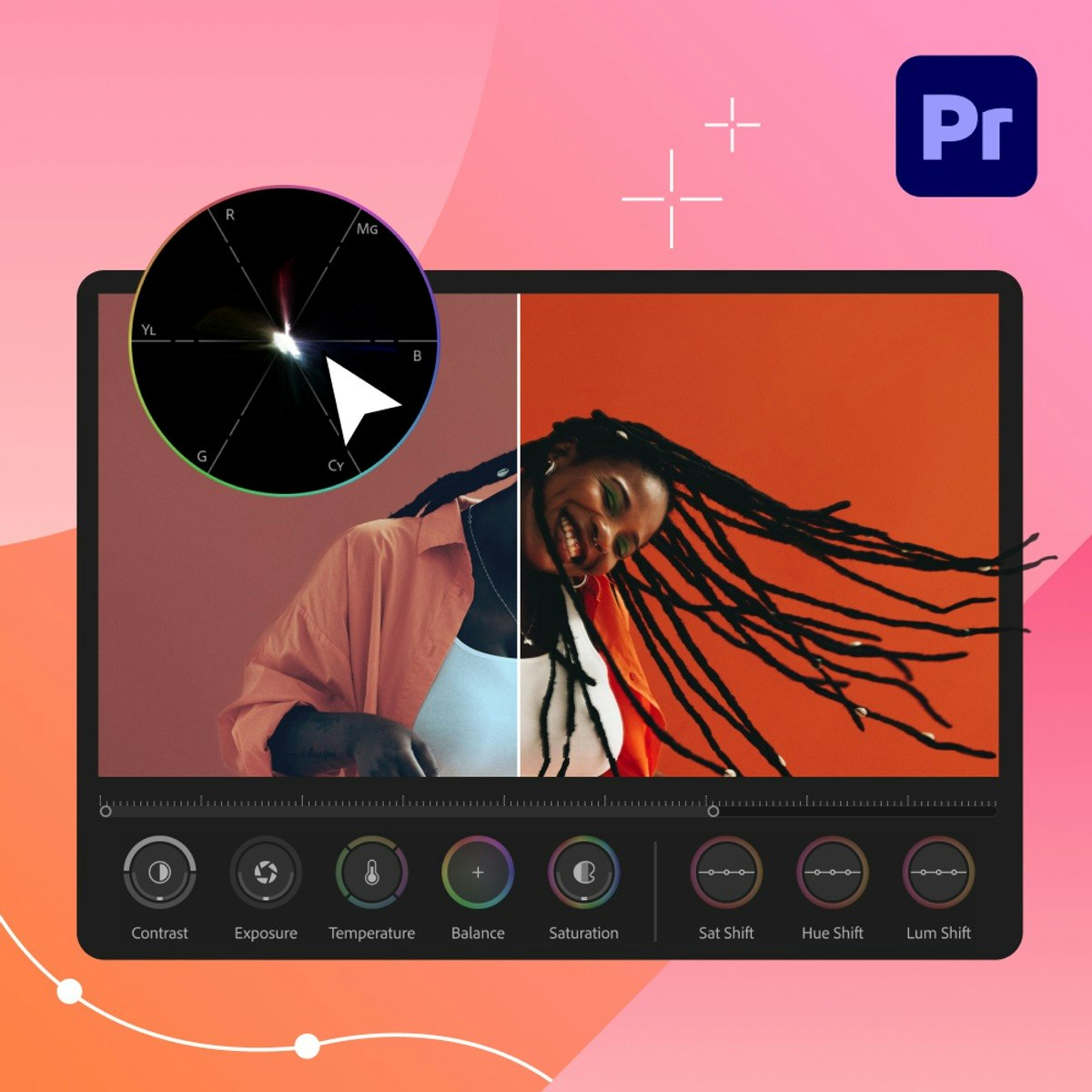
You will learn to prepare a Premiere project for finishing and delivery with the precision expected of a professional assistant editor. By the end of this course, you'll configure color-managed editing environments, use waveform, vectorscope, and histogram tools to flag technical image issues for the colorist. You'll reconform proxy-based sequences to full-resolution camera originals and consolidate project media for finishing. You'll also prepare the handoff packages downstream teams depend on: exporting AAF and OMF files for audio post-production, identifying VFX shots and generating pull lists, and writing turnover documentation that includes delivery manifests and issue logs. Through hands-on exercises, you'll explore the automation tools and collaborative workflows professional assistant editors use to manage complex productions, including Adobe Media Encoder watch folders for scalable encoding. You'll finish by archiving a completed project with Project Manager and writing wrap documentation, and you'll learn how the assistant editor role progresses across production types and toward an editing career.

Linear Algebra and Geometry 2
Linear Algebra and Geometry 2 Much more about matrices; abstract vector spaces and their bases [None of our courses are produced using AI; they are all real-human products.] Chapter 1: Abstract vector spaces and related stuff S1. Introduction to the course S2. Real vector spaces and their subspaces You will learn: the definition of vector spaces and the way of reasoning around the axioms; determine whether a subset of a vector space is a subspace or not. S3. Linear combinations and linear independence You will learn: the concept of linear combination and span, linearly dependent and independent sets; apply Gaussian elimination for determining whether a set is linearly independent; geometrical interpretation of linear dependence and linear independence. S4. Coordinates, basis, and dimension You will learn: about the concept of basis for a vector space, the coordinates w.r.t.\ a given basis, and the dimension of a vector space; you will learn how to apply the determinant test for determining whether a set of n vectors is a basis of R^n. S5. Change of basis You will learn: how to recalculate coordinates between bases by solving systems of linear equations, by using transition matrices, and by using Gaussian elimination; the geometry behind different coordinate systems. S6. Row space, column space, and nullspace of a matrix You will learn: concepts of row and column space, and the nullspace for a matrix; find bases for span of several vectors in R^n with different conditions for the basis. S7. Rank, nullity, and four fundamental matrix spaces You will learn: determine the rank and the nullity for a matrix; find orthogonal complement to a given subspace; four fundamental matrix spaces and the relationship between them. Chapter 2: Linear transformations S8. Matrix transformations from R^n to R^m You will learn: about matrix transformations: understand the way of identifying linear transformations with matrices (produce the standard matrix for a given transformation, and produce the transformation for a given matrix); concepts: kernel, image and inverse operators; understand the link between them and nullspace, column space and inverse matrix. S9. Geometry of matrix transformations on R^2 and R^3 You will learn: about transformations such as rotations, symmetries, projections and their matrices; you will learn how to illustrate the actions of linear transformations in the plane. S10. Properties of matrix transformations You will learn: what happens with subspaces and affine spaces (points, lines and planes) under linear transformations; what happens with the area and volume; composition of linear transformations as matrix multiplication. S11. General linear transformations in different bases You will learn: solving problems involving linear transformations between two vector spaces; work with linear transformations in different bases. Chapter 3: Orthogonality S12. Gram-Schmidt Process You will learn: about orthonormal bases and their superiority above the other bases; about orthogonal projections on subspaces to R^n; produce orthonormal bases for given subspaces of R^n with help of Gram-Schmidt process. S13. Orthogonal matrices You will learn: definition and properties of orthonormal matrices; their geometrical interpretation. Chapter 4: Intro to eigendecomposition of matrices S14. Eigenvalues and eigenvectors You will learn: compute eigenvalues and eigenvectors for square matrices with real entries; geometric interpretation of eigenvectors and eigenspaces. S15. Diagonalization You will learn: to determine whether a given matrix is diagonalizable or not; diagonalize matrices and apply the diagonalization for problem solving (the powers of matrices). S16. Wrap-up Linear Algebra and Geometry 2 You will learn: about the content of the third course. Make sure that you check with your professor what parts of the course you will need for your final exam. Such things vary from country to country, from university to university, and they can even vary from year to year at the same university. A detailed description of the content of the course, with all the 214 videos and their titles, and with the texts of all the 153 problems solved during this course, is presented in the resource file "001 List_of_all_Videos_and_Problems_Linear_Algebra_and_Geometry_2.pdf” under Video 1 ("Introduction to the course"). This content is also presented in Video 1.
Implementing Parent Feedback with Google Forms
By the end of this project, you will have created a parent survey that you can send to your students’ parents at the end of each school year. Continued professional development is important to be the most effective and current teacher you can be. But we do not often receive the feedback we need to keep our growth going. Through this project, you will be ready to gain valuable feedback from parents, allowing you to discern areas of strength and growth for your future teaching. Using these same skills, you can go on from this project to create surveys to use with your students - especially for those in middle and high school - in order to start the year strong or gain insight for future growth. Feedback can also become a part of your professional portfolio. What better data than feedback from your classroom community?

Become a Calculus 3 Master
HOW BECOME A CALCULUS 3 MASTER IS SET UP TO MAKE COMPLICATED MATH EASY: This 526-lesson course includes video and text explanations of everything from Calculus 3, and it includes 161 quizzes (with solutions!) and an additional 40 workbooks with extra practice problems, to help you test your understanding along the way. Become a Calculus 3 Master is organized into the following sections: • Partial Derivatives • Multiple Integrals • Vectors AND HERE'S WHAT YOU GET INSIDE OF EVERY SECTION: Videos: Watch over my shoulder as I solve problems for every single math issue you’ll encounter in class. We start from the beginning... I explain the problem setup and why I set it up that way, the steps I take and why I take them, how to work through the yucky, fuzzy middle parts, and how to simplify the answer when you get it. Notes: The notes section of each lesson is where you find the most important things to remember. It’s like Cliff Notes for books, but for math. Everything you need to know to pass your class and nothing you don’t. Quizzes: When you think you’ve got a good grasp on a topic within a course, you can test your knowledge by taking one of the quizzes. If you pass, great! If not, you can review the videos and notes again or ask for help in the Q&A section. Workbooks: Want even more practice? When you've finished the section, you can review everything you've learned by working through the bonus workbook. The workbooks include tons of extra practice problems, so they're a great way to solidify what you just learned in that section. HERE'S WHAT SOME STUDENTS OF BECOME A CALCULUS 3 MASTER HAVE TOLD ME: • “Krista is an excellent teacher and her course is comprehensive. She is a clear communicator, makes complex calculus topics easily understandable, and uses video tools expertly.” - John • “One of the best instructors that I have ever learned from. She has a way of explaining topics so clearly that they become fairly easy. I took her calculus 2 course because I had a hard time understanding my teacher. I finished the class with a B+ mostly because I watched her videos, read the outline that she provides and practiced problems in the book.” - Desarael B. • “I have taken all 3 of her classes and sadly she doesn't have anymore. I honestly feel like more people including teachers should take notes on how she goes about teaching these difficult concepts. I flew through this class, not because it is easy, but because she makes it so easy to grasp everything. I am honestly bummed that this is the last leg of my journey with this incredible teacher. If people were half as good as she is at teaching there would be a lot more people in STEM. P.S. I am writing this review 2 months since completing her Calc 3 and have since gone on to take Partial Differentials, Linear Algebra, and Analysis. There would be absolutely no way I would've been able to learn this much in so little time without her. She gave me such a strong grasp on math and how to approach problems that I feel I have the tools to really explore so much more. Without her I'm sure I would still be learning derivatives. I would recommend this class to anyone going to college, in college, or out of college. These classes are some of the best reference materials you'll ever have. The only thing I do wish is to have some quizzes at least for the ODE's to really cement an understanding of the math. Already miss learning from you Krista! Thanks for everything you've helped me learn.” - Morgan G. • “This is the PERFECT GRE MATH SUBJECT TEST review for Calc III and DE. Thank you!!” - Carter R. YOU'LL ALSO GET: • Lifetime access to Become a Calculus 3 Master • Friendly support in the Q&A section • Udemy Certificate of Completion available for download • 30-day money back guarantee Enroll today! I can't wait for you to get started on mastering calculus 3. - Krista :)

Global Health and Humanitarianism
Welcome to the Global Health and Humanitarianism MOOC. We are delighted to have you with us, and hope that the next six weeks will provide an interesting and thoughtful experience for you. We hope the course will give you an overview of global health and humanitarianism in theory and in practice. These fields overlap, and are connected, in many significant ways. However, we have used three key themes to explore our subjects: each key theme will be discussed over two week blocks by specialist course lecturers, and supported by unique video perspectives by three keynote speakers who are leading specialists in the field. - Weeks 1 & 2: An Introduction to Global Health Dr Amy Hughes MBE; - Weeks 3 & 4: Humanitarian Responses and Dilemmas Dr Tim Jacoby; - Weeks 5 & 6: The Right to Humanitarian Assistance and the Responsibility to Protect Dr Kirsten Howarth. To get the best out of the course we encourage you to try and set aside a few hours each week. This will give you time to work through videos, written materials and linked resources, and to get involved with discussion with other learners. We have provided a variety of different readings, resources and suggested activity based on the course content. Some will be essential to your understanding of the MOOC themes, and to assessment (if you have chosen to take part in assessment activity). Others will be for those of you who want to discover more about a particular subject or perspective, or to make your own study of global health or humanitarianism in action. Check through the weekly resources and content to find out which best suit your needs. During the course we will look at a range of different opinions and debates, linked to key themes and addressing ethics and moral issues. We hope you will be inspired and encouraged to explore and share your own perspectives, and those of others, throughout the course. Different viewpoints are essential to understanding global health and humanitarian practice. We hope you enjoy the next six weeks finding out about Global Health and Humanitarianism, and look forward to hearing from you on the discussion boards.

Egyptian Arabic complete course | learn from Zero to Hero!
Unlock the beauty and practicality of Egyptian Arabic, the most widely understood Arabic dialect across the Middle East! This comprehensive course takes you on a step-by-step journey to mastering the essentials of Egyptian Arabic, making it easy, engaging, and accessible for English speakers, no matter your prior experience with the language. Through more then 100 carefully crafted lessons, you’ll explore and master key topics such as: • Simplified explanations for navigating everyday life situations: Learn how to introduce yourself, greet others, ask questions, and handle real-life scenarios like shopping, dining, and transportation with ease. • Numbers, colors, and essential descriptions: Develop the vocabulary you need to describe people, places, and things, as well as confidently use numbers in daily conversations. • Common verbs and phrases: Master essential verbs like "eat," "drink," "want," "like," and "live," empowering you to express your thoughts, needs, and preferences in any setting. • Prepositions and possessive pronouns: Gain the ability to connect your ideas and add depth to your sentences for more meaningful conversations. • Themed vocabulary: Build a strong vocabulary for everyday topics like food, household items, professions, transportation, and key cultural phrases to enrich your conversations. • Pronouns and essential grammar: Build a solid foundation in sentence structure, helping you speak confidently and form grammatically correct sentences without unnecessary complexity. This course not only focuses on language but also introduces cultural insights and practical applications, ensuring that your learning experience is not only educational but also relevant and enjoyable. Whether you're planning a trip to Egypt, working with Arabic-speaking colleagues, or simply curious to learn a new and vibrant language, this course provides everything you need to succeed. By the end of this course, you will: • Be able to hold basic to intermediate conversations in Egyptian Arabic. • Understand the cultural nuances of the Egyptian dialect. • Build confidence in your ability to navigate real-life situations and connect with native speakers. Start your journey to mastering Egyptian Arabic today and discover a whole new world of connection, culture, and communication!

ADHD: Everyday Strategies for Elementary Students
This course will provide an overview of ADHD diagnosis and treatment. Course participants can expect to learn about ADHD as a developmental disorder that begins early in childhood, and participants will also learn about evidence-based approaches for diagnosing ADHD. Following that, two evidence-based treatment approaches (the Daily Report Card and Parenting Strategies) will be introduced. (Note these course activities are informational and are not intended to replace working with a licensed/trained professional). Learning Objectives: Students will be able to identify the behaviors characteristic of ADHD, the components of a diagnosis, and evidence-based treatment procedures that can be used in the school or home. 1. Identify the key areas of functional impairment, symptom presentation, and diagnostic decision-making for youth with ADHD. 2. Develop a behavioral intervention suitable for treating ADHD in the school setting. 3. Apply effective parenting and teaching strategies for supporting youth with ADHD in the home, classroom, and neighborhood.

Master statistics & machine learning: intuition, math, code
Statistics and probability control your life. I don't just mean What YouTube's algorithm recommends you to watch next, and I don't just mean the chance of meeting your future significant other in class or at a bar. Human behavior, single-cell organisms, Earthquakes, the stock market, whether it will snow in the first week of December, and countless other phenomena are probabilistic and statistical. Even the very nature of the most fundamental deep structure of the universe is governed by probability and statistics. You need to understand statistics. Nearly all areas of human civilization are incorporating code and numerical computations. This means that many jobs and areas of study are based on applications of statistical and machine-learning techniques in programming languages like Python and MATLAB. This is often called 'data science' and is an increasingly important topic. Statistics and machine learning are also fundamental to artificial intelligence (AI) and business intelligence. If you want to make yourself a future-proof employee, employer, data scientist, or researcher in any technical field -- ranging from data scientist to engineering to research scientist to deep learning modeler -- you'll need to know statistics and machine-learning. And you'll need to know how to implement concepts like probability theory and confidence intervals, k-means clustering and PCA, Spearman correlation and logistic regression, in computer languages like Python or MATLAB. There are six reasons why you should take this course: • This course covers everything you need to understand the fundamentals of statistics, machine learning, and data science, from bar plots to ANOVAs, regression to k-means, t-test to non-parametric permutation testing. • After completing this course, you will be able to understand a wide range of statistical and machine-learning analyses, even specific advanced methods that aren't taught here. That's because you will learn the foundations upon which advanced methods are build. • This course balances mathematical rigor with intuitive explanations, and hands-on explorations in code. • Enrolling in the course gives you access to the Q&A, in which I actively participate every day. • I've been studying, developing, and teaching statistics for over 20 years, and I think math is, like, really cool. What you need to know before taking this course: • High-school level maths. This is an applications-oriented course, so I don't go into a lot of detail about proofs, derivations, or calculus. • Basic coding skills in Python or MATLAB. This is necessary only if you want to follow along with the code. You can successfully complete this course without writing a single line of code! But participating in the coding exercises will help you learn the material. The MATLAB code relies on the Statistics and Machine Learning toolbox (you can use Octave if you don't have MATLAB or the statistics toolbox). Python code is written in Jupyter notebooks. • I recommend taking my free course called "Statistics literacy for non-statisticians". It's 90 minutes long and will give you a bird's-eye-view of the main topics in statistics that I go into much much much more detail about here in this course. Note that the free short course is not required for this course, but complements this course nicely. And you can get through the whole thing in less than an hour if you watch if on 1.5x speed! • You do not need any previous experience with statistics, machine learning, deep learning, or data science. That's why you're here! Is this course up to date? Yes, I maintain all of my courses regularly. I add new lectures to keep the course "alive," and I add new lectures (or sometimes re-film existing lectures) to explain maths concepts better if students find a topic confusing or if I made a mistake in the lecture (rare, but it happens!). You can check the "Last updated" text at the top of this page to see when I last worked on improving this course! What if you have questions about the material? This course has a Q&A (question and answer) section where you can post your questions about the course material (about the maths, statistics, coding, or machine learning aspects). I try to answer all questions within a day. You can also see all other questions and answers, which really improves how much you can learn! And you can contribute to the Q&A by posting to ongoing discussions. And, you can also post your code for feedback or just to show off -- I love it when students actually write better code than me! (Ahem, doesn't happen so often.) What should you do now? First of all, congrats on reading this far; that means you are seriously interested in learning statistics and machine learning. Watch the preview videos, check out the reviews, and, when you're ready, invest in your brain by learning from this course!

Behavior Architecture - Understanding Human Behavior
Understanding human behavior is one of the most intriguing yet challenging pursuits. Despite countless theories, we still struggle to decode why people act the way they do. This raises a critical question: Are we failing because we misapply these theories—or because the theories themselves have gaps? In this course, you’ll explore the fascinating world of human behavior and uncover why traditional approaches often fall short. You’ll examine whether the problem lies in application or theory and discover innovative strategies to better understand and influence human behavior. Designed for beginners and those with some prior knowledge, this course welcomes professionals, students, and enthusiasts from diverse backgrounds. If you’re curious about what drives human decisions and want actionable insights, this course is for you.

Medical Coding - CPC and Healthcare Documentation Training
This course contains the use of Artificial Intelligence. It's an Unofficial Course. This comprehensive Medical Coding Masterclass is designed to provide a complete, step-by-step education in professional medical coding using the industry-standard code sets ICD-10-CM, CPT, and HCPCS Level II. Whether you are a beginner exploring a career in healthcare administration or an experienced healthcare professional seeking to strengthen your coding expertise, this course will equip you with the practical knowledge and coding frameworks used in real-world clinical and reimbursement settings. You will begin by building a strong foundation in the medical coding profession, including the role of coders in hospitals, clinics, physician offices, and insurance organizations. The course introduces essential medical terminology, anatomy, and physiology concepts that enable accurate interpretation of clinical documentation. You will also learn how healthcare reimbursement systems work, including common insurance plans, payer structures, and the financial impact of coding accuracy. Important regulatory topics such as HIPAA, patient privacy, and healthcare compliance are covered to ensure you understand the ethical and legal responsibilities of coding professionals. The course then provides in-depth training in ICD-10-CM diagnostic coding. You will master the structure and organization of the ICD-10-CM codebook, apply official coding guidelines, and understand sequencing rules for principal and secondary diagnoses. Special attention is given to coding common disease categories, including infectious diseases, neoplasms, endocrine disorders, injuries, poisonings, and external causes. Next, you will explore CPT procedural coding in detail. You will learn how the CPT codebook is organized, how to interpret coding symbols and notes, and how to correctly assign Category I, II, and III codes. The course explains CPT modifiers and their use in reporting special circumstances, as well as HCPCS Level II codes for supplies, medications, and non-physician services. You will gain confidence in coding procedures across all major body systems, including integumentary, musculoskeletal, respiratory, cardiovascular, digestive, urinary, reproductive, endocrine, nervous, ocular, and auditory systems. In addition to surgical coding, the course covers radiology, anesthesia, pathology and laboratory services, medicine section codes, and Evaluation and Management (E/M) services. You will learn modern E/M coding principles, including medical decision making and documentation requirements, enabling you to accurately code office visits and other professional services. Throughout the course, complex coding concepts are explained using clear, structured frameworks that make learning easier and more practical. By the end of the program, you will understand how to analyze provider documentation, apply official coding guidelines, assign accurate diagnosis and procedure codes, and support proper reimbursement while maintaining regulatory compliance. This course is an excellent resource for students preparing for coding certification exams, including those aligned with standards promoted by organizations such as AAPC and AHIMA. It is also highly valuable for medical billers, healthcare administrators, nurses, and other professionals involved in clinical documentation, claims processing, and revenue cycle management. By completing this course, you will develop the knowledge and confidence needed to pursue opportunities in medical coding, healthcare reimbursement, compliance, and auditing, while building a strong foundation for long-term success in the healthcare industry. Thank you

Black Performance as Social Protest
Black performance and social activism have been a model for protest globally. It has enriched and activated cries for justice in multiple contexts. This course will help you expand your understanding of Black performance as social protest and its active effects on performance and protest today. The arts are a potent way of responding to issues of injustice. From slavery and lynching to incarceration and disenfranchisement, Black performance has resisted oppression across several historical frames. On this course, you’ll read, watch, and listen to performances that illustrate various forms of artistic protest from the African Diaspora. You’ll cover chants of the enslaved and dances of heritage, before moving on to look at early 20th century migrations and United States protests. You’ll identify ways in which patterns of resistance from the past contribute to ongoing social justice movements, such as Black Lives Matter. After investigating the history of Black performance as social protest, you’ll produce a reflective manifesto for achieving racial equity through performance.

IELTS Vocabulary: 500 Essential Words and Idioms for IELTS
Do you need a band score of 7.0 or above on the IELTS test? Then this course is for you! Essential Words for IELTS is a collection of video presentations, worksheets and quizzes created for students preparing to take the IELTS test. By working through the materials, you will master the vocabulary needed to get a high IELTS score. • learn word meanings • hear how to clearly pronounce each word • see how each word is used in example sentences • learn how to use the word like a native through common collocations (words that frequently go together) • discover the different forms and derivatives of each word • get to know synonyms of each word - vital for success on the IELTS reading and listening tests • revise using a PDF version of each video • build your own vocabulary booklet using the printable vocabulary record that comes with each video • test yourself using multiple choice quizzes Together, this information will help you develop a deep knowledge of each word. PLUS Idioms Mini Course Learn the 100 most useful idioms for IELTS with downloadable worksheets. What students are saying: "The course has been organised accurately and fantastically, it was great job. The course will improve your listening skills as well, which was wonderful. Thanks a lot." "This course is very interesting, informative and helped me to learn many right words for improving English!!! Thank you very much, Charles for your course!!!" "It's a wonderful course and well done. The author has a clear British accent. There are a lot of new collocations which I didn't know. It's a pleasure taking this course. Thanks a bunch." "I am pleasantly surprised by the course, it is a really easy and simple way to learn." "It is a very informative and interesting course. I highly recommend it for everyone who wants to take IELTS." The Vocabulary In total, the course contains 500 words and idiomatic phrases that will help you get the band score you need on the IELTS test. These words have been carefully selected from the COBUILD English language corpus to cover functions and topics that are frequently found in the IELTS test. Each video presentation contains 7-10 words, the ideal number of words to learn in one go. Who is this course for? This course is for English language learners who are preparing to take or retake the IELTS test and need a band score of 7.0 or above. It is also useful for anyone who wants to improve their English by learning more English words and phrases, including students preparing to take the TOEFL, TOEIC, Cambridge First (FCE) Cambridge Advanced (CAE) tests. Course Image Designed by Freepik

Premium Logo Animation in Adobe After Effects: 3D & FX
Bring your logo animations into a whole new dimension with immersive 3D effects and cinematic motion graphics. In this advanced course, Valeri Visuals will guide you through professional-level techniques in Adobe After Effects, from creating realistic 3D logo animations to adding special effects that make your work stand out. By the end of this course, you will be able to: * Create 3D logo animations using After Effects tools and workflows. * Add advanced effects, lighting, and camera movement for depth and drama. * Combine animation techniques for high-impact visual results. This course is for learners with beginner to intermediate After Effects skills, ideally after completing the first two parts of the Premium Logo Animation series. You’ll work on challenging, portfolio-ready projects while benefiting from Valeri’s clear explanations, in-lesson guidance, and real-world tips for achieving a premium finish in your animations. Instructor bio: Valeri Visual is a freelance Motion Graphics Designer and educator specializing in Adobe After Effects. With a background in visual communication—spanning graphic design, illustration, and animation—Valeri brings both professional and teaching experience to his courses. After working in an animation studio and later as a full-time freelancer, Valeri discovered a passion for teaching. He has since taught at branding companies, mentored students, and built a global audience through tutorials on YouTube and Instagram. Over the past two years, he has developed digital courses designed to help graphic designers, illustrators, and aspiring motion designers expand their skills and grow their careers. Valeri’s mission is to empower creative professionals and entrepreneurs to increase their opportunities and income by mastering motion design with After Effects.

Somatic & Trauma-Informed Yoga Teaching | YACEP
What if teaching yoga wasn’t only about what you say or what you sequence, but about how you listen - to the body, to emotions, to the nervous system in front of you? Somatic & Trauma-Informed Yoga Teaching is designed for yoga teachers who want to teach with more awareness, sensitivity, and embodied presence. It is for teachers who sense that yoga is not only a physical practice, but a relational and nervous-system-shaping experience. Rather than focusing on adding new techniques or class formats, this course explores how we teach: how emotions live in the body, how the nervous system organizes experience, and how trauma-informed awareness can profoundly change the way yoga is offered. Through somatic yoga, nervous system education, emotional awareness, and embodied practices, you’ll learn to recognize patterns of activation, shutdown, and regulation - first in yourself, and then in the people you teach. The emphasis is not on fixing emotions or creating cathartic releases, but on building capacity, choice, and safety through the body. A core part of the training is dedicated to trauma-informed yoga. You’ll explore what trauma is and what it is not, how it affects posture, breath, perception, and behavior, and why well-intentioned yoga classes can become overwhelming without anyone realizing it. The course offers clear, ethical guidelines so you can teach with care, responsibility, and strong boundaries - without crossing into therapy. This training integrates: • Somatic yoga and embodied movement • Nervous system education and polyvagal-informed frameworks • Emotional awareness and regulation • Trauma-informed principles applied to yoga teaching • Embodied teaching and relational skills This is a 25-hour Continuing Education training recognized by Yoga Alliance, created for certified yoga teachers (200h or more) who want to refine their presence, language, pacing, and pedagogical choices. You'll receive a certificate upon successful completion. The course is fully pre-recorded and self-paced. It includes theoretical lessons, guided practices, meditations, a comprehensive course manual, PDF summaries, self-reflection questions, a final knowledge quiz, a recommended reading list, and curated music playlists for embodied practices. You are encouraged to move through the material slowly and integrate it gradually into your personal practice and teaching. This course is not therapy, and it does not promise healing or emotional release. It offers grounded knowledge, embodied experience, and clear boundaries so yoga can be taught with depth, responsibility, and respect for nervous system diversity. If you feel that yoga is a relational act - one rooted in presence, listening, and ethical awareness - Somatic & Trauma-Informed Yoga Teaching offers the foundations to teach from that place.

Activism in Sports and Culture
Sports have become an ever-present reflection of American culture, and an important symbol of the divisions and alliances in our society. Sports and political change walk hand in hand in America. The way that athletes and institutions deal with questions of race, economic hardship, nationalism, and political ties have become central to the way that we understand ourselves and our society. And yet, there are those who would prefer their sports free of controversy and opinion. Dedicated athletes, coaches, and media personalities have pushed back against this refrain, demanding to be seen not just as entertainers but as fully formed humans with political opinions and experiences. Their struggles against injustice have changed the face of America and kicked off a reckoning within modern-day sports. How does context inform the shape and outcome of protests? What is it about sports that provides space — or doesn't — for political statements? Why do some of us expect athletes to be activists, when others would rather they "shut up and dribble"? We'll explore all of these questions and more in this class. Your professor will be NBA All-Star and TNT Sports journalist and commentator Chris Webber, who leads interviews with iconic activists, including John Carlos and Jemele Hill as they wrestle with the meanings and outcomes of their activism. You'll read and watch primary source documents about acts of protest, and academic and journalistic work that reckons with the legacies of those acts. By the end of the course, you'll have a better understanding of historical and contemporary protest moments, and be able to create and apply new ways of thinking about the activism within the world of sports in history and today.

Master Neuroscience and Neuroanatomy.
Dr. Najeeb Lectures are the World's Most Popular Medical Lectures. Master Neuroscience and Neuroanatomy with Dr. Najeeb. Over 100 hours of videos with thousands of hand-drawn illustrations and crystal clear concepts. This course will completely change the way you look at Neuroanatomy and Neuroscience and we guarantee you that by the time you finish this course with us you'll feel like a professional. We use hand-drawn illustrations to empower your learning process because we believe lasting knowledge results from clear concepts. Our videos are interactive and fun to watch so you don’t have to spend hours memorizing.

Atención inclusiva al público con discapacidad
Este MOOC está dirigido principalmente a personal administrativo, secretarias/os, vendedores/as, asistentes, recepcionistas, conserjes y público en general interesado en la atención de personas con discapacidad. En este curso podrás conocer técnicas para la atención de personas en situación de discapacidad. Se realizará un repaso en torno conceptos relacionados a discapacidad, las barreras sociales, las normativas y recomendaciones de atención inclusiva.

Precalculus 1: Basic notions
Precalculus 1: Basic notions Mathematics from high school to university [None of our courses are produced using AI; they are all real-human products.] S1. Introduction to the course You will learn: about this course: its content and the optimal way of studying. S2. Magical letters and symbols You will learn: Greek and Latin letters and their usage in mathematics; mathematical symbols you will learn during this course. S3. Numbers and arithmetic You will learn: about different kinds of numbers (natural numbers, integers, rational numbers, irrational numbers, real numbers) and their arithmetic. S4. Absolute value and distances You will learn: Cartesian coordinate system: the axes, the unit, the origin, the coordinates of points, coordinates after reflections about the axes and the origin; absolute value as the distance from a real number to zero; absolute value for measuring distances; distances in abstract metric spaces. S5. Equations and inequalities You will learn: different ways of looking at equations and inequalities (as something to be solved, or as something what describes certain sets), with focus on linear equations and inequalities containing absolute value. Solution sets as subsets of R or R^2. S6. Functions You will learn: about functions: various ways of defining functions; domain, range, graph; x- and y-intercepts; surjections, injections, bijections, inverse functions; increasing and decreasing (monotone) functions; bounded functions; arithmetic operations on functions; compositions of functions; odd and even functions; transformations of graphs. S7. Logic You will learn: the meaning of the symbols used in logic; conjunction, disjunction, implication, equivalence, negation; basic rules of logic (tautologies) and how to prove them; two kinds of quantifiers: existential and universal; necessary and sufficient conditions. S8. Sets You will learn: the basic terms and formulas from the Set Theory and the link to Logic; union, intersection, set difference, subset, complement; cardinality of a set; Inclusion-exclusion principle. S9. Relations You will learn: about binary relations generally, and specifically about RST (Reflexive-Symmetric-Transitive) relations, equivalence classes, and about order (partial order) relations. S10. Functions as relations You will learn: definition of a function as relation between sets: domain and co-domain; injections, surjections, bijections, inverse functions. S11. Axioms, definitions, theorems, and proofs You will learn: the meaning of words axiom, definition, theorem, lemma, proposition, corollary, proof; Various types of proofs with some examples: direct proof, proof by induction, indirect proof, proof by contradiction. S12. Sequences and series; AP, GP, HP You will learn: how to use the symbols Sigma and Pi; you will also get an introduction to sequences and series, with some examples; arithmetic, geometric, and harmonic progressions. Make sure that you check with your professor what parts of the course you will need for your final exam. Such things vary from country to country, from university to university, and they can even vary from year to year at the same university. A detailed description of the content of the course, with all the 237 videos and their titles, and with the texts of all the 236 problems solved during this course, is presented in the resource file “001 List_of_all_Videos_and_Problems_Precalculus_1.pdf” under Video 1 ("Introduction to the course"). This content is also presented in Video 1.

Produce & Write in Ableton Live: Write Music in Any Genre
By the end of this course with Future Skills, you will be able to write compelling harmony parts in Ableton Live, design rich layered arrangements across genres, and shape professional mixes using EQ, compression, and reverb. Music Production & Songwriting in Ableton Live: Learn to Write Music in Any Genre is a deep dive into the emotional and sonic power of harmony — from foundational chord patterns and vamping to cinematic orchestration, synth textures, vocal harmonies, and modern production layering. Across three structured phases — harmony foundations, instrumental and textural expansion, and production and polishing inside Ableton — you’ll move from theory to hands-on creation. You’ll explore arpeggios, riffs, pedal tones, orchestration, sound design, live recording, and third-party plugins, then apply it all in a guided project where you lay down your own harmony parts. This course is ideal for musicians, producers, composers, and songwriters who want to expand their harmonic vocabulary across genres. To be successful, you should have basic familiarity with Ableton Live and a foundational understanding of chords and scales. Whether you're producing electronic tracks, scoring cinematic pieces, or building layered pop productions, this course will help you create harmony that truly resonates.

Learn Telugu Language - Complete Beginner Telugu course
If you are looking for a well-structured approach to learning Telugu, along with immersion into the language & culture, this is the course for you! This Telugu language course focuses on real-world Telugu conversations and Telugu usage, through rich contextual examples, and stories. All of this is delivered through engaging and interactive video lessons, that are easy to digest and visually immersive. The concepts are explained step by step with sufficient background for an absolute beginner. So whether you are a foreigner looking to visit India, or a person of Indian-origin connecting back with your heritage language, or an Indian from a non-Telugu state living in or visiting a Telugu state, you will easily be able to pick up the subtler nuances of grammar, pronunciation, and cultural mannerisms associated with the language. Our goal is to provide you with the toolkit to enter into the world of Telugu, because the most effective language learning happens when you immerse yourself into the language. This is a 4-week complete Telugu course for absolute beginners, that starts from Spoken Telugu basics to intermediate conversational fluency in Telugu and finally you learn the Telugu alphabet / Telugu Script. The spoken Telugu section is taught completely using English/ Latin alphabet, and the Telugu alphabet is taught separately. Hence, no prior knowledge of reading Telugu is required. We at Bhashafy teach by incorporating 'Comprehensible Input' into our Telugu lessons, with high-quality visual input, context-based examples, immersion, and interactive lessons. The course is designed such that you can start forming simple Telugu sentences from Day 1, and progress to full Telugu conversations by the end of a month. We give special importance to having relevant examples & practice exercises so that you can first build a Telugu vocabulary that's relevant to your own life & aspirations. That way the language learning is more sticky and memorable! We focus on spoken Telugu and primarily use the English/Latin alphabet to write the Telugu parts. So it is not mandatory to learn the Telugu script for this course. There are support resources provided in the Telugu script (Telugu alphabet) , and there are lessons to learn the Telugu script. So it is your choice if you want to learn to read Telugu, or concentrate only on spoken Telugu. Why buy this course to learn Telugu? · This Telugu language course is delivered by a native Telugu speaker with full proficiency in English · Beginner level to Advanced. We start from complete basics and advance to compound sentences and formats · High-quality Audio/Video. Visually immersive Input, images, and Interactive lessons · We use the English alphabet to write Telugu for easy readability for English-speaking learners. Learning to read Telugu is not mandatory (Telugu script is provided in downloadable PDFs if the student chooses to) · Focused lessons on learning Telugu script (Telugu alphabet) · Fun Practice Exercises and Relevant Examples from Day to Day life · Examples on learning Telugu through Tollywood/ Telugu movies and TV shows, Fun examples to immerse yourself in Telugu culture · Focus on Pronunciation with innovative tips and techniques to improve pronunciation · Hundreds of basic Telugu words and Telugu phrases are covered in dedicated vocabulary building lessons · Every lesson ends with a goal of applying the concept to speak about your own life. You will hence learn to introduce yourself in Telugu, talk about your family/friends, talk about your career and life, ask questions to others while traveling or shopping or ordering at a restaurant and talk about numerous other relevant situations in Telugu · Both formal Telugu as well as colloquial Telugu language are covered. You can use this course to speak to both elders & youngsters, or understand Telugu movies, or start new friendships. If you have ever wondered how to learn Telugu quickly or how to learn Telugu easily or how to improve your Telugu (in case you have already studied Telugu in the past), this is the most comprehensive Telegu learning Course to learn Telegu effectively. Telugu Speaking is made easy through relevant and effective examples, delivered with a high focus on quality as well as audio/video clarity. The course also contains multiple Telugu Vocabulary builder lessons to learn Telugu words and learn Telugu phrases for travel in India or learn enough Telugu speaking to interact with native Telugu speakers. We at Bhashafy love languages! The word "Bhasha" means "language" in many Indian languages including Telugu, Bengali, Tamil, Telugu, Sanskrit among others. Bhashafy is run by polyglots with a know-how in the mechanism of effectively learning a language from scratch. We have two key mantras: 1. Language education through the life story of the learner - Our examples always start with YOU, not arbitrary sentences. 2. Learn through comprehensible input - Your beautiful human brain is a language learning machine - we unlock its potential to learn language through context and visualizations.

The Challenges of Modern Caregiving
Care workers are occasionally lauded as “heroes” of society, but the special challenges they face are not fully understood. This course examines how the organization of care has changed in modern times and the dilemmas those developments pose to helping professionals. Among the questions it engages are: How does the meaning of care change when it is performed outside the family? Do bureaucratic systems discourage individuals from taking responsibility for others’ suffering? How do care professionals manage their emotions and those of their clients? Can and should care work be rehumanized? In addition to helping learners develop informed responses to these pressing issues, The Challenges of Modern Caregiving will give students the chance to learn a method that identifies gaps in existing care systems.

Best Way to Learn German Language: Advancing Beginner (A2.2)
➜ If you are a complete beginner, please consider taking Part 1 and Part II of my Beginner German Course, and the Part I of my advancing beginner course first. You can find it on my instructor profile. ➜ Move from Beginner to (Pre-)Intermediate German learner! Prepare for the Goethe A2 exam. Finally start speaking German! :) Jump from beginner to intermediate German speaker with this fun and structured course. Expand your vocabulary and grammar knowledge, make your sentences longer and more complex and level up your fluency! ➜ What you get: • 50+ bite-size lessons that can fit into every schedule • 30+ PDFs with exercises and practice materials • Assignments and quizzes to test and practice your knowledge • Instructor with over 100 000 happy students on Udemy, ready to answer any questions you might have! • Easy and colorful grammar explanations with many examples • Authentic dialogues and real-life situations • Illustrations, videos and animations to make it more fun to watch and learn ➜ Before learning any new grammar, we will repeat everything you should know before, so you can be sure to have all you need to follow along. After every lesson and unit, you will have a recap of grammar and vocabulary you learned. We will repeat everything a few times so you can remember it easily! What you’ll learn • You will learn all the important German A2 grammar and vocabulary • Get more confident and fluent while speaking • Learn all the tools you need for building longer and more complex sentences • All you need to jump from beginner to intermediate learner painlessly • Advance from A1 into A2 Are there any course requirements or prerequisites? • Beginner German A1 knowledge is required • This course is part 4 of my German language series, but it can also be taken as a separate course if you already mastered the A1 level Who this course is for: • If you are ready to advance from beginner to intermediate learner • If you want to take the Goethe A2 exam • If you finished my last two course in the series and are hungry for more If you are still not sure, check out the preview lesson available and see if this course would be a good fit for you. If not, you always have a 30-day money-back guarantee with no questions asked. But I doubt you’ll need it ;) So what are you waiting for? Let’s finally get you speaking German! See you in the course! :)

Textual Elements of Design: Fonts, Typography, and Spacing
Graphic design is telling a story by using both images and text. With that definition in mind, this course will focus on the textual elements of graphic design. From the history of typography, the difference between type, fonts and text as well as exposure to typography spacing, students will learn the value of selecting the best kind of type and combinations of fonts to get their message across in a visually pleasing manner.

Master English Grammar - Advanced Level
This course includes the following resources: • Lectures on all essential grammar topics (British teacher, 20 years' TEFL experience) • Advanced-level lectures on tenses, gerunds, modals, subjunctive, inversion, prepositions, conjunctions, determiners, reporting verbs, fronting, cleft sentences, adverb collocations, gradable adjectives, comparisons, and many more • Free 180-page ebook available for download (Master English Grammar - Part 1) full of supplementary exercises, images, hyperlinks, and answers. This is also available for purchase from Amazon. • 22 ebooks (1 more than 500 pages!) with exercises (vocab and grammar) for popular TV shows (including Sherlock, Harry Potter, True Detective, The Office, Westworld, Line of Duty, House of Cards, and many more) • Ask me a question and I will be delighted to try to disentangle you from the grammar web • Learn how to avoid the most common mistakes • Lifetime membership (more lessons and resources added every month) By the end of the course, your knowledge of English grammar will be deep enough to take on advanced exams, to watch US and UK TV, and to speak in a more complex way. Though accessible to intermediate students, the course delves into the details on many themes, for I have a passion for advanced grammar. I do not speak to my students slowly, as though they were pre-intermediate learners, so if that's the kind of course you are looking for, this one is not for you. Nonetheless, I do respond quickly to inquisitive students, so please join the fun if you are ready!
Introduction to Creative Writing: From Basics to AI
Unlock your creative potential and learn how to turn your ideas into finished stories! This practical course takes you from the foundations of creative writing to developing your own voice, building compelling characters, creating vivid scenes, editing your drafts, and using AI tools responsibly without losing what makes your writing unique. Throughout the course, you’ll explore: Finding Your Voice and Hooking Readers: Discover what creative writing is, explore different genres and styles, analyze the anatomy of a strong opening, and write a 500-word hook that captures attention and demonstrates your unique narrative voice. Outlining a Story That Keeps Readers Turning Pages: Learn how the three-act structure works, build a clear story arc, develop tension and conflict, and create a one-page outline with turning points, a central conflict, and a satisfying resolution. Creating Compelling Characters and Realistic Dialogue: Develop a protagonist with meaningful wants, flaws, secrets, and contradictions. Learn how to write dialogue that feels natural while revealing character through subtext, conflict, word choice, and what remains unsaid. Writing Vivid Scenes and Believable Worlds: Use sensory detail to make your scenes come alive, understand when to show rather than tell, and design a setting that feels specific, consistent, and lived-in. You’ll create a sensory scene and a setting bible for your own story. Editing Your Draft Like a Professional: Learn the difference between developmental, line, and copy editing, identify common first-draft problems, practice self-editing and peer review, and take your writing through a complete three-pass revision process. Using ChatGPT and Claude Without Losing Your Voice: Explore how AI tools can support brainstorming, outlining, feedback, and revision. Learn how to write effective prompts, recognize the limitations of AI-generated suggestions, protect your individual style, and make informed decisions about authorship and disclosure. Finishing, Polishing, and Sharing Your First Short Story: Bring everything together in a capstone project. Write and revise a complete short story, establish a sustainable writing routine, and explore practical ways to submit, publish, or share your work with readers and writing communities. By the end of the course, you’ll have a finished, revised short story, a repeatable creative-writing process, practical editing skills, a stronger understanding of story craft, and an AI-assisted workflow that supports your creativity without replacing your voice.

Advanced Kalman Filtering and Sensor Fusion
You need to learn know Sensor Fusion and Kalman Filtering! Learn how to use these concepts and implement them with a focus on autonomous vehicles in this course. The Kalman filter is one of the greatest discoveries in the history of estimation and data fusion theory, and perhaps one of the greatest engineering discoveries in the twentieth century. It has enabled mankind to do and build many things which could not be possible otherwise. It has immediate application in control of complex dynamic systems such as cars, aircraft, ships and spacecraft. These concepts are used extensively in engineering and manufacturing but they are also used in many other areas such as chemistry, biology, finance, economics, and so on. Why focus on Sensor Fusion and Kalman Filtering • Data Fusion is an amazing tool that is used pretty much in every modern piece of technology that involves any kind of sensing, measurement or automation. • The Kalman Filter is one of the most widely used methods for data fusion. By understanding this process you will more easily understand more complicated methods. • Sensor fusion is one of the key uses of Kalman Filtering and is extensively used in unmanned vehicles and self-driving cars. • Evaluating and tuning the Kalman Filter for best performance can be a bit of a 'black art', we will give you tips and a structure so you know how to do this yourself. • So you don’t waste time trying to solve or debug problems that would be easily avoided with this knowledge! Become a Subject Matter Expert! What you will learn: You will learn the theory from ground up, so you can completely understand how it works and the implications things have on the end result. You will also learn practical implementation of the techniques, so you know how to put the theory into practice. In this course you will work with a C++ simulation that leads you through the implementation of various Kalman filtering methods for autonomous vehicles. At the end of the course, the Capstone project is to implement the Unscented Kalman Filter and run it as it would be used in a real self-driving car or autonomous vehicle! We will cover: • Basic Background Probability and Systems Theory • Linear Kalman Filtering • Extended Kalman Filtering • Unscented Kalman Filtering • Advanced Topics for Sensor Fusion, such as fault detection and sensor error modelling. • C++ Implementation in simulation for a self-driving car sensor fusion problem. By the end of this course you will know: • How to use the Linear Kalman Filter to solve linear optimal estimation problems • How to use the Extended Kalman Filter to solve non-linear estimation problems • How to use the Unscented Kalman Filter to solve non-linear estimation problems • How to fuse in measurements of multiple sensors all running at different update rates • How to tune the Kalman Filter for best performance • How to correctly initialize the Kalman Filter for robust operation • How to model sensor errors inside the Kalman Filter • How to use fault detection to remove Bad Sensor measurements • How to implement the above 3 Kalman Filter Variants in C++ • How to implement the LKF in C++ for a 2d Tracking Problem • How to implement the EKF and UKF in C++ for an autonomous self-driving car problem What are the course requirements or prerequisites: This course is part of the more advanced series and as such it does have a few prerequisites: • Basic Calculus: Functions, Derivatives, Integrals • Linear Algebra: Matrix and Vector Operations • Basic Probability • Basic C++ Programming Knowledge Who is this course for: • University students or independent learners. • Aspiring robotic or self-driving car engineers or enthusiasts. • Working Engineers and Scientists. • Engineering professionals who want to brush up on the math theory and skills related to Kalman filtering and Sensor Fusion. • Software Developers who wish to understand the basic concepts behind data fusion to aid in implementation or support of developing data fusion code. • Anyone already proficient with the math “in theory” and want to learn how to implement the theory in code. What you will get in this course: • >8 hours of video lectures that include explanations and walk thoughts, pictures, diagrams and animations. • PDF documents of cheat sheets with important notes and exercises • C++ simulation code for a self driving car example. • All the source code and friendly support in the Q&A area. Why am I qualified to teach this course: I have been employed for the last decade as a Guidance, Navigation and Control engineer for a number of aerospace and automation companies, focusing on sensor fusion for aircraft, missile and vehicle state estimation. I have taught this content to bachelor’s, master’s and PhD students while teaching at university and to engineering professionals. So what are you waiting for?? Watch the course instruction video and free samples so that you can get an idea of what the course is like. If you think this course will help you then sign up, money back guarantee if this course is not right for you. I hope to see you soon in the course! Steve

Understanding justice and fairness in energy transitions
Energy transitions are not solely technological or economic shifts; they have profound social impacts that can either reinforce or challenge existing inequalities. The benefits and burdens of energy transitions are often unevenly distributed, with vulnerable communities frequently facing the greatest risks, such as displacement and environmental degradation, while having limited access to the benefits, such as cleaner energy and livelihoods. Studying justice in energy transitions can help reflect on and better understand the nature of these issues while identifying new ones along the way. Different ideas of justice can help us better understand what a fair or just transition might mean. By incorporating different ways of thinking and reasoning about justice, we can better understand and shape the goals of energy transitions. This course provides a foundation and set of methods to connect different aspects of energy transitions to justice. In doing so, you will learn how to analyse energy transitions in reference to certain justice-related outcomes, connect your own life and energy use to justice, and build and support arguments regarding why we might think of certain aspects of transitions as just or unjust.

Learn Hindi - Complete Hindi Language Course [2026]
If you are looking for a well-structured approach to learning Hindi, along with immersion into the language & culture, this is the course for you! This Hindi language course focuses on real-world Hindi usage, through rich contextual examples, and stories. All of this is delivered through engaging and interactive video lessons. The concepts are explained step by step with sufficient background for an absolute beginner. So whether you are a foreigner looking to visit India, or an Indian from a non-Hindi state, or are simply brushing up on your Hindi learning, you will be easily able to pick up the subtler nuances of grammar, pronunciation, and mannerisms associated with the language. Our goal is to provide you with the toolkit to enter into the world of Hindi, because the most effective language learning happens when you immerse yourself into the language. This is a 21-day complete Hindi course for absolute beginners, that starts from Spoken Hindi basics to intermediate conversational fluency in Hindi and finally Hindi alphabet / Hindi Script. The spoken Hindi section is taught completely in the English/ Latin alphabet, and the Hindi alphabet is taught separately. Hence, no prior knowledge of Hindi is required. We at Bhashafy teach using a research-backed 'Comprehensible Input' method, with high-quality visual input, context-based explanations, immersion, and interactive lessons. The course is designed such that you can start forming simple Hindi sentences from Day 1, and progress to full Hindi conversations by Day 21. We give special importance to having relevant examples & practice exercises so that you can first build a Hindi vocabulary that's relevant to your own life & aspirations. That way the Hindi learning is more sticky and memorable! We focus on spoken Hindi and primarily use the English/Latin alphabet to write the Hindi parts. So it is not mandatory to learn the Hindi script for this course. However support resources are provided with all the examples in Hindi script (Devanagari script) as well, and there are lessons to learn Hindi script (Devanagari), and tons of Hindi Reading Practice. So it is your choice if you want to learn to read Hindi simultaneously or concentrate only on spoken Hindi first. Why buy this course to learn Hindi? • Native Hindi speakers with full proficiency in English deliver this course • Beginner level to Advanced. We start from complete basics and advance to compound sentences and formats • High-quality Audio/Video. No readability issues as we do not use blackboard/whiteboard. • Visually immersive Input, images, and Interactive lessons • We use the English alphabet to write Hindi for easy readability for English-speaking learners. Learning to read Hindi is not mandatory (Hindi script is provided in downloadable PDFs if the student chooses to) • Focused lessons on learning Hindi script (To learn Devanagari script) • Fun Practice Exercises and Relevant Examples from Day to Day life • Examples on learning Hindi through Bollywood, Fun examples to immerse yourself in Hindi culture • Focus on Pronunciation with innovative tips and techniques to improve pronunciation • Hundreds of basic Hindi words and Hindi phrases are covered in dedicated vocabulary building lessons • Every lesson ends with a goal of applying the concept to speak about your own life. You will hence learn to introduce yourself in Hindi, talk about your family/friends, talk about your career and life, ask questions to others while traveling or shopping or ordering at a restaurant and talk about numerous other relevant situations in Hindi • Both formal Hindi as well as colloquial Hindi language are covered. You can use this course to speak to both elders & youngsters, or understand Hindi movies, or start new friendships. If you have ever wondered how to learn Hindi quickly or how to learn Hindi easily or how to improve your Hindi (in case you have already studied Hindi in the past), this is the most comprehensive Hindi learning Course to learn Hindi effectively. Hindi Speaking is made easy through relevant and effective examples, delivered with a high focus on quality as well as audio/video clarity. The course also contains multiple Hindi Vocabulary builder lessons to learn Hindi words and learn Hindi phrases for travel in India or learn enough Hindi speaking to interact with native Hindi speakers. We at Bhashafy love languages! The word "Bhasha" means "language" in many Indian languages including Hindi, Bengali, Tamil, Telugu, Sanskrit among others. Bhashafy is run by polyglots with a know-how in the mechanism of effectively learning a language from scratch. We have two key mantras: 1. Language education through the life story of the learner - Our examples always start with YOU, not arbitrary sentences. 2. Learn through comprehensible input - Your beautiful human brain is a language learning machine - we unlock its potential to learn language through context and visualizations.

Improvisação no Jazz
Aprenda os conceitos básicos de improvisação com Gary Burton, um dos improvisadores mais renomados do mundo do jazz, incluindo os processos mentais, melódicos e harmônicos que contribuem com as habilidades instintivas que um improvisador põe em prática ao realizar um solo. Embora muitas pessoas sejam fãs de jazz e compreendam que os músicos estão frequentemente "compondo" as notas que tocam durante uma apresentação, a maioria das pessoas — o que geralmente inclui os próprios músicos que estão aprendendo a improvisar — não sabe com clareza quais são os processos exatos que ocorrem e fazem isso tudo acontecer. O objetivo deste curso é apresentar os conceitos básicos da improvisação moderna e mostrar como dominar as diferentes habilidades musicais e mentais envolvidas. O autor do curso, Gary Burton, codifica uma abordagem muito procurada da improvisação, a qual tem sido o centro do currículo da Berklee College of Music há décadas. Os alunos que concluírem esse curso saberão o que e como praticar os diversos aspectos da improvisação, além de compreenderem como o improvisador se comunica espontaneamente com os ouvintes por meio de suas criações musicais.

Learn Dutch: Fast & Fun Speaking Method for Beginners (14hr)
Do you want to start speaking Dutch quickly and confidently? Dutch is often considered one of the easiest languages for English speakers to learn. With the right approach, you can begin speaking Dutch much faster than you might expect. This course is designed for complete beginners (A1–A2) who want to learn Dutch from scratch in a simple, practical, and conversation-focused way. Join 20,000+ students who have already started learning Dutch with this course. So if you are planning to travel, study, work, or move to the Netherlands (Holland) or Belgium, this course will help you start communicating in Dutch as quickly as possible. After completing this course, you will be able to speak Dutch and hold simple conversations using common Dutch phrases from daily life. Traditional Methods Do Not Always Produce Good Results I am originally from the Netherlands, and I have learned six languages myself. Because of this, I understand the challenges and frustrations of learning a new language. Over the years I have taught thousands of students from all over the world, and it became clear to me that many traditional methods for learning Dutch used by institutions and courses do not always produce good results. These methods often focus too heavily on memorizing grammar rules instead of actually using the language. That is why I created this course and a new learning system designed to help people like you learn Dutch for beginners in a practical and natural way. Dutch Communicative Language Teaching Method (DCLT) I developed a system that I call the Dutch Communicative Language Teaching Method. The idea behind this method is simple: You learn a language best when you actively communicate real meaning. When you talk about situations that happen in your day-to-day life, your natural language learning abilities become much more active. This allows you to learn the language faster and more effectively. Real-World Conversations and Daily Situations That is why all activities in this course are based on real-world conversations and situations from daily life. Instead of artificial or irrelevant examples, you will learn Dutch through practical situations such as: • meeting new people • introducing yourself • talking about where you are from • ordering food and drinks • shopping in stores • talking about your family • discussing where you live • asking questions and interacting with others This carefully designed system helps you build the Dutch language step by step, until you can understand and form sentences naturally. From the very start, you will be listening to and speaking Dutch, absorbing sentence structures almost without realizing it. How Does the Course Work? This Learn Dutch Beginner course consists of 14 hours of video lessons and more than 90 lectures. Each lesson includes: • speaking exercises • listening practice • Dutch grammar explanations • vocabulary building • cultural insights about the Netherlands and the Dutch language The goal is to help you develop practical Dutch communication skills as quickly as possible. What Will You Learn? In this course you will learn how to: • introduce yourself and others • say where you are from • ask people’s names • ask how people are doing • talk about your family • talk about languages and nationalities • discuss where you live • ask and answer questions about accommodation • buy food and groceries • ask for things in shops • talk about money and prices These topics correspond to CEFR Dutch level A1–A2, the beginner level of the Dutch language. Learn Dutch Today In this course, you will practice spoken dialogues that require no pen and paper. Just listen and speak. You will start speaking Dutch from the very beginning, making this an ideal system for beginners who want to learn Dutch naturally and quickly. Click the Enroll button, and we will see you in the first lesson: Meeting New People. Start learning Dutch today! Begin nu en start met het leren van Nederlands! About Dutch, Flemish, Holland and the Netherlands Dutch is spoken by around 23 million native speakers worldwide. It is the official language of: • The Netherlands • Belgium (Flanders) • Suriname Dutch is also an official language in Aruba, Curaçao, and St. Maarten. The term Flemish refers to Dutch as spoken in Flanders, the Dutch-speaking part of Belgium. The difference between the Netherlands and Holland is that the Netherlands refers to the entire country (12 provinces), while Holland refers only to the two provinces, North Holland and South Holland. However, the name "Holland" is still widely used internationally.

América Latina: una introducción
Quien egresa podrá identificar algunos de los rasgos históricos, culturales, sociales y políticos fundamentales de Latinoamérica, y comprende su construcción como una región interconectada e inserta en el contexto global.

English Pronunciation Institute
WHAT THIS COURSE IS NOT • Another repeat after me "shadow" technique program • Another program about English grammar and vocabulary...because YOUR goal is to master the American English Accent • A course taught to you by a teacher who has no speech and language training who experimented to come up with a method • A course filled with 50+ hours of people having conversations...you could've just watched TV..NOPE, that's definitely not this course WHAT THIS COURSE IS • Taught by a Speech-Language Pathologist using a unique physiological method...BUT explained simply, step-by-step • Focused extensively on PRONUNCIATION. That means, HOW English sounds are created with the mouth (articulators) • The most extensive practice of the English consonants, vowels, intonation, stress, phrasing, linking...and so much more WHY TAKE THIS COURSE? • If you are like others who have LOVED my book on Amazon and Audible- English Pronunciation Secrets: The Game-Changing Guide to Mastering the General American Accent- then you'll love this course as well. • Be understood when speaking English so you can be an EFFECTIVE communicator and appear professional and POLISHED • If you're not quite ready to invest thousands of dollars by working with me 1-on-1 through my coaching program (see my website proactivepronunciation for details if you are!), then this is the best way to get all that I know another way. THIS COURSE INCLUDES • A unique method using simple clear instruction • Downloadable AUDIO FILES and practice HANDOUTS : learn and practice anywhere, any time THE "Nothing to Lose Everything to Gain" GUARANTEE Because you won’t know if it’s helpful if you never see it from the inside! Try it for 30 days. See the value and results first-hand. If you’re not overwhelmingly impressed you get 100% of your money back no questions asked! See? That’s how confident I am that you will never want to give up these resources. They are that life changing. Best case scenario: You improve your English exponentially and avoid wasting years of your life never getting results. Worst case scenario: You get 4 weeks of free training AND you get your money back, no questions asked WHAT OTHERS HAD TO SAY ABOUT THIS COURSE! "5 STARS!" "WOW. BIG WOW! It's the best course on Udemy. And I mean whole Udemy, pound for pound best. If you're not native and struggle with your pronunciation, you can't get anything better. Every letter, all combinations, hundreds of practical exercises. I am quite obtuse and even I learn from this course a lot and IT DOES HELP. I can't recommend it enough, amazing stuff." Pawel B I feel like I improved so much since I first started this course. I love how Rebecca explains the content in a simple way. I feel more confident to speak and that I'm sounding clearer and more natural. Thank you Rebecca for this amazing course. Alice M This course is just phenomenal. Cover so much, for so little money. It should be definitely more expensive and I would be happy to pay more for such great comprehensive work. I am a foreigner, Polish, and was looking for a good program to improve my spoken English. I never imagined that I would find something as good. Amazing job. Thank You. P.B. The academic and structured approach to presenting the material is remarkable. I also purchased another course, a shorter one from a different course creator. I can't seem to go through it because, after this course, that one appears to be absolute chaos, causing nothing but headaches. Thank you! Hope to get more information from Rebecca Svitlana M Just awesome. It changed my pronunciation. Md. Raihanul I Absolutely love this course. So much more value than I expected. I am learning a lot. Raluca Maria S Just three lessons into the course, but am already seeing value. Abdulhameed O Rebecca's pronunciation course is pure gold. She is a fantastic teacher that will guide you on how to master English pronunciation, which will improve your confidence and change your relationship with English. Instead of guessing, you will learn to identify the sounds and how to move your mouth, lips and tongue to get the proper pronunciation. Understanding the sounds will also improve your listening skills. I strongly recommend following Rebecca's guidance to finesse your English skills. Sylvia A The best course you can find for pronunciation, I've learned in weeks things I never learned I'm years. Gedeòn H I find this course just awesome. Before I tried another course which disappointed me. Once I lost confidence in courses from Udemy but this course has changed my mind. It helps me a lot. Now I think my target to master American pronunciation is within easy reach. I think so far, there is no better course than this on this topic. Md. Mojahidul. I. And 20 THOUSAND other students agree DESCRIPTION Module 1: How to Identify the basics of speech and where your problems stem from, learn the basics of speech movements Module 2: How to confidently pronounce all of the most used sounds in the North American English accent If you can adjust the most used sounds, you will have the greatest impact in your pronunciation with the least amount of effort. This means you can be understood and feel confident you will know how to correct yourself when you face trouble words. Module 3 : Master the music of English pronunciation to your benefit so you can speak fluently with impact. If you can use the rules of emphasis, stress, and linking, you will become an effective and charismatic speaker. This means you will not only no longer need to repeat yourself, but you will begin to enjoy speaking English with others. I am so excited to share with you all of the secrets you've been waiting to use!

The Harder Side of Science Communication
In this course, you will explore how to develop and implement evidence-based methods for science communication. We’ll discuss major theories of human learning, cognitive phenomena like bias and motivated reasoning that can undermine even the best activities, and the science behind why mis/disinformation spreads so quickly. We’ll end with motivational interviewing and a discussion of how to use learning engineering to design educational activities.

Dr. K's Complete First Semester General Chemistry I Course
The course presented here is the exact General Chemistry I course that I taught as a university professor in a Chemistry Department that was certified by the American Chemical Society, the professional organization for chemists. All topics that are essential to any General Chemistry I course are covered here in detail. My teaching style for this Udemy course is exactly how I taught in the lecture halls. Each topic is explained in detail, terms are defined and then examples are done to show how the theory is applied in practice. As was the case when I was teaching at the university, students have access to ample supplemental material, all of which will be in the Resource Folders. In addition to the 30+ hours of lectures, I have included a downloadable audio mp3 file of each lecture. For all but three lectures, I’ve included a Practice Assignment where you can test your understanding of the material. Also included is a detailed answer key for each Practice Assignment. A total of nearly 100 examples are worked out in the lectures and for each section (except section 8), I have included a list of the problems that you can download and follow along. For learning nomenclature; i. e., the systematic naming of elements, ions and chemical compounds, I have included flash card videos that you can download to drill yourself. I’ve also included a number of memory aids (mnemonics) to help you remember the symbols for the commonly used elements and important concepts in chemistry. Any graphs, figures or tables presented in the lectures are also available as downloadable files. This course assumes that you have no prior knowledge or experience with chemistry. In fact, this course is ideal for anyone who needs to take General Chemistry at the college level but did not have it in high school. This course is also well-suited for those who need to refresh their knowledge of General Chemistry before taking it at the college level. Since chemistry is a quantitative science, a working knowledge of high school algebra is needed. If your math skills are weak, this course will show you what types of math calculations are needed and you can hone those skills prior to your taking the course. For this Udemy course, I used the Openstax Chemistry textbook which can be downloaded free of charge in pdf format at their website. A downloadable copy is also available in the Resources Folder for Lecture 1. However, if you already have an old textbook, that may also work for you. Topics may be presented in somewhat different order, however.

Sacred Texts in Dialogue: Exploring the Bible and the Qur'an
From the University of Notre Dame’s Department of Theology–ranked as the world’s best theology, divinity, and religious studies program–Professor Gabriel Said Reynolds invites learners into an exploration of two of the world’s most influential sacred texts. The Bible and the Qur’an have much in common: both books speak of Adam, Abraham, Moses, Jesus and Mary. Both books describe God’s mercy and God’s justice. In other ways, however, they differ sharply. The Qur’an insists that God has sent a new prophet: Muhammad. It also criticizes the teaching, and the behavior, of Jews and Christians. In Sacred Texts in Dialogue, we will explore the common points, and stark differences, between the Bible and the Qur’an. Sacred Texts in Dialogue assumes no previous knowledge of the Bible or the Qur’an. Its approach is academic: students will learn about the world in which the Bible developed (both the Hebrew Bible/Old Testament and the New Testament), and the world in which the Qur’an developed centuries later. At the same time, learners will discover the place that each scripture has in the religious life of believers. We will explore the intense devotion that believers have to the Bible and the Qur’an, and see how that devotion shapes society, religion, and politics in our world today. Upon the successful completion of this program, the participant will receive a document certifying that the participant completed the program. The document will not qualify as an academic credential, and the recipient will not earn any academic credits [or receive a transcript] from the University of Notre Dame in connection with the program. Participants in the program are not students at the University of Notre Dame, and completion of the program does not qualify any participant for status as an alumnus of the University of Notre Dame.

Learn Tamil Language - Complete Beginner Tamil Course
If you are looking for a well-structured approach to learning the Tamil language, along with immersion into the language & culture, this is the course for you! This Tamil language course focuses on real-world Tamil conversations and Tamil usage, through rich contextual examples, and stories. All of this is delivered through engaging and interactive video lessons, that are easy to digest and visually immersive. The concepts are explained step by step with sufficient background for an absolute beginner. So whether you are a foreigner looking to visit India, or a person of Indian-origin connecting back with your heritage language, or an Indian from a non-Tamil state living in or visiting a Tamil speaking region, you will easily be able to pick up the subtler nuances of grammar, pronunciation, and cultural mannerisms associated with the language. Our goal is to provide you with the toolkit to enter into the world of Tamil, because the most effective language learning happens when you immerse yourself into the language! This is a 4-week complete Tamil course for absolute beginners, that starts from Spoken Tamil basics to intermediate conversational fluency in Tamil and finally you learn the Tamil alphabet / Tamil Script. The spoken Tamil section is taught completely using English/ Latin alphabet, and the Tamil alphabet is taught separately. Hence, no prior knowledge of reading Tamil is required. We at Bhashafy teach by incorporating 'Comprehensible Input' into our Tamil lessons, with high-quality visual input, context-based examples, immersion, and interactive lessons. The course is designed such that you can start forming simple Tamil sentences from Day 1, and progress to full Tamil conversations by the end of a month. We give special importance to having relevant examples & practice exercises so that you can first build a Tamil vocabulary that's relevant to your own life & aspirations. That way the language learning is more sticky and memorable! We focus on spoken Tamil and primarily use the English/Latin alphabet to write the Tamil parts. So it is not mandatory to learn the Tamil script for this course. There are support resources provided in the Tamil script (Tamil alphabet) , and there are lessons to learn the Tamil script. So it is your choice if you want to learn to read Tamil, or concentrate only on spoken Tamil. Why buy this course to learn Tamil? · This Tamil language course is delivered by a native Tamil speaker with full proficiency in English · Beginner level to Advanced. We start from complete basics and advance to compound sentences and formats · High-quality Audio/Video. Visually immersive Input, images, and Interactive lessons · We use the English alphabet to write Tamil for easy readability for English-speaking learners. Learning to read Tamil is not mandatory · Focused lessons on learning Tamil script (Tamil alphabet) · Fun Practice Exercises and Relevant Examples from Day to Day life · Examples on learning Tamil through Kollywood/ Tamil movies and TV shows, Fun examples to immerse yourself in Tamil culture · Focus on Pronunciation with innovative tips and techniques to improve pronunciation · Hundreds of basic Tamil words and Tamil phrases are covered in dedicated vocabulary building lessons · Every lesson ends with a goal of applying the concept to speak about your own life. You will hence learn to introduce yourself in Tamil, talk about your family/friends, talk about your career and life, ask questions to others while traveling or shopping or ordering at a restaurant and talk about numerous other relevant situations in Tamil · Both formal Tamil as well as colloquial Tamil language are covered. You can use this course to speak to both elders & youngsters, or understand Tamil movies, or start new friendships. If you have ever wondered how to learn Tamil quickly or how to learn Tamil easily or how to improve your Tamil (in case you have already studied Tamil in the past), this is the most comprehensive Tamil learning Course to learn Tamil effectively. Tamil Speaking is made easy through relevant and effective examples, delivered with a high focus on quality as well as audio/video clarity. The course also contains multiple Tamil Vocabulary builder lessons to learn Tamil words and learn Tamil phrases for travel in India or learn enough Tamil speaking to interact with native Tamil speakers. We at Bhashafy love languages! The word "Bhasha" means "language" in many Indian languages including Tamil, Hindi, Bengali, Telugu, Sanskrit among others. Bhashafy is run by polyglots with a know-how in the mechanism of effectively learning a language from scratch. We have two key mantras: 1. Language education through the life story of the learner - Our examples always start with YOU, not arbitrary sentences. 2. Learn through comprehensible input - Your beautiful human brain is a language learning machine - we unlock its potential to learn language through context and visualizations.

Indigenous Religions & Ecology
At first glance the fields of religion and ecology may seem and unlikely pairing, but a deeper consideration reveals the two have a great deal to contribute to one another and are indeed inextricably linked. Religions recognize the unity and interdependence of humans with nature. Ecological sciences affirm this deep interconnection with the natural world. This partnership can inspire work for the wellbeing of the Earth community There is a need for broader literacy and deeper knowledge of the world’s religions and their ecological contributions. This specialization, "Religions and Ecology: Restoring the Earth Community", contributes such a perspective. Each course celebrates the vitality of religiously-informed action for the Earth and recognizes the longstanding contributions of Indigenous peoples in offering visions and practices for ecological flourishing. This is course 2 of 5 in the "Religions and Ecology: Restoring the Earth Community" specialization that focuses on the ecological dimensions of religious traditions throughout the world. The course is designed as a gateway to the significant contributions of Indigenous peoples of Africa, Asia, the Americas, and Pacific Regions for environmental understanding. The diversity of Indigenous communities around the planet makes selective coverage necessary, but shared patterns of resilience manifest themselves worldwide. So much has emerged in the last several decades in understanding traditional environmental knowledge, as you will see. This course is for lifelong learners curious to know more about world religions and ecology, environmental professionals eager to deepen the discourse of environmental protection and conservation, those working with non-profit organizations and NGOs on issues of ecological justice, and religion leaders and laity who wish to know how they can contribute to interreligious dialogue on environmental projects.

Trigonometry 1 with The Math Sorcerer
This is a course on Trigonometry. This courses covers roughly the first half of what is typically taught in a college level course on Trigonometry, hence the name, Trigonometry 1. It includes tons of videos, as well as a few assignments with solutions. This course starts from the very beginning and it assumes you know some basic algebra, although very little algebra is actually used throughout the course. There are a few instances where some algebra does come up, but those instances are explained carefully in the videos. This course is intended for beginners. One of the most difficult parts of trigonometry is computing the trigonometric function values, and so this course places extra emphasis on that topic. Several examples of computing trig function values are given and I explain different ways to compute them. Here are some suggestions for how to use this course. • Watch the videos at your own pace. As you watch the videos, take notes and try to work through the examples I do by yourself. • Work through the assignments if you want to, although this really not a requirement. • Have fun, and remember trigonometry is super useful for learning further math. I hope this course helps someone. Remember to try to have fun and work at your own pace. Good luck:)
Creating Ethical Media and Journalism
This course is aimed at journalists and content creators who are committed to developing their ethical practice within their role. By the end of this course, you will have completed nine modules of content centring on improving ethical practice, completed your own ethical framework for future ethical dilemmas, and have been part of a community of journalists who have similar values and motivations to improve the news ecosystem, not only in the U.K., but internationally.

Master linear algebra: theory and implementation in code
You need to learn linear algebra! Linear algebra is perhaps the most important branch of mathematics for computational sciences, including machine learning, AI, data science, statistics, simulations, computer graphics, multivariate analyses, matrix decompositions, signal processing, and so on. You need to know applied linear algebra, not just abstract linear algebra! The way linear algebra is presented in 30-year-old textbooks is different from how professionals use linear algebra in computers to solve real-world applications in machine learning, data science, statistics, and signal processing. For example, the "determinant" of a matrix is important for linear algebra theory, but should you actually use the determinant in practical applications? The answer may surprise you, and it's in this course! If you are interested in learning the mathematical concepts linear algebra and matrix analysis, but also want to apply those concepts to data analyses on computers (e.g., statistics or signal processing), then this course is for you! You'll see all the maths concepts implemented in MATLAB and in Python. Unique aspects of this course • Clear and comprehensible explanations of concepts and theories in linear algebra. • Several distinct explanations of the same ideas, which is a proven technique for learning. • Visualization using graphs, numbers, and spaces that strengthens the geometric intuition of linear algebra. • Implementations in MATLAB and Python. Com'on, in the real world, you never solve math problems by hand! You need to know how to implement math in software! • Beginning to intermediate topics, including vectors, matrix multiplications, least-squares projections, eigendecomposition, and singular-value decomposition. • Strong focus on modern applications-oriented aspects of linear algebra and matrix analysis. • Intuitive visual explanations of diagonalization, eigenvalues and eigenvectors, and singular value decomposition. • Improve your coding skills! You do need to have a little bit of coding experience for this course (I do not teach elementary Python or MATLAB), but you will definitely improve your scientific and data analysis programming skills in this course. Everything is explained in MATLAB and in Python (mostly using numpy and matplotlib; also sympy and scipy and some other relevant toolboxes). Benefits of learning linear algebra • Understand statistics including least-squares, regression, and multivariate analyses. • Improve mathematical simulations in engineering, computational biology, finance, and physics. • Understand data compression and dimension-reduction (PCA, SVD, eigendecomposition). • Understand the math underlying machine learning and linear classification algorithms. • Deeper knowledge of signal processing methods, particularly filtering and multivariate subspace methods. • Explore the link between linear algebra, matrices, and geometry. • Gain more experience implementing math and understanding machine-learning concepts in Python and MATLAB. • Linear algebra is a prerequisite of machine learning and artificial intelligence (A.I.). Why I am qualified to teach this course: I have been using linear algebra extensively in my research and teaching (in MATLAB and Python) for many years. I have written several textbooks about data analysis, programming, and statistics, that rely extensively on concepts in linear algebra. So what are you waiting for?? Watch the course introductory video and free sample videos to learn more about the contents of this course and about my teaching style. If you are unsure if this course is right for you and want to learn more, feel free to contact with me questions before you sign up. I hope to see you soon in the course! Mike

The Making of Modern Ukraine
Ukraine must have existed as a society and polity on 23 February 2022, else Ukrainians would not have collectively resisted Russian invasion the next day. What does it mean for a nation to exist? Is this a matter of structures, actions, or both? Why has the existence of Ukraine occasioned such controversy? In what ways are Polish, Russian, and Jewish self-understanding dependent upon experiences in Ukraine? Just how and when did a modern Ukrainian nation emerge? For that matter, how does any modern nation emerge? Why some and not others? Can nations be chosen, and can choices be decisive? If so, whose, and how? Ukraine was the country most touched by Soviet and Nazi terror: what can we learn about those systems, then, from Ukraine? Is the post-colonial, multilingual Ukrainian nation a holdover from the past, or does it hold some promise for the future?

IELTS 7+ Band Complete prep Course by the best IELTS Expert
Welcome to a Band 9 strategy IELTS preparation course by the IELTS expert Why should you learn my course? I have been training people for 12 years. My official affiliations and certifications from British Council, IDP & AEO and numerous success stories of 7+ Band score around the world authenticate very well that my course will definitely boost up your IELTS score. This course content has already helped thousands of candidates to get their IELTS done up to 9 Band. So, don't worry, it will lead you towards your targeted Band score easily. Over the period of 12 years, my candidates reported to me back with the good news that they improved their IELTS Band from 5.5 to 7.5 in Speaking & Writing and rose up from 6 to 9 Band straight in Listening and Reading. If you are still struggling to get your immigration and study visa processed just due to IELTS preparation, then leave your stress behind of getting it because you have landed on a RIGHT IELTS COURSE FOR YOUR BRIGHT 7+ BAND SCORE. My course accomplishes end-to-end solutions to all the problems and confusions of READING, LISTENING, WRITING & SPEAKING modules. I will not leave any stone to persuade you of the challenges and differences between IELTS Academic and IELTS General Training. You will also get to know the relevant vocabulary and grammar which will accelerate your scores dramatically. Are you still away and struggling to get a 7+ Band score in IELTS? Find out your situation from the given ones and feel the difference yourself; You selected a course but it did not lead you to the desired band in the IELTS exam • It often happens with IELTS exam learners but our candidates never faced a such challenge in preparation as our techniques always enable people to figure out what to do and what not to achieve their targeted band score. You hired a trainer but you eventually found his/her teaching inaccurate • You will ever find our tips perfect to achieve a band 9 in your IELTS exam as our candidates have successfully secured up to 9 Band in their final exams. This proves our skills matchless among other trainers. The trainer, you learned with, didn't give you sufficient practice material • You will get enough updated course material and assignments to practice which will be sufficient to meet the apex of the IELTS exam. You did assignments but the trainer did not check/mark them • Here with me, candidates get their assignments marked and checked to get the real evaluation of their IELTS especially in the case of Speaking & Writing. You have attempted IELTS many times but still, you are behind your target • It is because your trainer did not highlight the loop wholes in your minor errors which can be pointed out only by an expert of IELTS. You are not able to achieve a unique combination of IELTS scores e.g L8 R7 W7 S7 and L6 R6 W6 S6. • Again, there is a technique to follow to get these unique combinations of IELTS scores. So I am going to share these techniques in my course as well. There so many other mistakes that candidates make while attempting their actual IELTS examination. My course is going to over all those tips and tricks which will be enough to fulfill the requirement of your final exam. Main Features of my course: • Training for each module separately • up-to 140 hours extensive learning and practice • Mock tests with marking and remarks • Sample Essays/Letters/Reports from the desk of examiner. • Updated Course material. • Exercises and Quizzes • FREE access to a world-wide participants group • FREE access to global Speaking evaluation program • FREE access to global Writing evaluation program • Explanation of Questions by the trainer • Home assignments and marking • Online support • Excellent Audio/Video streaming • Speaking module evaluation • Writing module evaluation • IELTS Speaking 7+ Band strategies • IELTS Writing 7+ Band strategies By the end, you will: • identify your weak areas • aid your grey areas with proper guidance • be able to understand the requirements of IELTS examiner • understand the differences between myths and right strategies of IELTS exam • be able to attempt IELTS with in two weeks • have completed all necessary 7+ Band Writing techniques • have learnt all tips to cross 7+ Band in Speaking • be able to finish up Reading module in time with corrections • be able to understand to score Listening module answers to perfect 8 Band Organization of Course: My course is divided into major 5 sections: • IELTS Mindset • IELTS Reading • IELTS Listening • IELTS Writing • IELTS Speaking NOTE: • Reading & Writing modules of IELTS ACADEMIC are separately mentioned in major respective sections. • Reading & Writing modules of IELTS GENERAL TRAINING are separately mentioned in major respective sections.
Learn to Teach Java: Writing Classes and Arrays
Learn to program using Class design and 1-D Arrays in Java, and prepare to teach others using the free, online interactive CS Awesome textbook. In this course for teachers we'll guide you both in learning Java concepts and skills but also in how to effectively teach those to your students. This course will support you in teaching the Advanced Placement Computer Science A course or a similar introductory university-level programming course. We'll cover the critical Java concepts of class design and 1-dimensional arrays, as covered in the APCS A Units 5 and 6. Each topic will begin by relating Java to block-based programming languages and then provide video overviews of CS Awesome content along with additional materials to supplement learning for your students. You'll engage with additional materials to support your teaching including "deep dive" classroom discussion questions, assessment overviews, code tracing and problem solving skills for your students, including preparation for free response coding questions.

Bayesian Statistics for Data Science
This course teaches the foundational material of statistics covered in an introductory college course, with a focus on mastering the basic components of any Bayesian model - the prior distribution and the likelihood, and how to find a posterior distribution, credible intervals, and predictive distributions. Along the way, you'll become more comfortable with probability in general and gain a new perspective on how to analyze data! We start from scratch - no experience in Bayesian statistics is required. Students should have a strong grasp of basic algebra and arithmetic. R and RStudio, or Python, is required if you would like to run the optional coding sections The course includes: • 5.5 hours of video lectures • Interactive demonstrations using R and Stan (Python code is included too!) • Quizzes to check your understanding • Review assignments with solutions to practice what you have learned You will learn: • The basic rules of probability • Bayes' rule, including common examples with medical testing and flipping coins • The terminology of different components of a Bayesian model: the prior distribution, posterior, likelihood, and predictive distribution • Conjugate priors • Credible intervals and Bayes estimators • Modeling binary data with the Bernoulli and Binomial Distribution, and the Beta distribution prior • Modeling count data with the Poisson Distribution, and the Gamma distribution prior • Modeling continuous data with the Normal Distribution, and the Normal distribution prior • An introduction to simple linear regression This course is ideal for many types of students: • Anyone who wants to learn the foundations of Bayesian statistics and understand concepts like priors, posteriors and credible intervals • Data science and data analytics professionals who would like to refresh and expand their statistics knowledge • Academics in the social, biological, and physical sciences This course is ideal for anyone, from beginners to seasoned professionals. It doesn't matter if you're just starting your journey in data science, looking to upgrade your existing skills, or simply have an interest in Bayesian statistics. My goal is to make Bayesian statistics accessible and understandable for all.
STEAM con propósito: experiencias que transforman el aula
¿Cómo lograr que sus estudiantes conecten lo que aprenden con problemas que les importan? Este curso le ofrece una metodología probada para diseñar experiencias STEAM en su aula, sin depender de laboratorios sofisticados ni de tecnología costosa. Desarrollado por el Laboratorio CREA de la Universidad de los Andes, este MOOC le enseñará a aplicar un ciclo de creación —preguntar, imaginar, planificar, crear y mejorar— como estructura para transformar sus clases en experiencias donde sus estudiantes investigan problemas reales, construyen soluciones y aprenden haciendo. Aprenderá a integrar ciencia, tecnología, ingeniería, arte y matemáticas de forma natural, articulada con los estándares curriculares y adaptable a los recursos que ya tiene disponibles. CREA ha trabajado con colegios públicos, privados y fundaciones de diversas regiones de Colombia, lo que ha permitido validar una metodología flexible, replicable y centrada en el aprendizaje significativo. Este curso traduce esa experiencia en herramientas concretas para usted. Al finalizar, será capaz de diseñar proyectos STEAM contextualizados, facilitar procesos de prototipado e iteración con sus estudiantes y convertir el error en una oportunidad formativa. No necesita ser ingeniero. Necesita decidir que sus estudiantes pueden ser creadores, no solo receptores de información.