Cursos de Desarrollo
Los mismos datos para todos, vengan de Udemy o de Coursera: precio, valoración, duración e idioma. 1.285 cursos encontrados. Afinar la búsqueda

ChatGPT Clone using React.js
This course features Coursera Coach! A smarter way to learn with interactive, real-time conversations that help you test your knowledge, challenge assumptions, and deepen your understanding as you progress through the course. In this hands-on course, you will build a powerful AI chatbot application using React.js. Starting with an introduction to the fundamentals of React, you'll explore components, props, and state management—essential skills for any web developer. As you progress, you'll dive into creating the chat interface, integrating the ChatGPT API, and enhancing the user experience with local storage and environment variables. Along the way, you’ll tackle error boundaries, styling, and loading indicators, all while refining your React.js expertise. The course guides you step-by-step, from building the chat window and input system to deploying the app live on Vercel. Each section is designed to provide you with the skills necessary to create a real-world AI chatbot. You’ll implement the ChatGPT API using Axios, handle asynchronous processes smoothly, and store user data effectively. This course is ideal for developers looking to expand their front-end skills while exploring AI integration. With its hands-on approach, you'll leave with a fully functional ChatGPT clone that is production-ready. By the end of the course, you will be able to build dynamic, interactive web applications with React.js, integrate external APIs, and deploy apps to Vercel. Additionally, you'll gain the ability to manage state and props effectively, implement error boundaries, and style React components to create a seamless user experience.

Advanced Guide to Adobe InDesign CC: Tables & Effects
This course is all about taking your editorial layouts and workflow even further. Your course instructor, Kate Silver, will dive deep into tables, text data management, object styles, blending modes, and subtle effects to give your designs that polished, professional edge. If you’ve been doing things the long way in InDesign, I’ll show you faster, smarter methods. By the end of this course, you’ll be able to: * Build clean, data-driven tables and stylish timetables * Apply object styles, shadows, and graphic effects with confidence * Remove image backgrounds using clipping paths * Use tools like the Story Editor, Gridify, and Find/Change to save hours You’ll design projects like a table-based coffee book, flyers, and an editorial-style timetable, all while learning 60+ tools and time-saving tricks. This class is perfect for designers looking to improve their technical layout skills and produce print or digital pieces for real clients. You’ll need a working knowledge of InDesign and some experience using paragraph styles and page layout features to succeed. Instructor bio: Kate Silver is a graphic and shoe designer, Top Teacher on Skillshare, and instructor at the UK’s leading Adobe training center in London. She creates beginner and advanced courses on design software including Adobe Photoshop, Illustrator, InDesign, Canva, and more. With experience designing for brands like Jimmy Choo and Sophia Webster, Kate brings hands-on expertise to her classes, making complex tools simple and accessible. Her lessons focus on clarity, practical projects, and smart shortcuts to help students build real skills with confidence.

Asymmetric Cryptography and Key Management
Welcome to Asymmetric Cryptography and Key Management! In asymmetric cryptography or public-key cryptography, the sender and the receiver use a pair of public-private keys, as opposed to the same symmetric key, and therefore their cryptographic operations are asymmetric. This course will first review the principles of asymmetric cryptography and describe how the use of the pair of keys can provide different security properties. Then, we will study the popular asymmetric schemes in the RSA cipher algorithm and the Diffie-Hellman Key Exchange protocol and learn how and why they work to secure communications/access. Lastly, we will discuss the key distribution and management for both symmetric keys and public keys and describe the important concepts in public-key distribution such as public-key authority, digital certificate, and public-key infrastructure. This course also describes some mathematical concepts, e.g., prime factorization and discrete logarithm, which become the bases for the security of asymmetric primitives, and working knowledge of discrete mathematics will be helpful for taking this course; the Symmetric Cryptography course (recommended to be taken before this course) also discusses modulo arithmetic. This course is cross-listed and is a part of the two specializations, the Applied Cryptography specialization and the Introduction to Applied Cryptography specialization.

Building Applications with Spring Boot and MVC Architecture
Building Applications with Spring Boot and MVC Architecture Course is designed for aspiring Java developers and backend engineers eager to master modern web application development. You’ll start by building a strong foundation in Spring Boot, understanding how its auto-configuration, embedded servers, and opinionated defaults accelerate Java project delivery. Through hands-on lessons, you’ll learn to structure applications using the Model-View-Controller (MVC) pattern and gain practical experience with project setup, application structuring, and Thymeleaf templating. In the second module, you’ll dive into integrating relational databases using Spring Data JPA and Hibernate. You’ll practice creating entity classes, managing repositories, and performing CRUD operations, while mastering advanced concepts like one-to-many and many-to-many relationships, validation, and exception handling. This module equips you to build robust, data-driven applications with reliable persistence and clean architecture. The final module focuses on building and securing RESTful APIs with Spring Boot. You’ll explore REST principles, create endpoints, handle HTTP methods, and return JSON responses. You’ll also implement authentication and authorization with Spring Security and JWT, and document your APIs using Swagger/OpenAPI, ensuring your services are production-ready and easy to integrate. By the end of this course, you will confidently: - Build and structure Spring Boot applications using MVC best practices - Integrate relational databases and manage data with Spring Data JPA and Hibernate - Develop secure, well-documented RESTful APIs using Spring Security and Swagger - Apply core Spring concepts like dependency injection and annotation-based configuration - Launch production-ready Java web applications and qualify for backend developer roles This course is ideal for those who: - Want a step-by-step, hands-on introduction to Spring Boot and MVC architecture - Are new to Java web development or looking to upskill for backend engineering roles - Prefer learning by doing and applying knowledge to real-world projects - Are preparing for job interviews, technical assessments, or Java/Spring certifications This course empowers you to build scalable, maintainable Java applications and unlock new career opportunities in modern web development. Disclaimer: This course is an independent educational resource developed by Board Infinity and is not affiliated with, endorsed by, sponsored by, or officially associated with Broadcom or any of its subsidiaries or affiliates. This course is not an official preparation material of Broadcom. All trademarks, service marks, and company names mentioned are the property of their respective owners and are used for identification purposes only.

Algorithms and Complexity
Algorithms and complexity are at the heart of computer science, shaping how we design solutions and measure efficiency. This course provides a rigorous introduction to both the theory and practice of algorithms. You’ll begin with automata theory, exploring how machines recognise and process languages. You’ll then move into practical algorithmic techniques, including searching and sorting, before learning to design and evaluate recursive and iterative algorithms. Finally, you’ll study complexity theory, developing the ability to classify problems and understand computational limits. By combining abstract models with real-world techniques, this course equips you to design algorithms, assess performance, and reason about scalability. Whether you’re pursuing studies in computer science, preparing for a programming role, or aiming to strengthen your technical foundations, you’ll gain both theoretical insight and practical skills for tackling computing challenges.

Crea Diseños de Marketing en Redes Sociales con Canva
Al final de este proyecto, creará diseños de imágenes utilizando Canva. A lo largo de las tareas, podrá editar fotografías, utilizar tipografías, colocar elementos de diseño y contenido y finalmente, su publicación en redes sociales. Este proyecto guiado es para aquellas personas interesadas en mejorar su imagen o su emprendimiento en redes sociales a partir de una herramienta accesible como Canva. Además, vamos a comprender herramientas de diseño, utilización de plantillas, elementos y textos. Este proyecto le proporcionará la capacidad de crear posteos y storys para redes sociales utilizando Canva, que combina la flexibilidad del diseño de plantillas con la capacidad de edición del mismo. Saber diseñar imágenes para redes sociales con canva te abre una gran posibilidad de crecer profesionalmente, puede ser un acercamiento al mundo laboral del diseño ¡especialmente en campos prometedores como publicidad, marketing digital o community manager! Canva es un software y sitio web de diseño gráfico simplificado. Es accesible y utilizado del mismo modo por diseñadores como por personas que no forman parte del mundo del diseño. Sus herramientas se pueden utilizar tanto para el diseño web como para los medios de impresión y gráficos.

Websitemodernisierung mit generativer KI in Google Cloud
Optimieren Sie die Navigationsumgebung Ihrer Website mit generativer KI, um die Suchfunktion für die Nutzer zu verbessern. In diesem Kurs lernen Sie, wie Sie mit Vertex AI Search Ihren Nutzern eine auf generativer KI basierende Suchfunktion bieten können, mit der sich Inhalte auf der Website einfacher finden lassen. Als Website-Editor lernen Sie außerdem, wie Sie mit generativer KI schnell und effizient anhand von Vorschlägen Inhalte übersetzen und verbessern können.

Software Design Methods and Tools
Since many software developers are compulsive coders, they have created software over the years to help them do their job. There are tools which make design and its associated tasks easier. The course introduces some basic tools and techniques to help you with design. Tools aren’t always tangible, however. The last two lessons of this course discuss questions of Ethics in software development. The purpose here is, as with tools, to equip you to better carry our your responsibilities as a designer. Students will be required to have a prior knowledge of writing and delivering software and some programming knowledge in java.

JavaScript for Dynamic Web Development
This course features Coursera Coach! A smarter way to learn with interactive, real-time conversations that help you test your knowledge, challenge assumptions, and deepen your understanding as you progress through the course. This course introduces you to JavaScript, the dynamic programming language used for creating interactive, engaging web applications. You’ll start by learning the basics of JavaScript, such as variables, data types, loops, and conditional statements. From there, you’ll move on to more advanced topics, including manipulating the DOM (Document Object Model) to interact with HTML elements and handle user inputs through events. The course emphasizes practical application, with a focus on building real-world projects. Throughout the course, you'll work on projects such as "Guess My Number" and a fully functional web application where you design t-shirts, calculate prices and sizes, and validate forms using JavaScript. Each project builds on the skills learned in previous lessons, culminating in a comprehensive final project where you implement dynamic interactivity and integrate your JavaScript knowledge to enhance the user experience. Ideal for beginners with some prior programming experience, this course will help you develop a strong foundation in JavaScript, empowering you to create interactive and dynamic websites. By the end of the course, you'll be ready to tackle complex JavaScript-driven web projects with confidence.

The Power of Object-Oriented Programming
Object-oriented programming (or OOP) is a model that allows you to organize data by classes and objects using attributes. It’s also one of the most popular types of programming, making it an essential skill to help you better communicate with programmers in your organization. In this four-week course from the University of Michigan, you will expand your knowledge of OOP and learn how to write programs with objects from classes and how to write your own classes. You’ll also gain confidence as you learn to understand and modify larger object-oriented programs. This course has a highly stimulating and creative approach to OOP. This includes activities like creating an image collage as well as a model of a real-world object, such as a Magic 8-Ball. Through these activities, you’ll put your programming knowledge into practice using fun and innovative methods. This course will allow you to communicate and work alongside other learners along the journey. With this support, you’ll be able to use knowledge-sharing and teamwork to broaden your understanding and explore the possibilities of OOP together. This course is designed for learners interested in extending their knowledge of Python. It will also be helpful to those wishing to learn a textual programming language or for professionals who work and communicate with programmers but don’t use Python.

Python Scripting: Dates, Classes and Collections
This course is the second course in a series that aims to prepare you for a role working as a programmer. In this course, you will be introduced to the four main concepts in programming: Advanced String Operations and Dates, Modeling Classes, Development of Classes and Collections. Labs will allow the students to apply the material in the lectures in simple computer programs designed to re-enforce the material in the lesson.

Scaled Agile Framework (SAFe)/Optimize SAFe ARTs
Improving delivery at scale requires more than running SAFe ceremonies — it requires using data, prioritization, and reflection to drive real change. In this short, hands-on course, you’ll learn how to analyze Agile Release Train (ART) performance, make economically sound portfolio decisions, and run Inspect & Adapt events that lead to measurable improvement. Designed for beginner SAFe practitioners in project and program management roles, this course focuses on practical application of SAFe measurement and continuous improvement practices. You’ll explore how to interpret ART metrics such as PI Predictability and escaped defects, identify throughput bottlenecks and quality gaps, and explain what those signals mean to leaders. Through realistic scenarios, guided activities, and decision-based practice, you’ll apply Weighted Shortest Job First (WSJF) to evaluate portfolio epics and recommend funding priorities within Lean budgets. You’ll also design and facilitate an Inspect & Adapt workshop, using root-cause analysis and quantified goals to turn insight into action. By the end of the course, you’ll be able to use data to guide decisions, prioritize work transparently, and lead improvement conversations that build trust and deliver results across the enterprise.

Distributed Load Testing Using Kubernetes
This is a self-paced lab that takes place in the Google Cloud console. Lab has instructions to conduct distributed load testing with Kubernetes, which includes a sample web application, Docker image, and Kubernetes deployments/services.

Fondamentaux de la cybersécurité
Voici le premier cours de la Certification en cybersécurité de Google. Ces cours vous permettront d'acquérir les compétences dont vous avez besoin pour postuler à un emploi de niveau débutant dans le domaine de la cybersécurité. Dans ce cours, vous serez initié au monde de la cybersécurité grâce à un programme interactif élaboré par Google. Les événements majeurs qui ont conduit à l'expansion du domaine de la cybersécurité, le rôle essentiel que revêt la cybersécurité dans la gestion d'une entreprise aujourd'hui et les responsabilités professionnelles qui incombent à un analyste cybersécurité débutant, ainsi que les compétences requises, seront mis en avant. Les employés de Google qui travaillent actuellement dans le domaine de la cybersécurité vous guideront à travers des vidéos, des activités pratiques et des exemples qui simulent des tâches courantes de cybersécurité, et vous aideront à développer vos compétences pour vous préparer à l'emploi. Les participants qui termineront cette certification seront aptes à postuler à des emplois de niveau débutant dans le domaine de la cybersécurité. Aucune expérience préalable n'est nécessaire.

Enhancing Mac Security: Strategies for Protection
Fortifying Your Digital Fortress: Mac Security Strategies for Ultimate Protection. Discover essential Mac security in this comprehensive course tailored for beginners. Learn to safeguard your Mac workstation effectively as you delve into fundamental security features, threat assessment, and proactive management. Gain insights into automating security processes and adopting top-notch practices, ensuring robust protection for your Mac. Enroll now to master the art of securing your Mac with confidence.

Crear un panel de inspiración para su marca con Canva
Al final de este proyecto, tendrá todas las habilidades básicas para crear un panel de inspiración para su marca utilizando Canva, una herramienta en línea para crear y editar imágenes de marketing. Podrá definir su identidad de marca y lograr diseñar sus proyectos exitosos y creativos utilizando las diversas herramientas de diseño, colores y gráficos que ofrece Canva.

Intermediate Python – Libraries, Tools & Practical Projects
This course features Coursera Coach! A smarter way to learn with interactive, real-time conversations that help you test your knowledge, challenge assumptions, and deepen your understanding as you progress through the course. This course is designed to elevate your Python skills by teaching you how to leverage powerful libraries, tools, and practical projects. You will work with key Python libraries such as Pandas for data analysis, NumPy for scientific computing, and Bokeh for data visualization. Additionally, you will gain hands-on experience with real-world projects, like web mapping and building an interactive English thesaurus. Whether you're interested in automating tasks or diving deep into data analytics, this course prepares you to handle complex challenges with Python. Throughout the course, you'll begin by mastering data manipulation with CSV, JSON, and Excel files. The journey continues with a focus on numerical computing using NumPy and creating interactive web maps with Python. You’ll also explore image and video processing, gaining the ability to work with computer vision and control webcams. In the final modules, you’ll develop apps that combine data analysis and visualization, culminating in the creation of an interactive web app for real-time data visualization. This course is ideal for intermediate Python learners who want to advance their knowledge by working on practical applications. You’ll gain in-depth expertise in Python libraries, and by the end, you will be equipped to handle various types of data analysis and programming challenges using Python. By the end of the course, you will be able to load and analyze datasets, manipulate and visualize data using advanced libraries like Pandas, NumPy, and Bokeh, create interactive web apps for data visualization, and handle image and video processing with Python.

Master Advanced Video Editing with Adobe Premiere Pro
By the end of this course, learners will stabilize complex footage, design professional motion graphics, create reusable MOGrt templates, animate Essential Graphics, and produce accurate, platform-ready captions using Adobe Premiere Pro. Learners will apply advanced editing techniques to enhance visual quality, maintain branding consistency, and ensure accessibility compliance in professional video workflows. This course is designed for editors who already understand the fundamentals of Adobe Premiere Pro and want to elevate their skills to an advanced, production-ready level. Through structured modules, learners gain hands-on experience with Warp Stabilizer optimization, advanced text styling, motion graphics template creation, dynamic media replacement, callout design, and end-to-end captioning workflows. Each lesson builds practical expertise that can be immediately applied to real-world projects. What makes this course unique is its focus on reusable, scalable workflows rather than isolated features. Learners not only master individual tools but also learn how to integrate them into efficient, collaborative editing pipelines. Upon completion, learners will be equipped to deliver polished, accessible, and visually consistent video content that meets modern industry standards.

IT Fundamentals for Business Profiles: Programming
This course is part of a five-course introductory series in Business Information Systems, created to open the door to the fascinating field of Information Technology. The program has been carefully structured for professionals from non-IT areas —such as finance, administration, or management— who wish to gain a solid foundation in Information Technology. By acquiring this knowledge, you’ll be able to communicate more effectively with IT and telecommunications experts within your organization or partner companies. You’ll also improve your ability to define requirements, assess workloads, and monitor outcomes with greater precision and confidence. The content of this series aligns with the topics covered in the CLEP Information Systems and Computer Applications (ISCA) exam. In this specific course, you’ll explore the fundamentals of software programming. We’ll cover essential programming logic, data and file structures, the principles of object-oriented programming, database management with SQL, and key aspects of web development —including HTML, XML, CSS, and JavaScript. After completing all five courses in the series, you’ll be equipped to collaborate effectively with IT professionals and, if desired, take the CLEP ISCA exam with confidence.

Design Patterns & Fundamentals in Node.js
This course features Coursera Coach! A smarter way to learn with interactive, real-time conversations that help you test your knowledge, challenge assumptions, and deepen your understanding as you progress through the course. Mastering design patterns in Node.js is an essential skill for developing maintainable and scalable applications. This course will guide you through the core principles of design patterns, from creational and structural to behavioral and advanced patterns, using real-world Node.js examples. By learning these patterns, you will enhance your ability to write cleaner code, manage dependencies effectively, and build robust systems. The course is divided into eight comprehensive modules, starting with an introduction to the prerequisites and course structure. You’ll explore various design patterns in-depth, from the Singleton and Factory patterns to the Strategy and State patterns. The course also covers advanced topics such as asynchronous task cancellation and asynchronous initialization, demonstrating how to handle concurrency and manage asynchronous workflows efficiently. The journey will take you through practical examples and case studies that challenge you to think critically and apply these patterns in real-world situations. This course is ideal for developers who have a basic understanding of Node.js and wish to deepen their knowledge of design patterns. It is suitable for intermediate-level learners looking to sharpen their skills in building scalable and maintainable software systems. Familiarity with JavaScript and basic web development concepts is recommended. By the end of the course, you will be able to apply design patterns such as Singleton, Factory, and Observer in Node.js, manage asynchronous flows with async/await and promises, and enhance your application's performance and scalability through advanced patterns.

Advanced 3D Techniques and Sculpting for Games
This course features Coursera Coach! A smarter way to learn with interactive, real-time conversations that help you test your knowledge, challenge assumptions, and deepen your understanding as you progress through the course. This advanced course takes your 3D modeling and sculpting skills to the next level, focusing on techniques for game design. Learn how to integrate curves, sculpt intricate details, and master shader creation for enhanced realism. By the end of the course, you’ll be equipped with the skills to create complex 3D models, including characters, structures, and assets for games. You will start by learning how to use curves for detailed elements, like Viking-inspired features, and refine your meshes to bring them to life. Then, dive into the basics of sculpting, turning your artistic visions into mesh models. You'll gain advanced techniques for adding intricate details like shields, chimneys, and stairs, and explore shader creation that adds depth and realism to your work. The course continues with lessons on modeling boats, lattices, and ropes, with a focus on creating realistic textures and using modifiers like the remesh tool. You’ll also experiment with water shaders to simulate natural environments and use particle systems for dynamic scenes. Throughout, you’ll apply your skills in hands-on projects that make each lesson relevant and practical. This course is intended for experienced users who are comfortable with 3D modeling basics and want to advance their skills for game design or animation. A background in 3D software and modeling principles is recommended. The course provides the technical knowledge and artistic techniques required to build complex, game-ready assets.

NodeJS Made Easy for MEAN or MERN Stack
This course features Coursera Coach! A smarter way to learn with interactive, real-time conversations that help you test your knowledge, challenge assumptions, and deepen your understanding as you progress through the course. Unlock the power of Node.js in full-stack development with this in-depth course, designed for developers looking to master the MEAN or MERN stack. You will start by learning the fundamentals of Node.js, from understanding its architecture to installing essential tools like Visual Studio Code and NPM. Progressing through the course, you will dive into creating real-world applications, adding dependencies, and mastering key modules like HTTP, OS, and file systems, all while learning the best practices for writing both synchronous and asynchronous code. As you advance, you will explore Express.js for creating RESTful APIs, integrate MongoDB for efficient data management, and harness Mongoose for working with MongoDB through schemas and models. You will also tackle key aspects of testing, debugging, and modularizing your applications, ensuring clean and maintainable code. With the inclusion of Docker for containerization and deployment on AWS, you'll be equipped with the tools to develop, deploy, and maintain full-stack applications in any production environment. This course is perfect for beginner to intermediate developers who want to dive deep into Node.js, Express, MongoDB, and React (or Angular) in the MEAN or MERN stack. There are no strict prerequisites, but familiarity with JavaScript and basic web development concepts is beneficial. The course is designed to cater to both novice and intermediate learners, providing real-world projects that showcase the skills needed in today's job market. By the end of the course, you will be able to build, test, and deploy a full-stack application using Node.js, Express, MongoDB, and React or Angular, and implement Docker and AWS EC2 for deployment. You will also have a solid foundation in modularizing and structuring your applications for better scalability and maintainability.

Develop a Swipe-Match iOS App Using Swift
By completing this course, learners will be able to design swipe-based user interfaces, implement gesture-driven interactions, organize application logic using clean architecture principles, optimize animations for performance, and deliver a polished Tinder-style iOS prototype using Swift and UIKit. This course provides a hands-on, project-based approach to iOS development by guiding learners through building a Tinder clone from scratch using iOS 12 and Swift. Learners will progress step by step from setting up the project and designing swipeable cards to managing user actions, structuring data models, and refining animations for a smooth user experience. Each module builds practical skills that mirror real-world iOS app development workflows. What makes this course unique is its focus on interaction-driven UI development rather than isolated concepts. Instead of learning features in abstraction, learners apply them immediately within a complete, functional app. The course emphasizes clean code practices, gesture handling, animation polish, and maintainable architecture—skills highly valued in professional iOS development. Upon completion, learners gain not only a strong portfolio project but also confidence in building modern, interactive iOS applications from idea to prototype.
Laboratório de Programação Orientada a Objetos - Parte 1
Estamos muito felizes de lançar agora este curso que apresenta os conceitos mais importantes em torno do paradigma de desenvolvimento mais comum da indústria de software hoje: a Programação Orientação a Objetos (POO). Oferecido pelo Departamento de Ciência da Computação do Instituto de Matemática e Estatística da USP, o curso é voltado para quem já conhece os conceitos básicos de POO e quer se aprofundar no assunto, tornando-se um excelente programador. Ele funciona bem como uma sequência natural aos 2 cursos anteriores do Prof. Fabio Kon do IME-USP no coursera: Introdução à Ciência da Computação com Python. Se você ainda não sabe programar, deve começar por este outro curso: https://www.coursera.org/learn/ciencia-computacao-python-conceitos Mas, se você já sabe programar em outra linguagem confortavelmente, pode vir direto para este curso sem grandes dificuldades. A maior parte dos exemplos de código serão em Java e Python e apresentamos uma pequena visão geral dessas linguagens no início do curso. O curso é dividido em duas partes de aproximadamente 6 semanas cada. Nesta Parte 1, os tópicos cobertos são: (1) Recapitulação dos conceitos básicos de POO (2) UML (Linguagem Unificada de Modelagem OO) (3) Linguagens interpretadas vs. compiladas (4) Orientação a Objetos em Java e em Python (5) Qualidade de Código e Boas Práticas de Programação OO (6) Bugs, depuração e testes (7) Linguagens dinâmicas vs. estáticas (8) Classes abstratas e interfaces (9) Coleções de Objetos (10) Polimorfismo (11) Tratamento de Exceções (12) Streams (Fluxos de dados) (13) Padrões de Projeto (Design Patterns) - Estratégia, Adaptador, Singleton, Método Fábrica, Fábrica Abstrata, Protótipo, Estado (14) Model-View-Controller (MVC) Matricule-se! Estamos esperando por você! Se tiver alguma dúvida, escreva no fórum! Fabio Kon e equipe do IME-USP

3D Models with Adobe Photoshop: Design a Pickleball Paddle
**Enroll in this Guided Project before April 2026, for a free 1-month trial to the Creative Cloud Plan!** This Guided Project, 3D Models with Adobe Photoshop: Design Pickleball Paddle, is for advanced Photoshop users. This guided project is intended on helping advanced Photoshop users accomplish configuring a 3D model, establish a color palette to apply to the model, create custom textures to apply to the model, and use graphic design principles to design a typographic element for the 3D model. In this hour-long project-based course, you will learn how to build a 3D model of a pickleball paddle, apply graphic styles like color, create and apply custom textures, and design typography in an engaging way to attract potential clients and investors. To achieve this, we will work through how to construct a 3D pickleball paddle using the Adobe Photoshop 3D menu, including building the paddle face and handle grip. As well as how to establish a traidic color palette for the project, how to create custom textures and apply them to 3D models, and learn how to make typographic design choices to create engaging graphics for the face of our paddle, all to create a final presentation to export. This project is unique because it combines advanced Photoshop skills with specific application to designing a functional and visually appealing 3D model of a pickleball paddle, integrating various graphic styles and techniques directly applicable to product design and export processes. In order to be successful in this project, you will need to have advanced experience in Adobe Photoshop, including familiarity with the workspace layout, layers panel, adjustments panel, and experience with advanced tools such as the perspective grid. As well as, knowledge of 3D modeling concepts and graphic design principles such as color theory, typography, and typographic hierarchy.

Linux Bash Shell Scripting with Real-Life Examples
Updated in May 2025. This course now features Coursera Coach! A smarter way to learn with interactive, real-time conversations that help you test your knowledge, challenge assumptions, and deepen your understanding as you progress through the course. Embark on a journey to master Linux Bash Shell Scripting, starting with an insightful introduction to the course and a detailed overview of the syllabus. You'll set up your lab environment using Oracle Virtual Box and create your first virtual machine to run CentOS 7, providing a solid foundation for your scripting practice. Next, delve into the core concepts of shell scripting, from understanding the kernel and different types of shells to running your first script. This section is designed to build your confidence as you learn scripting standards, including naming conventions, file permissions, and script formatting. By the end of this phase, you'll be equipped with the skills to write and execute basic shell scripts. The course culminates with real-life scripting projects that simulate common administrative tasks. You'll learn to automate processes such as file backups, remote server connectivity checks, and user account management. These practical examples will not only solidify your scripting knowledge but also enhance your ability to handle real-world scenarios efficiently. Additional resources offer advanced tips and troubleshooting techniques to ensure your success in a Linux environment. This course is ideal for aspiring system administrators, developers, and IT professionals who want to enhance their Linux skills through Bash shell scripting. A basic understanding of Linux and command-line operations is recommended but not required.
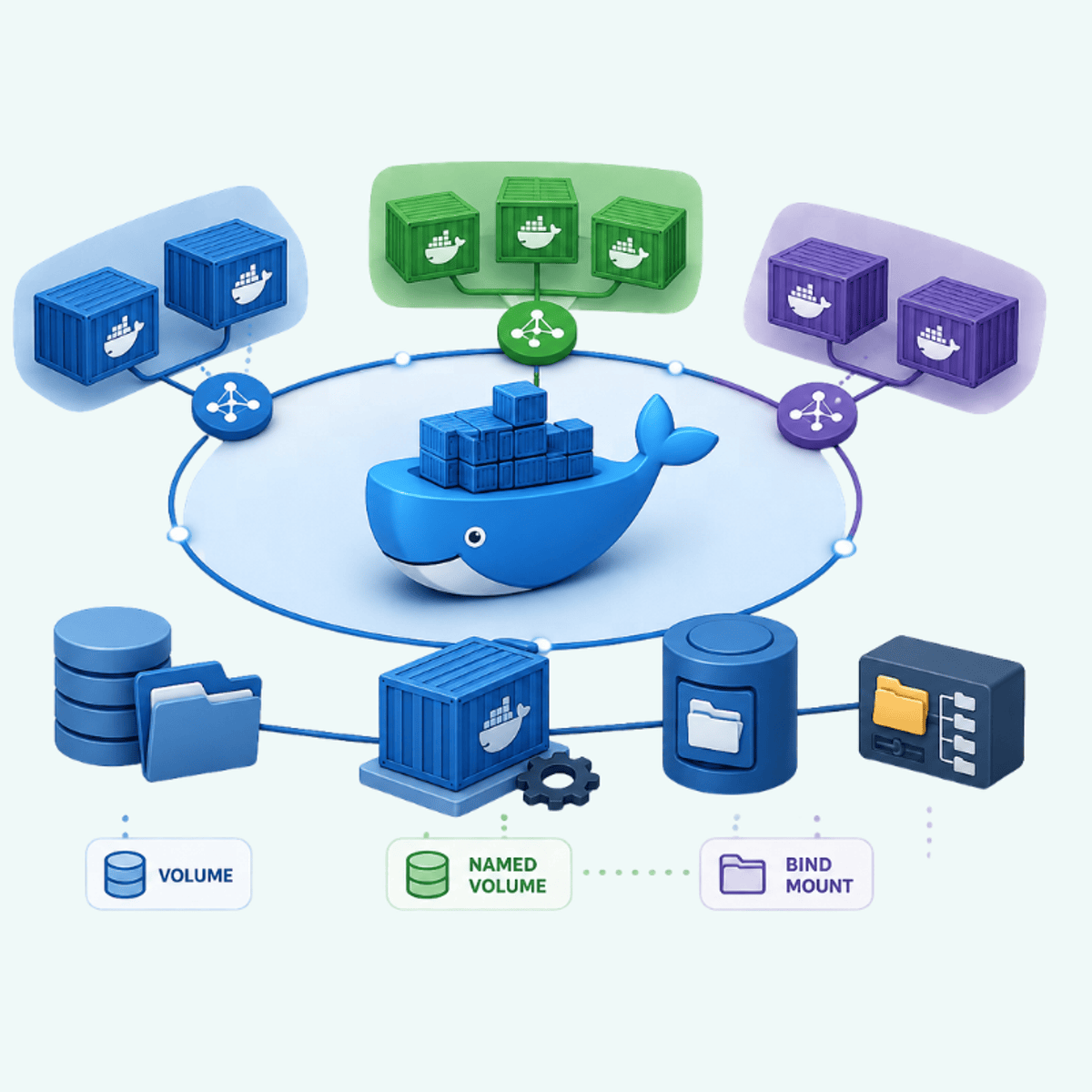
Docker Networking and Storage
Run reliable containerized applications through this practical course built around 10 real-world demos covering Docker networking and storage, from container communication and network isolation to persistent data, backup, and migration. Built around the Docker Certified Associate (DCA) exam objectives, this course develops the skills needed for real-world Docker operations and certification readiness. Designed for developers, DevOps learners, cloud professionals, IT students, career switchers, and those preparing for the DCA exam, this course helps you understand how containers communicate and operate in realistic DevOps environments. In this course, you'll explore Docker networking concepts, network namespaces, the Docker bridge network, DNS and service discovery, Docker network drivers, overlay networking, Docker storage, Docker volumes, bind mounts, the Overlay2 storage driver, and volume lifecycle management. By the end, you'll be able to configure Docker networking, connect containers, troubleshoot connectivity issues, persist application data, and protect container workloads with backup and migration workflows. Enroll now to build reliable networking & storage skills.

Applied Mathematical Methods for Computing
Mathematics underpins every aspect of computing, from algorithms and artificial intelligence to data analysis and cryptography. Applied Mathematical Methods for Computing equips you with essential tools in algebra, vectors, matrices, sequences, series, combinatorics, probability, and statistics. These methods provide the structure and reasoning needed to solve complex computational problems. Across four modules, you’ll explore advanced techniques, practise solving real-world examples, and build the confidence to apply mathematics in programming, algorithms, and data science. By the end, you’ll have a comprehensive toolkit for modelling systems, analysing uncertainty, and reasoning rigorously about computational tasks. Whether you’re preparing for advanced studies in computer science or strengthening your foundations for professional roles, this course offers the mathematical depth you need to succeed.

Introduction to DeepSeek
Did you know that a single AI model release wiped out over $1 trillion in global market value in just one day? As per Reuters, the launch of DeepSeek's R1 model in January 2025 triggered the largest tech selloff in history, with Nvidia alone losing $600 billion. This Chinese startup achieved something that shocked Silicon Valley: they built an AI model rivaling OpenAI's best at a small fraction of the cost and in a fraction of the time. Welcome to the world of DeepSeek, where open-source innovation meets high performance. This beginner-friendly course will take you from a curious observer to a confident user. We’ll walk through the basics, explain how the Mixture-of-Experts architecture works, and show you how to use DeepSeek tools in your projects. You'll discover exactly how DeepSeek's reasoning models outperform industry-leading AI systems on mathematical tasks while costing 95% less to run. We'll walk you through three different ways to access these models: the free web interface, API integration, and running them locally on your hardware. This course is designed for a diverse group of learners, including developers and AI enthusiasts who are curious about open-source alternatives to proprietary models. It’s equally valuable for data scientists exploring cost-effective reasoning models for R&D, as well as business professionals seeking to leverage AI for automation and content generation. Students and researchers with a passion for cutting-edge AI architectures will also benefit from the hands-on insights provided throughout the course. While this course is beginner-friendly, a basic understanding of artificial intelligence and machine learning concepts will help learners grasp core ideas more quickly. Familiarity with APIs and web-based tools is recommended, as the course covers accessing DeepSeek models through different interfaces. Some exposure to command-line tools is helpful—especially for those opting for local deployment—but is not strictly required. By the end of this course, learners will be able to critically analyze the architecture and capabilities of DeepSeek models like V3 and R1 and how they stack up against proprietary offerings. They’ll gain the skills to implement DeepSeek in practical scenarios using web tools, APIs, and local environments. Learners will also explore real-world use cases—from content generation to automation—and apply strategies for cost-effective integration while accounting for limitations and best practices in deployment.
Cómputo evolutivo
La computación evolutiva (evolutionary computation, EC), aplica la teoría de la evolución natural y la genética en la adaptación evolutiva de estructuras computacionales, proporcionando un medio alternativo para atacar problemas complejos en diversas áreas, como la ingeniería, economía, química, medicina y, porque no, las artes. Una población de posibles soluciones de un problema dado es análoga a una población de organismos vivos que evolucionan cada generación, al recombinar los mejores individuos de la población y transmitir sus características de dichos individuos padres, a sus descendientes. En este campo, diferentes esquemas de métodos evolutivos se han desarrollado, los cuales difieren en el tipo de estructuras que conforman la población. Algoritmos evolutivos (AE), como también se le conoce al cómputo evolutivo (EC), se definen como métodos de optimización y búsqueda, los cuales están inspirados y tratan de imitar de manera parcial los procesos de la evolución natural, y mantienen una población de estructuras que evolucionan de acuerdo a reglas de selección y otros operadores genéticos, como cruzamiento y mutación (Bäck, 1996). Los algoritmos evolutivos no son los únicos métodos de optimización propuestos a partir de sistemas biológicos. Se tiene una variedad de algoritmos de optimización, que tratan de imitar el comportamiento de sistemas naturales, como las colonias de hormigas, algoritmos culturales y optimización por cúmulos de partículas, entre otros. De aquí surge lo que se conoce como algoritmos bioinspirados, ya que toman sus bases a partir de la estructura de procesos y sistemas biológicos: la evolución, la selección natural, comportamiento social de animales, como las hormigas, abejas, peces. BÄCK, T. (1996) Evolutionary Algorithms in Theory and Practice. Oxford University Press. DARWIN, C. (1859) On the Origin of Species by Means of Natural Selection, or the Preservation of Favoured Races in the Struggle for Life, John Murray.

Python Programming Essentials
This course will introduce you to the wonderful world of Python programming! We'll learn about the essential elements of programming and how to construct basic Python programs. We will cover expressions, variables, functions, logic, and conditionals, which are foundational concepts in computer programming. We will also teach you how to use Python modules, which enable you to benefit from the vast array of functionality that is already a part of the Python language. These concepts and skills will help you to begin to think like a computer programmer and to understand how to go about writing Python programs. By the end of the course, you will be able to write short Python programs that are able to accomplish real, practical tasks. This course is the foundation for building expertise in Python programming. As the first course in a specialization, it provides the necessary building blocks for you to succeed at learning to write more complex Python programs. This course uses Python 3. While many Python programs continue to use Python 2, Python 3 is the future of the Python programming language. This first course will use a Python 3 version of the CodeSkulptor development environment, which is specifically designed to help beginning programmers learn quickly. CodeSkulptor runs within any modern web browser and does not require you to install any software, allowing you to start writing and running small programs immediately. In the later courses in this specialization, we will help you to move to more sophisticated desktop development environments.

Essential Guide to LLMOps
Large Language Models have transformed modern AI workflows, and this course provides the essential strategies needed to operate them effectively in production. You will explore the core principles of LLMOps, understanding why reliable deployment, monitoring, and continuous improvement are critical in today’s AI-driven landscape. Through practical explanations and hands-on guidance, the course helps you build confidence in optimizing LLM performance, managing model lifecycles, and applying scalable operational techniques. By learning how to streamline workflows and apply governance best practices, you will gain the skills needed to deliver consistent, secure, and high-quality AI outcomes. The content blends foundational theory with real-world practices, offering a balanced view of both the technical and operational challenges in modern LLM systems. Concepts are reinforced through practical frameworks and actionable strategies to ensure meaningful application in professional environments. This course is ideal for machine learning engineers, data science practitioners, AI leaders, and technical professionals aiming to enhance their expertise in deploying and managing LLMs. Foundational knowledge of machine learning is recommended to maximize learning outcomes.
Introduction to Generative AI: Concepts and Techniques
This four-module course gives you a clear, practical foundation in Generative AI from what it is and where it’s used, to how modern models work and how to apply them responsibly. You’ll start with the big picture: GenAI capabilities across text, image, audio, and video, plus real-world industry applications. Then you’ll dive into the science behind today’s Large Language Models: text representation (tokenization, embeddings), and the Transformer architecture (positional encoding, self-attention, encoder/decoder flow). Next, you’ll get hands-on with LLMs and workflows: crafting effective prompts, calling models via web/UI and APIs, running models locally (e.g., via Ollama), and extending capabilities with Retrieval-Augmented Generation (RAG) and fine-tuning. Finally, you’ll examine challenges and responsible practice, including copyright, privacy and security, explainability, and questions of ownership in the GenAI era. Designed for learners with basic Machine Learning and Python familiarity, the course blends short lessons with labs, quizzes, and exercises. By the end, you’ll understand the core concepts and architectures behind GenAI with a strong sense in ethical and responsible use and GenAI limitations. By the end of this course, learners will be able to: Explain how generative AI spans text, image, audio, and video and assess real industry workflows where it creates value. Trace the evolution of language modeling from probabilistic/NLP approaches to Transformers, and justify why attention overcomes prior limitations. Understand tokenization and word embeddings, and reason about how these representations affect model behavior. Decompose a Transformer block and follow tensors, through self-attention, MLPs, and normalization to explain how representations are formed and refined. Operate LLMs via web UIs, APIs, and locally with Ollama to write minimal inference code and improve outputs using prompt patterns and get familiar with concepts of RAG and Fine-Tuning as possible next steps. Identify, analyze, and explain LLMs shortcomings such as bias, hallucination, ownership, and prompt injection by formulating user-level guidelines, organizational processes, and governance policies.

Test, Learn, Evolve: Usability Testing in Figma
In this course, learners will elevate their UX design skills by immersing themselves in comprehensive usability testing methodologies using Figma as their primary design and testing platform. They will learn how to plan effective usability tests, conduct user sessions with Figma prototypes, and systematically gather valuable user feedback to identify areas for improvement. Throughout the course, learners will develop skills in test facilitation, data collection, and translating user insights into actionable design improvements using Figma's collaborative features. By the end of this course, learners will be able to: - Plan and design comprehensive usability testing strategies using Figma prototypes - Conduct effective usability test sessions and facilitate user feedback collection - Analyze usability test results and identify patterns in user behavior and pain points - Iterate on designs based on data-driven insights and user feedback

Advanced Branding in Canva
Advanced Branding in Canva equips learners with the skills to design and manage sophisticated brand identity systems that go far beyond logos. This course focuses on building flexible, scalable brand systems that establish strong recognition and consistency across diverse applications. Participants will learn to create extended color palettes, responsive logos, pattern libraries, and comprehensive typography systems that form the foundation of a distinct brand voice. Beyond creation, the course emphasizes implementation and governance, teaching learners how to design professional brand guidelines and asset management systems that ensure consistency across platforms, teams, and campaigns. Through guided lessons, screencasts, and applied projects, learners will practice developing multi-component brand identities, constructing visual languages through typography, and managing brand elements at a professional level. The final deliverable is a complete brand style guide and governance system designed for real-world application.

Introduction to Programming with MATLAB
This course teaches computer programming to those with little to no previous experience. It uses the programming system and language called MATLAB to do so because it is easy to learn, versatile and very useful for engineers and other professionals. MATLAB is a special-purpose language that is an excellent choice for writing moderate-size programs that solve problems involving the manipulation of numbers. The design of the language makes it possible to write a powerful program in a few lines. The problems may be relatively complex, while the MATLAB programs that solve them are relatively simple: relative, that is, to the equivalent program written in a general-purpose language, such as C++ or Java. As a result, MATLAB is being used in a wide variety of domains from the natural sciences, through all disciplines of engineering, to finance, and beyond, and it is heavily used in industry. Hence, a solid background in MATLAB is an indispensable skill in today’s job market. Nevertheless, this course is not a MATLAB tutorial. It is an introductory programming course that uses MATLAB to illustrate general concepts in computer science and programming. Students who successfully complete this course will become familiar with general concepts in computer science, gain an understanding of the general concepts of programming, and obtain a solid foundation in the use of MATLAB. Students taking the course will get a MATLAB Online license free of charge for the duration of the course. The students are encouraged to consult the eBook that this course is based on. More information about these resources can be found on the Resources menu on the right.

Productividad Empresarial con IA: ChatGPT
La era digital ha cambiado la forma en que las personas interactúan con la información y el conocimiento. Cada vez es más común tener fácil acceso a los grandes bancos de información, lo que ha aumentado la demanda de herramientas y tecnologías que permitan una búsqueda y acceso más eficiente a la información. En este contexto, el conocimiento básico sobre ChatGPT se ha vuelto fundamental para muchas personas, ya que se trata de una tecnología avanzada de lenguaje que permite a los usuarios interactuar con la información de manera más natural y eficiente. ChatGPT es un modelo de lenguaje desarrollado por OpenAI que ha sido entrenado con millones de documentos y páginas web para responder preguntas y brindar información en tiempo real. Esta tecnología permite a los usuarios obtener información y conocimiento de manera más rápida y precisa que la búsqueda manual en línea. Además, ChatGPT también puede ser utilizado para realizar tareas como la generación de texto, la traducción de idiomas, el análisis de textos propios y en general la resolución de problemas. Tener conocimientos básicos sobre ChatGPT es es crucial en la era digital, ya que permite a los usuarios interactuar de manera más eficiente con la información en general. Esto es especialmente importante para aquellos que dependen de volúmenes importantes de información para su trabajo o para tomar decisiones importantes en su vida diaria. Por lo tanto, es importante que aprendas a utilizar esta herramienta y sacarle el máximo provecho para mejorar la productividad empresarial y este curso te ofrece lo necesario para poder tener los conocimientos necesarios para poder mejorar la eficiencia y efectividad en varios procesos en la vida laboral diaria gracias al ChatGPT.

العمل مع المكونات في تطبيق فيغما
في هذه الدورة التدريبية القائمة على المشروع والتي تستغرق ساعة واحدة، ستتعلم كيفية العمل مع المكونات في فيغما. ستكتسب أيضا خبرة عملية كيفية تجاوز المكون وإنشاء خيارات متعددة. في نهاية هذه الدورة، ستكون قادراً على العمل مع المكونات في فيغما بطريقة فعالة.

Lodash Essentials 2026 - Practical Utility Library Guide
This course features Coursera Coach! A smarter way to learn with interactive, real-time conversations that help you test your knowledge, challenge assumptions, and deepen your understanding as you progress through the course. This comprehensive course on Lodash Essentials 2026—Practical Utility Library Guide will provide you with the tools to simplify JavaScript development using Lodash. By the end, you'll master key Lodash methods and advanced functions that optimize code efficiency and performance. You will work with arrays, objects, strings, and even custom methods, making your code cleaner and easier to maintain. The course is divided into practical modules, each focusing on a specific Lodash functionality. You'll start with basic installation and basic methods before advancing to complex transformations like filtering, sorting, and grouping data. You will also be challenged with hands-on DIY projects that mimic real-world scenarios, solidifying your understanding of Lodash in practice. This course is ideal for developers who want to optimize their JavaScript code using Lodash, from beginners to advanced learners. By the end of the course, you'll be capable of implementing Lodash utilities in real-world projects.

Agentic AI Systems with Vector DBs & RAG
Want to build AI that learns, adapts, and evolves in real-time? The future of AI is Agentic AI. While traditional models are built on static logic, Agentic AI enables systems to learn, think, and make autonomous decisions, evolving with each interaction and adapting to new data. In this Agentic AI course, you’ll master RAG (Retrieval-Augmented Generation) and vector databases like pgVector and ChromaDB, unlocking the ability to build AI systems that dynamically retrieve data, learn from context, and make smarter decisions. You’ll gain hands-on experience creating scalable, real-time adaptive AI—critical for industries looking to stay ahead. What makes this course unique? Unlike others, it combines cutting-edge RAG tools with practical applications of pgVector and ChromaDB, giving you the power to create AI that evolves with every interaction. Perfect for AI developers, engineers, and innovators eager to shape the future of AI. Don’t just follow trends—lead them. Enroll now and start building the future of AI today!

Databricks Data Engineer Associate: Practical Guide
This course covers all essential Databricks concepts for aspiring data engineers, including Apache Spark fundamentals, Delta Lake, performance optimization, and data pipeline creation. With real-world demonstrations, you will gain practical experience in deploying and orchestrating data engineering workflows. This course is designed to equip you with the skills needed to become a certified Databricks Data Engineer Associate. Starting with an introduction to Databricks, you will explore its role in modern data engineering and its integration with Apache Spark. From understanding basic data processing operations to building powerful data pipelines, you’ll gain hands-on experience in Spark architecture and execution, Delta Lake for data management, and the use of Databricks’ advanced features like Unity Catalog for governance and Delta Live Tables for orchestration. You’ll dive deep into Spark fundamentals, learning about data transformations, actions, and lazy evaluation, followed by the performance optimization techniques essential for data-heavy applications. The course also covers crucial data warehousing concepts like OLAP and OLTP, along with Delta Lake’s ACID transactions and time travel for data management. Through practical demonstrations, you will learn how to sign up for Databricks, create and manage notebooks, ingest and transform data, and optimize performance using partitions and parallelism. The course culminates in a comprehensive capstone project that ties everything together, giving you the experience and knowledge to pass the Databricks Certified Data Engineer Associate exam and excel in data engineering tasks. This course is designed for aspiring data engineers, data scientists, and IT professionals who wish to build a strong foundation in Databricks and Apache Spark. It's ideal for individuals looking to gain hands-on experience in data engineering workflows, Spark execution, performance optimization, and Delta Lake for managing large-scale data. Familiarity with data engineering concepts or programming basics will be helpful, but the course is suitable for both beginners and those seeking certification. The course follows a project-based approach, where you work through practical demonstrations and real-world scenarios. Each section introduces essential concepts followed by hands-on tutorials to reinforce learning. By the end, you will have mastered the skills necessary to build and optimize data pipelines and perform key tasks required for the Databricks Certified Data Engineer Associate exam. This course is based on Databricks Certified Data Engineer Associate - Practical Guide, by Yogesh Raheja, Thinknyx Technologies. This course is licensed and distributed by Packt. All rights reserved. Packt is one of the world's most prolific publishers of cutting-edge technical content. For over two decades we've made it our mission to curate and publish the knowledge of only the very best technical experts. We focus on real-world courses that help our customers get the job done, with coverage that extends across a wide range of established and cutting-edge technical topics. If you're an individual or an organisation that embraces learning by doing, Packt is the perfect fit for you.

XHTML - Beginners
Apply and Validate XHTML Structure Using Editors and Browsers is a beginner-friendly course that introduces the fundamentals of HTML and XHTML while developing practical skills for creating, testing, and validating standards-compliant web pages. You will learn how to identify the structure and semantic elements of HTML documents, build XHTML pages using correct syntax and formatting conventions, and evaluate document validity through recognized validation practices. As you progress, you will explore practical development tools, including Notepad++ for writing clean XHTML code and Firefox developer tools for inspecting, testing, and verifying XHTML output. Through hands-on activities, you will gain experience selecting appropriate development environments and using browser-based tools to analyze and improve your code. This course is designed for beginners, aspiring front-end developers, and content creators who want a solid foundation in XHTML and web markup. By the end of the course, you will be able to create well-structured XHTML documents, validate syntax for standards compliance, and confidently use editors and browser tools to test and refine your work. If you want to build a strong foundation in XHTML using practical workflows and recognized web standards, this course provides a clear, structured path to get started.

Continuous Delivery & DevOps
Amazon famously delivers new code every 11.6 seconds. Just a few years ago, this was unthinkable: many ‘cutting edge’ firms would release software quarterly. When it comes to digital innovation, velocity is critical and many would say it’s the most reliable determinant of success. Bringing an organization to the state of the art (or even functional capability) in this area requires strong work in a combination of disciplines and a combination of both technical and managerial skills. There is no single cookie-cutter approach for achieving this capability. Much like agile, the right focus and formulation depends a lot on the facts and circumstances of the team. This course, developed at the Darden School of Business at the University of Virginia and taught by top-ranked faculty, will provide you with the interdisciplinary skill set to cultivate a continuous deployment capability in your organization. After completing this course, you will be able to: 1. Diagnose a team’s delivery pipeline and bring forward prioritized recommendations to improve it 2. Explain the skill sets and roles involved in DevOps and how they contribute toward a continuous delivery capability 3. Review and deliver automation tests across the development stack 4. Explain the key jobs of system operations and how today’s leading techniques and tools apply to them 5. Explain how high-functioning teams use DevOps and related methods to reach a continuous delivery capability 6. Facilitate prioritized, iterative team progress on improving a delivery pipeline

Current Issues in Ethics and AI
Artificial intelligence, particularly with the introduction of generative AI, is fundamentally impacting a huge spectrum of human experience. This ranges from the vast majority of jobs and professions to education, healthcare, media and entertainment, and much more. These rapid advances have been accompanied by a huge array of fundamental and greatly impactful ethical challenges, including bias and inaccuracy in AI systems, where AI systems should and shouldn’t replace humans, and potential benefits and harms from various types of autonomous systems, and existential issues including the future of human work and the possibility of AI systems whose intelligence exceeds that of humans. This course provides students with a broad exposure to the ethical issues arising from AI, along with the experience and ethical tools to analyze them. It is intended to help students recognize and deal with these issues in their professional careers and their lives. It is based on a combination of current media articles and recent research papers, and is designed so that it can be kept current by refreshing the references it is based on. This course can be taken for academic credit as part of CU Boulder’s Masters of Science in Computer Science (MS-CS) and the Master of Science in Artificial Intelligence (MS-AI) degrees offered on the Coursera platform. This fully accredited graduate degree offer targeted courses, short 8-week sessions, and pay-as-you-go tuition. Admission is based on performance in three preliminary courses, not academic history. CU degrees on Coursera are ideal for recent graduates or working professionals. Learn more: MS in Computer Science: https://coursera.org/degrees/ms-computer-science-boulder MS in Artificial Intelligence: https://www.coursera.org/degrees/ms-artificial-intelligence-boulder

Data-Oriented C++ in Scientific Programming
Learn how to write efficient, maintainable C++ code for data-intensive applications in this hands-on course. Key application areas include scientific simulation software, statistical data processing, and computer graphics. You’ll begin by exploring how modern C++ supports high-efficiency programming and review the principles of a central piece of hardware in data-intensive applications: computer memory. Next, the course shifts to software design. You’ll examine performance shortcomings of traditional object-oriented programming and dive into data-oriented perspective, which improves performance by structuring code around the data itself. You’ll learn how this paradigm overcomes bottlenecks and leads to more scalable, high-performance solutions. Finally, you’ll apply these principles to modern multi-threaded systems. Through hands-on experience you will learn to use C++'s built-in parallel features to target both multi-core CPUs and GPUs.

Build an End-to-End Data Capture Pipeline using Document AI
This is a self-paced lab that takes place in the Google Cloud console. In this lab you use Cloud Functions and Pub/Sub to create an end-to-end document processing pipeline using Document AI. The Document AI API is a document understanding solution that takes unstructured data, such as documents and emails, and makes the data easier to understand, analyze, and consume. In this lab, you will create a document processing pipeline that will automatically process documents that are uploaded to Cloud Storage. The pipeline consists of a primary Cloud Function that processes new files that are uploaded to Cloud Storage using a Document AI form processor and then saves form data detected in those files to BigQuery. If the form data includes any address fields the address data is then written to a Pub/Sub topic that in turn triggers a second Cloud Function that uses to Geocoding API to provide geographic coordinate data for the address that is also written to BigQuery. This is a simple pipeline that uses a general form processor that will detect basic form data, such as a labelled field containing address information. Document AI processors that use one of the specialized parsers that are beyond the scope of this lab provide enhanced entity information for specific document types even when those documents do not include labelled fields. For example, a Document AI Invoice parser can provide detailed address and supplier information, from an unlabelled invoice document because it understands the layout of invoices.

Introduction to Android Automotive for Infotainment Systems
Android Automotive OS is transforming how millions interact with their vehicles daily, with major automakers like GM, Ford, and Volvo adopting this platform. This Short Course was created to help Software Development professionals accomplish building production-ready infotainment applications that meet automotive safety standards. By completing this course, you'll be able to architect AAOS apps that integrate seamlessly with vehicle systems while ensuring driver safety compliance. By the end of this course, you will be able to: Understand Android Automotive system architecture to describe the roles of System UI, car services, and Vehicle HAL in infotainment stacks, Apply Car App Library templates to integrate a media playbook app that conforms to driver-distraction guidelines, and Apply emulator or device deployment steps to install and test an AAOS application using appropriate manifest and permission settings. This course is unique because it provides hands-on experience with real Vehicle HAL integration and teaches both GAS and non-GAS implementation approaches across multiple OEM platforms. To be successful in this project, you should have a background in Android development and familiarity with Android Studio.

Tailwind CSS Practice Project: Build a Product Card
Welcome to this exciting new course on Tailwind CSS! This course introduces some intermediate Tailwind concepts that are perfect for rapidly building and styling websites in the real world. If you’re new to Tailwind, head to our Learn Tailwind course here on Coursera for a quick intro. Throughout this course, we’ll build on these concepts, taking you from the basics to more advanced features, and dive into even more amazing things that Tailwind can do. We’ll use Tailwind to build a web store product card for our client using professional mockups—one for desktop and one for mobile. By the end, you'll have discovered intermediate and advanced styling techniques using Tailwind CSS and crafted a fully responsive, professional product card for a web store.
HTML5: Content Authoring Fundamentals
In the current age, using the Internet has become essential to communication and gaining access to information, much like the telephone and newspapers were to earlier generations. Familiarity with the Internet comes with a certain level of expectation regarding the attractiveness and ease of use of web pages. Web designers need to create effective and successful websites. If users find your website difficult to navigate, they may not visit it again. HTML5 and CSS3 are some of the most integral and evolving web technologies that enable you to structure content and present it on the web. Knowledge of these languages will help you create web pages that are easy to read and appealing to users. This course lays the foundation for mastering these two popular web publishing technologies. This course is designed as an introduction to HTML and CSS for those who want to learn to develop standards-compliant web content, with a focus on current HTML5 and CSS3 standards. This course can be taught on Microsoft® Windows®, Apple® Mac OS® X, or Linux®, and supports developers who work in any of those environments. In this course you will: author content in HTML, embed and link content, format content with CSS, author complex content structures, and test and publish HTML content. This course requires that you have access to several different web browsers, including Google Chrome and Mozilla Firefox, and a text editor with line numbering and syntax coloring. The course setup instructions provided in the first module of the course go into more detail about the hardware and software requirements.

Infrastructure d'IA : types de déploiements
Ce cours constitue un guide complet pour déployer, gérer et optimiser des charges de travail d'IA et de calcul hautes performances (HPC) sur Google Cloud. À travers une série de leçons et de démonstrations pratiques, vous explorerez diverses stratégies de déploiement, allant d'environnements hautement personnalisables utilisant Google Compute Engine (GCE) à des solutions gérées comme Google Kubernetes Engine (GKE). Plus précisément, vous apprendrez à créer des clusters et à déployer GKE pour l'inférence.