Cursos de Datos e IA
Los mismos datos para todos, vengan de Udemy o de Coursera: precio, valoración, duración e idioma. 470 cursos encontrados. Afinar la búsqueda

Apply Dart Programming Fundamentals for Beginners
Learners will be able to explain core Dart programming concepts, apply correct syntax, use variables and operators effectively, and manage data using constants and lists. This course enables beginners to build a strong foundation in Dart programming through structured lessons, practical examples, and progressive skill development. The course is designed to guide learners step by step from basic programming concepts to writing logical Dart programs with confidence. Through clearly explained syntax rules, real-world code examples, and in-depth coverage of operators and data structures, learners gain hands-on experience that reinforces theoretical understanding. Each module builds logically on the previous one, ensuring smooth knowledge progression without overwhelming beginners. What makes this course unique is its beginner-focused approach, emphasis on practical understanding, and carefully sequenced content aligned with real programming workflows. Concepts are introduced incrementally, reinforced through examples, and validated through practice and graded assessments. By the end of the course, learners will be prepared to confidently continue into Flutter development or intermediate Dart programming topics, making this course an ideal starting point for aspiring developers.
Fundamentos de la visualización de datos con Tableau
En este curso descubrirás qué es la visualización de datos y cómo podemos usarla para ver y comprender mejor los datos. Con Tableau, examinaremos los conceptos fundamentales de visualización de datos y exploraremos la interfaz de Tableau, identificando y aplicando las diversas herramientas que Tableau tiene para ofrecer. Este curso está diseñado para el alumno que nunca ha usado antes Tableau, o que puede necesitar un repaso, o desea explorar Tableau con más profundidad. No se requieren antecedentes técnicos o analíticos previos. El curso te guiará a través de los pasos necesarios para crear tu primera visualización desde el principio en función del contexto de los datos.
Machine Learning with ChatGPT: Image Classification Model
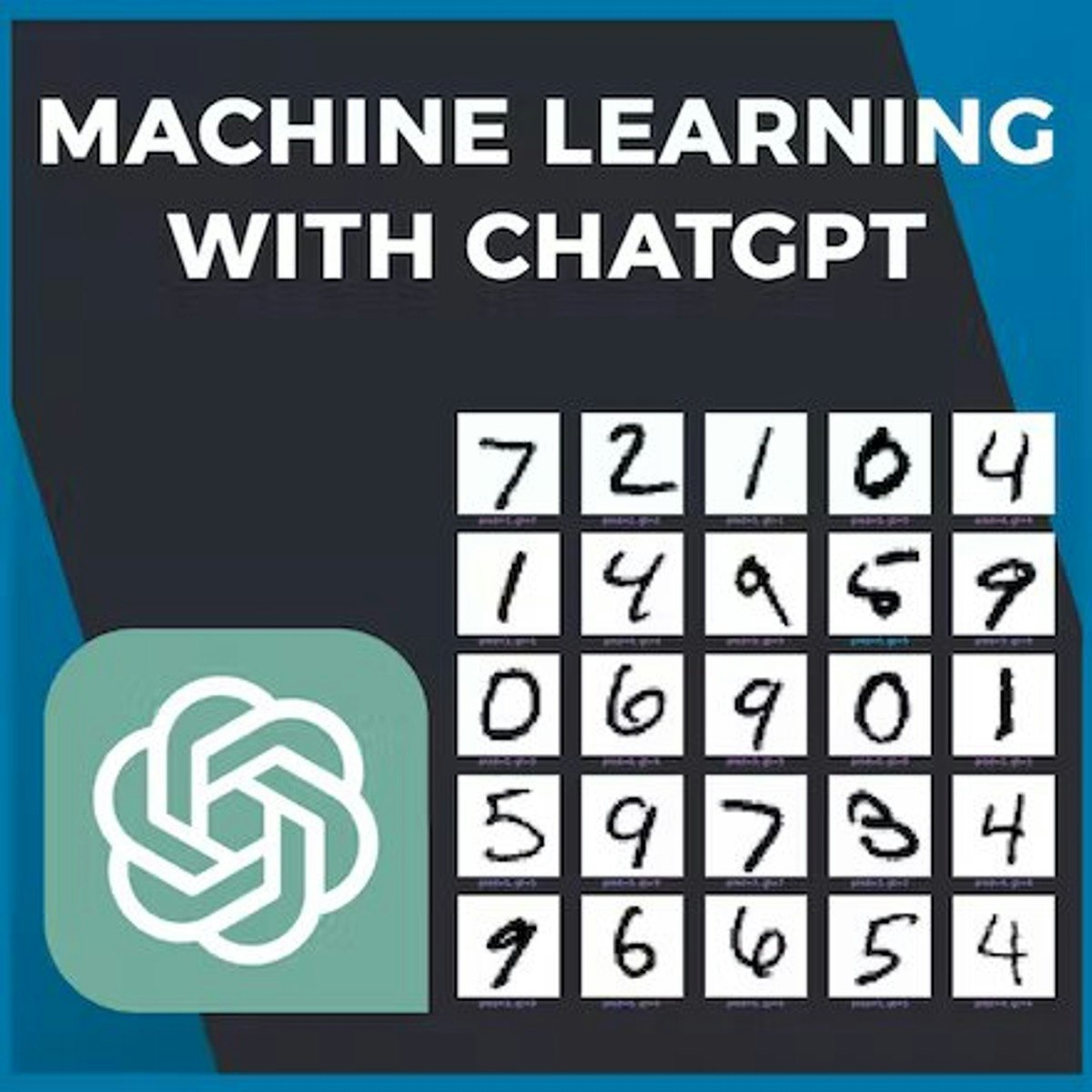
In this 1-hour project, you will learn how to build a machine learning model using ChatGPT. We will use the MNIST database which is a large database of handwritten digits that is commonly used for training various image processing systems. You will be introduced to the process of fine-tuning, which involves adjusting the model's parameters to learn task-specific relationships between input and output. You will import the necessary libraries and load the data, and then split the data into training and testing sets. You will then define the model architecture, compile the model, and train it on the training data. After training, you will evaluate the model's performance on the testing data and make any necessary adjustments. This course is aimed at learners who are looking to get started with ChatGPT and explore how it can be used for coding and Machine Learning tasks. Prerequisites include a Google account and basic coding and machine learning knowledge. By the end of this project, you will have a solid understanding of how to build a machine learning model using ChatGPT. This project will provide you with step-by-step guidance through instructor-led videos. Unlike some other projects on Coursera, this experience will not utilize a virtual machine. Instead, learners will complete the project on their own browser or device.

End to End LLMs with Azure
This comprehensive course equips you with skills to leverage Azure for building and deploying Large Language Model (LLM) applications. Learn to use Azure OpenAI Service for deploying LLMs, utilizing inference APIs, and integrating with Python. Explore architectural patterns like Retrieval-Augmented Generation (RAG) and Azure services like Azure Search for robust applications. Gain insights into streamlining deployments with GitHub Actions. Apply your knowledge by implementing RAG with Azure Search, creating GitHub Actions workflows, and deploying end-to-end LLM applications. Develop a deep understanding of Azure's ecosystem for LLM solutions, from model deployment to architectural patterns and deployment pipelines.
Evaluating LLM Performance and Efficiency
This comprehensive course is for product managers, ML engineers, and technical leads responsible for transforming LLM concepts into reliable, cost-effective production services. In today's AI-driven landscape, building a functional model is only the beginning. You will learn the complete framework for measuring, documenting, and optimizing LLM applications to ensure that they deliver real business value efficiently and consistently. The course begins by grounding you in product-centric development, teaching you to create a clear Product Requirements Document (PRD) that defines scope, MVP features, and success metrics. You'll evaluate features against acceptance criteria to identify gaps and validate user requirements. You will evaluate Zero-Shot, Few-Shot, and Chain-of-Thought prompt patterns and develop runbooks for vector index management. You will learn to analyze compute-spend reports to propose concrete cost-reduction strategies, such as model quantization, and use value-stream mapping to identify and eliminate inefficiencies in your development and release pipelines.

Microsoft Copilot for Excel: AI-Powered Data Analysis
This is a hands-on, project-based course designed to help you leverage Copilot in Microsoft Excel to solve real-world data analytics problems. We’ll start by reviewing Microsoft Copilot’s basic features and limitations, compare strengths and weaknesses against GenAI tools like ChatGPT, and get you up and running with Copilot for Microsoft 365 on your machine. From there, we’ll dive into each of Copilot’s core use cases for data management and analysis. You’ll practice adding new formula columns using natural language, applying conditional formatting rules to highlight key data points, and analyzing data to find insights using pivot tables and charts. Last but not least, we’ll showcase how to use Copilot’s generative AI engine for more advanced use cases, including writing dynamic array formulas and generating Python code within Excel. Throughout the course, you’ll play the role of an HR Admin at ACME Corporation, a global manufacturing company. Using the skills you learn throughout the course, you’ll manipulate employee data, monitor performance metrics, and make data-driven recommendations to your HR supervisor. If you're an Excel user looking to add Copilot to your data analytics workflow, this is the course for you!
Integración y preparación de datos
El manejo de datos que permita generar conocimiento útil para una organización es cada vez más importante en los trabajos de alta demanda al día de hoy. Es así como este curso presenta al estudiante una metodología para el desarrollo de proyectos basados en datos, en especial de ciencia de datos. Hace énfasis en los procesos de exploración, transformación, integración de fuentes de datos estructuradas y no estructuradas con el fin de mejorar la eficiencia y calidad en los resultados de análisis posteriores como los basados en modelos analíticos. El estudiante tendrá a su disposición diferentes tutoriales con ejemplos en contextos cercanos a la realidad para comprender mejor los conceptos desarrollados en el curso y practicar su aprendizaje con el punto de extensión propuesto en cada tutorial. De igual manera, contará con videos, lecturas ilustradas y sugerencias de lecturas para profundizar en los temas de interés. Consideramos que esto le permitirá al estudiante afianzar sus conocimientos llevando a la práctica lo aprendido.

AI-Driven Attribution Testing
Welcome to AI-Driven Attribution Testing course an engaging and comprehensive course designed to guide you through the fundamental concepts and practical applications of attribution testing powered by artificial intelligence. This course is most suitable for marketers, data analysts, data scientists, and business leaders who aim to leverage data-driven insights for decision-making. It's also beneficial for students and professionals with a keen interest in the convergence of AI, data analysis, and marketing. In Module 1: Attribution Testing - Fundamentals, we will introduce you to AI-Driven Attribution Testing, explaining its purpose and significance in today's data-driven world. The module will further equip you with a strong understanding of the fundamentals of Attribution Modeling, essential for anyone venturing into this field. Next, in Module 2: AI-Driven Attribution Testing - Implementation, you will apply your understanding to real-world scenarios, learning how to implement AI-Driven Attribution Testing effectively. You'll also explore best practices and case studies to solidify your learning. The course concludes with a glimpse into the future trends in attribution testing and an important discussion about ethical considerations in the field. By the end of this course, you'll have a thorough understanding of AI-Driven Attribution Testing, know how to implement it effectively and be familiar with ethical guidelines that govern this field. Your newly gained knowledge and skills in AI-Driven Attribution Testing can empower you to make data-informed decisions and bring considerable value to your organization or future career. Second-year undergraduates interested in engineering or science, along with high school students and professionals interested in programming. Disclaimer: This is an independent educational resource created by Board Infinity for informational and educational purposes only. This course is not affiliated with, endorsed by, sponsored by, or officially associated with any company, organization, or certification body unless explicitly stated. The content provided is based on industry knowledge and best practices but does not constitute official training material for any specific employer or certification program. All company names, trademarks, service marks, and logos referenced are the property of their respective owners and are used solely for educational identification and comparison purposes.
Microsoft SQL Server: Performance Tuning Essentials
Do you want your applications to run smoothly and efficiently, with lightning-fast database responses and minimal downtime? Well! You are in the right place to achieve this. Welcome to our comprehensive course on optimizing SQL Server performance, where you will discover the techniques to maintain efficiency and ensure smooth back-end operation for your applications. You will also learn to maximize database performance techniques and strategies to enhance query tuning, indexing strategies, and overall database optimization. This course is perfect for Database Administrators, IT Professionals, Data Analysts, and Technical Managers involved in SQL Server management and performance optimization. If you're responsible for ensuring the efficiency of database operations and looking to enhance your SQL Server performance skills, this course will provide you with essential tools and techniques. Having a basic understanding of SQL query language, SQL Server, and database management concepts is beneficial. This foundational knowledge will help you better understand the performance optimization strategies covered throughout the course. By the end of this course, you will be able to analyze and tune SQL queries, evaluate database indexing strategies, monitor SQL Server performance, troubleshoot common issues, and apply best practices for consistent and reliable database operations. These skills will enable you to enhance database efficiency, minimize downtime, and optimize system performance effectively.

Build and Execute MySQL, PostgreSQL, and SQLServer to Data Catalog Connectors
This is a self-paced lab that takes place in the Google Cloud console. In this lab you will explore existing datasets with Data Catalog and mine the table and column metadata for insights.

Generative AI: Tools, Techniques, and Applications
This course delves into the world of generative AI, covering essential models, prompt engineering, and practical uses across popular platforms. Learn how to harness generative AI tools for content creation, data analysis, business solutions, and organizational transformation. Through this course, learners will gain hands-on experience with leading platforms such as ChatGPT and Microsoft Copilot, mastering advanced prompting techniques and understanding how to integrate generative AI into various business, educational, and creative settings. You will develop the skills to use AI tools confidently while discovering their impact on modern workflows. What sets this course apart is its focus on actionable insights, blending foundational theory with real-world applications. Practical examples ensure learners are equipped to leverage AI for a wide range of use cases, from business process automation to creative content generation. This course is designed for professionals and aspiring leaders who want to stay ahead of the curve in the AI-driven landscape. A basic understanding of technology and business concepts will help you make the most of the course. This course is part two of a three-course Specialization designed to provide a comprehensive learning pathway in this subject area. While it delivers standalone value and practical skills, learners seeking a more integrated and in-depth progression may benefit from completing the full Specialization. From Artificial Intelligence All-in-One For Dummies Copyright © 2025 by John Wiley & Sons, Inc. All rights reserved, including rights for text and data mining and training of artificial technologies or similar technologies. Used by arrangement with John Wiley & Sons, Inc.

Deploying Deep Learning: Quantization, Serving, and Edge AI
"Production Deep Learning: Inference, Quantization & Edge Deployment is designed for ML engineers and developers who want to master the full deployment lifecycle — from compressing and quantizing models to serving them at scale using vLLM, Triton, ONNX, and Llama.cpp. Module 1 covers model compression fundamentals, including pruning, distillation, and INT8/INT4 quantization using AWQ and GPTQ, with a focus on the accuracy–latency tradeoff. Module 2 dives into high-throughput serving architectures, exploring vLLM's PagedAttention, NVIDIA Triton, TensorRT, and scaling inference across GPU clusters with autoscaling patterns. Module 3 focuses on CPU and edge deployment using ONNX Runtime, GGUF, and Llama.cpp, plus multimodal inference with CLIP and LLaVA on resource-constrained devices. Module 4 is a capstone project where you'll quantize a fine-tuned LLM, build a production API with vLLM, benchmark performance, and containerize your model with Docker for cloud and edge deployment. By the end of this course, you will: - Apply INT4/INT8 quantization techniques (AWQ, GPTQ, GGUF) to compress LLMs for production - Deploy high-throughput inference servers using vLLM, Triton, and ONNX Runtime - Run optimized models on GPU, CPU, and edge devices using Llama.cpp and TensorRT - Build, benchmark, and containerize an end-to-end production-ready inference API" Disclaimer: This is an independent educational resource created by Board Infinity for informational and educational purposes only. This course is not affiliated with, endorsed by, sponsored by, or officially associated with any company, organization, or certification body unless explicitly stated. The content provided is based on industry knowledge and best practices but does not constitute official training material for any specific employer or certification program. All company names, trademarks, service marks, and logos referenced are the property of their respective owners and are used solely for educational identification and comparison purposes.

Transfer Learning Foundations for AI Models
Transfer learning has transformed modern artificial intelligence by making it possible to build powerful AI solutions without training models from scratch. This course provides a practical introduction to machine learning, neural networks, transfer learning, and transformer architectures while helping you develop hands-on skills using Python and widely used data science libraries. You will begin by working with NumPy, Pandas, Matplotlib, and Seaborn to prepare, analyze, and visualize data for machine learning. You will then build and evaluate your first machine learning models before exploring how neural networks learn, how CNNs extract features, and how pretrained models can be adapted through transfer learning. The course concludes with transformer fundamentals, including self-attention, multi-head attention, encoder-decoder architectures, and the evolution of modern transformer families. You will also learn how to choose between transfer learning and training from scratch and select the right pretrained model for different AI applications. By the End of This Course, You Will Be Able To: - Apply Python and data science libraries to prepare and analyze machine learning data. - Build, train, and evaluate fundamental machine learning models. - Explain how neural networks and convolutional neural networks learn. - Apply transfer learning techniques to adapt pretrained models. - Select suitable pretrained models for different AI use cases. - Explain self-attention, multi-head attention, and transformer architectures. Designed for aspiring AI engineers, machine learning practitioners, software developers, data professionals, students, and technology enthusiasts, this course provides a practical foundation for understanding and applying transfer learning and pretrained AI models.

No-Code Machine Learning Using Amazon AWS SageMaker Canvas
This course features Coursera Coach! A smarter way to learn with interactive, real-time conversations that help you test your knowledge, challenge assumptions, and deepen your understanding as you progress through the course. In this course, you'll gain hands-on experience with AWS SageMaker Canvas, a powerful no-code tool for machine learning. You'll start by understanding the basics of machine learning and Amazon Web Services (AWS), laying a solid foundation for the rest of the course. As you progress, you'll explore how SageMaker Canvas simplifies building, training, and deploying machine learning models with no coding required. Throughout the course, you'll complete four projects that cover real-world applications such as banknote authentication, spam SMS detection, customer churn prediction, and wine quality prediction. These projects will guide you through adding training data, building models, making predictions, and validating accuracy. The hands-on experience will deepen your understanding and help you master SageMaker Canvas' interface and capabilities. By the end of the course, you'll be able to apply your skills to a variety of machine learning tasks using SageMaker Canvas. This course is ideal for individuals who are new to machine learning or those looking to streamline the process of building machine learning models without writing code.
Automate Auditable SAS EG Analytics
Research shows 80% of analytical projects is dedicated to data preparation, making efficient data structuring workflows critical for productivity. This Short Course was created to help Data Analysis professionals accomplish rapid development of reproducible SAS Enterprise Guide pipelines using visual tools and automation features. By completing this course, you'll be able to build Query Builder flows for filtering, joining, and aggregating data, implement parameterized prompts for standardized reruns, validate generated SAS code for accuracy, and structure projects with clear traceability—capabilities you can deploy to production tomorrow. By the end of this course, you will be able to: ● Use the Query Builder for filtering, sorting, and creating calculated columns ● Perform table joins, aggregations, and transpose operations for data reshaping ● Create prompts for user input and implement conditional execution logic to support standardized workflows ● Understand and validate generated SAS code, debug using the SAS log, and create repeatable analytical processes with governance controls This course is unique because it emphasizes the full analytical lifecycle from data manipulation through workflow automation to code validation, bridging point-and-click Query Builder operations with reproducible research principles and auditability requirements for regulated environments. To be successful in this project, you should have a background in data analysis fundamentals, basic SQL concepts, and analytical workflow design at CB2 intermediate-level expertise.
Build a Machine Learning Image Classifier with Python
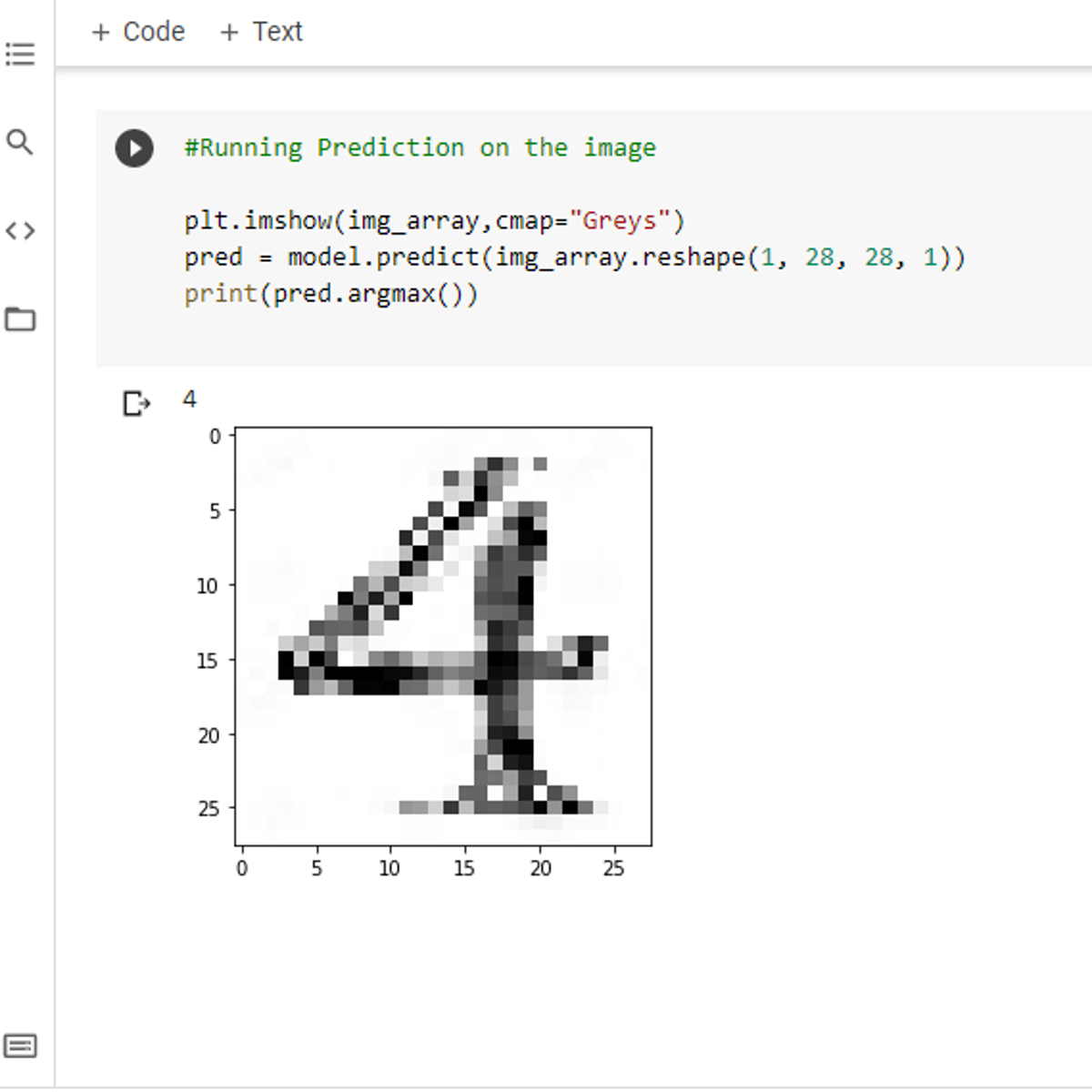
In this 1-hour long project-based course, you will learn how to build your own Machine Learning Image Classifier using Python and Colab. You will be able to easily load the data, preview it, process and normalize it, then train and test your model! I hope you enjoy the experience! Note: This course works best for learners who are based in the North America region. We’re currently working on providing the same experience in other regions.

Advanced Analytics with Power BI
Welcome to the Advanced Analytics with Power BI course, where you will get hands-on experience with Power BI’s advanced features for complete data analysis and visualization. Discover the power of data transformation and learn how to develop dynamic reports and dashboards that drive decision-making. This course covers industry-specific applications, guiding you through Power BI’s full capabilities so you can gain deeper insights and strengthen your analytical skills. By the end of this course, you will be able to: - Explain the different data sources in Power BI Desktop. - Demonstrate the use of Power Query Editor to clean and transform data. - Manipulate data using advanced DAX formulas and create impactful data stories with a variety of visualization techniques. - Apply Power BI Service features to elevate the quality, sharing, and collaboration of your reports and dashboards. - Create interactive and informative reports and dashboards on Power BI Service by leveraging its key tools. This course is designed for a diverse audience including freshers, data analysts, business analysts, business intelligence analysts, and IT professionals who want to enhance their Power BI and data analysis skills to support data-driven decision making. Prior experience with Microsoft Excel or spreadsheet applications can be beneficial, but all essential concepts are introduced in a clear, accessible way to support learners at every level. You will complete the course with practical expertise in building robust, visually engaging reports and dashboards using the Power BI ecosystem.

Building a Real-World Data Science Solution
Transform theoretical knowledge into practical expertise in this comprehensive project-based course designed for aspiring data professionals. Through an end-to-end project using synthetic customer support data (designed to mirror real-world scenarios) , you'll integrate advanced analytics, cloud computing, and AI-assisted development to solve authentic business challenges. Leveraging AWS services throughout the project, you'll work with S3 for data storage and management, utilize SageMaker for model development and deployment, and create automated data pipelines—gaining hands-on experience with industry-standard cloud tools. Upon completion, you'll be able to: • Design and implement end-to-end data science solutions • Build automated data pipelines with AWS integration • Create production-ready machine learning models • Develop interactive dashboards and reports • Generate comprehensive project documentation

Fundamentos de Inteligência Artificial para Finanças
Nossas boas-vindas ao Curso Fundamentos de Inteligência Artificial para Finanças. Neste curso, você aprenderá que a transformação digital em Finanças é a reorganização e a remodelagem das funções financeiras e contábeis, utilizando a tecnologia para recriar sistemas operacionais e processos eficientes, que inclui substituir ou não os sistemas tradicionais para todas as áreas do negócio. Podemos resumir como uma mudança de mentalidade que as empresas passam com o objetivo de se tornarem mais modernas e acompanharem os avanços tecnológicos que não param de surgir, como Internet das Coisas (IoT), computação em nuvem, Big Data, inteligência artificial e os robôs. Ao final deste curso, você será capaz de entender temas como Aprendizado de Máquinas, Aprendizado Profundo e Inteligência Artificial. Este curso é composto por quatro módulos, disponibilizados em semanas de aprendizagem. Cada módulo é composto por vídeos, leituras e testes de verificação de aprendizagem. Ao final de cada módulo, temos uma avaliação de verificação dos conhecimentos. Estamos muito felizes com sua presença neste curso e esperamos que você tire o máximo de proveito dos conceitos aqui apresentados.

Understanding China, 1700-2000: A Data Analytic Approach, Part 2
The purpose of this course is to summarize new directions in Chinese history and social science produced by the creation and analysis of big historical datasets based on newly opened Chinese archival holdings, and to organize this knowledge in a framework that encourages learning about China in comparative perspective. Our course demonstrates how a new scholarship of discovery is redefining what is singular about modern China and modern Chinese history. Current understandings of human history and social theory are based largely on Western experience or on non-Western experience seen through a Western lens. This course offers alternative perspectives derived from Chinese experience over the last three centuries. We present specific case studies of this new scholarship of discovery divided into two stand-alone parts, which means that students can take any part without prior or subsequent attendance of the other part. Part 1 (https://www.coursera.org/learn/understanding-china-history-part-1) focuses on comparative inequality and opportunity and addresses two related questions ‘Who rises to the top?’ and ‘Who gets what?’. Part 2 (this course) turns to an arguably even more important question ‘Who are we?’ as seen through the framework of comparative population behavior - mortality, marriage, and reproduction – and their interaction with economic conditions and human values. We do so because mortality and reproduction are fundamental and universal, because they differ historically just as radically between China and the West as patterns of inequality and opportunity, and because these differences demonstrate the mutability of human behavior and values. Course Overview video: https://youtu.be/dzUPRyJ4ETk

Relational Database Design and Advanced Querying
Develop expertise in relational database design principles and implementation using SQL Server. This course teaches normalization techniques, entity-relationship modeling, and schema optimization to create efficient database structures. You'll use DDL (Data Definition Language) statements to build and modify database objects while enforcing data integrity through constraints. The advanced querying section covers complex joins, subqueries, CTEs, and aggregate functions that enable sophisticated data analysis. You'll also explore data warehousing concepts and learn to leverage GenAI to assist with complex query development from natural language descriptions. By the end of this course, you'll be able to design normalized databases from scratch and write advanced queries that extract meaningful insights from complex data structures.

Agentic AI Content for Practitioners (Teams: Data)
Agentic AI Content for Practitioners (Teams: Data) is an intermediate-level course designed to equip data professionals, software engineers, and business analysts with the knowledge and skills to design, implement, and optimize AI agents for intelligent data automation. As organizations transition from experimental AI deployments to enterprise-scale implementations, this course provides the practical expertise needed to build reliable, scalable agent systems that deliver measurable business value. Through hands-on labs, real-world case studies, and interactive projects, you'll learn to transform manual data operations into intelligent, adaptive systems. The course covers everything from agent architecture fundamentals to advanced optimization strategies, preparing you to lead AI agent initiatives in your organization. You'll explore popular frameworks, design patterns, and deployment strategies while addressing critical considerations like error handling, scalability, and enterprise integration. Whether you're automating data quality monitoring, building predictive analytics systems, or creating intelligent customer service agents, this course provides the foundation you need to succeed in the rapidly evolving landscape of AI-powered data automation.

H2O ai Large Language Models (LLMs) - Level 1
Begin your exploration of Large Language Models (LLMs) with our foundational Level 1 course! Tailored for both beginners and those with some machine learning experience, this course provides a deep understanding of essential concepts and techniques in language modeling. Led by Andreea Turcu, H2O ai's expert in AI education, you will start by learning what a language model is and its crucial role in natural language understanding. We'll explore the evolution of these models and delve into the techniques used to develop and refine them. The course also highlights real-world applications across industries, demonstrating the transformative power of LLMs. You will also gain a strong foundation in neural networks and deep learning, essential for mastering advanced AI techniques. A significant portion of the course focuses on transformer architecture, the backbone of modern LLMs, and compares it with other architectures to highlight key innovations. We'll guide you through the methodologies of pre-training and fine-tuning LLMs, emphasizing transfer learning and domain-specific adaptation. By the end of the course, you'll have the skills to create and apply language models effectively, making you a strong candidate for roles in natural language processing, machine learning, and data science. Come aboard our dynamic course, where you'll dive into practical applications of language models and supercharge your AI career!

Track Marketing Goals with Google Analytics
Google Analytics is essential for understanding website performance and driving marketing success. This course teaches you to track campaigns, measure conversions, and demonstrate ROI using Google’s analytics tools. You will learn to navigate reports, set up goal tracking, analyze traffic sources, and apply segmentation to understand user behavior. Through hands-on practice, you will create SMART marketing goals, interpret dashboards, integrate Google Ads data, and export actionable insights. These skills help marketers move from data-curious to data-confident, enabling smarter decisions and optimized campaigns. By course completion, you will build systematic reporting workflows, understand metrics versus dimensions, and confidently answer key questions: Which channels drive conversions? Are campaigns meeting goals? Where should investments go next? Google Analytics expertise is a must-have for marketers across industries.

Analyze Supply Chain Demand Trends Using Heatmaps & Clusters
Learners will be able to analyze supply chain demand trends, interpret heatmap visualizations, apply data preparation techniques, and evaluate clustering methods to uncover meaningful demand patterns. By the end of this course, learners will confidently explore demand data, compare visualization approaches, and derive actionable insights to support data-driven supply chain decisions. This course is designed to help learners build practical machine learning–oriented analytical skills specifically for supply chain demand analysis. Learners will progress from understanding foundational supply chain concepts to applying advanced visualization and clustering techniques using heatmaps. Through step-by-step demonstrations, learners will learn how to prepare datasets, validate function inputs, discretize continuous data, and interpret multiple visual outputs effectively. What makes this course unique is its strong focus on visual analytics as a decision-support tool in supply chain management. Rather than emphasizing theory alone, the course demonstrates how real-world demand trends can be explored and compared using multiple analytical perspectives. This hands-on, visualization-driven approach enables learners to bridge the gap between raw data and strategic insight, making the course especially valuable for aspiring data analysts, supply chain professionals, and machine learning practitioners seeking applied, job-relevant skills.

PySpark: Apply & Analyze Advanced Data Processing
Take your PySpark skills to the next level by learning advanced data processing techniques for real-world analytics and scalable data workflows. In this course, you will apply the Python API for Apache Spark to solve practical data challenges in customer analytics, text extraction, and simulation modeling. Designed for learners with foundational Python and PySpark knowledge, this course guides you through implementing RFM (Recency, Frequency, Monetary) analysis and K-Means clustering for customer segmentation, extracting and preprocessing text from images and PDFs using Optical Character Recognition (OCR) and PySpark DataFrames, and constructing Monte Carlo simulations to model probability and uncertainty. Through hands-on exercises, real-time demonstrations, and practical quizzes, you will strengthen both your technical skills and conceptual understanding while working with advanced PySpark workflows. By the end of the course, you will be able to apply scalable data processing techniques for business intelligence, analytics, text mining, and probabilistic modeling using PySpark. Whether you are a data professional looking to expand your PySpark expertise or seeking practical experience with advanced analytics techniques, this course provides focused, application-driven learning using real-world scenarios.

Foundations of Data Analysis with Pandas and Python
Embark on a comprehensive journey into data analysis with Python and Pandas. Learn to set up Anaconda and Jupyter Lab on macOS and Windows, navigate Jupyter Lab's interface, and execute code cells. - You'll start by mastering essential Python programming concepts, including data types, operators, variables, functions, and classes. - Then, dive into Pandas to create and manipulate Series and DataFrames. The course covers data importing from sources like CSV, Excel, and SQL databases, along with techniques for sorting, filtering, and data extraction. - Advanced analysis methods, including group-by operations, merging, joining datasets, and pivot tables, are also explored to equip you with the skills for efficient and sophisticated data analysis. Ideal for aspiring data analysts and scientists, no prior programming knowledge is necessary with the included Python crash course.
Réseaux neuronaux et Deep Learning
Vous souhaitez vous lancer dans l’IA de pointe ? Ce cours est là pour vous y aider. Les ingénieurs en Deep Learning sont très convoités et la maîtrise de ce domaine vous ouvrira de nombreuses opportunités professionnelles. Le Deep Learning est également un nouveau « superpouvoir » qui vous permettra de développer des systèmes d’IA qui n’étaient même pas envisageables il y a encore quelques années. Vous découvrirez dans ce cours les bases du Deep Learning. Une fois que vous l’aurez terminé, vous serez en mesure de : - comprendre les grandes tendances technologiques sur lesquelles repose le Deep Learning ; - développer, entraîner et utiliser des réseaux neuronaux profonds entièrement connectés ; - mettre en œuvre des réseaux neuronaux efficaces (vectorisés) ; - comprendre les principaux paramètres de l’architecture d’un réseau neuronal. Ce cours ne se limitera pas à une description rapide ou superficielle du Deep Learning, mais vous expliquera également son fonctionnement. Une fois que vous l’aurez terminé, vous serez donc en mesure de l’utiliser dans vos propres applications. En outre, si vous recherchez un poste dans l’IA, vous aurez la capacité de répondre à des questions de base posées lors d’entretiens. Il s’agit du premier cours de la Spécialisation Deep Learning.

Dashboarding and Funnel Analytics for Product Insights
You'll build expertise in transforming raw user data into actionable product insights through interactive dashboards and funnel analytics. By completing this course, you'll gain the ability to translate stakeholder requirements into technical specifications, create self-service analytics tools, and identify optimization opportunities that drive business growth. You'll develop proficiency in retention analysis using heatmaps, design user activation funnels, and apply statistical methods to detect meaningful trends in engagement metrics. This hands-on course uniquely combines business requirements gathering with advanced visualization techniques and predictive analytics, preparing you to bridge the gap between technical analysis and strategic decision-making. You'll work with real-world scenarios involving user journey mapping, channel performance analysis, and correlation studies that validate key business metrics. Upon completion, you'll possess the comprehensive skill set needed for product analytics, marketing optimization, and data-driven user experience roles.

Advanced Excel for Data Analysis & Automation
Learn how to apply advanced Excel techniques, analyze complex datasets, and automate repetitive tasks to improve productivity and decision-making in professional environments. This course provides practical skills in advanced formulas, lookup functions, data structuring, and Excel automation using macros. The course begins with mastering Excel foundations and speed techniques, helping learners improve efficiency through keyboard shortcuts, navigation methods, and interface controls that streamline daily data operations. Learners will develop faster and smarter ways to work with spreadsheets and large datasets. As the course progresses, learners focus on enhancing interaction and data structuring using Excel controls, comments, named ranges, and advanced formulas. The course explains how to organize business data effectively, improve collaboration, and create structured workflows for accurate analysis and reporting. Advanced modules cover complex calculations, logical functions, lookup techniques, and workflow automation using macros. Learners will gain hands-on experience in reducing manual effort, automating repetitive processes, and performing high-level data analysis using practical business scenarios. What makes this course unique is its application-focused approach that combines productivity enhancement, advanced analytical techniques, and automation into one structured learning journey. By the end of the course, learners will be able to confidently analyze data, automate Excel workflows, optimize reporting processes, and apply advanced spreadsheet skills in real-world business environments.

Block Cipher Modes of Operation Training
This Block Cipher Fundamentals and Modes of Operation course equips you with the foundational skills to understand and apply encryption in real-world security systems. Start by exploring the basics of encryption and how block ciphers protect digital data. Compare block and stream ciphers to understand their strengths and applications in secure communications. Dive into core encryption modes like ECB (Electronic Codebook) and CBC (Cipher Block Chaining), then advance to modern modes such as CFB, OFB, and CTR. Learn how each mode influences encryption strength, efficiency, and data integrity. To be successful in this course, no prior experience is required, this course is beginner-friendly and ideal for students, developers, and cybersecurity enthusiasts. By the end of this course, you will be able to: - Understand the structure and role of block ciphers in digital security - Distinguish between block and stream ciphers - Apply key block cipher modes like ECB, CBC, CFB, OFB, and CTR - Evaluate how different modes affect encryption performance and strength Ideal for anyone looking to build a strong foundation in cryptography and secure system design.

Dynamic Heat Maps in Spreadsheets
Master the art of creating dynamic heat maps in Microsoft Excel for powerful data visualization and sales analysis. Learn how to transform raw datasets into interactive dashboards using conditional formatting, formulas, and heat map techniques. In this hands-on Excel project course, learners will build interactive heat maps using real sales data while applying practical business reporting workflows. The course covers conditional formatting, custom formatting, checkboxes, VLOOKUP, SUMIFS, data validation, and advanced Excel formulas to create visually engaging dashboards. Learners will analyze sales trends by time, weekdays, channels, and continents while building professional heat maps that simplify large datasets into meaningful visual insights. The course also demonstrates how to use interactive controls, dropdown filters, and optimized cell references to improve dashboard functionality. By the end of the course, learners will confidently create Excel heat maps, visualize business data effectively, and build interactive reporting dashboards for real-world analysis and decision-making.

Applied DAX: Business Metrics and Analytical Solutions
Advance your DAX skills by applying them to real-world business scenarios across customer analytics, human resources, project management, finance, and operations. This course demonstrates how DAX can drive actionable insights in diverse domains. Learners will discover how to use DAX to solve practical business problems, including calculating customer metrics, analyzing HR data, managing project performance, and performing financial and operational analysis. The course covers a variety of industry-relevant measures and techniques, such as Net Promoter Score, lifetime value, absenteeism, schedule variance, currency exchange, and equipment effectiveness. By mastering these applications, learners will be able to translate business requirements into effective DAX solutions. Through scenario-based explanations and step-by-step walkthroughs, the course emphasizes the practical use of DAX in business analytics. Learners gain confidence in applying DAX to real data challenges and interpreting results for decision-making. This course is part two of a three-course Specialization designed to provide a comprehensive learning pathway in this subject area. While it delivers standalone value and practical skills, learners seeking a more integrated and in-depth progression may benefit from completing the full Specialization. This Specialization is based on the book DAX for Humans, by Greg Deckler. Packt is one of the world's most prolific publishers of cutting-edge technical content. For over two decades we've made it our mission to curate and publish the knowledge of only the very best technical experts. We focus on real-world courses that help our customers get the job done, with coverage that extends across a wide range of established and cutting-edge technical topics. If you're an individual or an organisation that embraces learning by doing, Packt is the perfect fit for you.
Visualize Marketing Data with Looker Studio
Transform raw marketing data into compelling visual stories that drive business decisions. This Short Course was created to help digital marketing professionals accomplish effective data visualization and reporting using Google's powerful Looker Studio platform. By completing this course, you'll be able to connect data sources, create professional time-series charts, and share actionable insights with your marketing team - skills you can apply immediately in your daily workflow. By the end of this course, you will be able to: Apply a reporting tool to create a basic time-series visualization Configure chart filters to focus on specific time periods Generate shareable reports for team collaboration This course is unique because it focuses on practical, hands-on implementation rather than theory, teaching you the exact steps marketing professionals use daily to monitor key metrics and communicate performance trends. To be successful in this project, you should have basic familiarity with marketing metrics and data concepts.

Big Data with Hadoop: Apply MapReduce, Pig & Hive
Build practical Big Data analytics skills by processing real-world sensor datasets with Hadoop MapReduce, Apache Pig, and Apache Hive. You’ll begin by exploring how sensor data is collected and structured, then preprocess JSON files and apply Big Data principles for efficient data handling. Using MapReduce, you’ll analyze demographic and social datasets through use cases involving gender ratios, income tax predictions, and child labor analysis. Next, you’ll use Apache Pig functions, relations, and reusable scripts to simplify data processing. You’ll create data flows and apply filtering, grouping, and aggregation techniques to uncover patterns and calculate meaningful ratios. Finally, you’ll explore Hive architecture and features, execute SQL-like Hive queries on historical and JSON-based datasets, and evaluate results that can support government, business, strategic, and policy decisions. Designed for learners who want hands-on experience with Big Data processing and analysis, this project-based course brings MapReduce, Pig, and Hive together in one structured workflow. You’ll practice designing data flows, troubleshooting errors, and transforming raw sensor data into meaningful reports and actionable insights. Enroll to develop practical skills for analyzing large-scale data and supporting evidence-based decision-making.

Menganalisis Data untuk Menjawab Pertanyaan
Ini adalah materi kelima dalam program Google Data Analytics Certificate. Materi ini akan membekali Anda dengan keterampilan yang dibutuhkan untuk melamar pekerjaan analis data tingkat pemula. Dalam pelatihan ini, Anda akan menjelajahi fase "analisis" dari proses analisis data. Terapkan apa yang telah dipelajari sejauh ini pada analisis Anda untuk memahami data yang telah Anda kumpulkan. Anda akan belajar cara mengatur dan memformat data menggunakan spreadsheet dan SQL untuk membantu melihat dan memikirkan data dengan cara yang berbeda. Anda juga akan mengetahui cara melakukan perhitungan kompleks pada data untuk menyelesaikan tujuan bisnis. Anda akan belajar cara menggunakan formula, fungsi, dan kueri SQL saat melakukan analisis. Para analis data Google akan mengajarkan dan memberi tahu Anda berbagai cara untuk menyelesaikan tugas umum analis data dengan menggunakan peralatan dan sumber daya terbaik. Pembelajar yang menyelesaikan program sertifikat ini akan memiliki bekal yang cukup untuk melamar kerja sebagai analis data tingkat pemula. Tidak membutuhkan pengalaman apa pun. Di akhir materi ini, Anda akan: - Mempelajari cara mengatur data untuk analisis. - Memahami proses untuk memformat dan menyesuaikan data. - Memperoleh pemahaman tentang cara mengumpulkan data dalam spreadsheet dan dengan menggunakan SQL. - Menggunakan formula dan fungsi dalam spreadsheet untuk perhitungan data. - Mempelajari cara menyelesaikan perhitungan menggunakan kueri SQL.
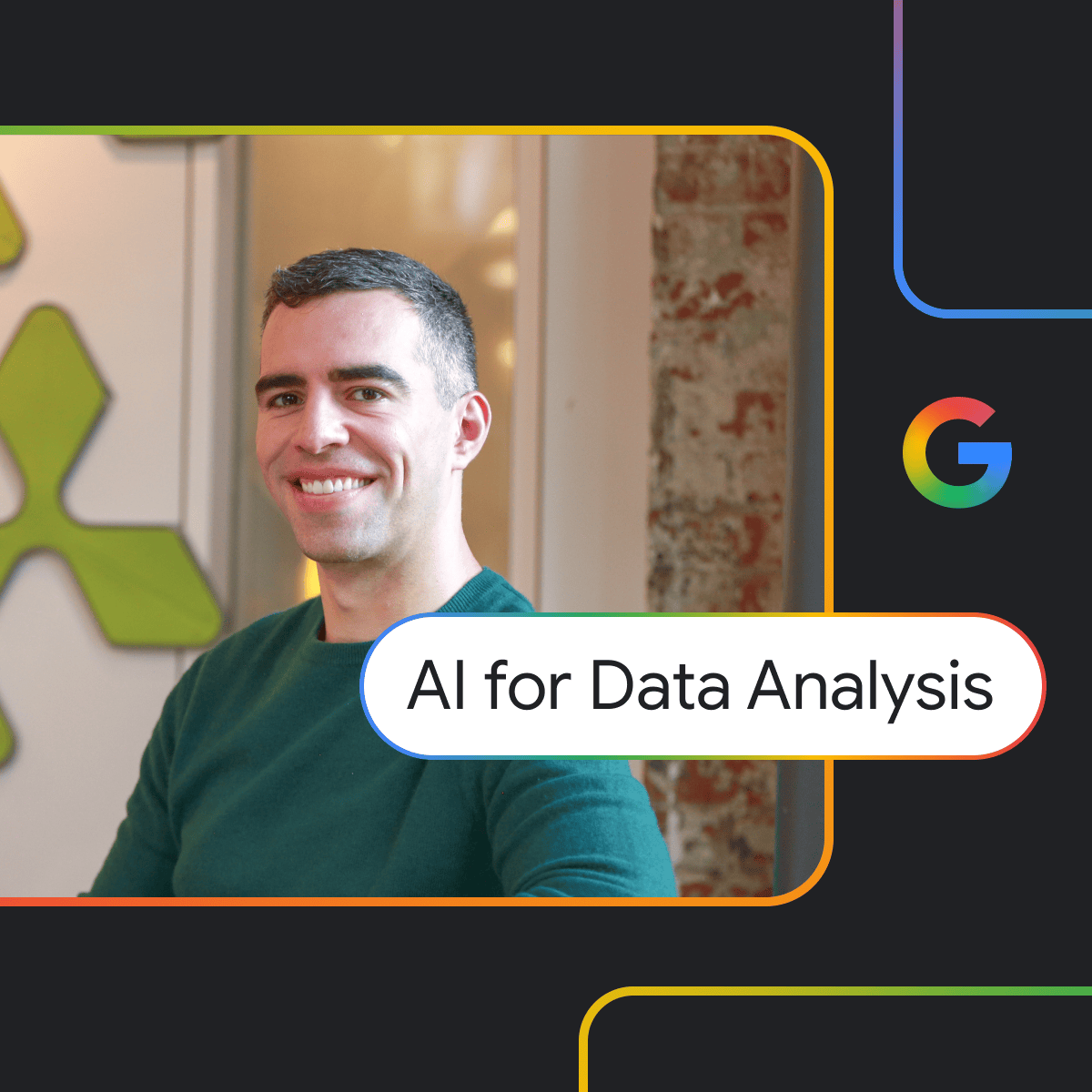
AI for Data Analysis
Are the answers you need buried in a dataset you can't decipher? In this course, you’ll learn to use AI as your analytical partner to transform unstructured data into clear, actionable insights. You’ll use Gemini to identify the right success metrics for any project and practice converting messy, raw data into structured tables. You'll use everyday language to generate powerful spreadsheet formulas and create compelling charts in Google Sheets—empowering you to make smarter, data-driven decisions. By the end of this course, you will create: • Success metrics you can stand by: Use Gemini to define exactly what to measure for your project so you can present your results with confidence. • A structured dataset: Clean and organize messy information into a structured Google Sheets table that is ready for immediate analysis. • Data visualizations and formulas: Use natural language to generate spreadsheet functions and create charts that visualize your findings to drive evidence-based decisions. • Business performance simulator: Use Gemini Canvas to transform static data into an interactive tool, so you can "test-drive" changes and visualize their ripple effects in real time.
Data Quality and Debugging for Reliable Pipelines
You'll build the diagnostic and preventive skills that keep data pipelines trustworthy and production-ready. In this course, you'll learn to define automated data quality tests, trace anomalies back to their source, and apply advanced Python debugging techniques to resolve complex pipeline failures — three capabilities that employers consistently seek in data engineering roles. What sets this course apart is its end-to-end, practical focus: you won't just learn what data quality means — you'll write YAML test suites, navigate monitoring dashboards, analyze stack traces, and step through live code with debugging tools. Each skill builds toward a complete picture of pipeline reliability, from prevention to detection to resolution. By the end, you'll be equipped to catch data issues before they reach downstream consumers, communicate root causes clearly, and ship more dependable data products.
Solve Business Problems with AI and Machine Learning
Artificial intelligence (AI) and machine learning (ML) have become an essential part of the toolset for many organizations. When used effectively, these tools provide actionable insights that drive critical decisions and enable organizations to create exciting, new, and innovative products and services. This is the first of four courses in the Certified Artificial Intelligence Practitioner (CAIP) professional certification. This course is meant as an entry point into the world of AI/ML. You'll learn about the business problems that AI/ML can solve, as well as the specific AI/ML technologies that can solve them. In addition, you'll get an overview of the general workflow involved in machine learning, as well as the tools and other resources that support it. This course also promotes the importance of ethics in AI/ML, and provides you with techniques for addressing ethical challenges. Ultimately, this course will get you thinking about the "why?" of AI/ML, and it will ensure that your more technical work in later courses is done with clear business goals in mind.

Present Compelling Data Stories, Drive Outcomes
Healthcare organizations generate massive amounts of data daily, yet only 30% of data-driven insights actually influence critical patient care decisions. The gap? Compelling storytelling that transforms complex analysis into actionable intelligence. This Short Course was created to help data analysis professionals accomplish the critical task of translating healthcare data into stories that drive better patient outcomes. By completing this course, you'll be able to synthesize complex analytical results into executive-ready summaries, validate the credibility of data insights, and design narrative structures that guide healthcare leaders to clear, actionable decisions you can apply immediately in quality reviews and strategic planning sessions. By the end of this course, you will be able to: - Create a concise, one-slide executive summary to communicate the key findings of an analysis - Evaluate whether insight statements are supported by the data presented - Design a compelling narrative structure for data presentations, dashboards, and reports This course is unique because it focuses specifically on healthcare contexts where data storytelling can literally save lives and improve patient experiences. To be successful in this project, you should have a background in basic data analysis concepts and familiarity with healthcare quality metrics.

Wrangling Data in the Tidyverse
Data never arrive in the condition that you need them in order to do effective data analysis. Data need to be re-shaped, re-arranged, and re-formatted, so that they can be visualized or be inputted into a machine learning algorithm. This course addresses the problem of wrangling your data so that you can bring them under control and analyze them effectively. The key goal in data wrangling is transforming non-tidy data into tidy data. This course covers many of the critical details about handling tidy and non-tidy data in R such as converting from wide to long formats, manipulating tables with the dplyr package, understanding different R data types, processing text data with regular expressions, and conducting basic exploratory data analyses. Investing the time to learn these data wrangling techniques will make your analyses more efficient, more reproducible, and more understandable to your data science team. In this specialization we assume familiarity with the R programming language. If you are not yet familiar with R, we suggest you first complete R Programming before returning to complete this course.

Introduzione alla Data Visualization con Tableau
L’obiettivo del corso è formare professionisti della Business Intelligence attraverso l’apprendimento della piattaforma Tableau, strumento leader di questo settore. La mole di dati a disposizione è sempre più grande ed estrarre informazioni utili per sfruttare queste informazioni è compito degli analisti. Un ruolo cruciale lo riveste la data visualization: il tassello del processo analitico che permette di capire come rappresentare al meglio i propri dati per elaborare strategie data-driven. In questo corso verranno presentate tutte le funzionalità di Tableau Desktop, il tool dedicato alla costruzione delle analisi dei dati. Introduciamo i diversi prodotti della suite Tableau, l’interfaccia grafica e gli ambienti di lavoro, per passare, infine, alla presentazione delle unità minime del lavoro su Tableau: dimensioni, misure e tipi di dato. Vengono illustrati i contenuti relativi ai modi e ai tipi di connessione ai dati, e le strategie di selezione e organizzazione dei dati. Infine tutti gli elementi necessari per imparare a combinare insieme i dati e lavorare con set, date e misure multiple.
GenAI for Sales Teams
Generative Artificial Intelligence (GenAI) is revolutionizing the sales process, offering sales teams new ways to boost productivity, efficiency, and impact. By leveraging powerful language models and other AI-driven capabilities, sales professionals can streamline workflows, personalize customer engagements, and uncover data-driven insights to drive better results. This course is designed for sales managers, account executives, aspiring sales development representatives (SDRs), and sales operations specialists looking to integrate GenAI tools into their workflows, enhance productivity, and drive innovation in their sales processes. Learners should have a basic understanding of sales concepts and workflows, familiarity with common sales tools and platforms like CRM systems, and some exposure to sales-focused analytics. An open mindset towards new technologies and a willingness to experiment with GenAI tools are also essential. Whether you're a sales leader looking to guide your team towards more efficient, data-driven practices, or an individual contributor seeking to future-proof your skills, this course will start you on the path to unlock the transformative potential of GenAI in sales.

Data Management and Visualization
Whether being used to customize advertising to millions of website visitors or streamline inventory ordering at a small restaurant, data is becoming more integral to success. Too often, we’re not sure how use data to find answers to the questions that will make us more successful in what we do. In this course, you will discover what data is and think about what questions you have that can be answered by the data – even if you’ve never thought about data before. Based on existing data, you will learn to develop a research question, describe the variables and their relationships, calculate basic statistics, and present your results clearly. By the end of the course, you will be able to use powerful data analysis tools – either SAS or Python – to manage and visualize your data, including how to deal with missing data, variable groups, and graphs. Throughout the course, you will share your progress with others to gain valuable feedback, while also learning how your peers use data to answer their own questions.

Inferential Statistical Analysis with Python
In this course, we will explore basic principles behind using data for estimation and for assessing theories. We will analyze both categorical data and quantitative data, starting with one population techniques and expanding to handle comparisons of two populations. We will learn how to construct confidence intervals. We will also use sample data to assess whether or not a theory about the value of a parameter is consistent with the data. A major focus will be on interpreting inferential results appropriately. At the end of each week, learners will apply what they’ve learned using Python within the course environment. During these lab-based sessions, learners will work through tutorials focusing on specific case studies to help solidify the week’s statistical concepts, which will include further deep dives into Python libraries including Statsmodels, Pandas, and Seaborn. This course utilizes the Jupyter Notebook environment within Coursera.

Advanced Deployment, MLOps, and Generative AI in Azure
This course features Coursera Coach! A smarter way to learn with interactive, real-time conversations that help you test your knowledge, challenge assumptions, and deepen your understanding as you progress through the course. In this course, you will master advanced deployment strategies, MLOps, and generative AI using Azure ML Studio. You’ll explore techniques to scale machine learning workloads with parallel processing, distributed training, and serverless deployments, including deployment on edge devices and Kubernetes. Learn to manage machine learning workflows with Azure DevOps, GitHub Actions, and Infrastructure as Code (IaC), ensuring seamless integration and security. You’ll also dive into the fundamentals of generative AI, understanding how models like GPT, DALL·E, and others are revolutionizing the AI landscape, and how to fine-tune these models for specific tasks. Throughout the course, you’ll gain hands-on experience with real-time and batch inference, logging, and model monitoring using Azure Monitor and Application Insights. You will also work with cutting-edge tools to optimize models for inference speed and deploy them in production environments. The course will equip you with the skills to operationalize machine learning models effectively, from deployment to monitoring, ensuring they stay efficient and secure over time. This course is designed for professionals and developers looking to advance their skills in machine learning operations (MLOps) and explore the transformative potential of generative AI models. You will work with practical demos to apply what you learn in real-world scenarios, building deployable models that integrate seamlessly with your existing systems. By the end of the course, you will be able to deploy machine learning models using advanced strategies like distributed training and serverless deployment. Implement MLOps pipelines with Azure DevOps and GitHub Actions for end-to-end automation, and Fine-tune and optimize generative AI models like GPT and DALL·E for customized tasks.

Performance Optimization & Analytics
Learn how to move beyond basic campaign launches and start using data to improve results. In this course, you will classify marketing content by buyer journey stage, segment your audiences based on behavior and demographics, and design and execute A/B tests to find what resonates. You will work in HubSpot and Mailchimp to generate reports, identify optimization opportunities, and ensure your automated sequences maintain brand compliance. By the end of this course, you will be able to: map content to buyer journey stages and identify content gaps; build dynamic audience segments for personalized targeting; execute A/B tests on email subject lines, copy, and send times; analyze campaign performance reports to drive optimization decisions; and audit automated sequences for brand and compliance standards. This course includes a project focused on optimizing a real campaign scenario using segmentation and testing.

A Practical Approach to Timeseries Forecasting Using Python
This course features Coursera Coach! A smarter way to learn with interactive, real-time conversations that help you test your knowledge, challenge assumptions, and deepen your understanding as you progress through the course. Dive into the dynamic world of time series forecasting with this comprehensive and hands-on Python course. You’ll gain practical skills in data manipulation, visualization, and forecasting techniques—empowering you to uncover trends, identify patterns, and make predictions using real-world datasets. Whether you're preparing stock forecasts or tracking public health trends, you'll be equipped to apply advanced forecasting tools effectively. Your journey begins with the fundamentals of time series data and gradually builds through essential processing techniques, including decomposition, noise reduction, and feature engineering. As the course progresses, you’ll explore powerful statistical models such as ARIMA and SARIMA before moving into deep learning-based forecasting using LSTM, BiLSTM, and GRU models. Hands-on projects like COVID-19 case prediction, Microsoft stock forecasting, and birth rate trend analysis reinforce theoretical knowledge and provide you with ready-to-use code and workflows. Quizzes and real datasets at every step ensure a fully immersive learning experience. This course is ideal for data enthusiasts, analysts, and aspiring machine learning engineers. A basic understanding of Python programming and fundamental statistics is recommended. The course is best suited for learners at an intermediate level.

SQL for Data Science (and Version Control with GitHub)
Master industry-standard SQL and database management in this comprehensive course designed for aspiring data professionals. Through hands-on projects and real-world datasets, you'll progress from basic queries to advanced data manipulation techniques, enhanced by modern AI tools. This course is perfect for beginner/intermediate level data enthusiasts and Excel-savvy professionals ready to advance their data skills. Starting with basic database concepts and progressing through real-world scenarios, you'll develop the practical skills needed for modern data analysis roles, culminating in a capstone project that demonstrates mastery of SQL fundamentals, advanced querying techniques, database optimization, and professional documentation practices. Upon completion, you'll be able to: • Write complex SQL queries using advanced techniques including subqueries, CTEs, and window functions • Design and optimize database schemas for improved performance and data integrity • Clean, transform, and analyze data using professional SQL workflows • Integrate AI tools to enhance query optimization and automation • Build comprehensive data analysis reports using version control best practices with high school students and professionals with an interest in programming.

Data Viz Using Tableau & Presenting With Storytelling
Data visualization is a crucial aspect of data analysis and decision-making in today's data-driven world. In this course, you will delve into the fascinating realm of data visualization and harness the power of Tableau, a leading data visualization tool. You'll learn how to transform raw data into insightful visuals that convey complex information effectively. This course will empower you to create compelling visualizations that aid in decision-making, storytelling, and conveying insights to both technical and non-technical stakeholders. Data analysis is only as impactful as your ability to communicate the findings to others. This course will equip you with the skills and techniques necessary to craft compelling data stories and deliver persuasive presentations that resonate with diverse audiences.