Cursos de Negocios
Los mismos datos para todos, vengan de Udemy o de Coursera: precio, valoración, duración e idioma. 3.046 cursos encontrados. Afinar la búsqueda

Standard 9.2 - Part 1 Foundation Enterprise Architect Course
>> Learn about the most recent changes to the TOGAF(R) standard version 9.2 with this best-selling training course, including English closed captions. All slides are available for download! All audio files are available for download! << Over 28,000 students bought the TOGAF(R) 9.1 version of this course. This version has been completely redone and re-recorded, based on the latest changes to the standard. If you look at the job listings, developers and architects with TOGAF experience are in high demand. You can get certified as an enterprise architect with the TOGAF 9.2 certification exam (OG0-091), and this course will teach you what you need to know! It takes training to become an Enterprise Architect. Much of that comes through on-the-job skills learned working on software projects larger-and-larger in scope. But there is a very specific way to design software at enterprise scale. The Open Group has defined a standard for this method for almost 10 years now, and over 400 companies and government agencies have been involved in crafting that standard. It is called TOGAF - The Open Group Architecture Framework. The truth is: This course helps you become certified in the TOGAF 9.2 specification. Through learning the Architecture Development Method (ADM), you will become better at designing systems. If you already architect software for a living, learning an official enterprise architecture framework such as this takes you to the next level of your career. You owe it to yourself: If you are a software developer, this is your chance to learn the proper techniques for assessing the requirements of an enterprise, and designing the right solutions for today and tomorrow! While software development is skill any teenager can acquire, and the salaries paid to software developers fall or are frozen, it's those who know the complex skills of designing large software projects that will still be in high demand. Specifically, this course will teach you: • The details of the TOGAF 9.2 Foundation exam (OG0-091), including how to book it, and my experiences taking the exam • The basic and core skills of the TOGAF framework • The Architecture Development Method (ADM), all of the phases, and the key information to know to pass the exam • Other topics covered on the exam, including Architecture Governance, Architecture Capacity, Enterprise Continuum, Capability Assessment, and reference frameworks such as TRM and III-RM This course is focused on passing the exam. In-person classes for this same exam costs $2,000 and take 2 days of intensive training. This course aims to bridge the gap between that level of in-person training, and self-study. If you've ever tried to read the TOGAF 9.2 specification or even the official study guides for the exam, you will perhaps agree that they are lengthy and hard to understand. The TOGAF 9.2 spec is 500 pages long. The official study guide is 265 pages. Both are written in that same style that many official specifications are written in - both very precise and extremely lengthy. Watching these lectures, doing the quiz questions, and following up with a reading of the relevant section of the specification will your self-study time by hours, and will give you the confidence to take the exam and get certified at Part 1! So join me: Join over 28,000 students studying for the TOGAF 9 Part 1 certification test in one of my Udemy courses! Many have taken and passed the exam after taking this course! I am confident that this course will save you many, many hours of studying time compared with just reading the 500-page spec yourself. If you are in any way not satisfied, for any reason, you can get a full refund from Udemy within 30 days. No questions asked. But I am confident you won't need to. I stand behind this course 100% and am committed to helping you pass. You won't get that commitment from a book, or from any other TOGAF class on Udemy. I am a TOGAF Certified architect, and a member of the Open Group's Architecture Forum - helping to define the standard going forward. I am using the TOGAF 9.2 specification under a commercial license. TOGAF is a registered trademark of The Open Group in the United States and other countries. SoftwareArchitect(dot)ca is a member of The Open Group Architecture Forum and holds a current, valid TOGAF(R) Commercial License. Thank you for signing up for this course on Udemy. The course will always be up-to-date here and nowhere else.

Business Modeling Tools
This course introduces learners to the Data Analysis tools in Microsoft Excel. More specifically, learners will focus on how to build and use single regression and multiple regression to solve business problems.

Business Development & B2B Sales for Startups- Sales Valley
WHY LEARN BUSINESS DEVELOPMENT & SALES? You might be offering an amazing product or service…but developing business relationships and generating sales is typically the hardest part about growing your startup. The first challenge most startup comes across is generating leads and scheduling your first meetings with potential customers who might be interested in buying your product or service. The second challenge startups face is once your do get your first meetings, what exactly should you say to sell your product/service and how exactly do you close the deal? Now, most startups aimlessly try finding new clients by cold calling or going to networking events and play the numbers game…which we all know can lead to inconsistent results, and frankly, can be a huge waste of time. THERE HAS TO BE A BETTER WAY, RIGHT? Fortunately, I’ve created a PROVEN methodology specifically for startups and high growth companies to generate a consistent flow of leads using cold emailing, develop their communication and sales skills, and close more deals. And it’s called Sales Valley. Unlike other courses, Sales Valley is the COMPLETE PLAYBOOK the top Silicon Valley startups use to develop business relationships and exponentially grow their businesses. As long as you use our proven Sales Valley Methodology (which I’ll show you how to do step by step), you’ll be able to get a meeting and close a deal with anyone! Best of all, you'll learn how to generate meetings while working remotely and working from home. Here are some of the many things I’ll cover for you in this course that trains on how to master the complete sales cycle from start to finish: • We will show you how to build your own sales process to maximize efficiency for your business • How to send cold emails to get a meeting with ANYONE from small, medium, and Fortune 500 companies • How to write like a professional copywriter even if you don’t have any copywriting experience • Bonus Cold Email Scripts & Templates for every situation • Exactly how to run a successful business meeting • How to become a better listener and identify customers’ main pain points • The best way to pitch your idea and convince people to believe in you • How to get customers to buy emotionally and justify logically • How to handle deal-breaking objections and turn skeptics into buyers • How to close deals without using high-pressure techniques • How to exponentially scale your business • How to sell and generate meetings remotely and be productive while working from home This course will teach you EVERYTHING you need to know to develop more business relationships and generate more sales for your startup whether you’re already familiar with business development & sales or if you’re just getting started. I’ve personally tested all these bulletproof growth strategies myself with small, medium, and Fortune 500 companies in all types of industries like retail, real estate, health care, etc. as one of the TOP salespeople at Oracle and Y-Combinator-backed startup, Lob. I'm confident the Sales Valley Methodology WILL WORK for YOU to grow your startup or your money-back guarantee. 30-DAY MONEY BACK GUARANTEE Sales Valley is designed to walk anyone through the steps to get a meeting with your dream clients and closing the deal, start to finish. Everything is given to you. You’ll have all the tools you need. If you do this program, take action, and don’t generate more leads then I will give you a full immediate refund. No questions asked. Now if you’re ready to take your startup to the next level, I’ll see you inside! -Patrick

IIBA® Entry Certificate in Business Analysis™ (ECBA™) Exam Prep
This IIBA®-endorsed course prepares the learners to pass an industry-leading certification for aspiring business analysts - Entry Certificate in Business Analysis™ (ECBA™) by IIBA®. This certification prepares and equips Business Analysis Professionals with expertise and key competencies to start their career. The certification improves the marketability, employability, and earning potential of practitioners. Entry Certificate in Business Analysis™ (ECBA™) provides individuals, with no business analysis experience who are developing their business analysis skills, with a certificate that recognizes their entry into the business analysis profession. The target audience for this information includes individuals aspiring to become business analysts, as well as those who already have less than two years of experience in the field. Project managers, product owners, and anyone with an interest in obtaining an IIBA certification are also included in the intended audience. Furthermore, this information is relevant for professionals who are currently certified by IIBA and are seeking opportunities for professional development units. While prior exposure or interest in the business analysis profession is beneficial, it is not mandatory for participation in the course. However, obtaining IIBA® membership and having access to the BABOK® Guide is recommended, as the course expects participants to read the corresponding BABOK® chapters as they progress. This additional resource can enhance the learning experience and provide valuable insights into the principles and practices of business analysis.

Seth Godin's Value Creation Master Class
A new course from one of Udemy's most popular teachers. Are you ready to take your work to a new level? This project you’re working on, the new business or offering, what sort of value does it create? This is a loaded question but a vital one. That's our work. It's what we do: we build organizations and projects that create value. No value, no project. Understanding the levers of value creation gives you a significant unfair advantage. This is a master class for leaders, marketers, managers and freelancers. It includes a 35-page workbook and a series of direct, useful conversations that are guaranteed to change the way you approach your work. What we’re seeking here isn’t a fancy elevator pitch or a carefully compressed mission statement. Instead, the challenge is to describe (without regard in any way for how you benefit, or for how your organization profits), precisely what’s in it for the user, the customer, the people you seek to serve. Seth Godin is one of the most popular bloggers in the world, the guy American Way Magazine called, “America’s Greatest Marketer.” He’s written 18 bestselling books, started successful companies, but mostly, he’s a teacher. In his first ever Master Class, Godin doesn’t waste time with entertainment. Instead, he’s put together a focused, useful course and a significant workbook, all designed to help you produce more value in less time. Watch the videos, do the workbook, engage with your fellow students and then repeat the process. After a few cycles, you will begin to see things you’ve never realized were important. Go make a difference. This course will help make that possible.

Create a Flyer Using Microsoft Word
After successfully completing this project, you will have created a visually appealing flyer using Microsoft Word. While building a flyer, you will use various features in Word. You will use the Insert feature to insert a picture in a document. Other features you will use include applying styles to text and pictures. You will insert a numbered list, convert it to a bulleted list, and then modify the bullets. You will also discover how to apply a theme to a document.

Supply Chain Management A-Z: Operations & Logistics Basics
This MBA style course prepares and empowers you to make a REAL difference. Turbo-charge your career and your business. This course is for the new or aspiring supply chain & operations manager, the ambitious procurement professionals, the striving logistics supervisors, hands-on production planners and the practical business optimization analysts. • Take control of your supply chain to have and "impact" and "improve" your business operations - manufacturing, services, retail, logistics industrial operations and production. • Equip yourself to take a new leading role in your workplace - improving your processes, systems, business / organization. • Understand the fundamentals, then details of the essentials of supply chain management, the core business trade-offs, essential analysis, calculations and basic optimisation methods. • Become the Supply Chain Management authority in your team on improving the operations systems in your business. Course Sections: 1. Introduction to Supply Chain Management 2. Stakeholders and Relationships 3. Components of a Supply Chain 4. Types of Supply Chain and Value Stream Mapping 5. Forecasting Demand 6. Demand Management 7. Bullwhip Effect 8. Sales and Operations Planning 9. Inventory Management 10. Measuring Performance with Metrics / KPIs In this course, you will learn: • Objectives: What are the "Aims and Objectives" of a good Supply Chain. How to balance the "Trade Offs" • Type of Supply Chain: The difference between an "efficient" and a "responsive" supply chain and why you can be both • Relationships: Segment your Stakeholders and Tailor your Relationships. Are you transactional or collaborative? • Forecasting: Quantitative and Qualitative Methods of Forecasting Demand. • Excel work-throughs: Worked examples in excel of the most common quantitative forecasting methods and calculating forecast error. • Reducing Variation: Why demand variation is the enemy and how you can control it • Bullwhip Effect: Control the Bullwhip Effect: What it is, how does it happen (to us all!) and how to control it • Improve a Supply Chain: By reducing Delays, Uncertainties and Decision Tiers • S&OP Planning Structure: MRP, ERP and Software integration • Inventory: The core reasons we "need" inventory and why it really costs us so much more than most managers think • KPIs: 5 essential supply chain Metrics to give you a "deep" and "balanced" view of your performance Business operations come in all shapes and sizes with a host of unique challenges; but good supply chain management is essential to them all. Whether you work in retail, manufacturing production, distribution and logistics or even service companies such as restaurants, retail, hospitality or health and beauty; - an effective supply chain is a key determent of your business's success. Getting a strong control and continuously improving your business supply chain operations is essential to remain competitive, improving profitability, improving customer satisfaction, reducing costs and improving delivery. A solid grasp of the "wider" supply chain picture is essential to be considered for a managerial position or seek promotion as higher roles require greater stakeholder relationships, building partnerships and business agreements either with other supply chain functions within your business or external companies. Take control of your career and equip yourself with a solid base in Supply Chain Management; full of practical insights and tools that you can use right now to unlock the potential of yourself and your business! FULL COURSE CONTENTS 1. Introduction to Supply Chain Management A Life Changing Supply Chain Welcome The Supply Chain of Life - Blood Why is Supply Chain Management Important? What is Supply Chain Management? Aims and Objectives of a Good Supply Chain Key Activities in Supply Chain 2. Stakeholders and Relationships Stakeholders and Relationships - Introduction The Main Stakeholders Suppliers, Producers and Distributors Retailers and End Customers Stakeholders and their Relationships Vertical and Horizontal Relationships Segmentation of Suppliers Transactional vs Collaborative Relationships 3. Components of a Supply Chain Components of a Supply Chain - Introduction OEMs, Supplier Tiers and Internal Functions Other Components of a Supply Chain A Typical Supply Chain 4. Types of Supply Chain and Value Stream Mapping Efficient vs Responsive Supply Chains Matching Supply Chain Type to Product Type Value Stream Mapping VSM - An Example talk-through (VSM - example map) 5. Forecasting Demand Forecasting Demand - Introduction Why do we Need a Forecast? The Golden Rules of Forecasting Collaborative Forecasting - What Collaborative Forecasting - Why Collaborative Forecasting - How Forecasting Methods Quantitative Forecasting Forecasting using Moving Averages Forecasting using Weighted Averages Forecasting using Exponential Smoothing Calculating Forecast Error Spotting Trends from Noise 6. Demand Management Waiting for the Barber - Story Demand Management - Introduction What is Demand Management? Causes of Demand Variation External Demand Management - Methods Internal Demand Management - Methods 7. Bullwhip Effect Bullwhip Effect - Introduction Demand Management through the Supply Chain The Bullwhip Effect - Background The Bullwhip going up the Supply Chain Why Does It Happen? Reducing Delays to Improve a Supply Chain Reducing Uncertainty to Improve a Supply Chain Reducing Decision Tiers to Improve a Supply Chain 8. Sales and Operations Planning Sales and Operations Planning (S&OP) - Introduction What is S&OP for? S&OP - Planning Structure Independent vs Dependent Demand Bill of Materials (BOM) Materials Requirements Planning - Overview MRP continued Enterprise Resource Planning - ERP Supply Chain Management Software 9. Inventory Management Inventory Management - Introduction What is Inventory? Types of Inventory Why do we Need Inventory? Why Else do we Hold Inventory? Costs of Inventory Financial Costs of Inventory Ordering Costs of Inventory Holding Costs of Inventory Operational Costs of Inventory 10. Measuring Performance with Metrics / KPIs Measuring Performance - Introduction What are Metrics? Business's Perspective on Performance Categories of Supply Chain KPIs / Metrics Selected Metrics / KPIs for Supply Chain Inventory Turns / Turnover Days On Hand / Days Inventory Outstanding Cash to Cash Cycle Time Customer Lead Time On Time In Full % (OTIF) Fill Rate % Wrap Up Congratulations

Excel Financial Statement Modeling and Bookkeeping Automation
Unlock the foundation of financial modeling by mastering how to construct, reconcile, and automate integrated financial statements in Excel. This course demystifies the complex world of financial reporting, teaching you the essential skills to create accurate, reliable financial models from the ground up. Starting with the fundamental principles of double-entry bookkeeping, you'll learn how to build dynamic Income Statements, Balance Sheets, and Cash Flow Statements. You'll discover how financial statements interconnect, how to apply spreadsheet functions to automate calculations, and how to implement formula-driven checks to detect and correct potential misstatements. By the end of this course, you'll have the skills to create transparent, auditable financial models that form the backbone of professional financial analysis. Whether you're an aspiring financial analyst, accountant, or business professional, this course provides the critical skills needed to ensure financial data integrity and accuracy.

Strategic Cost Management: Procurement and Supply Chain 2026
Welcome to Strategic Cost Management course for Procurement and Supply Chain specialists! In this course we will look into procurement’s role in the company and some prejudges about Procurement, Purchasing and Supply Chain specialists. You will understand that our role in the company is really important, and the bets way to prove it is to look into the leverage effect of Procurement. Savings on Procurement are directly contributing to a company’s Profit. One Dollar saved = One Dollar earned! We will learn about the pressure for price reduction and some low price illusions that can happen in your practice. Constant cost development is not just a wish from the purchaser. It is a business routine in a modern world. And then we will learn about preparation to price negotiations, different approaches to pricing depending on the type of supplier. We will talk about the following questions to your suppliers: -Do you have any frame agreements? Commitments? For how long? -How easy is for you to find alternative supplier? -How easy is for supplier to find alternative customer? -Is there any special competence/knowledge/patent/know-how existing at this supplier? -Does supplier have the specific equipment dedicated only for your products/services? Are there any major undepreciated investments for such equipment at supplier?.. Important part of the course is cost analysis of the products. You will learn making cost modelling for the specific product at the specific supplier. And then using the cost based pricing for Strategic Cost Management. We will also look into the economy of scale (when your supply volumes increase): administrative economies, financial savings and economical use of by-products... We will finish the course with long term contracts and frame agreements, that help to avoid the bad surprises in business. There are a lot of variables in business with your suppliers: forecasts, raw material prices, exchange rates, efficiency, technical development and innovation and many more... The only constant thing is change:) This course will help you to stay calm, work effectively and proactively with cost on the strategic level! This course was prepared based on my own experience and the best practices I have used by myself. Also this course contains some theoretical knowledge and practical tools that are used by the world class companies and supply chain managers. The material is easy to follow and understand, well-structured and presented in a simple and straightforward way. And what is very important – you can start using the tools and the logic of Strategic Cost Management already after finishing the course. I am proud of the materials collected in this course. And I am sure that you will bring your Procurement and Supply Chain work to a completely new level! Have a look into the preview lessons. If you like them - just go for the course. You will not regret it! P.S. As a bonus - I have decided to share my e-books on Procurement. Some useful and fun read for you, some motivation and inspiration. Enjoy your course and leave me a comment after you complete the course :) Robert
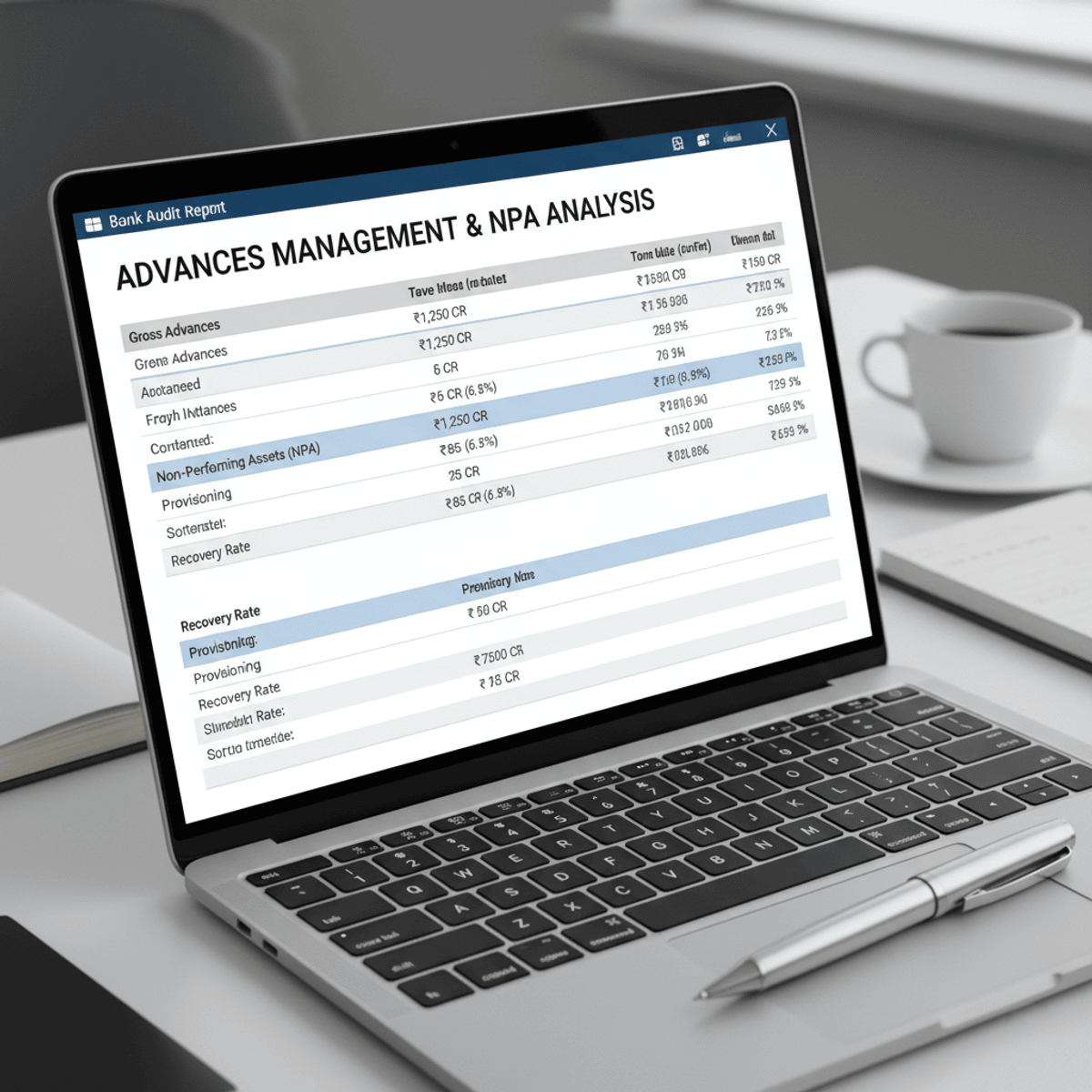
Analyze & Evaluate Bank Branch Audit Practices
Learners will analyze bank branch audit procedures, evaluate asset classification and provisioning norms, assess credit appraisal and post-sanction compliance, and apply regulatory and operational controls in real-world banking scenarios. This course provides a structured and practical understanding of bank branch auditing, covering advances management, prudential norms, concurrent audit systems, KYC compliance, and operational housekeeping controls. By completing this course, learners will strengthen their ability to identify non-performing assets (NPAs), interpret restructuring guidelines, examine risk-based audit planning, and evaluate internal control systems within bank branches. The course bridges regulatory theory with applied audit practice, enabling professionals to confidently review loan documentation, deposits, cash operations, and sensitive custody procedures. What makes this course unique is its comprehensive coverage of both financial and operational audit areas within a bank branch environment. It integrates regulatory compliance, fraud prevention mechanisms, and concurrent audit techniques into a cohesive learning pathway, equipping learners with job-ready auditing competencies aligned with modern banking standards.

Grant Writing for Nonprofits and Freelance Writers
Many nonprofits are worried about tax law changes affecting donations. To be competitive, you need to diversify and build your skills for generating revenue. This course is designed for nonprofits that want to not only get better at writing successful proposals, but also get better at the process of researching and applying for foundation and government grants. The course is also for grant writers or freelance writers who want to offer their clients a more comprehensive approach to grant writing. When you’re done with the course, you’ll have assembled one of the most powerful tools a nonprofit can have – a proposal boilerplate. The boilerplate contains about 75% of the language you’ll need as you’re drafting proposals. Working on the boilerplate outside the pressure of a proposal deadline will result in language that is better-written, as well as more thoughtful and strategic. It will also set you up to be uber-efficient as you’re writing proposals in the future. Throughout this course we'll be using real examples and real language, and each lesson includes a transcript, so you can kickstart your own boilerplate. You’ll also be given strategies and tips for finding foundation and government grants, including: • Identifying five relevant local foundations • Gathering information about grants at the local, state, and federal level for you to start pursuing Finally, we’ll be walking through key strategies for completing solid applications, including: • Letters of intent • The budget • Meeting a funder’s expectations Each video session includes two downloads: a PDF of the slides in handout format, and a Word document transcript.

Cost Accounting: Decision Making
In the third course, you will learn how to use information from cost accounting to improve managerial decision-making. We discuss business decisions and suggest how cost information can support them best. For example, how will costs change if managers adjust cost drivers? How many units do companies need to sell in order to avoid losses or to achieve a targeted profit? How can managers improve pricing or product programs with information from cost accounting?

Quality Management And Quality Assurance Expert (Accredited)
Quality Management And Quality Assurance Offering high quality products and services can transform a business. But here's the problem: Many people struggle to even define the meaning of quality and how it should be measured. Just ask around and find out for yourself. THIS COURSE This course can be your first step in the world of quality management and quality assurance on your way to becoming a quality champion. What will you learn? • What are some common definitions of quality? • How can quality be analyzed systematically with a cause and effect matrix? • How can quality be measured? • What are some common KPIs in quality management and quality assurance? • What is total cost of quality? • What is the difference between quality assurance and quality control? • What is VOC (Voice of Customer) and how can it help in quality assurance? • What is a CTQ factor (Critical To Quality) and how can it help in quality management? • How do audits help in quality assurance and quality management? • How does event tree analysis help us with risk management? SIX SIGMA ACADEMY AMSTERDAM (SSAA) The training is provided by SSAA, an accredited provider of education that was set up by university lecturers from Holland, with the aim to make academic quality education more affordable, accessible and engaging. As of 2023, we have trained over 150,000 students worldwide. We hope to welcome you to our short, free introductory course. Team SSAA
Public Speaking with Canva
In this project-based course, you will learn how to structure and visually organize a public speech using Canva. You will explore public speaking models and techniques and use Canva’s design tools and templates to create visual materials that support a clear and effective presentation. You will learn how public speaking can be used across different formats and contexts, including presenting ideas or projects, pitching to clients, and delivering presentations using digital and multimedia tools. These skills can be applied in academic, professional, and other presentation environments. By the end of the project, you will have created a structured presentation in Canva and developed a better understanding of how speech structure and visual design can support effective public speaking. This project is intended for learners who are familiar with Canva and want to strengthen their public speaking and presentation skills.

B2B Sales Objections Simplified
>> The fastest-growing Sales Training Series on Udemy! Learn directly from an actual Sales Director of Training for a Fortune 500 Company! The material inside is currently being taught at the highest level in the Fortune 500 sales space. You can't afford to miss this! << ********** Are you afraid of getting an objection in sales? Are you using the same method to handle objections over the phone and in person? In this part of SALES in 21 DAYS Program, all of your sales objections will be simplified. You will experience objections from clients in all aspects of your sales cycle. Each situation, whether it happens face to face or over the phone, you must use a different technique to handle them if you want to be successful. In this course we will cover where sales objections come from, how to handle them when the customer is in front of you, different techniques on how to handle them over the phone and even a technique on handling the price objection! You will leave this course with the materials ready to create custom objection handling scripts that will work for your business. Get ready to learn various sales techniques around the different scenarios you will receive objections, how to understand where your clients are coming from, and benefit from the objection handling materials that will be provided inside of the assignments section of the course! ********** Peter, VP of Sales said: "Derek's series on Sales are great on their own, but when taken together they make for a rounded experience covering the sales cycle in great detail. Derek is highly competent as a sales trainer, and while I've taken a lot of sales courses on Udemy, the courses by Derek stands head and shoulders above the rest." Scott says: “The instructor has a way of making the overwhelming task of handling objections seem achievable. He is very motivating!” Barbara says: “Another great course by Derek Shebby.” Learn directly from a highly successful Fortune 500 sales coach who has trained hundreds of sales reps, sales managers and vice presidents in their sales careers. The sales strategies you will learn are still being taught in the sales training classroom today.

Change Leadership: Strategic Route Analysis with Miro
By the end of this guided project, you will be fluent in creating a change implementation model using Route Analysis for a hands-on example. This will equip you with a systemic implementation framework for change that can be utilised in professional and personal life. Change happens all the time, and in being able to identify factors involved in change and developing a model for how to implement change you increase your chances for success. This analysis will help you if you are in: + Strategy development + Program Management + Project Management + Business Process Re-Engineering + Product Development + Organisational Development Furthermore, this guided project is designed to engage and harness your visionary and exploratory abilities. You will use proven models in change management with Miro to develop your change leadership skills for various settings.

Intro to Business • HR: Payroll Fundamentals
From how to calculate earnings to determining which taxes apply and how to file them, processing payroll can be kind of confusing. In this course, we use everyday, easy-to-understand language to explain the fundamentals every person responsible for getting payroll processed should understand - whether you're the person actually doing, a small business owner overseeing someone else, or a student learning the activity. While this course uses United States information as examples, the information and principles included apply to almost every country in the world. Successful students will not only grasp how each of the different aspects of payroll process work, they will understand how (and when) those pieces come together resulting in employees receiving actual paychecks. Throughout the entire course, quizzes and actual working "homework assignments" are used to reinforce the lessons as well as help the student understand what they are grasping or needing to restudy. Some of the many areas covered in the course include: • Starting off, students learn the basic legal requirements that must be met before employees start receiving payroll, along with expectations employers should keep in mind when they work with their employees. • Next, the course delves into how gross pay is determined, whether it's hourly wages, annual salary, tips, commissions, bonuses, incentives or more. Also, the definition and expectations of Independent Contractors is covered, along with tax forms for these services. • How often are employees paid and how that affects many different steps of the entire operation. • Which payroll deductions are Mandatory according to government, versus which ones are Voluntary. How are all those different deductions calculated, collected, matched, and paid. • Several different tax form types are required to successfully process payroll each pay period and every year. MANY other lessons are included such as: • What is Unemployment Insurance and is it paid by the employee or employer? • Court-ordered Garnishments legally require an employer to withhold an employee's pay and turn it over to someone else. Understand how and why. • How does an employer process and prepare an employee's final paycheck. • Which records need to be kept and for how long.

Master Bond Accounting: Analyze, Value & Apply IFRS
By the end of this course, learners will be able to explain core bond terminology, analyze interest structures, calculate bond prices using present value, apply premium and discount amortization, and evaluate IFRS requirements for financial instruments. These skills prepare learners to confidently interpret and record bond-related transactions in real-world accounting environments. This course provides a step-by-step progression from foundational concepts to advanced valuation and IFRS reporting techniques. Learners first explore how bonds function, how coupon structures influence interest flows, and why present value is essential for accurate measurement. They then apply these concepts using both straight-line and effective interest rate methods, interpreting their impact on carrying amount and interest expense. The course concludes with practical corporate examples and clear IFRS alignment, helping learners bridge theory with professional application. What makes this course unique is its deep integration of conceptual clarity, quantitative techniques, and global reporting standards, supported by real-world scenarios and structured explanations that demystify complex bond accounting topics. Whether preparing for advanced studies or strengthening professional expertise, learners gain practical, industry-relevant skills essential for modern financial reporting.

Technical Communication: Speak the Language of Business
You know your subject. But do people actually understand you? Have you ever: • Been told to “keep it higher level” or “be more strategic”? • Watched business stakeholders lose interest halfway through your explanation? • Felt frustrated because other teams “just don’t get it”? • Struggled to explain a technical issue to leaders, executives, or customers? • Been asked to “speak the business language”? If yes, this course is for you. Technical expertise is not enough At work, technical skill helps you solve problems. Communication skill helps other people understand, support, approve, and act on your ideas. The professionals who progress fastest are often not the smartest technical experts. They are the people who can explain complex ideas clearly, adapt to different audiences, and communicate in a way that gets buy-in. That’s exactly what this course will help you do. Learn how to explain technical topics clearly to anyone In this course, you’ll learn a practical communication system designed specifically for technical professionals who need to talk to non-technical audiences. Whether you work in engineering, IT, software, cybersecurity, operations, data, science, finance, legal, or another specialist field, the methods in this course will help you explain ideas in a way people quickly understand. You’ll learn how to: ✓ Explain technical ideas to non-technical people without confusion ✓ Communicate clearly with executives, leaders, and business teams ✓ Reduce jargon and stop overexplaining ✓ Get to the point quickly and structure your message clearly ✓ Help your audience understand why your message matters ✓ Speak in a way that gains attention, understanding, and buy-in Practical methods you can use immediately This course includes: ✓ A practical 5-part framework for workplace communication ✓ 10+ methods for simplifying complex ideas ✓ Simple scripts for structuring messages clearly ✓ Techniques to tailor communication for different audiences ✓ Real examples showing how to explain highly technical topics in plain English The lessons are practical, straightforward, and designed for real workplace situations. Each video is short, focused, and easy to apply. You’ll be able to start using what you learn immediately—without needing to complete the whole course first. Created by a technical professional turned communication expert My name is Chris Fenning. I started my career in engineering and IT before becoming a communication skills author, trainer, and instructor. I’ve taught at international business schools and worked with professionals from organisations including Google and NATO. The methods in this course are regularly described as some of the most practical and game-changing communication techniques participants have seen because they are simple, realistic, and easy to apply at work. Stop struggling with these common communication problems Avoid problems like: ✗ Too much detail ✗ Too much jargon ✗ Unclear presentations ✗ People not understanding your message ✗ Executives asking for “the high-level version” ✗ Other teams not seeing why your work matters ✗ Great ideas not getting support because the message wasn’t clear Use these methods in real workplace situations The techniques in this course can help you in almost any workplace communication situation, including: • Updating senior leaders and executives • Explaining technical work to non-experts • Working with different teams or departments • Presenting ideas and proposals • Getting buy-in for projects • Discussing requirements • Giving status updates • Solving problems collaboratively • Educating an audience • Asking for support or resources …and much more. The result? You’ll be able to explain complex topics clearly, communicate with confidence, and feel confident your audience understands what you’re saying—whether they are technical or not. If you’re ready to stop being misunderstood and start getting your message across clearly at work, this course will help. Frequently Asked Questions Q: My work is very technical. Will this course help me talk to the business teams? A: Absolutely yes! The methods in this course are a step by step process to create a message that is suited to your audience. If you need to talk about a technical topic to a non-technical audience the methods in this course will show you how. There are simple scripts to help build an understandable message. The course includes 10+ methods to simplify a message and examples that are specifically designed to show how to explain incredibly complex and technical ideas to non-technical audiences. Q: Will this course help me communicate with other teams? A: YES! That’s one of primary goals of this course, to help you communicate clearly with any audience - especially people outside your own team. When you use the methods in this course, you will improve the way you communicate with someone outside your team. You'll understand what approach will help them understand and the type of information to include to make sure you get their attention and help them see why your message is important. When you use these methods your messages will be relevant, relatable, simple, and jargon free. This course helps when communicating with any audience - Internal, external, executives, people higher or lower in your organisation, and more. The methods you learn in this course are applicable to any situation where you want people to understand what you are saying, recognise the importance of your message, and quickly understand without the need for detailed explanations. Q: Will this course help me when talking or writing to senior stakeholders and executives? A: Yes it will. Executives and senior leaders appreciate well-structured communication that focused on topics relevant to their goals and objectives. The frameworks in this course show you how to make any message relevant to any audience. The methods you'll learn show how to make the impact of your message clear and how to relate it to the specific goals and outcomes the executives care about. Executives and senior leaders will appreciate the clear way you structure messages and are likely to be impressed with the clarity of your communication. If you've ever been told you need to be "more strategic" or "Learn to speak their language" you will learn those skills in this course. Q: Do I have to complete the whole course before I get any real value? A: No - the content of the course is designed to give you tools you can use right away. You can use the methods in each section as soon as you have finished watching the videos. The more of the course you complete the more benefit you'll get, but you can start using what you learn long before completing all 4 hours of lessons. Q: How long does it take to finish the course? A: The lessons are between 5 and 15 minutes long and the total video duration is 4 hours. The activities take additional time so you should expect to spend 6 hours in total. The videos are self-paced and you can complete them at your own pace.

Presentation Skills with Story Telling
A smarter way to learn with interactive, real-time conversations that help you test your knowledge, challenge assumptions, and deepen your understanding as you progress through the course. Mastering the art of effective presentations can significantly boost your communication skills. In this course, you'll learn the essential techniques to confidently present ideas, structure your message, and captivate your audience. With a combination of practical tips and expert insights, you’ll develop the skills to present powerfully and persuasively. The course begins by focusing on presentation skills, addressing how to reduce jitters, structure your message, and design visually compelling slides. You'll also learn to engage with your audience, overcome nerves, and develop a confident presentation style. We delve into the art of structuring your presentation and how to deliver it with the right flow, keeping your audience hooked from start to finish. The second part of the course introduces storytelling for business. You'll discover how to craft compelling stories that resonate with your audience. Learn the strategies that professional storytellers use to engage and captivate listeners, and understand why storytelling is an essential skill in business communication. This section also offers a practical model for structuring your own impactful stories. This course is ideal for business professionals, managers, marketers, and anyone who wants to improve their presentation and storytelling abilities. Whether you're delivering a pitch, leading a meeting, or speaking at a conference, this course will equip you with the skills you need to communicate effectively. There are no specific prerequisites, but a basic understanding of presentation tools is helpful.

Digital Transformation - Strategy Masterclass
A complete Digital Transformation Strategy Creation course on Udemy! You'll learn unique and in depth knowledge from a senior product manager who works in digital for one of the World's top 100 banks. From understanding the fundamentals of digital transformation to key digital transformation concepts, from exploring why strategies are essential for digital transformation to the phases of digital transformation strategy creation, right through to the essential content for any digital transformation strategy and how to present your strategy to any audience. I offer Q&A sessions with students and detailed summaries of all lectures and topics covered as well as a wide range of resources to help progress your knowledge. In a matter of hours you'll master all you need, to do things like: • Understand and be able to explain the critical role of strategies in digital transformation • Lead work in creating digital transformation strategies • Work on a range of essential parts of a strategy - including visions, problem statements, roadmaps, financial projections, strategic pillars and target ambitions • Create digital transformation strategies that can deliver immediate customer value • Explore how you manage key stakeholder relationships and obtain buy in for your strategy • Master the skills of presenting your strategy - to audiences ranging from executives to peers. This course will equip you with the knowledge and skills to standout when it comes to digital transformation career opportunities. Plus you get access to a discord community of like minded digital transformation professionals along with a dedicated chatbot - which will answer questions on the course, and help you grow your skills in digital transformation. You get access to personally crafted lectures, detailed lecture summaries, assignments to challenge you, and curated resources to help progress your knowledge - all from a leading instructor on Udemy in digital transformation. My courses in digital transformation are used, and in some cases mandated, by many organizations in banking, energy, manufacturing, technology consulting and government who actually make this a part of their mandatory annual learning! What’s included in the course? • High-Quality Video Lectures: where you'll learn about digital transformation...this isn't about confusing you with jargon, but creating a learning environment where you can learn the fundamentals of digital transformation. • Downloadable Handouts & Resources: which will help you to enhance your understanding and retention of the key concepts. • Quizzes and Assignments: to help validate your learning and help you develop practical skills in digital transformation. • Lifetime Access with NO Expiration: so you can learn at your own pace, and you can come back at any time you feel unsure or you need a refresher. What ELSE is included in the course? • Lecture Summaries: an easy to understand wrap up of each lecture to help you round out your knowledge on each topic. • Completion Certificate: your Udemy Certificate of Completion - which you can share on LinkedIn and get recognized for mastering this highly valued skillset. • Discord Community: a community of like minded professionals, including further learning opportunities, networking and potential opportunities & roles. • DX Chat AI: a dedicated AI DX coach and expert helping you with the course content and beyond as your expert DX adviser. ____________________________________________ Students accelerate their careers after understanding digital transformation! • 20% have started a new career after completing courses in digital transformation • 18% have received a pay increase or promotion. Understanding and applying the concepts taught in this course can help you accelerate your career too. Right now, there are 100,000s of job listings worldwide that are looking for digital transformation professionals - across product, technology and management, that pay on average $140,000 + / year. Digital transformation consultants charge out at up to $10,000 /day. But how exactly do you get into digital transformation? How do you develop knowledge in creating great digital transformation strategies? There are definitely no degrees in digital transformation or formal certifications, and courses online just scrape the surface. They don't provide real, practical and proven digital transformation techniques. Most folks working in digital transformation, like me, have built up their skills over many years of hard work in technology and management. Well that's where I can help you. You'll get up to date, practical and proven digital transformation skills and knowledge from a digital insider. The kind of skills and knowledge that can help you land a job in digital transformation or help you grow your current knowledge of digital. Students aren't required to know anything beforehand. All you need is enthusiasm and an inquisitive mind. I'l teach you the fundamentals and how to apply them, to help you master digital transformation and be an expert at digital transformation strategy creation.

Leading Through Communication, Coaching, and Trust
Managers build leadership credibility primarily through communication and interpersonal interaction. Teams rely on managers to provide clear expectations, guide discussions, offer constructive feedback, and handle workplace challenges with professionalism. This course introduces the communication and coaching practices that support effective team leadership. Learners examine how managers conduct structured meetings, deliver feedback conversations, support employee development, and respond to difficult interpersonal situations. Throughout the course, learners apply their skills in realistic workplace scenarios, using digital tools such as Microsoft Teams, Outlook, and OneNote to communicate and collaborate. By the end of the course, learners understand how communication clarity, emotional awareness, and constructive coaching practices help managers build trust and guide productive team interactions.

Technical Communication And Soft Skills For Engineers
In today's dynamic and highly collaborative engineering landscape, effective technical communication is paramount. Engineers must convey complex ideas, share critical information, and collaborate seamlessly with colleagues, clients, and stakeholders. This course has been meticulously designed to empower engineers with the skills and tools necessary to excel in their professional communication. Mastering Technical Reports The course delves into the art of crafting comprehensive technical reports. Engineers will learn how to structure reports effectively, present data clearly, and develop a compelling narrative. Topics covered include: • Understanding the purpose and audience of technical reports. • Organizing information logically and coherently. • Incorporating charts, graphs, and visual aids for enhanced clarity. • Techniques for concise and engaging executive summaries. Leveraging ChatGPT for Efficient Writing Engineers will harness the power of AI-driven tools like ChatGPT to streamline their writing process. By integrating AI assistance into their workflow, participants will learn how to: • Use ChatGPT to generate and refine technical content. • Automate proofreading and error correction. • Optimize content for readability and engagement. • Save time and boost productivity in technical writing tasks. Effective Email Communication Email is a fundamental means of communication in the engineering field. This module focuses on enhancing email correspondence, ensuring that engineers' messages are not only clear but also convey professionalism. Key topics include: • Writing concise and impactful subject lines. • Structuring emails for maximum clarity. • Managing tone and formality in professional communication. • Handling attachments and file sharing effectively. Writing with Clarity and Precision Being clear and direct in technical writing is essential for conveying information accurately. In this final module, engineers will refine their communication skills, ensuring that their messages are readily understood by both technical and non-technical audiences. Concepts covered include: • Avoiding jargon and using plain language. • Techniques for editing and proofreading for clarity. • Strategies for presenting complex concepts simply and effectively. Course Features: • Interactive Learning: Engage with real-world examples, case studies, and practical exercises to apply what you've learned. • AI-Powered Tools: Learn to utilize AI-driven writing tools like ChatGPT to enhance your technical content. • Expert Guidance: Receive guidance from an experienced instructor with a background in technical communication. • Flexible Schedule: The course is designed to accommodate busy engineering professionals, with self-paced modules and weekly webinars for discussions and Q&A sessions. Importance Of Developing Soft Skills For Business Or Professional Work In professional settings, we often compete with co-workers or other businesses that have similar skillsets. Soft skills like leadership, self-management, personal development, time management, and productivity will help you get ahead. Improve your soft skills, and watch your business or career skyrocket. Who Should Enroll: This course is ideal for engineers at all career levels who want to elevate their technical communication skills. Whether you're a junior engineer looking to improve your report-writing abilities or a seasoned professional aiming to refine your email communication, this course has valuable insights to offer. Why Choose this Course: • Gain a competitive edge in your engineering career by becoming a more effective communicator. • Save time and effort by using AI-powered writing tools to enhance your content. • Improve your collaboration and teamwork by conveying your technical ideas clearly and concisely. • Elevate your professional reputation with clear and impactful technical communication. Elevate your engineering career by enrolling in the "Enhancing Technical Communication for Engineers" course. Learn to write compelling reports, leverage AI for efficiency, master email communication, and communicate with clarity and precision. Join us on this transformative journey towards becoming a more effective and influential technical communicator in the engineering world. Enroll today and unlock the power of clear and impactful communication in your engineering endeavors.

First Steps in Easil
By the end of this project, you will have learned how to use Easil to promote and advertise your business. Today, you will create simple projects using the free version of Easil. We will both use templates, and create designs from scratch. Easil is a web based all-in-one tool that helps you create visual content online. Learners can easily create and implement creative edits with online design tools to use when marketing their business. We can use Easil to complete this project because it provides all the tools you need to create an organized and visually appealing product while offering a variety of options for sharing and collaboration.

The Climb: 6 Steps to a Powerful Personal Brand
Here's the simple truth: powerful personal brands enjoy benefits that others don't. They command higher fees, are referred more often, haggle less over price, if at all, are frequently mentioned in the media, and are thought of first. Why? What is their magic? What is their secret sauce? Well, there is a secret sauce. Personal brands didn't become powerful personal brands by accident. Their brand story, colors, logo, book covers, profile pics, and Tweets were carefully planned. Well, I've had the opportunity to work directly with some of the world's greatest brands - no, not in an indirect way, but in a hands-on way. I still do to this day. As such, I know the steps you need to take to climb to the top of your market. And you will learn those steps in this course. You will learn: • Exactly what automatically attracts the right people to you. • How to share your brand story in a way the world finds immediately credible. • What to post on social media to cause your audience to want to follow you. • How to break through all of the noise in the marketplace. • How to position yourself as the go-to expert in your field. • And much, much more. Welcome aboard. Let's take the climb to the top of the market.

Analyze Financial Models: Scenarios and Sensitivity
Analyze Financial Models: Scenarios and Sensitivity is an intermediate course designed for financial analysts, FP&A professionals, and investment professionals who need to move beyond static financial models. In today's volatile economic environment, relying on a single forecast is risky. This course provides the tools to build resilient, dynamic models that account for uncertainty, empowering you to make strategic decisions with confidence. You will learn to systematically stress-test your financial models using scenario and sensitivity analysis in Microsoft Excel. Through expert-led screencasts and hands-on activities, you will master tools such as the Scenario Manager, build one- and two-way data tables, and create powerful visualizations, such as tornado charts, to pinpoint which variables pose the greatest risks. The course culminates in an assignment in which you will analyze a real-world business case and deliver a concise, data-driven recommendation to stakeholders, demonstrating your ability to translate complex analysis into an actionable business strategy. Please note: A solid foundation in financial modelling concepts and proficiency in using Microsoft Excel for financial analysis are required to get the most out of this course.

Basic Grant Proposal Writing for Nonprofits
An in-depth look at it takes to craft winning grant proposals for nonprofit programs. The course covers building your fundraising case, to learning about different types of foundations and other funding sources, to the seven essential elements of a fundable proposal. We'll take a close look at crafting strong outcomes statements, the use of storytelling to make an impact, and what funders are looking for. This online course is adapted from the instructors' fifteen years of experience teaching grant proposal writing in a classroom setting to over 1,000 nonprofit professionals.

Facebook Content Creation Essentials
Creating content that stands out on Facebook requires a mix of compelling writing, eye-catching visuals, and engaging videos. In this course, you’ll develop the essential skills to craft posts that capture attention, drive engagement, and resonate with your audience. You’ll start by mastering the art of writing effective Facebook posts, learning how to structure content for maximum impact and leverage AI tools for ideation. Next, you’ll explore visual storytelling, using photos, graphics, and design techniques to enhance your content. Finally, you’ll dive into video creation, discovering how to plan, shoot, and edit engaging videos optimized for Facebook Watch. By the end of this course, you will be able to: - Create engaging written posts optimized for Facebook's Feed - Produce visually compelling photo and graphic content - Develop effective video content for Facebook Watch - Create engaging content with Facebook's powerful tools

Business Strategy Masterclass - Master Business Strategy
Transform Your Business Landscape: A Comprehensive Journey into Strategic Mastery Welcome to the definitive guide on mastering business strategy, the most comprehensive course available on Udemy. This course is meticulously designed to equip you with the essential skills and frameworks required to excel in strategic planning, execution, and innovation. Whether you’re a seasoned executive, a budding entrepreneur, or a business professional aiming to elevate your strategic thinking, this course provides the strategic toolkit needed to navigate today’s dynamic business environment with confidence and foresight. Why Enroll in This Course? In today’s competitive business world, strategic prowess is not just advantageous—it’s essential for sustainable growth and success. This course stands out as the ultimate resource for mastering business strategy, covering everything from foundational concepts to advanced frameworks and practical applications. By understanding and implementing effective strategic principles, you’ll position yourself as a leader capable of driving strategic initiatives and steering your organization toward enduring success. Course Highlights: • Comprehensive Curriculum: Dive deep into over 10 hours of expert-led video lectures that explore strategic analysis, formulation, implementation, and innovation. • Practical Assignments: Apply your learning through thought-provoking assignments designed to simulate real-world business scenarios. Engage in the interactive Q&A section to discuss insights, challenges, and solutions with peers and instructors. • For Every Business Professional: Whether you’re an aspiring entrepreneur, a mid-career manager, or a seasoned executive, this course is essential for developing and honing your strategic mindset. What You’ll Learn: • Strategic Analysis: Master essential tools such as PESTLE, SWOT, and Porter’s Five Forces to analyze market dynamics and identify strategic opportunities. • Strategy Formulation: Utilize advanced frameworks including the BCG Matrix, Ansoff Matrix, and GE-McKinsey Matrix to craft innovative strategies aligned with your business objectives. • Implementation and Innovation: Explore the integration of AI and digital marketing strategies to drive operational efficiencies, enhance customer engagement, and foster business growth. Why Strategy Matters: A robust business strategy serves as the blueprint for organizational success. By mastering strategic planning and execution, you’ll: • Drive Growth: Anticipate market trends and capitalize on growth opportunities to expand your market presence. • Enhance Competitiveness: Differentiate your business in competitive markets and sustain long-term profitability. • Navigate Uncertainty: Equip yourself with the tools and insights to adapt and thrive amidst evolving business landscapes. Enroll Today: Empower Your Strategic Vision Join a global community of learners committed to mastering business strategy. Whether you’re looking to advance your career, lead strategic initiatives, or enhance your business acumen, this course provides the knowledge and skills to elevate your professional journey. Enroll now and embark on your path to becoming a master strategist. Gain the strategic expertise and capabilities to drive meaningful impact and achieve sustainable business success.

Corporate Venturing: Launching and Leading Innovation
By the end of this course, you will be able to design, launch, and scale corporate venturing initiatives that drive innovation and create strategic value for your organization. Whether you're building a Corporate Venture Capital (CVC) program, launching an accelerator, implementing a venture client model, or strengthening partnerships with startups, you'll gain the frameworks and tools needed to turn innovation into measurable business results. This comprehensive course demystifies the world of corporate venturing and provides actionable strategies for professionals seeking to harness innovation through collaboration with startups and emerging technologies. Across four modules, you'll explore the full lifecycle of corporate venturing, from assessing organizational readiness and securing executive buy-in to sourcing startups, managing venture portfolios, measuring success, and scaling programs for long-term impact. Through real-world case studies from organizations such as Google Ventures, Intel Capital, and BMW Startup Garage, you'll learn how leading companies use corporate venturing to accelerate growth and stay ahead of disruption. Practical assignments, templates, and tools, including readiness assessments, venture program blueprints, accelerator design guides, and KPI dashboards, will help you develop a customized corporate venturing strategy for your own organization. Whether you're an innovation leader, corporate strategist, entrepreneur, or executive, you'll finish the course with a concrete action plan for building and leading successful corporate venturing programs.

Master in Marketing Management, Strategy & Planning
Do you know how successful Marketing Managers consistently make strategic marketing decisions that drive business growth while many others simply execute marketing activities? The difference is not creativity alone. It is the ability to make the right strategic decisions before investing time, money and resources. The most successful Marketing Managers and Future CMOs know how to answer four critical questions: • Which customers should we target? • What unique value should we offer them? • How should we position our products and services against competitors? • How do we execute that strategy consistently across every element of marketing? This course is designed to help you master these four strategic capabilities. Rather than teaching marketing as a collection of disconnected topics, this course follows the complete decision-making process used by successful marketing leaders—from understanding customers and developing compelling value propositions to creating differentiated market positions and executing winning marketing strategies. Drawing on more than two decades of marketing leadership experience with Hindustan Unilever, Johnson & Johnson, Danone and other leading organizations, I will show you how experienced marketing leaders make strategic decisions that create customer value, sustainable competitive advantage and profitable business growth. You will learn how to: • Identify attractive customer segments and select the right target markets. • Develop compelling Value Propositions that customers truly value. • Build winning Positioning Strategies that differentiate your offerings from competitors. • Translate Marketing Strategy into effective execution through Product Strategy, Pricing, Marketing Communications and Distribution decisions. • Formulate complete Marketing Strategies and Marketing Plans using proven MBA and industry frameworks. • Apply Artificial Intelligence to Customer Segmentation, Consumer Insights, Product Innovation and Marketing Planning to improve strategic decision making. • Analyze markets, customers and competitors to make better marketing decisions with greater confidence. Unlike many marketing courses that focus primarily on Digital Marketing, Branding or Advertising, this course takes an integrated Marketing Management perspective. You will understand how every major marketing decision works together to create customer value and business success. A unique strength of this course is its practical learning approach. Every major strategic topic is reinforced with a dedicated real-world business case study, allowing you to observe how successful organizations formulate and execute marketing decisions in practice. You will analyze decisions from globally recognized companies including Nike, Johnson & Johnson, L'Oréal, Unilever, Louis Vuitton, Priceline and Titan, helping you bridge the gap between marketing theory and real-world execution. Whether you are an MBA or BBA student, Marketing Executive, Product Manager, Entrepreneur, Business Owner or an aspiring Marketing Manager, this course provides the strategic frameworks, practical tools and executive thinking required to advance your career. If your ambition is to move beyond executing marketing activities and begin making the strategic decisions that shape products, brands and businesses, this course is designed for you. Preview the free lectures to experience the teaching approach, explore the comprehensive curriculum and discover how strategic marketing decisions create lasting competitive advantage. I look forward to helping you develop the strategic thinking, decision-making and execution capabilities required to become a successful Marketing Manager, Marketing Leader and Future CMO. Enroll today and begin mastering the strategic marketing decisions that build successful businesses and exceptional marketing careers. This Course is Part of a Structured Learning Path Learning Path: BUSINESS & MANAGEMENT FOUNDATION (MINI MBA PATH) (Starter → Builder → Advanced) This course is your BUILDER step. Next Recommended Courses After completing this course, continue your growth with: CAT Examinations Prep (Starter) MBA / Business Fundamentals (Starter) AI Essential for MBA Students (Builder) Finance Fundamentals (Builder) Operations / SCM (Builder) HRM (Builder) Business Strategy (Advanced) Crisis Management (Advanced) Management Case Analysis (Advanced) Learning Path: MARKETING & GROWTH PATH (Starter → Builder → Advanced) This course is your STARTER step. Next Recommended Courses After completing this course, continue your growth with: Digital Marketing (Starter) Product Management (Builder) Brand Management (Builder) Marketing Cases (Advanced) AI for Marketing (Advanced)

Introducción a la Contabilidad Financiera
A menudo, nos referimos a la contabilidad financiera como «el lenguaje de los negocios», es decir, el lenguaje que los directivos utilizan para transmitir información financiera y económica sobre su empresa a aquellas partes externas a ella, como los accionistas y los acreedores. Ninguna persona que trabaje en el mundo de los negocios puede permitirse desconocer el mundo de las finanzas. Tanto si diriges tu propio negocio como si te estás formando para ocupar un puesto de directivo, necesitarás entender la información financiera y ser capaz de interactuar con los contables o los directores financieros… En definitiva, ¡necesitarás hablar el lenguaje de los negocios! Gracias a este curso, podrás aprender los fundamentos del lenguaje de los negocios. Una vez que lo hayas finalizado, podrás leer e interpretar los estados financieros para realizar diagnósticos empresariales y tomar decisiones y, lo que es más importante, contarás con una base teórica que te permitirá seguir profundizando en la contabilidad y en las finanzas por ti mismo. No olvides que, al igual que al aprender cualquier otra lengua, dominar la contabilidad requiere una práctica constante.

How to Start a Business - Business Entity Selection
This is one of the most important courses you can take before starting a business. Whether you are starting a new business or re-evaluating your current business circumstances, you may want or need a “business entity” that is separate from you in the eyes of the law. The type of structure you choose for your business can be critical to the successful management and growth of your business and can also have important tax implications. In this course, you will learn all about different entity types and the implications of doing business without one. You will gain a solid introduction to business entities and learn the nuances and differences among them. You will be more readily informed to discuss your needs with business associates and professionals and be equipped to more confidently choose the structure for your business. In this course you will gain a thorough understanding about important differences in doing business under different structures, including: • Sole-proprietorships • partnerships • limited-liability company (LLC) • corporation (c corp) • corporation with an “s” election (s corp) This course will also introduce you to the advantages and disadvantages of the different entity types so you are more informed and empowered to readily select the entity which is correct for your situation. This course will cover: • an introduction to business structures • the concept of a “separate and distinct” entity • the security that can be provided from a separate business entity • the risks associated with piercing the corporate veil • the structures of different “ownership and management framework” You will also be given an extensive and thorough outline for the course and an easy to understand comparison table that shows the differences in Ownership, Liability, Management/Control, Taxes, Documents, and Capital Contributions associated with the different business structures. In this course, you will learn: • how to create an entity • the role of the secretary of state in most states • where to go to learn about entities in your state • the importance of a trade name and how to create one • the importance of an Employer Identification Number (EIN) and how to get one • how to make an “S” election for an “S corp” You will also be given a thorough reference of the documents needed to form a corporation and an LLC. For many business situations, you can create and register a business entity on your own. If you understand the issues and the process you can decide whether it makes sense to consult with legal counsel for assistance. This course will prepare you to have the basic knowledge to communicate more effectively from an educated perspective and to make better decisions. We are excited to offer this course to you and know, from our own experience, that the material in this course will be incredibly helpful and valuable to you. We’re glad you’re here to learn this important information so let’s get started learning!

Master Private Equity Basics: Analyze, Structure & Apply
Build a strong foundation in private equity by learning how investments are structured, funds operate, and value is created throughout the investment lifecycle. In this course, you will explore the fundamentals of private equity, analyze deal structuring methods, evaluate fund mechanics, and apply negotiation and performance monitoring strategies through a practical, step-by-step approach. Designed for students, aspiring finance professionals, and entrepreneurs, this beginner-friendly course explains how private equity funds are organized, how investments are structured, and how returns are generated. You will learn essential concepts including fund structures, fee models, pre- and post-money valuation, preferred shares, liquidation preferences, financial engineering, asset purchases, private placement memorandums, and the roles of general and limited partners. You will also examine private equity strategies, follow the complete investment process from initial approach and due diligence to negotiation and exit, and understand how fund managers evaluate deals and monitor post-investment performance. What makes this course unique is its integration of foundational theory with practical applications across the entire private equity investment process. By the end of the course, you will be able to analyze private equity transactions, evaluate investment structures, understand fund operations, and apply key concepts used in private equity decision-making and performance management.

Intro to Management Accounting
Do you want to learn management accounting? Are you a finance professional looking to boost their skills? If so, you've come to the right place! The Introduction to Management Accounting Course introduces the fundamental concepts and practical applications of management accounting. It’s designed to equip students with the skills to analyze financial information for decision-making purposes within an organization. No prior knowledge of accounting is required. This is the perfect course for aspiring financial controllers, financial analysts, and any finance professional looking to advance in their career. Why learn Management Accounting? Management Accounting is crucial for any organization because it provides the financial insights needed for strategic planning, decision-making, and control. This course offers a comprehensive introduction to the field—equipping you with the skills to make informed business decisions and manage financial resources effectively. Course Content • Introduction to Management Accounting: Grasp the basics and significance of management accounting, its primary objectives, and how it supports business goals. • Cost Concepts and Classification: Learn about production vs non-production costs, direct vs indirect costs, and fixed, variable, and stepped costs. Apply this knowledge through practical case studies. • Cost-Volume-Profit Analysis: Understand CVP analysis, determine break-even points, calculate margins, and set target profits. Engage with case studies to reinforce learning. • Cost Accounting Techniques: Explore accounting for material, labor, and overhead costs. Use practical examples to compare marginal and absorption costing methods. • Budgeting Basics: Follow a step-by-step guide to preparing a budget, explore various budgeting techniques, and learn how to monitor and control budgets through variance analysis. • Standard Costing and Variance Analysis: Learn about standard costing, its advantages and limitations, and how to analyze sales, material, labor, and variable overhead variances. Apply these concepts through case studies. • Performance Measurement and Control: Discover key performance measurement concepts, KPIs, balanced scorecard approaches, and benchmarking. Reasons to Enroll • Real-World Applications: Practical examples given throughout the course and several opportunities to solve real-world examples and apply your knowledge. • Expert Instruction: Gain insights from an experienced instructor, who offers over a decade of industry expertise and a wealth of knowledge. She has worked at world-famous companies like Pwc and Coca-Cola. • Comprehensive Coverage: Gain a deep understanding of management accounting principles and techniques. • Career Advancement: Equip yourself with highly-valued skills in the finance and accounting industry. What You Gain • Proficiency in financial analysis, management accounting, and modeling • Advanced budgeting and forecasting skills • Expertise in cost classification, CVP analysis, and variance analysis • Practical Excel skills for financial planning and analysis Additional Course Benefits • Full HD Video Lessons: Ensure a clear and engaging learning experience. Course Q&A: Receive answers to your questions from the instructor and peers. • Downloadable Resources: Access PDF notes, Excel files with practical examples, and other valuable materials. • Certificate of Completion: Receive a certificate upon completing the course to showcase your new skills. Join the thousands of professionals who have enhanced their finance careers with this course. Click 'Buy now' and master the art of management accounting.

Analytics, Law, and Athlete Representation
In this course, we will discuss the interplay of law, data analysis, and athlete representation using the athlete's career path trajectory as the focus. The intent is to introduce data analytical tools, laws, & regulations applicable to athlete representation throughout various stages of an athlete’s career. The primary focus is on athlete development and representation within the regulatory frameworks of federal and state laws and other pertinent rulemaking authorities, including pro sports unions.

Corporate Finance #11 Capital Budgeting
This course will show how to make capital budgeting decisions from a corporate finance perspective. We will include many example problems, both in the format of presentations and Excel worksheet problems. The Excel worksheet presentations will include a downloadable Excel workbook with at least two tabs, one with the answer, the second with a preformatted worksheet that can be completed in a step-by-step process along with the instructional videos. Capital budgeting decisions involve planning for projects and future cash flows extending more then one year into the future. The common example of a capital budgeting decision is the decision to purchase a large piece of equipment that will impact future cash flow for multiple years. The typical format of a capital budgeting decision often includes a cash out flow a time period zero, resulting in cash inflows, or reduced outflows due to increase efficiencies, over multiple years. Because capital budgeting decisions impact cash flows for multiple years, time value of money concepts are used, including present value of one calculations and present value of annuity calculations. The primary tools used in capital budgeting decisions are the net present value calculation (NPV) and the internal rate of return calculation (IRR). Both of these tools utilize time value of money concepts, and we will spend a lot of time with them. We will also discuss the payback period calculation and the modified internal rate of return or (MIRR).

Gestiona el flujo de trabajo con el sistema Kanban
Este curso está diseñado para profesionales que buscan aplicar prácticas ágiles en sus organizaciones, con el objetivo de facilitar la gestión del trabajo y optimizar los procesos del equipo. Aquí, aprenderás a aplicar la metodología Kanban de manera efectiva, entendiendo sus principios, prácticas y valores esenciales. En el camino, descubrirás que gestionar un flujo de trabajo a través de Kanban va más allá de implementar un simple tablero. Para obtener resultados reales, es esencial adoptar todas las prácticas que garantizan un uso correcto del método. ¿Sabías que uno de los errores más comunes es no eliminar desperdicios que no agregan valor a los clientes? Aquí aprenderás a detectarlos utilizando el enfoque Lean, lo que te permitirá realizar mejoras significativas en tu trabajo diario.

Investment Banking Learning Path: Practical Skills Mastery
Introduction Investment banking is a dynamic and multifaceted field that drives financial markets and corporate growth through services like underwriting, mergers, acquisitions, and capital raising. This course is designed to offer a comprehensive overview of investment banking, beginning with fundamental concepts, distinctions between types of banks, and insights into the intricate roles within an investment bank. By the end, students will not only understand the industry structure but also gain hands-on skills in financial analysis and modeling using tools such as MS Excel. Section 1: Introduction to Investment Banking In this introductory section, we delve into the core functions of investment banking and its essential role in the global economy. Starting with an overview, students learn the key differences between investment banks and other types of banks, including retail and commercial banks. Following this, we discuss the buy-side and sell-side of investment banking, covering asset management companies (AMCs), and examine how research supports investment decisions. The section also explores roles in sales, trading, and equity research, highlighting how banks help companies raise capital through IPOs and private placements. Students will gain insight into underwriting processes and understand the roles of market makers and M&A advisors. Lastly, we break down the structure of an investment bank, helping students grasp how various divisions operate synergistically to support clients' financial goals. Section 2: MS Excel for Investment Banking Analysis Excel is an indispensable tool in investment banking analysis, and this section introduces students to essential Excel skills. Beginning with the basics, students learn about navigating Excel’s interface, formatting data, and performing fundamental mathematical operations. They move on to advanced functions, including conditional formatting, pivot tables, and chart creation, which are vital for data visualization. Practical applications include working with complex formulas, logical functions like IF and SWITCH, and data validation. By the end of this section, students will have gained robust Excel skills, enabling them to analyze and present financial data effectively. Section 3: Financial Statements & Analysis (FSA) Foundation Financial statements provide critical insights into a company’s performance and are central to investment banking analysis. This section covers the primary financial statements: the income statement, balance sheet, and cash flow statement. Students learn the structure and components of each statement, from revenue recognition to the importance of cash flows, and gain a deep understanding of accounting principles. By analyzing real-world examples, they explore how these statements fit into the business cycle and support financial decision-making. Section 4: FSA - Income Statement In this section, students delve into the income statement, starting with basic formats and calculations for profit margins. Topics include non-recurring items, changes in accounting estimates, and various methods of revenue recognition, such as percentage completion and installment methods. By analyzing a company's income statement before and after adjustments, students gain practical skills in income statement analysis and learn to evaluate profitability more effectively. Section 5: FSA - Balance Sheet This section covers the intricacies of the balance sheet, focusing on assets, liabilities, and equity. Students learn about current assets like cash and receivables, inventory valuation, and long-term assets such as goodwill. They also explore current and long-term liabilities, risk profiles, and shareholder equity. Through case studies, students gain insights into real-world applications, enabling them to assess a company’s financial health accurately. Section 6: FSA - Cash Flows Analysis The cash flow statement is crucial in assessing a company’s liquidity and financial flexibility. Students learn to prepare cash flow statements using both the direct and indirect methods and gain a comprehensive understanding of cash flows from operating, investing, and financing activities. Through exercises and real-world examples, they become adept at analyzing cash flow trends and their implications. Section 7: FSA - FSA Techniques In this section, students are introduced to foundational FSA techniques such as horizontal and vertical analysis, which help in understanding changes in financial data over time. The course also covers ratio analysis, including activity, liquidity, solvency, and profitability ratios. By analyzing cash conversion cycles, working capital, and returns on equity, students develop skills to evaluate a company's operational efficiency and financial stability. Section 8: FSA - Earnings Per Share (EPS) Understanding Earnings Per Share (EPS) is essential in valuing a company. This section explains basic and diluted EPS, showing how factors like stock dividends and stock splits affect EPS calculations. Students work through practical examples, including stock options and convertible securities, to understand how EPS reflects a company's profitability and performance. Section 9: Income Tax - Understanding Income Tax Concepts Investment banking analysis requires a solid grasp of tax implications on financial statements. This section introduces deferred tax assets and liabilities, valuation allowances, and the impact of tax rate changes. Students learn how to interpret tax effects on the financial statements, gaining a well-rounded understanding of corporate tax considerations. Section 10: Shareholder’s Equity In this section, students explore components of shareholder equity, including common and treasury stock, retained earnings, and dividends. They learn about comprehensive income, preference shares, and stock splits, equipping them to assess changes in ownership value and the impact on shareholder wealth. Section 11: Equity Research & Financial Modeling - Tesla Inc. The course culminates with a capstone project focused on Tesla Inc. Students conduct an in-depth equity research analysis, analyzing Tesla's historical data, sales performance, and financial statements. They learn to project revenue, forecast operating expenses, and develop a comprehensive financial model for Tesla, using techniques covered throughout the course. Section 12: Valuation Techniques - DCF This section focuses on the Discounted Cash Flow (DCF) method, a fundamental valuation technique used to estimate the value of an investment based on its expected future cash flows. The lectures introduce DCF concepts, including terminal value, cost of capital, net debt, and sensitivity analysis, and walk students through the detailed steps of predicting cash flows and determining terminal values. Real-world case studies are employed to provide practical experience, enabling students to gain hands-on knowledge in applying DCF for valuation. Additionally, there’s a comparison between DCF and other valuation methods, such as comparable company analysis. Section 13: Valuation Techniques - Relative Valuation In this section, students delve into relative valuation, which involves comparing a company’s value with that of similar entities to determine its worth. Various multiples, like P/E ratio, EV/EBITDA, and P/B ratio, are examined alongside their advantages and limitations. The lectures also cover methods for finding comparable companies, equity value vs. enterprise value, and benchmarking. Practical exercises involve analyzing real companies' financial data, helping students understand how to apply these techniques effectively. Section 14: Management Buyout (MBO) This section explores Management Buyouts (MBOs), where a company’s management team purchases the organization. The topics cover the MBO process, types of buyouts, funding sources, valuation, and price determination. Using examples, students learn about financing options, capital gains, and acquisition pricing. The lectures also discuss scenarios where MBOs may be favorable, along with potential challenges and criteria for successful buyouts. Section 15: Bankruptcy Liquidation and Corporate Restructuring This section discusses the financial distress stages and corporate restructuring options. Students learn about bankruptcy types, insolvency concepts, liquidation, and related calculations, including the Z-Score model and Absolute Priority Rule (APR). Emphasis is placed on restructuring methods, salvage value, and reorganization of unsecured debt. These topics are illustrated with real-world cases to build understanding of managing distressed assets. Section 16: Funding Mergers and Acquisitions In this section, students explore funding strategies for mergers and acquisitions (M&A), including stock swaps, cash payments, and external commercial borrowing. The lectures examine the effects of M&A on earnings per share (EPS) and total earnings. Various payment methods are discussed, and students gain insight into how financing decisions affect merger outcomes. Practical examples aid in understanding how M&A is financed and its impact on both companies involved. Section 17: Investment Banking Case Study - HP and Compaq Using the case of HP and Compaq’s merger, this section provides an in-depth look at M&A from an investment banking perspective. Topics covered include outstanding shares, tax implications, market reactions, stock and cash payment options, and capital structure impacts. The analysis aims to highlight the complex decisions and consequences surrounding a high-profile merger. Section 18: Leveraged Recapitalization This section covers leveraged recapitalization, a strategy in which a company restructures its capital by increasing debt to pay dividends or repurchase shares. Topics include the purpose and process of leveraged recapitalization, asset and liability restructuring, and ways of executing a leveraged recap. Students learn through case studies, including Sealed Air Corporation, to understand how leveraged recapitalizations can impact shareholders and overall financial strategy. Section 19: Mergers and Acquisitions (M&A) Students explore various aspects of M&A, including types of mergers (horizontal, vertical, and conglomerate), parties involved, and synergies created. The section introduces metrics like the Herfindahl-Hirschman Index for measuring market concentration and discusses earnings bootstrapping. Real examples and scenarios help illustrate M&A dynamics. Section 20: Cash Flow and Comparable Companies This section emphasizes free cash flow and comparable company analysis (CCA) as key metrics in valuation. Students learn about calculating cash flow, analyzing companies, and understanding the advantages and limitations of CCA. Lectures cover acquisition costs and other factors that can impact valuation and investment decisions. Section 21: Goodwill and Acquisition This section explores goodwill in the context of acquisitions, discussing how goodwill is calculated and its accounting implications. Topics include divestitures, restructuring, and tax considerations. Comparable transaction analysis is also introduced to help students evaluate acquisition value based on similar deals. Section 22: Synergy and its Benefits Students examine synergies in M&A, focusing on how combined assets can create value beyond standalone capabilities. Topics include value generation, cost reduction, and operational and financial restructuring. Case studies, especially from East Asia, provide examples of how synergies drive strategic mergers. Section 23: Securing Asset Lenders The final section discusses asset-backed lending, mezzanine, and subordinated debt as tools for securing company assets and fostering growth. The lectures also cover corporate restructuring strategies in international contexts, examining findings from the UK and Canada. Various debt structures and growth types are discussed as means of achieving corporate control and strategic restructuring. Section 24: Capital Market & Financial Instruments In this section, we explore the intricate world of capital markets and the diverse financial instruments that operate within them. The opening lectures provide an introduction to financial markets, discussing their critical role in the economy, and classify them into various types. We differentiate between the money market and the capital market, outlining their unique functions and characteristics. The capital markets are further dissected into equity markets, debt markets, and derivative markets, with detailed discussions on the instruments prevalent in these areas. A key focus is on equity shares, covering their defining characteristics, advantages for both issuers and investors, and the potential disadvantages that issuers may face. Preference shares are also examined, detailing their types, characteristics, advantages, and disadvantages for both issuers and investors. Debentures take center stage next, with an in-depth analysis of their characteristics, advantages, disadvantages, and classifications. This discussion extends into the realm of derivatives, where we explore their characteristics, advantages, disadvantages, and classifications, offering a comprehensive understanding of these complex financial instruments. The section also encompasses mutual funds, defining their structure, advantages, disadvantages, and classifications. Capital market intermediaries are introduced, with a series of lectures dedicated to their various roles in the market ecosystem. The intricacies of stock exchanges and the trade life cycle are explored, detailing the processes from order types to corporate actions, culminating in a thorough examination of the regulatory environment that governs capital markets. Section 25: IPO - Understanding Process and Markets This section delves into the Initial Public Offering (IPO) process, beginning with an introduction to IPO modeling and the features of the primary market. The advantages and disadvantages of IPOs are outlined, followed by a detailed examination of the IPO process itself, including methods for determining offer prices and the book-building process. The significance of IPO grading and factors considered in grading are discussed, alongside the roles of credit rating agencies and merchant banks in facilitating IPOs. The green shoe option and the role of stabilizing agents are also covered, providing a holistic view of how IPOs function in capital markets. Section 26: IPO - Fund Raising Here, we continue our exploration of IPOs, focusing specifically on fund-raising aspects. The lectures cover valuation techniques and key assumptions made during the IPO process, along with an analysis of profit and loss statements in the context of fund-raising. We discuss the impact of depreciation, amortization, and interest on loans, alongside taxation considerations. The section also includes cash flow statements and balance sheet analyses relevant to fund-raising activities. Valuation methods such as Discounted Cash Flow (DCF) and EBITDA are explained, and we differentiate between IPOs and Follow-on Public Offers (FPOs), concluding with a summary of fund-raising strategies. Section 27: IPOs And FPOs - Valuation Techniques This section examines the various valuation techniques relevant to IPOs and FPOs. We introduce investment banking concepts, including underwriting and book-building processes, and discuss the advantages and disadvantages of both IPOs and FPOs. The lectures further explore quantitative and qualitative factors influencing IPO valuations, highlighting primary and secondary shares, deal sizes, and gross proceeds. The distinctions between IPOs and FPOs are clarified, providing valuable insights into these important capital-raising mechanisms. Section 28: Private Equity In this section, we explore the landscape of private equity, beginning with its definition and the structure of private equity funds. We examine the fee structures typical in private equity, along with expected returns and deal structuring techniques. Different forms of deal structuring, including pre-money and post-money valuations, participating preferred shares, and liquidation preferences, are analyzed. The lectures also cover private equity strategies, investments, and the critical role that banks play in this space. We discuss the value of private equity investments and the intricacies of private equity structuring, including financial engineering concepts. Section 29: LBO This section introduces the concept of Leveraged Buyouts (LBOs), starting with who qualifies for an LBO and illustrating the concept with various real-world examples. We delve into LBO structures and financing, outlining the advantages and disadvantages associated with them. Key topics include valuation methodologies, cash flow considerations, and the overall capital structure in LBO transactions. The section discusses transaction details and operational assumptions, culminating in a focus on calculating free cash flows and Internal Rate of Return (IRR), along with insights into transaction multiples. Section 30: Venture Capital Here, we provide an overview of venture capital modeling, including its history, life cycle, and the broad framework of venture capital investments. Key topics include free cash flow examples and company valuation methods, emphasizing pre- and post-money valuations. The structure of capitalization tables is explained, along with techniques for calculating investor returns and total equity valuation. The internal rate of returns and free cash flow calculations are presented, summarizing the financial modeling process essential for venture capital. Section 31: Assets and Liability Management This section focuses on the principles of asset and liability management (ALM), discussing capital management systems and the implications of periodic and mismatch asset and liability management. Key concepts such as liquidity gap reports and revised interest income are covered, alongside calculations for Macaulay duration and yield to maturity (YTM) in bond duration. We explore cash flow calculations, rate shifts, and the overall impact of asset and liability considerations in financial management. Section 32: Portfolio Management In this section, we introduce portfolio management concepts and modern portfolio theory, discussing investment clients and pension plans. The steps in the portfolio management process are outlined, along with a detailed examination of pooled investments such as mutual funds. Return calculations, expected returns, variance, covariance, and correlation are discussed extensively. Risk aversion, indifference curves, and utility theory applications are explored, leading to insights into the Capital Market Line (CML) and the Capital Asset Pricing Model (CAPM). Section 33: Pitchbook Preparation The final section covers pitchbook preparation, beginning with an overview of types of pitchbooks and the art of writing one. Examples from notable companies such as Dell and Autonomy illustrate the principles of effective pitchbook design. We discuss key highlights and principles in pitchbook preparation, including the importance of agendas, partnership highlights, and strategies for creating impactful presentations. This comprehensive exploration equips participants with the knowledge to effectively prepare pitchbooks for various financial scenarios. Conclusion By the end of this course, students will have acquired a comprehensive understanding of investment banking operations, financial statement analysis, and advanced Excel techniques. Equipped with these skills, they will be ready to excel in roles within the investment banking industry, performing complex analyses and making informed financial decisions. Whether aspiring to work in M&A, equity research, or financial modeling, students will leave with a strong foundation and practical skills to launch their careers in investment banking.

Building Community Engagement Foundations
This course introduces the foundations of community engagement and content strategy. You’ll learn how to build engaging online communities, create content that drives participation, and align community initiatives with broader business objectives. Through practical examples and guided activities, you’ll explore the role of a community manager, the key elements of successful online communities, and how various community types serve different goals. You’ll also learn how to plan and coordinate content across Meta technologies, establish a consistent brand tone and voice, and encourage meaningful interaction through user-generated content. By the end of the course, you’ll be prepared to support healthy, engaging communities that balance member needs with organizational priorities.

Microsoft 365 Copilot Masterclass for Office Professionals
Microsoft 365 Copilot is the biggest change to office work in years. But most people only scratch the surface, because nobody ever showed them how to use it properly. This course fixes that. This is a practical, hands-on Microsoft Copilot course built for office professionals, not for developers and not for IT admins. If you spend your day in Word, Excel, PowerPoint, Outlook, and Teams, you will learn exactly how to turn Copilot into a teammate that saves you hours every single week and helps you produce noticeably better work. You will master Microsoft 365 Copilot across every core app: • Copilot in Word: draft, rewrite, summarize, and transform documents in seconds • Copilot in Excel: analyze data, generate formulas, and build PivotTables and charts using plain English • Copilot in PowerPoint: turn a document into a polished, presentation-ready deck in minutes • Copilot in Outlook: tame your inbox, summarize long threads, and draft replies that sound like you • Copilot in Teams: capture meeting recaps, extract action items, and catch up on busy channels fast • Microsoft 365 Copilot Chat: your cross-app command center for grounded, multi-source work From there, we go into the 2026 frontier: Copilot Notebooks, Copilot Pages, Think Deeper extended reasoning, and building your own no-code Copilot Agents in Copilot Studio. At the heart of everything is prompt engineering, the single highest-leverage skill in the AI era. You will learn a simple, repeatable framework, the RICE method (Role, Intent, Context, Expected output), plus grounding, the technique that lets you reference your own files, people, and meetings so Copilot works from your real data instead of guessing. What makes this course different is how it is taught. Every lesson follows one connected, realistic business scenario: a simulated B2B software company preparing for a major funding round. You will not sit through abstract feature demos. You will follow real workflows, real documents, and real decisions, so your skills compound from the very first lesson all the way to a full capstone project. The course is completely up to date as of the March 2026 Microsoft Copilot release, with the current interface, current feature names, and honest "real talk" moments about what Copilot still cannot do. By the end, you will have your own Copilot playbook and the confidence to cut hours off your week, every week. If you are ready to stop reading about AI and actually start using it at work, enroll today and let's get started.

Drive Growth with Lifecycle
Growth doesn’t come from acquisition alone, it comes from how customers move through the entire lifecycle. In this course, you’ll learn how to identify growth opportunities across acquisition, expansion, and retention, and activate the right strategies at the right time. You’ll start by analyzing lifecycle funnels to uncover where growth is stalling. Using real-world frameworks and HubSpot reports, you’ll diagnose issues using metrics like conversion rates, time-between-purchases, and referral velocity. From there, you’ll move into execution designing and implementing lifecycle programs such as upsell, cross-sell, and referral campaigns. The course then focuses on what matters most: revenue impact. You’ll evaluate program performance using ROI, revenue per recipient, and scalability frameworks like CAC-to-LTV and payback period, using tools like Klaviyo. Through hands-on activities and role-based scenarios, you’ll step into the role of a lifecycle marketing manager, building programs and defending your strategy with data. This course is for early- to mid-career lifecycle marketers, CRM marketers, growth marketers, marketing managers, and customer marketing professionals who want to strengthen their ability to drive customer acquisition, retention, and expansion. It is best suited for learners with a basic understanding of marketing concepts and customer journeys who are looking to develop practical, data-driven lifecycle marketing skills.

Powerpoint 4 Video Part A - Introduction+Character Animation
My brandnew series "Powerpoint 4 Video" will show you how easy it is to create your own marketing and explainer videos with powerpoint. This is Chapter A! I have been creating cool marketing videos and explainer videos for years. Many people do not know that you can create cool animated videos with powerpoint! Here I will show you how! In Chapter A "Meet Oscar" I will show you how to create and animate a cartoon-avatar. You will learn 5 different animations: In part 1 I will give you some general overview on scripting and on where to find cool pictures for your avatar and then we will create our first animation. In part 2 we will make Oscar blink. This makes every avatar more vivid and more human. In part 3 we will change our avatar's mood. In part 4 I will show you how to craft a new facial expression yourself - and animate it. And in part 5 we will make our avatar talk! There are already more classes planned in this series! This class does not show how to render and edit videos, it is all about animation in powerpoint. But you will be shown in later chapters of this series! Basic knowledge of powerpoint is of advantage.

Social intelligence
CREO Social Intelligence Course helps you understand how people communicate beyond words and how to respond with greater sensitivity, timing, and social awareness in complex environments. This course is designed for professionals, managers, team members, founders, and leaders who want to improve communication, social awareness, judgement, and relationship management in complex workplace interactions. It is especially relevant for people who need to read subtle cues, manage conflict, collaborate across differences, and communicate with timing and tact. Through this course, you will explore how social intelligence is shaped by self-awareness, perception, context, emotional regulation, and behavioural choice. By the of this course you will learn how to read subtle cues, interpret unspoken meaning, navigate social complexity, and build stronger trust, cohesion, and influence in professional and everyday interactions.

Facebook Ads: Guía Completa
Si te gusta conseguir clientes potenciales, entonces te vas a emocionar con estos vídeo entrenamientos. ATENCIÓN: La Carta Más Importante Que Tú Jamás Leerás Antes De Lanzar Tu Primer O Próximo Anuncio En Facebook Ads Para Conseguir Clientes Potenciales En TU Negocio De: Alex Ramirez Instructor Experto en Marketing Digital Querido estudiante, hay vídeo entrenamientos entre los expertos del Marketing Digital, entrenamientos que ningún principiante jamás encontrará gratis en YouTube y a los expertos les gusta que así sea. Estos vídeo entrenamientos son increíblemente fáciles de seguir una vez te sean revelados y sin embargo ellos te permiten INSTANTÁNEAMENTE sin importar lo poco que tú sepas sobre Facebook Ads, pasar de ser un principiante a ser un experto en el Marketing con Facebook Ads. Lo cual significa que tú, en tu siguiente anuncio: • Conseguirás más clientes potenciales • Pagarás menos dinero por cada cliente potencial • Sabrás el proceso paso por paso para aplicarlo en tu negocio (o el de tus clientes) • Estarás instantáneamente dentro del mismo "Nivel Avanzado" en el que los expertos de Facebook Ads están para hacer Marketing práctico, sin estrés y ultra efectivo que genere tráfico & produzca clientes potenciales en TU negocio o emprendimiento La mejor parte es que tú no tienes que hacer nada diferente. Lo único que tú necesitas es saber cuáles son estos vídeo entrenamientos (que te llevarán a ser un experto en el Marketing con Facebook Ads) y seguirlos paso por paso. ¿Cómo puede ser? Cómo puedes tú no hacer nada diferente en cuanto a Facebook Ads y de repente, y lo digo en serio, DE REPENTE comenzar a hacer Marketing con Facebook Ads como los expertos? Realmente es muy simple. Mucho más simple de lo que tú jamás podrías imaginar. Verás, tú ya sabes exactamente lo que tú necesitas para tener éxito haciendo Marketing con Facebook Ads, tú simplemente no lo tenías disponible hasta ahora: • Vídeo entrenamientos con base en la práctica y los resultados del creador del curso • Un curso digital que no esté desactualizado Los expertos miramos vídeo entrenamientos como los que yo te voy a enseñar, vídeo entrenamiento tras vídeo entrenamiento, porque los expertos sabemos algo que los principiantes NO SABEN. Que para tener éxito aprendiendo una nueva habilidad como la de conseguir clientes potenciales para tu negocio a un costo bajo por medio del Marketing con Facebook Ads, debemos aprender de cursos digitales y vídeo entrenamientos que cumplan estos 2 requisitos: • El experto que nos enseña practica lo que predica • El experto que nos enseña está comprometido con el curso a largo plazo Lo peor que te puede pasar es comprar un curso digital en Udemy que esté grabado por un "Experto" que sabe mucha teoría, pero que no tiene ejemplos reales de CÓMO invirtió su propio dinero haciendo Marketing con Facebook Ads. Imagina que APARTE de ser un "Experto" con mucha teoría y cero práctica, ADEMÁS tenga vídeo entrenamientos dentro de su curso, con la versión del Administrador de Anuncios desactualizada! Para ahorrarte esa mala experiencia, te prometo que: • Yo práctico Facebook Ads a DIARIO y tú verás los resultados de mis propios anuncios • Estaré disponible y accesible para TODAS tus dudas y preguntas Pero esta promesa de dos partes es sólo uno de tus beneficios al comprar mi curso, Aquí tienes 16 BENEFICIOS ADICIONALES que tu obtienes: • Podrás Explicar Perfectamente ¿Qué Es Facebook Ads? & Sabrás Cómo Hacer Publicidad En Facebook Correctamente • Entenderás Cómo Hacer Un BUEN Anuncio En Facebook Ads Por Medio De Ejemplos Reales En Los Que Invertí Dinero • Descubrirás "Los 3 Niveles De Conciencia" Sigue A Tus Clientes Potenciales En Cada Paso Del Proceso De Compra • Dominarás Facebook Lead Ads Para Generar Clientes Potenciales En Tu Negocio Por Medio De Una Campaña Real • Navegarás Por El Administrador De Anuncios Como Lo Haces En Tu Propia Casa Con Autoridad & Facilidad • Usarás Facebook Video Ads Como Los Profesionales Para Crear Tus Propios Públicos Personalizados • Podrás Definir Tu Público Objetivo Usando Los Informes De Facebook Ads Esto Es Avanzado Pero Simple De Implementar • Podrás Usar La Biblioteca De Anuncios Como Fuente INFINITA De Ideas Para TUS Anuncios Aprende El Secreto De "Swiping" • Crearás E Instalarás El Pixel De Facebook De Manera Rápida Y Fácil Esto Lo Puedes Hacer Hasta Con Los Ojos Cerrados • Usarás La Información Del Pixel Para Capturar Eventos Importantes En Tu Negocio Clientes Potenciales, Ventas, Etc. • Dominarás La Creación De Públicos Personalizados Usando El Pixel De Facebook Verás Lo Sencillo Que Es Hacer Esto • Los Secretos Qué Aprendí Al Invertir $600 USD En Campañas De Facebook Ads Te Revelo Todos Los Detalles • Usarás Facebook Marketing (Publicidad Paga) Para Generar Ventas En Piloto Automático En TU Negocio Cuando Quieras • Obtendrás Las Plantillas Para Todas Las Medidas De Los Anuncios En Facebook E Instagram Son 3 Tamaños Diferentes • Tendrás El Conocimiento Necesario Para Aplicar Copywriting Efectivo E Incrementar Los Resultados De Tus Anuncios • Entenderás La Diferencia Entre El Administrador Comercial Vs Administrador De Anuncios No Es Lo Que Tú Piensas Además tu satisfacción está garantizada. Cuando compres mi curso tendrás una garantía de reembolso de 30 días. Tomas CERO RIESGO, con una garantía completa, sin hacerte preguntas, obtendrás 100% el reembolso de tu dinero si no estás satisfecho con mi curso. Si no estás contento, por cualquier razón o SIN razón alguna, solo envía un mensaje corto y obtendrás un reembolso rápido y amable. Y seguiremos siendo amigos. Bueno, aquí está el trato: si quieres acceder a mis vídeo entrenamientos del tipo que usan los Expertos para hacer Marketing rentable con Facebook Ads, haz clic en el botón "Comprar Ahora" y completa el proceso de pago. Sólo cuesta lo mismo que una cena económica para dos. Y es completamente reembolsable, sin preguntas o dificultades. Mira los vídeo entrenamientos y siente por ti mismo los 16 beneficios más mi promesa de dos partes (1) ejemplos reales & (2) estaré disponible y accesible para TODAS tus dudas y preguntas. Luego ponlos en práctica y mira cómo afecta TU Marketing con Facebook Ads. Si eres como mis estudiantes existentes, tú podrás sentir como pasas de ser un principiante, a ser un experto en el Marketing con Facebook Ads la primera vez que pruebes lo que te enseño. Y si no estás satisfecho, por cualquier razón, sólo envía un mensaje y obtendrás un reembolso rápido de la totalidad de tu dinero. Es así de simple. Pero apresúrate. Los descuentos en Udemy cambian con frecuencia, y lo más probable es que el descuento que puedes ver ahora no esté disponible si pospones la compra. Podrías pagar mucho más dinero si esperas. Debes hacer clic en "Comprar Ahora" ya mismo, mientras esta carta sigue fresca ante tu vista. Si no, lo olvidarás, y NUNCA aprenderás el contenido de estos vídeo entrenamientos prácticos que primero establecen el fundamento del Marketing rentable con Facebook Ads, y luego te llevan a lo avanzado. Es todo tan simple, que tú quedarás fascinado. Pero también es poderoso, nunca volverás a hacer Marketing con Facebook Ads de la misma manera. Recuerda, tú no tienes que hacer nada diferente sólo acceder a estos vídeo entrenamientos y seguirlos paso por paso. Simple. Fácil. Cambia de nivel principiante a experto literalmente de la noche a la mañana. Pero debes hacer clic en "Comprar Ahora" ya mismo. No te pierdas la oportunidad. Atentamente, Alex Ramirez. Posdata, aquí tienes algunos comentarios de estudiantes que han comprado mis cursos: Alvaro Soria - "Muy educativo e interesante. La información esta bien presentada y claramente establecida. Una educación amena y divertida. Realmente me encantó." Larry - "Sin duda fue una buena elección, hasta ahora desconocía lo que he visto o lo interpretaba de otra forma más complicada. Un millón de Gracias." Eduardo Nava - "Un estupendo curso para aprender Email Marketing ! No dejen de perder la oportunidad de tomarlo." Antonio - "Excelente curso, bien explicado de principio a fin se nota la experiencia de Alex, quedé muy contento con todo el contenido del curso ya que puedo implementar las estrategias del email marketing a mi negocio online." Alejandro Davila - "Muy agradecido, la explicación es muy sencilla y muy fácil de entender. Me esta gustando mucho el curso de Facebook Ads." Leonardo Miguel - "Excelente, muy buena información basada en la experiencia." ¡TE VEO ADENTRO!

HR Management, Recruitment and Performance Systems
Develop practical skills in human resource management, workforce planning, recruitment, employee development, and performance management with this comprehensive HR strategy course. Designed for aspiring HR professionals, managers, and business leaders, this course helps learners understand how HR functions contribute to organizational effectiveness and long-term business success. The course begins with the foundations of HR management, introducing core HR functions, management principles, and the evolving role of HR in modern organizations. Learners then explore strategic workforce planning using the HARP framework, gaining insight into workforce alignment, attrition management, and HR strategy development. As the course progresses, learners examine recruitment and selection strategies, including sourcing methods, candidate evaluation techniques, and modern hiring practices that improve talent acquisition outcomes. The course also focuses on employee training and development, helping learners understand how organizations build workforce capabilities and improve employee performance. Finally, learners explore performance management systems and appraisal methods used to evaluate employee performance, support development, and strengthen organizational productivity. What makes this course unique is its integrated approach that combines foundational HR concepts with practical workforce planning and performance strategies. Through structured modules and real-world applications, learners will gain the confidence to align HR practices with business goals, manage talent effectively, and contribute to sustainable organizational growth.

Google Ads MasterClass 2026: All Features & Campaign Setups
Hi Guys, Welcome to my UPDATED NEW INTERFACE Google Ads MasterClass 2026: All Features & Campaign Setups! See How to Use Gemini AI, Asset Studio, Creator Partnerships to manage Google Ads Campaigns!! In my course you will learn everything about Google Ads. I have created video lessons on every campaign and every feature of Google Ads. You will get to see the real practical implementation of how to create each and every campaign and how to use every feature of this product. This is the most detailed course on Google Ads you will ever find on the internet. I have created different sections based on different topics of Google Ads and in each section, I have gone in-depth into explaining the concept of each feature and how to practically implement it in Google Ads. This course will give you a 100% understanding of Google Ads and after going through this course you will be capable of applying these concepts in building your own online business or handling Google Ads accounts of your clients. At such a low price, you're going to get 110 detailed video lessons, 21 assignments & 2 Practice Tests. A complete access to our student discussion forum, and the ability to ask me any questions you may have as you progress through the course. On top of all that, you get lifetime access and a 30-day, 100% money back guarantee! Topics you will learn in this course: - Google Ads Overview, Ad Auction, Google Network, Google Ads Account Structure, Search Campaign Creation - Keyword Research, Keyword Selection, Google Ads Keyword Planner, Negative Keywords, Search Terms - Ads - RSA, DSA, RDA, Call Ad - Ad Extensions - Sitelink, Call, Callout, Structured Snippet, Price, Promo, Lead Form, Location, App, Business Name & Business Logo - Keyword Insertion, Countdown, Location Insertion - Bidding - Bidding Strategy Overview, Manual CPC, Maximize Clicks, Maximize Conversions, Maximize Conversion Value, Target CPA, Target ROAS, Target Impression Share, eCPC, CPM, CPV - Display Network - Display Network Overview, Affinity, In-Market, Demographics, Detailed Demographics, Life Events, Remarketing, Topic, Placement, Display Keywords, Custom Audiences, Combined Audiences, Standard Display Campaign Creation - Conversion Tracking - CT Overview, Website, Phone, App, Import, Attribution - Remarketing - Overview, Audience Manager, Remarketing Campaign Creation, App Users, Youtube Remarketing, Customer List, Custom Combinations, Google Analytics, Lead Form Segment - Video - Instream Ad Campaign, In-Feed Ad Campaign, Bumper Ad Campaign, 15 Sec non-skippable Ad Campaign, Ad Sequence Campaign, Target Frequency Campaign, Audio Ads Campaign - Shopping Ads Overview, Google Merchant Center Creation, Shopping Ad Campaign Creation - Performance Max Campaign - Demand Gen Campaign - Universal App Campaign Creation - Smart Campaign Creation - Reports - Predefined Reports, Saved Reports, Dashboards - Shared Library - Audience Manager, Brand Lists, Location Groups, Exclusion Lists, Asset Library - Bulk Actions - Rules, Scripts, Solutions - Budgets & Bidding - Bid Strategies, Shared Budgets, Adjustments - Planning - Keyword Planner, Reach Planner, Performance Planner, App Advertising Hub - More Tools - Asset Studio, Page Feed, Dynamic Ad Feed, Hotel Properties Feed, Data Manager, Content Suitability, Ad Preview & Diagnosis Tool, Policy Manager, Admin - Asset Studio - Create new images, Create product images, Edit images, Bulk edit images, Create videos from images, Create videos, Trim videos, Add voice-overs - Drafts & Experiments - Billing - Summary, Documents, Transactions, Settings, Promotions - Google Ads Editor - Manager Accounts/My Client Center - Google Ads with Google GEMINI AI - Google Ads Resources - Google Ads Helpcenter, Google Ads Policy Helpcenter, Google Ads Blog, Search Engine Land - Google Ads Certification - Search, Display, Video, Shopping, Measurement, App Thank you so much for checking out my course. I look forward to seeing you in the course. So wait no more! Click on the 'Buy now' button and join my course today!! Also check out my other courses!!

Collaboration & Change Facilitation
In this course, you will explore how Confluence can be used to support collaboration, stakeholder communication, and Agile workflows within teams. You will learn how to use mentions, inline comments, shared editing, status communication, sprint planning, retrospectives, training delivery, and troubleshooting practices. You will work through collaborative workflows that help teams communicate clearly, coordinate work, and improve adoption of Confluence practices. You will also examine how status updates can support stakeholder visibility, how Agile documentation can be managed in Confluence, and how training and troubleshooting can strengthen team effectiveness. The included project-based work will help you apply these skills in the context of a team collaboration playbook. This course focuses on enabling team workflows and improving collaboration practices in real organizational settings.

Customer Experience with Generative AI: Advanced CX with AI
Dive deep into the transformative world of enhancing customer experience with generative AI in our comprehensive course. Tailored for forward-thinking professionals and businesses, this program delves into the evolution and dynamic capabilities of AI, illuminating its profound impact on customer interactions. Explore practical applications across diverse sectors—from optimizing customer queries in e-commerce to revolutionizing patient support in healthcare. Through engaging case studies and interactive simulations, you'll adeptly master the art of automating responses, handling intricate inquiries, and refining AI performance using advanced analytics. Throughout this transformative journey, you'll learn to customize generative AI solutions to meet specific customer experience objectives, seamlessly integrating them into existing workflows. Practical exercises, enriched by immersive role-playing scenarios, will finely hone your abilities in deftly managing customer feedback, resolving complaints, and delivering expert service insights. Delve into successful AI implementations spanning finance, healthcare, and beyond, gaining invaluable strategies to elevate customer satisfaction and bolster retention rates. By the culmination of this course, you'll emerge empowered to implement generative AI solutions with precision, driving heightened customer engagement, satisfaction, and ultimately, business triumph. Whether you're a seasoned professional seeking to innovate your approach or a visionary business leader aiming to stay ahead in a competitive landscape, harness the transformative power of AI-driven strategies for customer experience with confidence and proficiency.

Agile Strategy for Competitive Advantage
In this course, you will learn how to identify and capitalize on transient sources of competitive advantage in today’s fast-paced business environment. You will understand the shift from traditional, sustainable advantages to more dynamic, flexible ones that require agility in decision-making and strategy. Additionally, you will explore how modern leaders can navigate disruptions and leverage innovation to stay ahead of competitors. Real-world examples and practical assessments will help you apply these concepts to your business context. This course is ideal for managers and business leaders who seek to enhance their strategic thinking and adapt to market changes. A basic understanding of business operations will be helpful, but no prior experience in agility or strategy is required.