Cursos de IT y software
Los mismos datos para todos, vengan de Udemy o de Coursera: precio, valoración, duración e idioma. 902 cursos encontrados. Afinar la búsqueda

Cisco BGP Masterclass for Enterprise Network Engineers
If you want to take your networking career to the next level by mastering BGP on Cisco routers, then this course is for you! It gives you a deep understanding of how BGP works, and how to configure and troubleshoot it. This is the one course you need to master BGP on Cisco routers. Full lab exercises are included so you'll get the hands-on practical skills you need to work on real world networks, and it's the only BGP course online where all questions posted in the Q&A section are answered. It offers an easy to understand, structured approach to shortcut your path to mastering BGP. In this course, you will: · Develop advanced level Cisco BGP networking knowledge and practical skills · Walk through complete and easy to understand explanations of each BGP concept · Follow simple step by step instructions to build your own fully featured lab on your laptop · Gain hands on configuration and troubleshooting experience through comprehensive lab exercises · Learn how advanced networking really works through real world examples throughout the course · Gain demonstrable knowledge and practical experience to supercharge your networking career Supercharge Your Learning with Hands-on Practice This course is chock full of activities. You’ll get over 150 pages of hands-on lab exercises with detailed answers to check your understanding every step of the way and build your configuration and troubleshooting skills. Full diagrams and lab setup files are included so you can get started immediately with just your laptop. No hardware equipment is required. All slides in the course are also included in supplemental study notes format with expanded bullet points clearly explaining the concepts. Why Learn from Me In this course, you won’t just gain the book smarts to understand BGP. You’ll also hone your hands-on skills to succeed as a network engineer in the real world. I’m a professional instructor who has been entrusted by Cisco since 2007 to develop and deliver training courses for their own engineers and partners. I’ve also designed multiple training courses for the largest service providers in the Asia Pacific region such as IBM, Verizon, and the Australian National Broadband Network. I’ve spent years distilling my decades’ worth of networking experience from the field into mentoring and supporting other systems engineers, and I’m passionate about passing my knowledge of Cisco networks onto others. As a student in this course, you’ll get lifetime access to the course materials and answers to every question you ask in the Q&A board. I love interacting with my students: anything you want to know, please ask. Value If you take a comparable BGP course at a training centre it will cost you thousands of dollars, and when it’s over you can’t experience the tutorials again or ask the instructor any more questions. When you take my course you can learn anytime you want in the comfort of your own home, and I’m always here for you whenever you need any help. Not sure about the best way to pay for this course? Ask your manager at work if they’ll expense it. They won’t have to pay the large fees of traditional classroom learning or have to cover your absence for a week. They get huge value from this investment in your future. When you’re done with the course, you’ll have truly mastered BGP. I’m excited to share all of my knowledge with you. Join me on this journey to turbocharging your career!

Cloud Network Security & Operations
Modern cloud environments demand sharp visibility, rapid response, and strong network defense. This Cloud Network Security & Operations course builds those capabilities from the ground up—starting with cloud monitoring essentials. You’ll learn to work with SIEM platforms, interpret security events accurately, manage incidents from detection to recovery, and design Cloud IR plans supported by defined roles, vulnerability scans, patch cycles, and baseline standards. You then move into end-to-end cloud network protection—understanding how segmentation contains threats, how IDS/IPS detect and block intrusions, and how ZTNA and UEBA transform identity and access. You’ll also explore encryption, VPNs, and cloud proxies to keep data secure across hybrid and distributed systems. The course concludes with resilience: Business Continuity Planning, cloud Disaster Recovery using RTO/RPO, replication, DR testing, automation, and the role of SLAs, metrics, and compliance in ensuring reliable cloud services. A perfect fit for SOC aspirants, cloud engineers, system admins, and IT professionals aiming for practical, job-ready cloud security skills.

Cloud-Based Hacking: Hack Logins, Computers & More
Welcome to my comprehensive course that will teach you how to use the cloud for hacking. With NO prior knowledge required, this course takes you from a beginner to an expert at launching advanced attacks from the cloud. Giving you the ability to hack online accounts, web browsers, bypass two or multi factor authentication, and gain full remote control over all operating systems (Windows, Linux and Apple Mac OS) from within the cloud. That's not all, you'll also be able to use the cloud knowledge you acquire in this course to host your own websites and your own cloud applications. This course is highly practical but it won't neglect the theory. We'll start with basics of ethical hacking and cloud computing. Then we'll dive and start using the cloud for hacking straight away. You'll learn everything by example, by hacking online accounts, computers, and browsers, no boring dry lectures. By the end of the course you will have a strong foundation in cloud computing and ethical hacking. To achieve this the course is divided into a number of sections, each aims to teach you a specific hacking technique! You'll first learn the cloud concepts related to this technique, then you'll learn how to use the cloud to hack computers, phones, browsers, online accounts and much more. As we do this I will also introduce you to different hacking concepts, tools and techniques. Everything will be taught through examples and hands-on practicals, there will be no useless or boring lectures! All the techniques in this course are practical and work against real systems, you'll understand the whole mechanism of each technique first, then you'll learn how to use it to hack from the cloud. Therefore by the end of the course you'll be able to modify these techniques to launch more powerful attacks, and adopt them to suit different situations and different scenarios . As mentioned this course will will teach you both ethical hacking and cloud computing at the same time, here are some of the topics that will be covered in the course: Hacking topics: • Phishing basics + advanced. • Clone / replicate any website on the internet. • Bypass two or multi factor authentication (2FA / MFA). • Hacking online accounts such as Whatsapp accounts, email accounts, etc. • Hacking Windows, Apple Mac OS and Linux from the cloud. • Creating backdoors for Windows, Apple Mac OS and Linux. • Creating trojans for Windows, Apple Mac OS and Linux. • Hacking web browsers on all operating systems and devices. • Stealing credentials using fake prompts . • Stealing sensitive info from hacked computers. • Accessing system resources such as the keyboard and camera from the cloud. • Advanced malware delivery using specialised cloud services. • Cross-platform download page to serve the right malware based on the target's OS. • URL manipulation to include convincing words such as Facebook. • Generating convincing download links with safe extensions such as .pdf. • Launching ransomware attacks from the cloud. • Tracking any device from the cloud using a link. • Read, write download, upload and execute files on compromised systems. • Botnet basics and concepts. Cloud topics: • Install & use Kali Linux from the cloud. • Cloning websites on the internet. • Install a GUI on cloud servers and access their desktop. • Hosting your own websites and cloud applications. • Enabling HTTPs. • Understand DNS and the different record types. • Use Amazon's cloud service AWS. • Configuring firewall rules. • Link a domain name to cloud servers. • SSH basics. • FTP and SFTP basics. • Apache2 basics. • Novnc. Other topics: • PHP basics. • Javascript basics • AI Basics • Linux basics. • Linux commands. • How to use the Linux terminal. Throughout the course you'll learn how to use use the following tools to achieve the above: • Kali Linux • AWS. • SSH. • Certbot • Evilginx. • Pwndrop. • Filezilla. • Openvnc. • Empire. • Starkiller • Distopia • Netcat. • BeEF. Checkout the curriculum and the course teaser for more info! With this course you'll get 24/7 support, so if you have any questions you can post them in the Q&A section and we'll respond to you within less than 15 hours. Notes: • This course is created for educational purposes only and all the attacks are launched in my own lab or against devices that I have permission to test. • This course is totally a product of Zaid Sabih & zSecurity, no other organisation is associated with it or a certification exam. Although, you will receive a Course Completion Certification from Udemy, apart from that NO OTHER ORGANISATION IS INVOLVED.

أمان تكنولوجيا المعلومات: الحماية من الهجمات الرقمية
تغطي هذه الدورة مجموعة متنوعة من المفاهيم والأدوات وأفضل الممارسات المتعلقة بأمان تكنولوجيا المعلومات. وهي تتناول التهديدات والهجمات والأشكال العديدة التي قد تتخذها. سنقدم لك بعض المعلومات التمهيدية عن خوارزميات التشفير وكيفية استخدامها لتأمين البيانات. ثم نستعرض بالتفصيل ثلاثة من جوانب أمان المعلومات، وهي المصادقة والترخيص والمحاسبة. سنغطي أيضًا حلول أمان الشبكات المتنوعة التي تشمل جدران الحماية وخيارات تشفير الشبكات اللاسلكية Wifi. وتكتمل الدورة بتجميع كل هذه العناصر معًا في بنية أمنية عميقة ومتعددة الطبقات، يلي ذلك توصيات حول كيفية دمج ثقافة الأمان في مؤسستك أو لدى أعضاء فريقك. في نهاية هذه الدورة، ستفهم ما يلي: ● طريقة عمل خوارزميات وتقنيات التشفير المختلفة فضلًا عن مزاياها وعيوبها. ● أنظمة وأنواع المصادقة المختلفة. ● الفرق بين المصادقة والترخيص ●كيفية تقييم المخاطر المحتملة والتوصية بالطرق التي من شأنها تقليل المخاطر. ● أفضل الممارسات الخاصة بتأمين الشبكة. ● كيفية مساعدة الآخرين في فهم مصطلحات الأمان وحماية أنفسهم.

Windows 365 course with Intune administration & simulations
We really hope you'll agree, this training is way more than the average course on Udemy! Have access to the following: • Training from an instructor of over 20 years who has trained thousands of people and also a Microsoft Certified Trainer • Lecture that explains the concepts in an easy to learn method for someone that is just starting out with this material • Instructor led hands on and simulations to practice that can be followed even if you have little to no experience TOPICS COVERED INCLUDING HANDS ON LECTURE AND PRACTICE TUTORIALS: Introduction • Welcome to the course • Understanding the Microsoft Environment • Foundations of Active Directory Domains • Foundations of RAS, DMZ, and Virtualization • Foundations of the Microsoft Cloud Services • DONT SKIP: The first thing to know about Microsoft cloud services • Questions for John Christopher Performing hands on activities • DONT SKIP: Using Assignments in the course • DONT SKIP: Before beginning your account setup • Creating a free Microsoft 365 Account • Getting your free Azure credit Basics of using Microsoft Windows 365 • Why use Windows 365? • Windows 365 vs Azure Virtual Desktop (AVD) • Licensing Windows 365 • Overview of Microsoft Intune in regards to Windows 365 • Role based access control (RBAC) for managing Windows 365 Provisioning Windows 365 • Creating a group for provisioning Windows 365 • Provisioning an Entra ID joined Windows 365 PC to users • Options for accessing a Windows 365 Cloud PC • Verifying Windows 365 has been provisioned to a user Utilizing client connections for Windows 365 • Using the web portal as a client • Using the Windows 365 client app • Using the remote desktop client app • Accessing files using Windows 365 • Deprovisioning our Windows 365 PC before moving on Establishing Azure network connections with Windows 365 • Visualizing Azure network connections with Windows 365 • Creating a VNet for use in Azure network connections • Permissions needed for Windows 365 to support Azure networking • Setting up Microsoft Entra join through an Azure network connection • Verifying the health of the established connection • Provisioning an Entra ID joined Azure network connected Windows 365 PC • Adding a Windows server to our network for testing • Verifying connectivity between a Windows 365 PC and a Windows Server • Deprovisioning our Windows 365 PC before moving on with the next lesson Using Windows 365 in a Hybrid AD DS/Entra ID environment • Registering a custom domain name online and in Azure • Visualizing a Hybrid configuration with Windows 365 • Promoting a Windows Server to an Active Directory Domain Controller • Installing Entra Connect Sync for Hybrid configuration • Configuring Entra Connect to support device sync • Configuring Azure permissions and DNS requirements for Hybrid environments • Configuring the Azure Network Connection for a Hybrid configuration • Provisioning a Hybrid based Windows 365 PC • Testing a Hybrid Entra joined Windows 365 PC • Deprovisioning and cleaning up our lab before continuing Implementing custom images in Windows 365 • Creating a reference Windows computer • Creating a snapshot of the reference computer and new vdisk from it • Setting up a capture VM that can be used for the custom image • Creating a capture image from a capture VM • Importing an image in as a custom image to Microsoft Intune • Provisioning a Windows 365 PC with a custom image • Testing out the provisioned Windows 365 custom imaged PC Managing and Securing Windows 365 PCs with Microsoft Intune • Performing remote actions on Windows 365 clients • Deploying applications to Windows 365 PCs with Intune • Using device configuration profiles to control settings • Implementing compliance policies on Windows 365 • Utilizing conditional access policies for controlling access • Managing Windows 365 operating system updates with Intune Conclusion • Cleaning up your lab environment • Getting a Udemy certificate

Data Publishing on BigQuery using Authorized Views for Data Sharing Partners
This is a self-paced lab that takes place in the Google Cloud console. In this lab you will learn how Authorized Views in BigQuery can be used to share customer specific data from a Data Sharing Partner.

Practical Kubernetes - Beyond CKA and CKAD | Hands-on
What’s in this course? Practical Kubernetes - Beyond CKA and CKAD | Hands-on is a comprehensive course designed to take you from foundational Kubernetes concepts to advanced, production-level skills, with a focus on practical applications and real-world scenarios. The course starts with foundational topics, perfect for beginners, covering core Kubernetes principles, container orchestration, architecture, and installation. As you progress, you'll dive into intermediate topics like Kubernetes objects, networking, and manifest file creation, setting the stage for more complex scenarios. In the advanced sections, you'll learn how to manage Kubernetes in production, covering tasks like rollouts/rollbacks, cluster maintenance, security using RBAC, and advanced pod configurations. You'll also explore specialized topics like monitoring, network policies, Ingress, private registries, and Helm charts for efficient application management. By the end of the course, you'll be well-prepared for both CKA and CKAD certifications, and more importantly, equipped with hands-on expertise to manage, deploy, and troubleshoot Kubernetes clusters in real-world environments. Special Note: This course is designed to showcase all practical concepts with live demonstrations. Every concept is presented in real-time, and any errors that arise are troubleshooted and addressed as they occur live in the demonstrations. Legal Notice: Kubernetes® is a registered trademarks of The Cloud Native Computing Foundation (CNCF) and/or The Linux Foundation in the United States and other countries. This course is not certified, accredited, affiliated with, nor endorsed by The Cloud Native Computing Foundation (CNCF) and/or The Linux Foundation. Student Testimonials: ★★★★★ "This is an awesome and informative course that provides a deep understanding and knowledge of Kubernetes and containerization, with in-depth practical hands-on experience." ★★★★★ "Just the right amount of history and information to make the process from VMs to containers understandable without too much history that is irrelevant to learning how to use the tools." Course Structure: • Lectures • Demos • Quizzes • Assignments Course Contents: • Course Introduction • Getting Started with Container Orchestration • Kubernetes at a Glance • Understanding Kubernetes Architecture • Installation and Configuration of a Kubernetes Cluster • Kubernetes Objects • Kubernetes Networking • Understanding and Developing Manifest Files • Application Rollouts and Rollbacks • Kubernetes Cluster Maintenance • More Useful Kubernetes Objects • Advanced Pod Tasks • Scheduling in Kubernetes • Getting started with Kubernetes Volumes • PV, PVC and Storage Classes • StatefulSets for Stateful applications • Cluster Upgrade • RBAC in Kubernetes • Ingress • Network Policies • Monitoring and Cluster Dashboard • Private Registry Integration • Getting Started with Helm Course Update History • December 03, 2024 - Added a New "Section 24" Certificate management with kubeadm • December 03, 2024 - Added a new lecture on "Deployment vs StatefulSets" • December 17, 2024 - Added a new lecture on "Introduction to StatefulSets" • January 24, 2025 - Added a New "Section 25 - Advanced K8s Tasks" with a lecture and a demo on "Pod Disruption Budgets (PDBs)" • February 07, 2025 - Added a New "Section 27 - Advanced Monitoring Using Prometheus and Grafana" with lectures on Getting started with Prometheus and Grafana and their hands-on demonstrations • March 05, 2025 - Added a new lecture and demonstration on "Kubernetes Events, Demonstration - Troubleshooting Tips | kubectl events" All sections of this course are demonstrated live, with the goal of encouraging enrolled users to set up their own environments, complete the exercises, and learn through hands-on experience!

AWS Serverless Development and Automation
This course features Coursera Coach! A smarter way to learn with interactive, real-time conversations that help you test your knowledge, challenge assumptions, and deepen your understanding as you progress through the course. Learn how to leverage AWS services to automate deployments and create serverless applications. This course covers a range of AWS tools including CloudFormation, Elastic Beanstalk, Lambda, API Gateway, and DynamoDB, with hands-on projects to build and deploy real-world applications. By the end of the course, you will be able to manage your infrastructure as code, deploy applications, and harness the power of serverless computing. Through practical demonstrations and guided lessons, you will explore CloudFormation and learn how to automate infrastructure provisioning. You will gain insights into Elastic Beanstalk for app deployments and experiment with the Elastic Beanstalk CLI to automate workflows. Moving into serverless computing, you’ll explore AWS Lambda, API Gateway, and Step Functions to build scalable applications that require minimal infrastructure management. The course also delves into DynamoDB for non-relational databases and Key Management Service (KMS) for encryption, rounding out your knowledge of AWS's essential tools. By the end, you will be equipped to build serverless applications and deploy them efficiently using modern cloud technologies. This course is ideal for developers looking to expand their cloud computing skills and anyone interested in automating deployment processes on AWS. Familiarity with basic cloud computing concepts is recommended, but no prior AWS experience is necessary.

[New] Kubernetes for Java Developers: Hands‑On Fundamentals
This course includes the use of artificial intelligence. One of its features is a Role Play exercise that lets you practice discussing Kubernetes architecture verbally. It helps you rehearse answering questions and become more confident talking about Kubernetes, which is an important skill during interviews. I encourage you to try the Role Play feature. This beginner-friendly course teaches how to deploy Java Spring Boot applications on a Kubernetes cluster using both imperative and declarative approaches. By the end of this course, you will be able to: • Understand core Kubernetes concepts including Pods, Nodes, Deployments, and Services • Set up your local environment using Docker Desktop • Containerize a Spring Boot microservice and push it to Docker Hub • Create and manage Kubernetes deployments using kubectl commands • Understand the difference between imperative and declarative approaches for deploying applications • Expose your application using Kubernetes Services and test connectivity • Scale deployments and manage environment variables imperatively • View application logs and perform rollbacks using Kubernetes rollout commands You will also learn the core components of Kubernetes architecture including: • API Server, • Scheduler, • Controller Manager, • etcd, • and the Worker Node components that run your application workloads. If you’re a Java developer looking to get hands-on with Kubernetes and understand how to deploy Java(Spring Boot) applications, this course is for you. If you have any questions about this course, please feel free to reach out to me and ask.
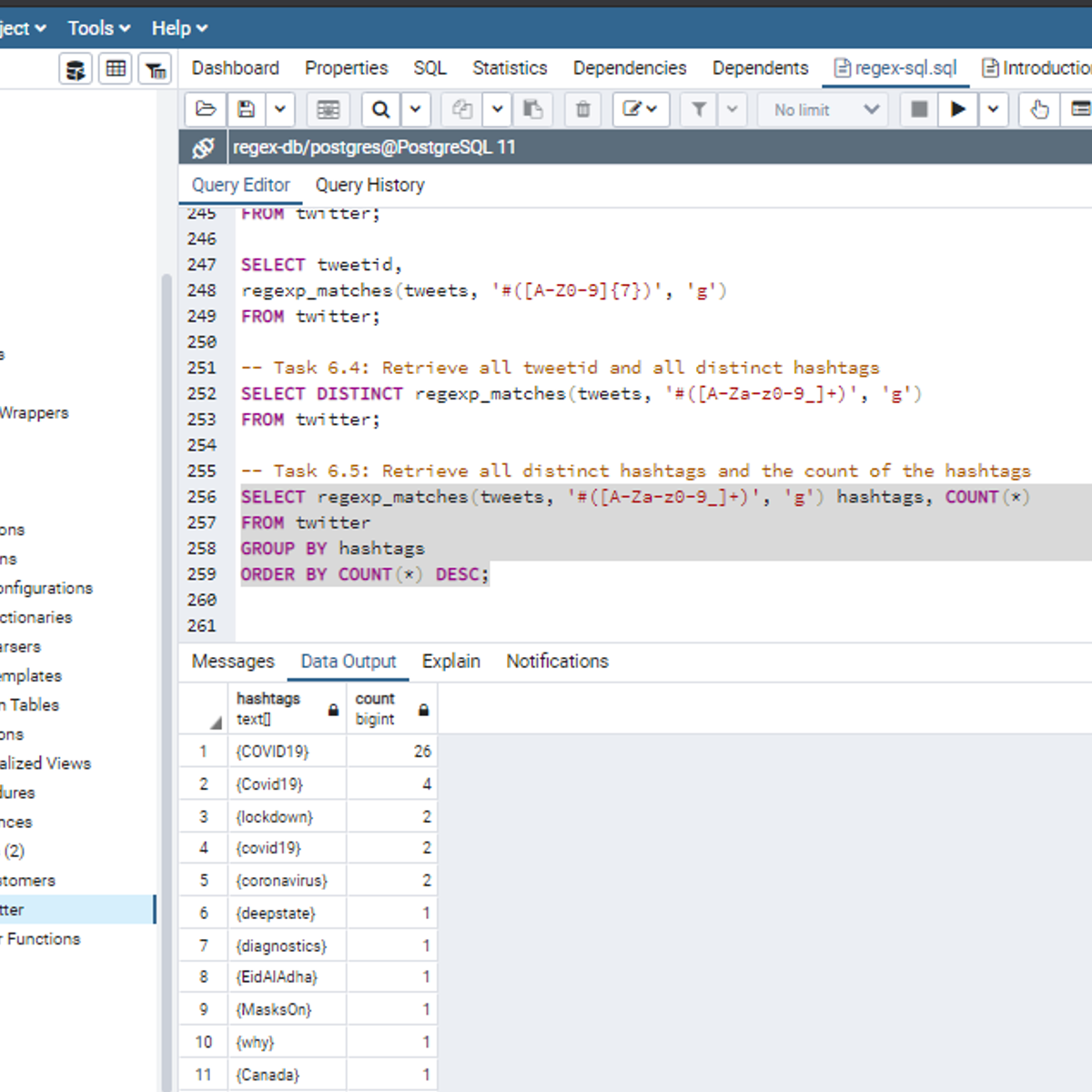
Introduction to Regular Expressions in SQL
Welcome to this project-based course, Introduction to Regular Expressions in SQL. In this project, you will learn how to use SQL regular expressions extensively for pattern matching to query tables in a database. By the end of this 2-and-a-half-hour-long project, you will be able to use POSIX regular expressions together with meta (special) characters in the WHERE clause and the SELECT clause to retrieve the desired result from a database. In this project, we will move systematically by first revising the use of the LIKE and NOT LIKE operators in the WHERE clause. Then, we will use different regular expression metacharacters together with POSIX operators in the WHERE clause. Also, we will use regular expressions to work on tweets from Twitter data. Be assured that you will get your hands really dirty in this project because you will get to work on a lot of exercises to reinforce your knowledge of the concepts. Also, for this hands-on project, we will use PostgreSQL as our preferred database management system (DBMS). Therefore, to complete this project, it is required that you have prior experience with using PostgreSQL. Similarly, this project is an intermediate SQL concept; so, a good foundation for writing SQL queries is vital to complete this project. If you are not familiar with writing queries in SQL and want to learn these concepts, start with my previous guided projects titled “Querying Databases using SQL SELECT statement." I taught this guided project using PostgreSQL. So, taking these projects will give the needed requisite to complete this Introduction to Regular Expressions in SQL project. However, if you are comfortable writing queries in PostgreSQL, please join me on this wonderful ride! Let’s get our hands dirty!

Ultimate Cisco Labs Master Course
The Ultimate Cisco Labs Master Course is a comprehensive, lab-driven Cisco networking course designed for anyone who wants to build practical, hands-on configuration experience across a wide range of real-world network scenarios. The course prioritises doing over theory, cutting straight to guided labs that replicate the kinds of tasks network engineers and IT professionals encounter in real environments. One of the defining features of the course is its flexibility around lab tools. Students can follow along using Cisco Modeling Labs, Cisco Packet Tracer, GNS3, or EVE-NG, or simply watch the labs to absorb configurations at their own pace. Hands-on exercises are completed inside a virtualised lab environment throughout, covering routing and switching, VLANs, trunking, spanning tree, and inter-VLAN routing as core foundational topics. Further topics include Quality of Service configuration, IPv6 addressing and deployment, SOHO network design and security, Hub-and-Spoke topologies, redundant and fault-tolerant network design, datacenter networking, corporate network design, DMZ architecture, and IoT device segmentation and management. Security-conscious network design is treated as a core principle throughout rather than a separate topic. The course is continuously updated with new labs and configurations as Cisco technologies evolve, meaning the content remains current and relevant over time. The course is designed for beginners new to networking who want to learn through practical labs, certification candidates preparing for CCST, CCNA, or CCNP, IT support professionals wanting to develop deeper Cisco configuration skills, network engineers looking for more structured lab experience across advanced topics, and career changers moving into networking who want practical, applicable skills. Please note that this course is intended for educational purposes only. Upon completion, students receive a Certificate of Completion suitable for adding to a résumé or LinkedIn profile.

Security Tools & Infrastructure Testing
This course pairs two technically connected topics that share a common toolkit: security tools and infrastructure testing. Covering approximately 4 hours of expert instruction across command-line security tools, protocol analysis, network scanning, log analysis, and penetration testing techniques, learners develop the practical skills to assess and monitor security posture using real-world tools. Learners benefit by gaining hands-on experience with CLI tools, network scanners, vulnerability assessment tools, and social engineering test techniques — skills that are directly applied in the security operations and testing domains of the Security+ exam. Online labs reinforce tool-based security tasks. By the end of this course, learners will be able to use security tools to assess infrastructure, conduct authorized testing, and apply penetration testing concepts to improve organizational security posture.

[NEW] GCP Professional Cloud Architect | Exam Prep
This course contains the use of artificial intelligence. Do you want to pass the Google Cloud Professional Cloud Architect exam on your first try and develop the architectural thinking skills to design, manage, and secure real cloud solutions at scale? This course is designed to get you there. My name is Vladimir, and I'll be your instructor. I hold 5 Google Cloud certifications, including the Professional Cloud Architect and Associate Cloud Engineer, as well as AWS AI certifications and the Project Management Professional. I've been teaching online for over 10 years and have helped thousands of students earn their cloud certifications. Now, I'm here to help you do the same. By the end of the course, you will be ready to sit the official Google Cloud Professional Cloud Architect exam. You will sharpen your ability to design, plan, and manage secure, scalable cloud solutions on Google Cloud. On architecture and design, you will build scalable, highly available, cost-efficient solutions aligned with the Google Cloud Well-Architected Framework, including migration planning and trade-off analysis. On infrastructure and AI, you will work with Compute Engine, GKE, Cloud Run, and Google AI and ML services, and learn to select the right compute for every workload. On data and storage, you will cover Cloud Storage, Cloud SQL, BigQuery, Bigtable, AlloyDB, Spanner and Firestore, and design the right data solution for each scenario. On networking, you will cover VPC design, hybrid and multicloud connectivity, Load Balancing, Private Service Connect and container networking. On security and compliance, you will cover IAM, Cloud KMS, VPC Service Controls, data sovereignty, PII handling and regulatory compliance. On operations and reliability, you will cover CI/CD, disaster recovery, monitoring, logging, deployment strategies, and keeping production reliable. I've also created a unique lecture format where I walk through the four official PCA case studies and show you exactly how to approach them on exam day. These case studies are published by Google before the exam, and up to 30% of your questions will be based on them. For each case study, I've prepared five dedicated scenario questions where I walk you through my thinking process - the same method I've used to pass multiple cloud certifications myself, and that has helped thousands of my students do the same. Let me quickly go over what makes this course special: • Approximately 30 hours of high-quality video content, strongly aligned with the latest PCA exam guide so nothing catches you off guard on exam day. • Hands-on demonstrations alongside architectural walkthroughs because while the PCA exam focuses on architectural decisions, you need to see how those decisions play out in a real environment. • Over 280 practice questions with detailed explanations, included as quizzes after each section. • Two full-length practice exams designed to prepare you perfectly for the real testing environment. • A downloadable Study guide with summaries of all lectures and convenient reference material covering key concepts from the entire course. • Regular updates based on the latest changes in Google Cloud offerings and exam content. This course is designed for IT professionals ready to earn the Google Cloud Professional Cloud Architect certification. This is a professional-level exam, and Google recommends having real-world GCP experience before sitting it. If you're coming from a background in cloud engineering, development, or architecture and want to move into a senior cloud architect role, you are exactly who this course is built for. With my structured approach, hands-on demonstrations, and proven teaching method, you'll have everything you need to pass the exam on your first try - and the practical knowledge to design and manage real Google Cloud solutions with confidence. Take a look at the preview videos, especially the roadmap to success, because I want to show you my plan for passing the exam! Ready to get started? I'll see you in the course. This course is not affiliated with, endorsed by, or sponsored by Google Cloud Platform (GCP) or Google LLC. Google Cloud and all Google product names are trademarks of Google LLC. All logos and trademarks are used for educational and identification purposes only.

Managing Security in Google Cloud - Português Brasileiro
"Este curso de treinamento autoguiado oferece aos participantes um amplo estudo sobre controles e técnicas de segurança no Google Cloud. Com palestras gravadas, demonstrações e laboratórios práticos, os participantes podem conhecer e implantar os componentes de uma solução segura do Google Cloud, incluindo o Cloud Identity, o Resource Manager, o Cloud IAM, os firewalls de nuvem privada virtual, o Cloud Load Balancing, peering do Cloud, o Cloud Interconnect e o VPC Service Controls. Este é o primeiro curso da série Security in Google Cloud. Quando completar este curso, inscreva-se no Security Best Practices in Google Cloud."

CompTIA A+ 220-1201 Core 1 Hands-On Course Full Training
CompTIA A+ 220-1201 Core 1 exam is one of the exams you will need to pass to get A+ certified. In this course, I will be using my 25+ years of experience teaching IT courses to give you a practical hands-on approach to all of the CompTIA A+ Certification Core (220-1201) exam Objectives. I will cover all of the exam objectives in detail using live actual components and in-depth explanations on each topic. I am a best-selling author that has sold over 250,000 books in project management and IT service management. I have helped thousands of students to pass their certification exams over the last 20 years. My method of teaching is engaging and fun. I will review how to build your own lab to follow along with me on this journey so you can gain the practical knowledge needed not only to pass your A+ Core 1 (220-1201) exam but also how to apply it in the real world of being an IT technician. This course will cover the following domains: • Mobile Devices • Networking • Hardware • Virtualization and Cloud Computing • Hardware and Network Troubleshooting This course includes: • Over 95 lectures. • Over 14 Hours of training. • We will only be covering the topics on your exam, no-nonsense and personal stories. • PDF of all course notes to study with during and after the class. • PDF of the exam objectives from CompTIA for the A+ Certification Core 1 (220-1201) exam. • End of domain quizzes. • Constantly updated course materials • Certificate of completion • Lifetime access To become A+ certified you will need to pass the core 1 (220-1201) and core 2 (220-1202) exams, this course will only prepare you to pass the core 1 exam.

Classify Images with TensorFlow Convolutional Neural Networks
This is a self-paced lab that takes place in the Google Cloud console. In this lab, you'll learn about how to use convolutional neural networks to improve your image classification models.

Mastering Agents with OpenAI Agents SDK & OpenAI Codex
Master the OpenAI Agents SDK and build production-ready AI agents from the ground up, then build every one of them hands-on with OpenAI Codex as your AI pair programmer. This comprehensive course takes you from your very first agent to deploying realtime, voice, and sandboxed multi-agent systems that integrate with real tools and external services. Whether you're a Python developer stepping into agentic AI, or an experienced engineer who wants to ship reliable agents to production, this course gives you everything you need: the core SDK primitives, the patterns that make agents safe and observable, and a Codex-driven workflow that lets you build faster than ever. What makes this course different: you don't just watch, you build. Every lab is constructed with OpenAI Codex, so you learn both the OpenAI Agents SDK and how to drive an AI coding agent to scaffold, implement, test, and ship real applications. What You'll Learn includes OpenAI Codex, Core SDK & Agent Design: • Foundations – Understand what agents are, the agent loop, and how the OpenAI Agents SDK fits together • Threads and Approval Modes – Understand the anatomy of a Codex thread and control permissions safely • Multitasking and Worktrees – Run Codex across multiple projects and parallel git worktrees • GitHub and Cloud Environments – Repositories, GitHub CLI, and running Codex in the cloud • AGENTS md, Skills, and Memory – Teach Codex your conventions so it builds the way you want • Plan Mode and Goal Mode – Move from one-shot prompts to planned, goal-driven builds • Scheduled Jobs, Heartbeats, and Plugins – Automate recurring work and extend Codex • Voice, Dictation, and Remote Control – Drive Codex hands-free, and from your phone • Multi-Agent Workflows – Orchestrate several Codex agents working in parallel • Computer Use, Appshots, and Sites – Let Codex drive apps, capture UI, and publish sites • Image Generation – Generate visual assets directly inside your Codex workflow • Prompts & Structured Output – Write effective instructions and get typed, structured results you can rely on • Model Settings – Configure models, providers, and transport for the behavior and cost profile you need • RunContext & Dependency Injection – Pass typed context and dependencies cleanly into your agents • Run Loop, RunResult & the REPL – Run agents, stream output, inspect results, and iterate fast • Hosted & Function Tools – Extend agents with built-in tools and your own Python functions • Agents as Tools – Compose specialized agents by calling one agent from another • Guardrails & Human Review – Add input/output guardrails and human-in-the-loop control for safety • Sessions & Memory – Persist conversation state, and move beyond SQLite to production session storage • Handoffs & Multi-Agent Orchestration – Route work across multiple agents to solve complex tasks • MCP & Connectors – Connect agents to external systems through the Model Context Protocol • Monitoring & Tracing – Trace, monitor, and debug agent runs for full production visibility • Realtime & Voice Agents – Build realtime voice agents and chain multi-step voice workflows • Sandbox Agents – Master SandboxAgents: manifests, capabilities, providers, mounts, credentials, memory, and state composition • Bonus: AWS Bedrock AgentCore – Deploy an OpenAI agent to production on AWS Hands-On Learning: 6 Production Labs Built with Codex This isn't just lectures. You'll build real applications through comprehensive, step-by-step labs, each driven with OpenAI Codex: • Lab 0: Setup – Set up your environment and your Codex workflow so you can build along from day one • Lab 1: Basic Agents – Build your first working agents with instructions, structured output, and context • Lab 2: Multi-Agent Handoffs & Agents as Tools – Orchestrate multiple agents that hand off work and call each other as tools • Lab 3: SandboxAgents – Build a SandboxAgent with manifests, capabilities, and secure mounts • Lab 4: SQL Analyzer Agent – Build a complete capstone agent that combines function tools, structured output, and sessions to analyze data • Lab 5: Voice Agents – Build a realtime voice agent and a chained voice workflow By the end, you'll be able to design, build, orchestrate, and ship production-grade OpenAI agents, and you'll have a repeatable Codex workflow to keep building long after the course ends.
Enterprise Database Migration
This course is intended to give architects, engineers, and developers the skills required to help enterprise customers architect, plan, execute, and test database migration projects. Through a combination of presentations, demos, and hands-on labs participants move databases to Google Cloud while taking advantage of various services. This course covers how to move on-premises, enterprise databases like SQL Server to Google Cloud (Compute Engine and Cloud SQL) and Oracle to Google Cloud bare metal.

The Ultimate Dark Web, Anonymity, Privacy & Security Course
Welcome to the ultimate dark net, privacy, anonymity and security course. With no prior knowledge required this course will take you from a beginner to advanced in all of these topics; teaching you how to properly and securely discover data and websites on both the dark web and clear web, access hidden (onion) services, communicate privately and anonymously using instant messages and email, manually use end-to-end encryption to protect your privacy and make it impossible to read even if it gets intercepted, sign and verify files, share files anonymously, transfer funds anonymously using crypto currencies such as Bitcoin and Monero and much more! You'll also learn how to do all of this in a secure manner making it very difficult for hackers or other entities to hack you or de-anonymise you. This course is highly practical but won't neglect the theory, first you'll understand the inner-workings of each topic and each technique covered, then you'll learn how to apply it in real-life scenarios ultimately teaching you how to use the dark net and the clear net in a more private, more anonymouse and more secure manner. By the end of the course you'll be able to combine the skills you learned and use them in any situation that requires more privacy, more anonymity or more security. This course covers four main topics, I chose to cover all of these topics in one course because I think it is very difficult to learn one without the others as they are very related, these main topics are: 1. Anonymity - anonymity is a state where your identity is unknown. Achieving this on the internet is not easy because of the way the internet is designed. In this course you'll learn a number of techniques to protect your anonymity; you'll first learn what the TOR network is, understand how it works and how it can significantly improve our anonymity, then you'll learn how to connect to it using the TOR Browser, using TAILS and using Qubes OS. You'll also learn how configure TOR properly to bypass censorship and connect even if its blocked! 2. Privacy - Using an anonymising network such as TOR is not enough to stay private and anonymous because the operating systems we use (Windows, Apple Mac OS and Linux) constantly collect data about us. Therefore in this course you'll learn how to use operating systems designed to be more private, more anonymous and more secure; TAILS and Qubes OS. You'll learn how to install these operating systems on a USB stick so you can use them on any computer without affecting the original operating system and without leaving any traces! There's also a fully section on encryption in which you'll learn how the two main types of encryptions work (symmetric and asymmetric), end-to-end encryption and how to use it to encrypt / decrypt and sign / verify data, This allows you to privately communicate and share any sort of data; whether it is simple text, or files such as images, videos, etc. without worrying about it being intercepted. The the payment methods we are used to use are not private and not anonymous. Therefore the course has a full section on crypto-currencies, to teach you about blockchain, crypto-currencies, and how to anonymously obtain two crypto currencies; Bitcoin and Monero and use them to send / receive funds. 3. Dark Net - This is the portion on the internet that is not indexed by search engines and require special configuration to access. Using anonymising networks and privacy-focused operating systems are 2 steps in the right direction of becoming more private and more anonymouse. However, unfortunately it is not enough, the services we use everyday are not private and constantly collect data about us, so the the search engines (Google or Bing), the email provers (ex: Gmail, or Yahoo), the instant messaging platforms (Whatsapp or Skype), the file sharing services (Dropbox or Google Drive) and the list goes on. All of these services are not private, not anonymouse and can be used to track us and de-anonymise us. Therefore in this course I will teach you how to carry out your normal day-to-day tasks in a more private and anonymous manner, so first I'll teach you how to search for websites and content on both the clear net and on the dark net, then I'll tech you how to discover hidden services (onion services) to carry out your normal day-to-day tasks privately and anonymously (such as communicating using emails, or instant messages, file sharing, etc.). 4. Security - All of the above will drastically enhance your anonymity and privacy and allow you to access both the dark web and the clear web privately and anonymously. However if you get hacked, the hacker will gain control over your system and therefore will be able to easily bypass whatever anonymity techniques you're using and de-anonymise you, so all of the above is useless without security. Therefore in this course I will teach you how to do all of the above securely, then at the last section of the course I'll show you how to take your security to the next level by dividing your operating system into a number of isolated security domains. Therefore even if you get hacked, only a small portion of your system will be compromised, making it extremely difficult for the hacker to compromise the entire system or de-anonymise you. With this course you'll get 24/7 support, so if you have any questions you can post them in the Q&A section and we'll respond to you within 15 hours. Checkout the curriculum and the course teaser for more info! Notes: • This course is created for educational purposes only . • This course is totally a product of Zaid Sabih & zSecurity and no other organisation is associated with it or a certification exam. Although, you will receive a Course Completion Certification from Udemy, apart from that NO OTHER ORGANISATION IS INVOLVED.

Generative AI for Azure Cloud Engineers
The Generative AI for Azure Cloud Engineers course is designed for Azure cloud engineers, DevOps professionals, solution architects, and IT practitioners who want to understand and implement Generative AI solutions using Microsoft Azure services. This course provides a comprehensive foundation in Azure OpenAI Service, Microsoft Copilot, Copilot Studio, Microsoft Foundry, and enterprise-grade Generative AI capabilities within the Azure ecosystem. This course introduces learners to the core concepts of Generative AI, including large language models, prompt engineering, multimodal AI, and Responsible AI practices. You will explore how Azure OpenAI Service enables text generation, code generation, and image generation, and how these capabilities integrate with Azure applications, automation workflows, and enterprise cloud architectures. You will also learn how Microsoft Copilot enhances productivity across Microsoft 365, security operations, and business applications, and how Copilot Studio enables engineers to build intelligent conversational agents. Additionally, the course introduces Microsoft Foundry, Retrieval Augmented Generation (RAG), model fine-tuning, and model catalog capabilities for building enterprise-ready AI solutions. Through conceptual explanations, demonstrations, and real-world Azure cloud engineering scenarios, this course helps you understand how to design, deploy, and manage Generative AI solutions securely and efficiently in Azure. The course delivers approximately 12–15 hours of structured video content, organized into four modules. Each module includes quizzes and knowledge checks to reinforce learning and validate understanding. Enroll in Generative AI for Azure Cloud Engineers to gain practical knowledge of Azure Generative AI services and confidently build intelligent cloud-native AI solutions using Microsoft Azure. Course Modules: Module 1: Generative AI Overview Understand the fundamentals of Generative AI, including its core concepts, architecture components, features, and enterprise use cases. Learn how Generative AI solutions work and explore Responsible AI principles to ensure safe, ethical, and compliant AI implementation. Module 2: Azure OpenAI Service and Applications Explore Azure OpenAI Service and learn how to build natural language, code generation, and image generation solutions. Understand prompt engineering, REST APIs, multimodal models, fine-tuning, and how Azure OpenAI powers enterprise AI solutions such as Microsoft Copilot. Module 3: Microsoft Copilot and Copilot Studio Overview Learn how Microsoft Copilot enhances productivity across business applications and how Copilot Studio enables the creation of intelligent conversational agents. Explore Copilot use cases, demos, and how Generative AI integrates with Microsoft Power Platform and enterprise workflows. Module 4: Microsoft Copilot, Security Copilot, and Microsoft Foundry Services Understand Microsoft 365 Copilot, Security Copilot, and Microsoft Foundry capabilities. Learn how Retrieval Augmented Generation (RAG), model catalog, and fine-tuning help engineers build optimized, scalable, and enterprise-grade Generative AI applications in Azure. By the End of This Course, You Will Be Able To: Understand core Generative AI concepts, components, and enterprise use cases Use Azure OpenAI Service to build text, code, and image generation solutions Apply prompt engineering techniques to control and optimize AI model responses Integrate Generative AI capabilities into Azure cloud applications and workflows Understand Microsoft Copilot, Copilot Studio, and their enterprise use cases Implement Retrieval Augmented Generation (RAG) and model optimization techniques Use Microsoft Foundry and model catalog to build enterprise-grade AI solutions Apply Responsible AI principles and best practices in Azure Generative AI deployments

DP-800 exam prep: Microsoft SQL Server AI Developer course
This course covers the advanced content required for the Microsoft DP-800 "Developing AI-Enabled Database Solutions" certification exam. What will you learn in this course? • We'll create an Azure SQL Database with sample data, as well as a Fabric SQL Database and install SSMS and Visual Studio Code. • We'll create T-SQL statements, including database objects, programmability objects, and basic and advanced T-SQL code. • We’ll then add GitHub and Microsoft Copilot, Implement data security and compliance, and Optimize database performance. • We’ll then create SQL Database Projects to implement schema changes, and add source control using GitHub. We’ll also integrate SQL solutions with Azure services. • Finally, we'll look at how to implement AI capabilities in database solutions. We’ll design and implement models, embeddings and intelligent search using vectors and full-text indexing, and design and implement retrieval-augmented generation. Once you have completed the course, you will have a good knowledge of developing AI-enabled Database Solutions using Azure SQL Database. And with some practice and knowledge of some additional topics, you could even go for the official Microsoft certification DP-800 - wouldn't the "Microsoft Certified: SQL AI Developer Associate" certification look good on your CV or resume? I hope to see you in the course - why not have a look at what you could learn?

GKE でのスケーラブルなワークロードの管理
Google Kubernetes Engine を使用して、アプリケーションを大規模にモダナイズ、管理、モニタリングする方法を学びます。このコースでは、講義とハンズオンラボを通じて、Google Kubernetes Engine(GKE)、GKE フリート、Cloud Service Mesh、Config Controller の機能を学習し、デプロイします。これらの機能を活用することで、複数のプロバイダでホストされた複数のクラスタに分散しているような最新のアプリケーションでも、適切に管理できるようになります。

OpenTelemetry for Observability: The Complete Course
Welcome to OpenTelemetry for Observability: The Complete Course! Are you ready to take full control of your distributed systems and build the production-grade observability platform your applications deserve? This course is designed to take you from observability fundamentals to a fully instrumented, Kubernetes-deployed system - using OpenTelemetry, Prometheus, Loki, Tempo, and Grafana. Why Learn OpenTelemetry and Observability? Modern software systems are distributed, dynamic, and complex. When something breaks in production, you need answers fast — and the difference between a five-minute fix and a five-hour outage often comes down to how well your system is instrumented. Here is why mastering OpenTelemetry and observability is essential right now: • OpenTelemetry Is the Industry Standard for Telemetry: OpenTelemetry is a CNCF-graduated project and the vendor-neutral standard for generating and collecting observability data. It is rapidly replacing proprietary instrumentation SDKs across the industry. Learning OpenTelemetry means your instrumentation code is portable across any backend - Prometheus, Grafana Cloud, Datadog, Honeycomb, and beyond - without rewriting a single line. • Metrics, Logs, and Traces Are No Longer Optional: Observability is not a nice-to-have anymore. Engineering organizations operating distributed systems rely on correlated metrics, logs, and traces to detect issues, diagnose root causes, and validate reliability targets. Teams that instrument their systems correctly ship with confidence. • Prometheus and Grafana Are the Backbone of Cloud-Native Observability: Prometheus is the de facto standard for metrics collection in Kubernetes environments. Grafana is the leading visualization and exploration platform across all three signal types. Together with Loki for logs and Tempo for traces, they form a complete open-source observability stack that is production-proven at scale (and entirely free to use!). • Distributed Tracing Solves the Problems Metrics Alone Cannot: When a request fails or slows down in a system with multiple services, metrics tell you something is wrong, but traces tell you exactly where and why. OpenTelemetry distributed tracing gives you end-to-end visibility across service boundaries, including asynchronous message queue patterns where traditional tracing tools fall short. • High Market Demand for Observability Skills: As organizations shift to microservices, platform engineering, and SRE practices, the demand for engineers who understand SLIs, SLOs, error budgets, and modern instrumentation is accelerating. Observability expertise consistently differentiates candidates for senior DevOps, platform, and SRE roles. By investing time in this course, you are building one of the most practical and transferable skill sets in modern software engineering: skills that apply regardless of the language, framework, or cloud provider your team uses. Why Should You Choose This Course? This course goes far beyond a surface-level introduction to OpenTelemetry. You will build and instrument a real distributed application end-to-end, using the same tools and workflows used in production environments today. • Learn by Doing with Extensive Hands-On Labs: Every concept in this course is immediately followed by a practical lab. You will instrument real code, deploy real infrastructure, and debug real issues. I provide the task, give you space to try it yourself, and then walk through the solution step by step. • Instrument a Real Distributed Application: We do not instrument a toy "Hello World" app. The course target is a distributed translation application with a Node.js frontend, a Python background worker, and a Redis queue. This multi-language, asynchronous architecture represents the kind of real-world complexity where observability truly matters. • Complete Coverage of All Three Observability Signals: Most courses focus on one signal type. This course covers metrics, logs, and traces in equal depth, including both automatic and manual instrumentation for each, applied to both services in the system. • Distributed Context Propagation Across Async Boundaries: One of the most challenging and most valuable skills in observability engineering is connecting traces across services that communicate asynchronously. This course tackles that challenge directly, walking you through bidirectional context propagation across a message queue so that a single end-to-end trace spans the entire system. • AI-Assisted Workflows Integrated Throughout: From auditing Kubernetes manifests to diagnosing deployment bugs, the course integrates AI tooling in a practical and realistic way. You will see how to use AI assistants to accelerate instrumentation, improve manifest quality, and speed up root cause analysis. • Kubernetes Deployment Included: The course does not stop at local development. You will migrate the full application and observability stack to Kubernetes using Kustomize, deploy to a live cluster, and verify that all three observability signals are flowing correctly in a real production-like environment. Which Skills Will You Acquire During This Course? As you progress through the lectures and labs, you will gain a comprehensive set of observability and instrumentation skills, including: • Building an Observability Stack from Scratch: You will deploy and connect Prometheus, Loki, Tempo, and Grafana, configure the OpenTelemetry Collector as a centralized telemetry pipeline, and verify that the full stack is operational before writing a single line of instrumentation code. • Defining Reliability Targets with SLIs, SLOs, and SLAs: You will learn to define user-centric Service Level Indicators, set Service Level Objectives as internal reliability targets, understand the difference between SLOs and contractual SLAs, and use error budgets to make informed decisions about deployment velocity versus stability. • Applying OpenTelemetry Automatic Instrumentation: You will enable automatic instrumentation for Node.js and Python services to capture framework-level metrics, logs, and traces with minimal code changes, giving you broad observability coverage as a starting point for both services. • Creating Custom Metrics with Counters and Histograms: You will implement manual metrics instrumentation to capture domain-specific business events that automatic instrumentation cannot surface. You will add dimensional labels to your metrics and explore them in Prometheus using PromQL. • Building Custom Spans for Business Logic Tracing: You will create manual OpenTelemetry spans to trace business-level operations inside your services, set span attributes and error status, and manage span lifecycle correctly to produce accurate, informative traces visible in Grafana Tempo. • Configuring Structured Logging with Trace Context Injection: You will replace unstructured log output with structured logging integrated with the OpenTelemetry SDK so that every log entry automatically carries trace context. You will then configure log-trace correlation in Grafana for one-click navigation between a log entry and its corresponding trace. • Implementing Distributed Context Propagation: You will manually inject and extract trace context across an asynchronous message queue boundary to connect frontend and worker spans into a single end-to-end trace. You will implement the full round trip and verify the complete trace in Grafana Tempo. • Using the Exporter Pattern for Third-Party Services: You will deploy a Redis exporter as a sidecar to collect operational metrics from Redis, which has no native OpenTelemetry support, and expose those metrics to Prometheus. This pattern applies to any third-party service in your stack. • Deploying to Kubernetes with Kustomize: You will write Kubernetes manifests for the full application and observability stack, manage multi-namespace configuration with Kustomize, deploy to a local cluster, diagnose and fix telemetry collection bugs, and verify end-to-end signal flow through a live Kubernetes environment. Get ready to build the observability platform your distributed systems deserve. Whether you are an engineer who has never written a span in your life or a practitioner looking to master OpenTelemetry properly, this course will give you the depth, the practice, and the confidence to instrument any system, in any language, on any platform. Let's get started!

Deploying & Managing Active Directory in Hybrid Environments
Strengthen your expertise in Active Directory (AD) with this comprehensive, hands-on course designed to prepare you for managing identity across both on-premises and cloud-connected environments. From traditional domain controllers to Azure AD and hybrid identity solutions, you’ll gain the skills to deploy, configure, and maintain a modern AD infrastructure with confidence. You’ll begin by exploring core Active Directory components, learning how to deploy and manage domain controllers in both on-premises environments and Microsoft Azure. Through practical demonstrations, you’ll configure FSMO roles, domain trusts, site links, and replication settings—building a solid foundation for more advanced hybrid scenarios. Next, you’ll dive into hybrid identity management, working with Azure AD, Azure AD Connect, and synchronization workflows. You’ll learn how to configure secure authentication strategies, manage health and monitoring, and ensure seamless identity integration across your hybrid environment. As you progress, you’ll gain hands-on experience with RODC deployment, Group Policy management, and user, group, and OU administration. You’ll also work with PowerShell, automating common AD tasks to streamline administration and support scalable, enterprise-ready workflows. By the end of this course, you will have: - Deployed and managed domain controllers in on-premises and Azure environments. - Configured FSMO roles, domain trusts, site configurations, and replication. - Implemented hybrid identity using Azure AD and Azure AD Connect. - Deployed and managed RODCs and applied Group Policies effectively. - Managed users, groups, and OUs with both GUI tools and PowerShell. - Developed the skills to troubleshoot, maintain, and optimize AD in hybrid setups. This course is ideal for IT professionals, system administrators, and cloud engineers looking to expand their skills in hybrid identity and Active Directory management. With practical, real-world scenarios throughout, you’ll be ready to apply your knowledge immediately in modern enterprise environments.

Verification Series Part 4: UVM Projects
Writing Verilog test benches is always fun after completing RTL design. You can assure clients that the design will be bug-free in tested scenarios. As system complexity grows day by day, System Verilog becomes a choice for verification due to its powerful capabilities and reusability, which help verification engineers quickly locate hidden bugs. System Verilog lags behind the structured approach, whereas UVM works hard to form a general skeleton. The addition of the configuration database shifts the way we used to work with the verification language in the past. Within a few years, verification engineers recognized the capabilities of UVM and adopted it as a de facto standard for RTL design verification. The UVM will have a long run in the verification domain; hence, learning about the UVM will help VLSI aspirants pursue a career in this domain. This is a Lab-based course designed such that anyone with the fundamentals of UVM could understand how verification engineers use UVM to perform verification of commonly used RTLs and sub-blocks in FPGA. The course covers verification of the combinational circuit like combinational adder, Sequential circuit like Data flip-flop, communication interfaces like a clock generator, UART, SPI, and I2C, and Bus protocols like APB, AXI, and demonstration of few useful UVM concepts like a virtual sequencer, TLM analysis FIFO, and a sequence library.

Essential Cloud Infrastructure: Core Services dalam bahasa Indonesia
Kursus akselerasi sesuai permintaan ini memperkenalkan peserta pada infrastruktur dan layanan platform yang komprehensif dan fleksibel yang disediakan oleh Google Cloud, dengan fokus pada Compute Engine. Melalui kombinasi video materi edukasi, demo, dan lab praktis, peserta akan mengeksplorasi dan men-deploy berbagai elemen solusi, termasuk komponen infrastruktur seperti jaringan, sistem, dan layanan aplikasi. Kursus ini juga membahas cara men-deploy solusi praktis termasuk kunci enkripsi yang disediakan pelanggan, pengelolaan keamanan dan akses, kuota dan penagihan, serta pemantauan resource.

Linux Device Driver Programming With Beaglebone Black (LDD1)
==> This should be your very first course to dive into the exciting world of "Linux device drivers" <== In this course you will learn , • Fundamentals Linux kernel module and syntax • Character device driver theory and code implementation • Platform bus, Platform device, and platform driver concepts • Platform driver implementation • Device tree from scratch • Accessing device tree nodes from drivers • Device instantiation through device tree nodes • Device tree properties and node syntax • Device tree overlays • Overlays testing via u-boot • Kernel synchronization services (Mutex, Spinlocks) • Linux device model and sysfs • Linux GPIO subsystem • Linux pinctrl subsystem Hardware Requirements: 1) For some exercises involving testing of GPIOs, pinctrl, device tree nodes, overlays, you need a board. In this course, Beaglebone Black board is being used. 2) Mini USB cable to power BBB 3) USB to UART cable for serial connection with BBB 4) Micro SD card 8/16 GB 5) SD card reader 6) 16x2 LCD and 10K potentiometer 7) Jumper wires 8)Bread board OS Requirements: 32/64 bit Ubuntu 18.04+ LTS Learning order of FastBit Embedded Brain Academy Courses, If you are a beginner in the field of embedded systems, then you can take our courses in the below-mentioned order. This is just a recommendation from the instructor for beginners. 1) Microcontroller Embedded C Programming: absolute beginners(Embedded C) 2) Embedded Systems Programming on ARM Cortex-M3/M4 Processor(ARM Cortex M4 Processor specific) 3) Mastering Microcontroller with Embedded Driver Development(MCU1) 4) Mastering Microcontroller: TIMERS, PWM, CAN, RTC,LOW POWER(MCU2) 5) Mastering Microcontroller: STM32-LTDC, LCD-TFT, LVGL(MCU3) 6) Embedded System Design using UML State Machines(State machine) 7) Mastering RTOS: Hands-on FreeRTOS and STM32Fx with Debugging(RTOS) 8) ARM Cortex M Microcontroller DMA Programming Demystified(DMA) 9) STM32Fx Microcontroller Custom Bootloader Development(Bootloader) 10) Embedded Linux Step by Step using Beaglebone Black(Linux) 11) Linux device driver programming using Beaglebone Black(LDD1) Other programming courses 1) Master The Rust Programming Language : Beginner To Advanced

Red Hat AI Technical Overview
This technical overview describes the complex AI landscape and the significant enterprise challenges associated with bringing AI applications into production. It details how the Red Hat AI portfolio provides a unified, consistent, enterprise-ready AI platform built on the foundation of OpenShift for deployment anywhere across the hybrid cloud. The platform accelerates model development and delivery by offering features like high-performance inference with vLLM and llm-d, model customization via RAG and fine-tuning, and pipelines and observability features to govern and automate the entire model lifecycle. Whether you're looking to build and train ML models or are responsible for installing and monitoring AI applications, this course will cover challenges of operationalizing AI, inference, connecting models to data, Agentic AI, and more!

AZ-104 Microsoft Azure Administrator course with SIMULATIONS
We really hope you'll agree, this training is way more than the average course on Udemy! Have access to the following: • Training from an instructor of over 20 years who has trained thousands of people and also a Microsoft Certified Trainer • Lecture that explains the concepts in an easy to learn method for someone that is just starting out with this material • Instructor led hands on and simulations to practice that can be followed even if you have little to no experience TOPICS COVERED INCLUDING HANDS ON LECTURE AND PRACTICE TUTORIALS: Introduction • Welcome to the course • Understanding the Microsoft Environment • Having a Solid Foundation of Active Directory Domains • Having a Solid Foundation of RAS, DMZ, and Virtualization • Having a Solid Foundation of the Microsoft Cloud Services • Order of concepts covered in the course Setting up for hands on • IMPORTANT Using Assignments in the course • Creating a free Azure Account • Activating Azure AD P2 license Manage Microsoft Entra users and groups • Understanding Microsoft Entra Identities • Create users • Create users in bulk • Understanding Groups in Azure and Microsoft 365 • Create groups in Microsoft 365 • Create groups in Azure • Manage licenses in Microsoft Entra ID • Manage external users • Configure self-service password reset (SSPR) Manage Azure using command line tools • Basic concepts of PowerShell • Installing the Az commands and connecting to Azure • Understanding Microsoft Graph vs Traditional PowerShell • Connecting to MS Graph to support cloud services with PowerShell • Implementing PowerShell with MS Graph to manage Entra ID • Using Cloudshell • Using Azure CLI / Bash • Installing Azure CLI locally Manage access to Azure resources • Understanding roles • Manage built-in Azure roles • Assign roles at different scopes • Assign roles for access assignment including custom role creation • Interpret access assignments Manage Azure subscriptions and governance • Manage subscriptions • Configure management groups • Manage costs by using alerts, budgets, and Azure Advisor recommendations • Manage resource groups • Apply and manage tags on resources • Configure resource locks • Implement and manage Azure Policy Configure access to storage • Understanding storage accounts • Create and configure storage accounts • Configure Azure Storage firewalls and virtual networks • Create and use shared access signature (SAS) tokens • Configure stored access policies • Manage access keys • Configure identity-based access for Azure Files Configure and manage storage accounts • Understanding Azure Storage redundancy • Configure Azure Storage redundancy • Configure object replication • Configure storage account encryption • Manage data by using Azure Storage Explorer and AzCopy Configure Azure Files and Azure Blob Storage • Create and configure a file share in Azure Storage • Create and configure a container in Blob Storage • Configure storage tiers • Configure soft delete for blobs and containers • Configure snapshots and soft delete for Azure Files • Configure blob lifecycle management • Configure blob versioning Automate deployment of resources by using ARM templates or Bicep files • Interpret an Azure Resource Manager template or a Bicep file • Modify, export and deploy resources using an Azure Resource Manager template • Modify and deploy resources by using a Bicep file • Export a deployment & convert an Azure Resource Manager template to a Bicep file Create and configure virtual machines • Create a virtual machine • Create a virtual machine using PowerShell • Configure Azure Disk Encryption • Move a virtual machine to another resource group, subscription, or region • Manage virtual machine sizes • Manage virtual machine disks • Deploy virtual machines to availability zones and availability sets • Deploy and configure an Azure Virtual Machine Scale Sets Provision and manage containers in the Azure portal • Understanding Azure Containers • Create and manage an Azure container registry • Provision a container by using Azure Container Instances • Provision a container by using Azure Container Apps • Manage sizing and scaling for containers, including Azure Container Instances/App Create and configure Azure App Service • Understanding App Service plans • Provision an App Service plan • Configure scaling for an App Service plan • Create an App Service • Configure certificates & Transport Layer Security (TLS) & Map custom DNS names • Configure backup for an App Service • Configure networking settings for an App Service • Configure deployment slots for an App Service • Removing App services that are no longer needed Configure and manage virtual networks in Azure • Visualizing virtual networks and subnets in Azure • Create and configure virtual networks and subnets • Create and configure virtual networks and subnets with PowerShell • Create and configure virtual network peering • Configure public IP addresses • Configure user-defined network routes • Troubleshoot network connectivity Configure secure access to virtual networks • Create & configure network security groups (NSGs) & application security groups • Evaluate effective security rules in NSGs • Implement Azure Bastion • Visualizing service endpoints and private endpoints • Configure service endpoints for Azure platform as a service (PaaS) • Configure private endpoints for Azure PaaS Configure name resolution and load balancing • Configure Azure DNS • Visualizing Azure load balancing • Setting up two VMs for load balancing • Configure an internal or public load balancer • Configure load balancing rules for two VMs • Configure inbound NAT rules • Configure SNAT outbound rules • Troubleshoot load balancing • Removing the load balancer which is no longer needed • Before creating the Application Gateway • Start creating an Azure Application Gateway • Specifying a back-end pool while creating an Application Gateway • Setting the routing rules while creating an Application Gateway • Finalizing the gateway creation • Delete the Application Gateway resources Monitor resources in Azure • Interpret metrics in Azure Monitor • Configure log settings in Azure Monitor • Query and analyze logs in Azure Monitor • Set up alert rules, action groups, and alert processing rules in Azure Monitor • Configure and interpret monitoring of VMs, etc by using Azure Monitor Insights • Use Azure Network Watcher and Connection Monitor Implement backup and recovery • Create a Recovery Services vault • Create an Azure Backup vault • Create and configure a backup policy • Perform backup and restore operations by using Azure Backup • Configure Azure Site Recovery for Azure resources • Perform a failover to a secondary region by using Site Recovery • Configure and interpret reports and alerts for backups • Cleaning up our Azure environment

Figma for UI/UX: Master Web Design in Figma
Updated in May 2025. This course now features Coursera Coach! A smarter way to learn with interactive, real-time conversations that help you test your knowledge, challenge assumptions, and deepen your understanding as you progress through the course. Unlock the full potential of Figma and become a proficient UI/UX designer with this comprehensive course. You'll start by exploring Figma’s essential tools, comparing it with other design software, and creating your first website design. As you progress, you’ll dive into advanced design techniques, including color theory, typography, effects, and component-based workflows. Through hands-on projects, you’ll design complete web layouts, mastering elements like headers, navigation menus, cards, and footers. You’ll also explore responsive design principles, ensuring your designs look great on any device. Additionally, you’ll gain insights into the freelancing world, learning how to build a portfolio and attract clients. By the end of the course, you’ll be equipped to bring your designs to life by preparing them for developers. You'll understand how to optimize your workflow with tools like Zeplin and how to deliver production-ready files. Whether you're an aspiring UI/UX designer or a freelancer looking to expand your skills, this course will guide you from beginner to expert.

Learn to Design Your Own Boards
Learning a basic board design is essential for everyone who would like to work in electronics or who would like to design electronic boards or products. Learning board design in the right software can open you door into many companies, help you to get a well paid job and can be used to design very complex and advanced boards. Design a Real Board and Learn Essentials of Using Altium Designer - Draw your own schematic - Route your PCB and do layout - Generate documentation needed to manufacture your PCB Altium Designer is a Powerful Software During this course you will learn how to use Altium Designer software. Altium Designer is a professional software used to design all kind of boards, from very simple ones to motherboards or servers. It is one of the most used software for electronic design. Learning Altium is useful for everyone planning or already working in electronics. Contents and Overview You will start with Arduino Uno reference schematic. You will learn how to re-draw the schematic, modify it, you will learn how to improve it and how to do PCB layout. The course videos are step-by-step and even if you are new in electronics or you have never used Altium Designer before, by repeating these steps, you will design your own board. By the end of this course, you will create all the necessary documents needed to manufacture the board. Within 15 hours you will learn how to: - Draw schematic, including tips for component selection and important circuits - Create components, draw schematic symbols and footprints - Place components into your PCB - Route PCB and useful tips about layout - Create 3D model of your board - Create board variants with different components fitted / not fitted - Create Bill of Material (BOM) - Create assembly drawings showing position of components on the board - Generate Gerbers, Pick and Place, Drill file and other files needed for manufacturing - Prepare professional documents needed to manufacture your PCB and assemble your board - Bring your board to life, flash firmware and run a simple LED Blinky example For everyone interested, the manufacturing documents created during this course can be used to build your board. Simply use PCB manufacturing data to get your PCB, buy components from Digikey and solder them by yourself. Enjoy this course :)

Intermediate Network Design and Redundancy
This course features Coursera Coach! A smarter way to learn with interactive, real-time conversations that help you test your knowledge, challenge assumptions, and deepen your understanding as you progress through the course. In this course, you will gain a deep understanding of network design, focusing on redundancy and security through various Cisco Packet Tracer configurations. By creating advanced networks like DMZ, hub-and-spoke, and three-tier architectures, you will learn to design scalable, efficient, and secure networks that can withstand failures and attacks. The course provides practical exercises on network components, such as routers, firewalls, and switches, while ensuring high availability and redundancy. Throughout the course, you will start by learning the basic concepts and move toward more advanced configurations. For example, you'll begin with setting up a DMZ (Demilitarized Zone) for secure external communication and progress to implementing network topologies like hub-and-spoke and three-tier networks, applying concepts like IP addressing, routing, and network security in real-world scenarios. You'll also work with cutting-edge IoT technology to expand your network capabilities. The course concludes with a solid focus on testing and troubleshooting, ensuring you're prepared to handle practical challenges in a professional environment. Through a combination of theoretical lessons and hands-on labs, you’ll confidently build and manage networks that are both functional and secure. This course is for aspiring network engineers and IT professionals who want to advance their skills in designing secure, scalable, and redundant networks. It is perfect for those preparing for Cisco certifications or professionals working with IoT technologies and troubleshooting network configurations. By the end of the course, you will be able to design and configure DMZ, hub-and-spoke, and three-tier network topologies, optimize them for security and redundancy, implement IoT systems, troubleshoot and test network configurations, and handle network scaling in real-world enterprise environments.

Learn Linux in 2 Days: Fast Track for Busy Professionals
Whether you’re brand-new to Linux or a busy IT professional who has dabbled in the terminal but never took time for a proper foundation, this course will rapidly bring you up to speed. We cut through the fluff with a fast-paced, two-day roadmap designed for results: • Day 1 focuses on the essentials: Setting up your Linux environment, navigating the file system, and handling user permissions with confidence. By the end of the first day, you’ll already feel at home in the command line. • Day 2 takes you further: You’ll dive into streams and pipes, environment variables, security best practices, and server deployment fundamentals—so you can apply Linux skills in real-world, high-stakes environments without fear of causing costly errors. Why This Course Stands Out • Fast & Focused: We respect your time. Each lesson is clear and concise, getting you up to speed quickly. • Interactive Quizzes: Continuous mini-challenges ensure you truly understand each concept, rather than just following along passively. • Two Comprehensive Practice Exams: Simulate real-world Linux tasks and confirm you’re ready to handle professional scenarios—even under pressure. • Hands-On Approach: You’ll learn everything through hands-on examples - from filesystem navigation to server setup - so you can apply these skills immediately at work or in personal projects. • Security & Error Prevention: Cover simple yet effective steps - like SSH key authentication, file permissions, or safe ways to work with linux commands - to protect your server and avoid costly mistakes in both personal and professional settings. 2-DAY ROADMAP Day 1: Foundations & Fundamentals • Course Setup – Choose your Linux environment (local or VM). • CLI Basics – Discover essential Bash commands to move around the filesystem. • Working with Files – Create, edit, copy, move, and organize files like a pro. • User & Group Permissions – Securely manage access, ownership, and privileges. • First Practice Exam – Test your newfound skills in a realistic environment. Day 2: Advanced Skills & Server Deployment • Streams & Pipes – Learn to process and filter data efficiently. • Shell Environment – Customize variables, aliases, and workflows. • Package Management – Keep your system up to date and install software responsibly. • Server Basics – Spin up a Linux server, configure SSH, and host a simple website or app. • Final Practice Exam – Confirm you’re ready for real-world, high-stakes Linux tasks. Take the fast track to Linux mastery and invest just two days to build skills that can transform your career. By the end of this course, you’ll confidently navigate the terminal, manage multiple users, and even deploy a live server—all without the fear of costly mistakes. Enroll now and empower yourself with high-value, future-proof Linux skills!

Cybersecurity Prevention & Detection: System and Privacy Data Protection
This course delves into the critical aspects of data protection and privacy, and is designed for aspiring and seasoned cybersecurity professionals alike. You will gain a robust understanding of risk classification and mitigation, data privacy laws, and the intricacies of SIEM processes, including query writing. Lessons are crafted to equip you with the skills to analyze logs, understand organizational policies, and leverage automation to enhance cybersecurity measures. With practical examples and demos, you'll learn to navigate the complexities of e-mail threat intelligence and become adept at safeguarding your organization's data.

Advanced Embedded Software with STM32, FreeRTOS & Modbus
This course contains the use of artificial intelligence. (e.g., a Python script used to test the Modbus application). Temporary AI-assisted narration in the final lessons is being replaced with natural voice recordings. If you’ve already know the basics of STM32 driver development or FreeRTOS, you may be looking for the next step: a way to bring these skills together into a real-world, professional project. This course is designed exactly for that purpose. You’ll build a complete indoor air quality sensor project from the ground up, using an STM32 Nucleo board, developing and integrating CMSIS-based peripheral drivers, FreeRTOS tasks, and custom Modbus RTU framework into a structured embedded software project. By working step-by-step through the design and implementation, you’ll not only learn how these elements work individually, but also how to architect, synchronize, and integrate them into a cohesive, real-world application. About the Course We begin with the foundation: • Integrating CMSIS for register-level development. • Integrating FreeRTOS as our real-time operating system. • Creating the startup FreeRTOS task. • Setting up system clocks and a clean project structure. From there, we build the project incrementally: • Writing a clean GPIO driver and non-blocking, UART, SPI, and I2C drivers that use FreeRTOS semaphores for synchronization. • Developing application-level FreeRTOS tasks to handle data acquisition, processing, and communication. • Adding external hardware: Sensirion environmental sensors (e.g., SHT3x, SGP40) and a custom FRAM driver over SPI for data storage. • Integrating a custom Modbus RTU framework, and then build the application-level tasks which support communication and data handling. Each piece is added step by step so you’ll see not just the code, but also the reasoning behind the design choices. Intended Outcome By the end of the course, you’ll have: • A fully functioning Air Quality Sensor project running on an STM32 MCU. • The ability to write register-level drivers using CMSIS. • Experience applying FreeRTOS synchronization mechanisms (queues, semaphores, mutexes and task notifications). • Practical knowledge of Modbus RTU integration and implementation. • A clear understanding of how to structure and grow professional embedded projects. This is not about isolated demos. It’s about learning how to build embedded software the way it’s done in real development environments. Other Noteworthy Highlights • Professional, modular programming style used throughout. • I2C, SPI, and UART drivers implemented with FreeRTOS synchronization for non-blocking operation. • Error Handling, System Health Monitor, Sensor Data Acquisition, Modbus Slave & Modbus Data Manager implemented as FreeRTOS tasks. • Step-by-step incremental project development. • Real-world integration of sensors and external memory. Hardware • STM32F446RE Nucleo Board (recommended) • A large portion of the course can be completed using just this board, so you can get started right away. • The external sensors (I2C temperature/humidity & VOC Index) and SPI FRAM can be integrated as you obtain them. Software • STM32CubeIDE • A Modbus master tool (e.g., Simply Modbus Master) for testing communication

Basics of Cyber Threat Intelligence
In today's rapidly evolving threat landscape, cyberattacks like ransomware, phishing, and data breaches demand more than reactive defense. This course introduces the fundamentals of cyber threat intelligence (CTI), empowering learners to anticipate threats, analyze adversary behavior, and produce actionable insights that inform security strategy, answering the core question of what is cyber threat intelligence and how it is used in real security operations. Grounded in real-world cases and current threat reports, this cyber threat intelligence (CTI) course draws on frameworks like MITRE ATT&CK and integrates key technologies including SIEM, SOAR, EDR/XDR, threat intelligence platforms, and Attack Surface Management. You will learn how CTI fits into the broader cybersecurity ecosystem and how intelligence is operationalized by modern security teams, including SOC analysts and incident responders. Designed for beginners and cybersecurity professionals alike, the curriculum builds foundational cyber threat intelligence skills before advancing to more complex analysis. Through practical exercises and hands-on tools, you will move beyond theory to map intelligence lifecycles, interpret threat data, and strengthen enterprise defense with intelligence-led cybersecurity practices, making this one of the most practical cyber threat intelligence certifications and training programs available today.

AB-900: Copilot & Agent Administration Fundamentals Course
We really hope you'll agree, this training is way more than the average course on Udemy! Have access to the following: • Training from an instructor of over 25 years who has trained thousands of people and also a Microsoft Certified Trainer • Lecture that explains the concepts in an easy to learn method for someone that is just starting out with this material • Instructor led hands on and simulations to practice that can be followed even if you have little to no experience TOPICS COVERED INCLUDING HANDS ON LECTURE AND PRACTICE TUTORIALS: Introduction • Welcome to the course • Understanding the Microsoft Environment • Having a Solid Foundation of Active Directory Domains • Having a Solid Foundation of RAS, DMZ, and Virtualization • Having a Solid Foundation of the Microsoft Cloud Services • DONT SKIP: The first thing to know about Microsoft cloud services • Questions for John Christopher • Order of concepts covered in the course • Certificate of Completion Setting up for hands on • IMPORTANT Using Assignments in the course • Creating a free Microsoft 365 Account • Getting your free Azure credit • Compliance blade renamed to Microsoft Purview Identify the core objects of Microsoft 365 services • Explain how license types assigned to users and groups affect access to MS365 • Explore the organization configurations by using the Microsoft 365 admin center • Identify the appropriate objects to configure by using the Exchange Online admin • Identify the appropriate objects to configure by using SharePoint in MS365 • Identify the appropriate roles and permissions for sites in SharePoint in MS365 • Identify the appropriate objects to configure by using the Teams admin center Understand the Microsoft 365 security principles • Explain the core Zero Trust principles • Understand authentication for authorization • Configure authentication methods • User identity creation • External user identity creation • Group creation in Microsoft 365 • Group creation in Azure • Understand threat protection and intelligence • Understand features and capabilities of Microsoft Defender XDR Identify the core security features of Microsoft 365 services • Understand features and capabilities of Microsoft Entra • Understand conditional access policies • Implement a conditional access policy from a template • Understand the purpose and benefits of SSO • Understand multi-factor authentication (MFA) • Implement multi-factor authentication (MFA) • Understand the concepts of role based access control (RBAC) • Implement role based access control (RBAC) • Identify the role of Privileged Identity Management (PIM) in an organization • Using Privileged Identity Management (PIM) in an organization • Identify the appropriate tools to troubleshoot common sign-in issues • Interpret Identity Secure Score in Microsoft Entra ID • Understand App registrations and Enterprise apps • Understand the concepts of Enterprise apps in Microsoft Entra • Create an App registrations in Microsoft Entra Understand Microsoft Purview • Understand features and capabilities of Microsoft Purview Information Protection • Data classification with sensitive info types in Microsoft Purview • Understand features and capabilities of Data Loss Prevention (DLP) in Microsoft Purview • Create a Data Loss Prevention (DLP) policy in Microsoft Purview • Understand Microsoft Purview Communication Compliance & Insider Risk Management • Understand Microsoft Purview Data Security Posture Management (DSPM) for AI • Identify the use cases for sensitivity labels in Microsoft Purview • Create sensitivity labels in Microsoft Purview • Understand retention • Create retention policies Microsoft Purview Data Lifecycle Management Understand data security implications of Copilot • Understand how Copilot accesses data • Understand how Microsoft Graph influences Copilot responses • Understand how Copilot uses permissions and other controls in Microsoft 365 • Understand responsible AI principles Identify data protection and governance risks for Microsoft 365 and Copilot • Identify compliance risks & recommendations by using Purview Compliance Manager • Identify sensitive information by using Microsoft Purview Data Explorer • Identify risks by using Insider Risk Management • Implement an Insider Risk Management policy using Microsoft Purview • Identify and respond to alerts generated by Microsoft Purview DLP • Identify policy violations generated by Communication Compliance • Identify user activities reported by Microsoft Purview activity explorer • Discover and manage AI activity by using DSPM for AI • Search for files and emails by using Content search in MS Purview eDiscovery Identify and monitor oversharing in SharePoint in Microsoft 365 • Identify the tools to troubleshoot oversharing in an organization • Run a data access governance report in SharePoint • Understand features and capabilities of SharePoint Advanced Management Understand features and capabilities of Copilot and agents • Compare the built-in capabilities of Copilot and agents • Compare Copilot monthly license model to pay-as-you-go, including SharePoint • Identify which Copilot features can be enabled or disabled • Identify use cases for Researcher, Analyst, and custom agents Perform basic administrative tasks for Copilot • Assign Copilot licenses • Monitor and manage Copilot pay-as-you-go billing policies • Monitor Copilot usage and adoption, Copilot Analytics and the MS365 admin center • Manage prompts, including saving, sharing, scheduling, and deleting Perform basic administrative tasks for agents • Identify how to configure user access to agents • Create an agent • Understand approval process for agents • Monitor agents, including usage, operational insights, and agent lifecycle

Apply & Deploy XML-to-JSON Conversion Using AWS Lambda
By the end of this course, learners will be able to analyze XML and JSON structures, build and execute an XML-to-JSON converter, deploy serverless code using AWS Lambda, and create and test an API Gateway endpoint for real-world integration. This hands-on course guides learners through the complete lifecycle of designing, coding, deploying, and validating a fully functional XML-to-JSON conversion workflow on AWS. Learners benefit by gaining practical experience with serverless development, understanding cloud-based data processing, and applying AWS services to solve real integration challenges. The course strengthens both foundational knowledge and applied cloud skills, making it highly valuable for developers, cloud beginners, and professionals working with data transformation pipelines. What makes this course unique is its end-to-end case-study approach, where learners not only write the conversion logic but also deploy it as a serverless, scalable API. Instead of theoretical lessons, each module walks step-by-step through real code, real deployment, and real AWS interactions—ensuring learners build confidence through practical execution. This project-driven design prepares learners to apply these skills immediately in workplace or production environments.

Synology NAS - Configure & Administer like a Storage Pro!!
Looking to understand how storage systems work — or want to master your own Synology NAS? You’re in the right place. In this course, you’ll learn everything you need to know about setting up, configuring, and managing Synology NAS systems — the same technology used by businesses and tech enthusiasts worldwide. We’ll cover the fundamentals of storage, key Synology tools, and advanced features that will make you a confident NAS administrator. If you’ve heard terms like SAN, NAS, or RAID but never fully understood them, this course breaks it all down in a clear, practical way. Whether you’re a beginner or already familiar with IT infrastructure, you’ll walk away with the skills to manage storage like a pro. Here’s what you’ll learn: • What a NAS is and how Synology systems fit into modern networks • How to install, configure, and secure your Synology NAS • How to create and manage disk pools, volumes, and shared folders • The differences between RAID types and how to choose the right one • Tips for optimizing performance, backups, and user management • Real-world examples of NAS use in both business and home setups Do you need experience? Not at all! This course is designed for beginners through to experienced IT professionals. Everything is explained simply, with step-by-step demonstrations. By the end of this course, you’ll be able to confidently install, manage, and administer a Synology NAS — and fully understand how modern storage systems work behind the scenes. – Emilio
Advanced .NET with TPL & PLINQ: Conducting Performance Boost
This Guided Project "Advanced .NET with TPL & PLINQ: Conducting Performance Boost" is designed for intermediate software developers interested in incorporating parallelism into their .NET projects. In this 1-hour long project-based course, you will learn how to implement parallel processing techniques using Task Parallel Library (TPL) and optimize data queries with Parallel LINQ (PLINQ). Additionally, you will learn to evaluate the performance improvements achieved through TPL and PLINQ and troubleshoot common issues related to parallel and asynchronous programming to ensure the reliability and efficiency of the system. To achieve this, we will work through tasks including creating and managing parallel tasks, handling task success and failure, incorporating task cancellation, and performing parallel data queries and transformations. This project is unique because it focuses on practical, hands-on applications of TPL and PLINQ to optimize the performance of data processing tasks in a simulated healthcare information system. To be successful in this project, you will need a basic understanding of .NET and C# programming, familiarity with asynchronous programming, and experience with LINQ.

Computer Science & Robotics - Learn by Doing! Linux to ROS 2
Dive into an immersive, hands-on journey from foundational computing to cutting-edge robotics. In this course, you’ll master essential developer tools (Linux command line, Git for version control, Docker containers, and VS Code IDE) and then apply them directly to robotics with ROS 2. We follow a learning-by-doing philosophy – “Learning is an active process. We learn by doing, only knowledge that is used sticks in your mind.” – so you’ll build real projects at every step. For example, you’ll set up a complete ROS 2 workspace on Linux inside a Docker container (as recommended by robotics best practices) and use Visual Studio Code to code and debug without worrying about OS conflicts. Step by step, you’ll write ROS 2 nodes and control topics and services, first in simulation and then on a physical robot – closing the loop between virtual testing and real-world application. This way, theoretical concepts immediately turn into working robot demos, ensuring the new skills truly stick in your mind. What you will learn • Linux & Dev Environment: Navigate the Linux terminal, install packages, and configure a developer setup on Ubuntu. You’ll use the terminal to interact with the filesystem, schedule tasks, and automate tasks with bash scripts, just as professional robotics engineers do. • Containerized Workflows: Use Docker to create isolated, reproducible development environments. You will learn how to download and use thousands of Docker Images available on Docker Hub and how to create your own custom images with Dockerfile. • Master Git, the professional Version Control System: Use Git and Github to track, commit and manage your code like a pro. Software Development is all about collaboration and community! You'll learn how to use Git and Github to collaborate with others, create branches, forks, and pull requests. • IDEs for Robotics Development: You will explore various Integrated Development Environments that will help you develop new cool features for your robot, streamlining your coding workflow. • ROS 2 Core Concepts: Learn ROS 2 fundamentals by writing your own nodes in Python or C++, publishing/subscribing to topics, calling services, and handling actions. Each concept is reinforced with practical examples and experiments on a simulated robot, following the “learn by doing” approach. • Simulation & Gazebo: Build a robot model and test its behavior in Gazebo simulation. You’ll practice digital twin techniques and see how changes in your code immediately affect the virtual robot, mirroring techniques from successful robotics courses. • Deploy to Real Robot: Transfer your simulation code to hardware. You’ll connect sensors and actuators, run your ROS 2 nodes on a real robot, and observe your software come to life in the real world. This completes the cycle of learning – from code to simulated testing to actual robot control. By the end of this course, you’ll have a portfolio of real-world projects: from setting up Linux-based dev environments with Docker to running ROS 2 on physical robots. On the way, you will master Git as a collaboration tool and as a time machine that will let you go back in time to previous versions of your code. You’ll gain the confidence and skills to tackle modern robotics challenges – learning by building and experimenting every step of the way.
Building Secure Automotive IoT Applications
The automotive industry is undergoing a rapid digital transformation, driven by the convergence of IoT and cybersecurity. This course empowers developers to build secure, scalable automotive IoT systems, enabling safer and smarter connected vehicles that meet evolving industry demands. Learners will understand how embedded systems, data, and security intersect to define the future of automotive innovation. Throughout the course, learners will gain hands-on experience in developing robust IoT solutions for vehicles, from designing vehicle architectures to implementing cybersecurity measures and ensuring compliance with automotive standards. Practical examples and exercises will help translate theoretical understanding into applied technical skill, preparing participants to create and deploy resilient automotive IoT applications. What sets this course apart is its balanced focus on both technical and practical dimensions of automotive IoT. Learners not only explore the underlying architectures and protocols but also apply best practices for security, scalability, and interoperability in real-world automotive environments. This course is designed for embedded developers, software engineers, and IoT professionals seeking to specialize in the automotive domain. A foundational understanding of programming and IoT concepts will help learners fully engage with the material.

DP-750: Microsoft Azure Databricks Data Engineer Associate
Are you ready to become an AZURE DATABRICKS DATA ENGINEER? Whether you're a beginner or a working professional who wants to level up, this course will guide you step by step with a hands-on, practical, and engaging approach. GAIN STRONG HANDS-ON WITH: • Core Components of Azure Databricks - Gain a deep understanding of Azure Databricks Lakehouse architecture and core components, including Delta Lake, Unity Catalog, Metastore, Volumes, Lakehouse Federation, and UDFs/UDTFs. • CI/CD Bundles - Develop and deploy Databricks Asset Bundles (DABs) for CI/CD workflows using Databricks CLI while implementing Git-based version control with Databricks Git Folders and Azure DevOps. • Databricks Compute - Configure Databricks compute for performance, including autoscaling, node sizing, auto-termination, pools, Photon, cluster policies, library management, and access control. • Data Ingestion - Master data ingestion with Lakeflow Connect, Notebooks, and Azure Data Factory from Azure SQL, Data Lake, REST APIs, and Event Hubs. Handle advanced scenarios including CDC, Auto Loader schema evolution, stream-static joins, watermarking, and late-arriving data. • PySpark & SparkSQL - Implement batch and streaming data transformations using PySpark and Spark SQL. Master data cleansing, joins, aggregations, set operations, pivoting, merges, and DBUtils for file management, secrets, and parameterization. • Lakeflow Declarative Pipelines - Build Lakeflow Declarative Pipelines using Streaming Tables and Materialized Views to create Star Schemas, implement Slowly Changing Dimensions (SCD), and enforce data quality with Expectations. • Job Orchestration - Orchestrate and schedule workflows using Databricks Jobs and Azure Data Factory, implementing retries, error handling, task dependencies, triggers, notifications, task values, and job recovery operations. • Databricks SQL Warehouse - Master Databricks SQL Warehouse features, including query parameters, caching, snippets, alerts, AI/BI Genie, CTAS, COPY INTO, deep/shallow cloning, and query history. • Performance Optimization - Optimize Databricks performance and cost with caching, partitioning, Z-ordering, liquid clustering, VACUUM, deletion vectors, and time travel. Analyze and troubleshoot Spark workloads using DAG visualization and Spark UI. • Security and Governance - Implement Databricks security and governance using Unity Catalog, RLS, data masking, ABAC, Azure Key Vault, service principals, lineage, access controls, permissions management, and data retention policies. • Monitoring and Audit Logging - Configure monitoring, audit logging, and performance tracking with Databricks, Azure Monitor, and Log Analytics. Create alerts and dashboards, optimize costs, and enable secure data sharing with Delta Sharing. What Makes This Course Different? • Super Engaging Lectures - No boring theory here! I explain every concept in a clear and beginner-friendly way using real-life examples and doodle visuals. • Deep Dive into Every Topic - I don’t just scratch the surface. You'll understand the “why” and “how” behind every feature. • Strong Hands-On Focus - Learn by doing! From pipelines to notebooks to warehouse, you’ll build real solutions step-by-step, just like an Azure Databricks Data Engineer does. DISCLAIMER : This course is independently created and not affiliated with or endorsed by Azure Databricks. All content, including explanations and practice materials, is original and intended solely for educational purposes. It does not include any actual certification exam questions and is based on publicly available documentation, real-world scenarios, and personal experience. Product names, logos, and trademarks used are the property of their respective owners and are included only for identification and learning. Always refer to official Azure Databricks documentation for the latest and most accurate information.

Dominant Risk Management Standards and Frameworks
Organizations with little experience in risk management will want to look to national and international organizations for guidance in designing and implementing their risk management efforts. There are two dominant organizations that offer guidance in this area: the U.S. National Institute for Standards in Technology (NIST) and the International Standards Organization. This course examines the risk management frameworks and standards offered by these organization and then discusses other available approaches. The course concludes with a discussion of applications and tools to support the organization’s risk management effort.

Pytest Course: Python Test Automation & GitHub Actions CI/CD
If you're a Python developer struggling with bugs, unstable code, or lack of confidence when deploying the solution is proper testing. This course teaches you how to use pytest, the most powerful Python testing framework, to build reliable, scalable, and production-ready applications. You’ll go beyond basic theory and learn real-world test automation in Python, including: • Writing unit tests and integration tests • Performing API testing using pytest • Applying Test-Driven Development (TDD) • Debugging and fixing bugs efficiently • Building CI/CD pipelines with GitHub Actions Unlike generic courses, this course focuses on practical implementation, helping you apply testing in real development workflows. By the end of this course, you will confidently: • Build scalable Python testing systems • Improve code quality and reliability • Automate testing processes • Integrate testing into modern DevOps pipelines - About this course Most developers eventually reach the same point. The project grows. Features accumulate. Small changes start breaking unrelated parts of the system. You hesitate before refactoring. You rely on manual checks. You know you need tests, but you are not fully sure where to start or how to structure them properly. This is exactly where python unit testing, integration testing, and the pytest framework become essential parts of modern python programming practices. With a solid test framework, developers can introduce reliable automation testing in python and avoid fragile manual checks. Another problem that I see all the time when talking to dev teams is that Test-Driven Development (TDD) often feels impractical and too slow if used incorrectly. Legacy code is already in production. Thousands of lines of code have been written without tests, and testing every line of existing code is absolute overkill. You know you need some approach to take control of your code efficiently without falling into perfectionism. This course shows how TDD (Test Driven Development) and modern python test automation techniques can be applied pragmatically in real projects without slowing down development. Whether you are searching for a complete pytest tutorial or a practical python testing course, this course is designed to help you build confidence with testing in real-world applications. In this course, we focus on writing high-quality tests the right way, following modern python testing best practices without overthinking, and automating testing in CI/CD pipelines using GitHub Actions. This allows your automation testing pipeline to run on every commit, bringing the benefits of modern DevOps workflows and Python CI/CD testing into your Python projects. This course is very practical. My goal is to give you a solid foundation in pytest, automation testing python, and all the important pytest framework features so you can use them with confidence in real python coding projects. We will work with real examples, NOT just small toy code. You will practice Python API testing with pytest, unit testing and integration testing in realistic scenarios. We will test functions and classes, practice FastAPI testing with pytest, and test code with multiple dependencies. You will see how pytest fits different types of projects and how it helps you stay confident as your code becomes more complex. - Course Roadmap This course is organized into six modules, each building on the previous one to guide you from basic software testing concepts to advanced python test automation and scalable automation testing with pytest, including full integration into CI/CD pipelines. • In "Module 1: Introduction" we cover the fundamentals of basic software testing, see practical examples and the benefits of test automation. We also discuss how to install pytest and write your first tests using the pytest framework. Then we move from theory to practice: understanding TDD (Test Driven Development) and BDD (Behavior-Driven Development) helps us understand why every Python project benefits from automated tests. • In "Module 2: Diving Deeper into pytest" we learn how to write tests effectively. You will write more tests for real-world examples and improve your python testing workflow. To do this, we need to better organize our tests inside a scalable test framework. We will also see how to avoid typical mistakes when starting with automation testing. • In "Module 3: Fixtures" we start diving deeper into pytest features. When you write more tests, repetitive setup patterns appear naturally. In this part we will learn how to create reusable fixtures for data, configuration, and environment setup. Understanding fixture scopes helps you build scalable test automation systems. We will practice FastAPI testing and see how it fits into python API testing workflows. • In "Module 4: Parametrization" we learn more about scalable automation testing. Writing one test that covers multiple inputs, edge cases, and scenarios is essential for efficient test automation. You will learn both basic and advanced parametrization patterns in pytest that improve clarity and maintainability. • In "Module 5: Advanced pytest" we dive deeper into advanced pytest framework features. Complex logic and unpredictable dependencies make writing tests challenging - and that’s where mocking becomes essential. You will also learn about markers, configuration files, code coverage, and the testing pyramid to build scalable automation testing strategies. • In "Module 6: CI/CD Automation" we focus on test automation at scale. You will learn how the CI/CD cycle works in Python projects and how to integrate pytest into an automated CI/CD pipeline using GitHub Actions. Every code change triggers automated tests, enabling reliable automation testing in modern development teams. All these topics are taught in detail with the essential theory, but most importantly with many practical demos and real-world python coding examples. After completing the course, you won’t "just know pytest" - you’ll be able to apply the pytest framework confidently in your daily work, implement python unit testing and integration testing, build scalable python test automation systems, and integrate automation testing into CI/CD pipelines for any Python project where clean, reliable, and maintainable code matters. This course works both as a complete pytest tutorial and as a professional python testing course for developers who want to improve software quality with modern testing practices.

Practice Exam for Certified Scrum Master (CSM) Certification
This course provides an overview of the Scrum Alliance Certified Scrum Master (CSM) certification. We will share the process required to qualify for the exam, specific education requirements, and exam specifics. We will wrap up the course with a 50-question mock exam designed to prepare you for the CSM certification test. Becoming a CSM is the beginning of your Agile journey and the first step along a path of continual learning. Passing the CSM examination can open many doors, and this course will ensure you are more than ready to achieve a passing score.

Introduction to Computer Networking - Beginner Crash Course
"This course explains concepts in a way where you genuinely don't need experience to understand. Relating the concepts to normal daily scenarios or routines is a great way to teach, and to get some much content done in 2 hours is fantastic." -Adam "It was very informative, and I enjoyed the instructor's explanations and examples. I will recommend him to friends any day!" -Frank Do you need to understand the basics of Computer Networking? Have you found that many training resources use complex technical jargon that makes it difficult to understand the basic concepts? If you need to get a basic understanding of Networking quickly and clearly, this is the course for you. Frequent quizzes and downloadable PDF study guides are recent additions to this course that will help you learn even faster! This course answers the questions: • What is an Ethernet network and how do MAC addresses work? • How is a router used to forward traffic between different networks? • What is the difference between and IPSEC and Layer 2 VPN? • How does DNS work, and why is it important? • What is DHCP, and how does it distribute IP addresses? • What are subnets, network addresses, and broadcast addresses? • What is the difference between a public IP address and a private IP address? • Key Features of this course: • Many downloadable PDF study guides included! • Most lectures in this course are 5 - 10 minutes long. • Ideal starting point for CompTIA Network+ prep. • Quizzes included after each chapter. Bonus content! If you need to get a basic understanding of IP Addressing quickly and clearly, this is the course for you! This course addresses the following topics: • What is the purpose of IP addresses? • Private vs. Public IPs • IPv4 vs. IPv6 • IP address structure in decimal and binary forms • How to create subnets and design network environments with multiple subnets • Variable Length Subnet Masking and classful addresses
Reliable Google Cloud Infrastructure: Design and Process
This course equips students to build highly reliable and efficient solutions on Google Cloud using proven design patterns. It is a continuation of the Architecting with Google Compute Engine or Architecting with Google Kubernetes Engine courses and assumes hands-on experience with the technologies covered in either of those courses. Through a combination of presentations, design activities, and hands-on labs, participants learn to define and balance business and technical requirements to design Google Cloud deployments that are highly reliable, highly available, secure, and cost-effective.

Active Directory & Group Policy Lab
This course will is geared to give you the skills you need to level up your career and get a high-paying job! To move up in your career you need to have solid experience that you can qualify when asked about. You need to know what you're talking about and that is what this course is all about. The topics covered in this course dive deep into Active Directory and Group Policy and will have you up to speed on what you need to know in no time! I do not fluff courses with pointless timefillers. Everything is designed to get you the information you need as quickly as possible.
AWS Cloud for Data and Database Migration
Welcome to the AWS Cloud for Data and Database Migration course. In this comprehensive program, you will explore key AWS database services, including Amazon RDS, DynamoDB, and Amazon Redshift. Discover their core features and learn to design scalable, secure, and cost-efficient cloud database architectures. Delve into database migration strategies, leveraging tools like AWS Database Migration Service (DMS) and the AWS Schema Conversion Tool (SCT) to overcome migration challenges and accelerate your journey to the cloud. The course also covers essential AWS migration tools and services such as Storage Gateway, AWS Snowball, and AWS Direct Connect, empowering you to manage seamless data and database migration projects. By the end of this course, you will be able to: - Identify core AWS Database Services and their distinguishing features. - Assess and apply AWS Database Migration Service (DMS) and Schema Conversion Tool (SCT) for migration scenarios. - Demonstrate hands-on database migration using AWS DMS. - Compare homogeneous and heterogeneous migration methods and select appropriate tools. - Design robust, scalable, and cost-optimized cloud database architectures tailored to business needs. This course is designed for cloud professionals, engineers, architects, and IT practitioners seeking advanced knowledge and practical skills in AWS data and database migrations. Prior experience with Cloud Computing and core AWS services is recommended. Join us and master AWS-powered data and database migration, building expertise that will help drive successful cloud transformation in your organization.