Cursos de Desarrollo
Los mismos datos para todos, vengan de Udemy o de Coursera: precio, valoración, duración e idioma. 1.285 cursos encontrados. Afinar la búsqueda

Build a Complete Mining Roguelite in Godot 4
Create a 2D mining roguelite while mastering Godot 4 fundamentals and gameplay systems

Optimizing 3G Layer 1 Firmware: Design to Debug
Optimizing 3G Layer 1 Firmware: Signal Processing and Baseband Control is an advanced, hands-on course designed for embedded systems engineers working on real-time wireless firmware. As 3G systems operate under extreme constraints—tight timing, limited power, and high complexity—this course helps you master the signal processing, scheduling, and control logic that keeps Layer 1 functioning with precision. you will learn to decode firmware structure, implement modulation and power control in embedded C, and debug for efficiency and sync accuracy. Through short videos, system-level readings, real-time coding labs, and interactive coaching, you will gain practical skills in optimizing performance-critical baseband firmware. Whether you are debugging ISR timing, balancing throughput with power budgets, or tuning synchronization accuracy, this course prepares you to architect smarter, leaner Layer 1 stacks under real-world pressures.

Monolith to Microservices - The Modernization Playbook
Legacy monoliths are everywhere. Rewriting them from scratch is risky, expensive, and often unnecessary. In Monolith to Microservices - The Modernization Playbook, you will learn how to modernize a real-world legacy application step by step using practical software architecture patterns used in enterprise systems. This is not a theory-only microservices course. You will work through a complete modernization journey: starting with a monolith, discovering domain boundaries, moving toward a modular monolith, introducing domain events, adding a Strangler Fig API Gateway, extracting a real microservice, adding a service-owned database, implementing the Outbox Pattern, integrating RabbitMQ, and finally adding observability and resilience with OpenTelemetry, Aspire Dashboard, and Elastic/ELK. You will learn how to break a monolith safely without breaking the business. The course uses a healthcare claims processing system as the case study, making the architecture realistic enough to demonstrate real modernization decisions: claims, members, policies, providers, documents, payments, notifications, audit trails, and reporting. By the end, you will understand not only how microservices are built, but how they are extracted from existing systems in a controlled, domain-driven, production-minded way. What You’ll Learn • Modernize a legacy monolith without a risky big-bang rewrite • Apply Domain-Driven Design to discover real service boundaries • Refactor a monolith into a modular monolith with clear module ownership • Use domain events to decouple business capabilities • Implement the Strangler Fig Pattern with an API Gateway • Extract a Documents microservice from an existing system • Add a service-owned database to remove shared database dependency • Implement the Outbox Pattern for reliable cross-service events • Replace local integration events with RabbitMQ • Add OpenTelemetry tracing, metrics, and logs • Use Aspire Dashboard for local observability • Understand how Elastic/ELK fits as a production-style observability option • Add basic gateway resilience, correlation IDs, and operational visibility • Build a modernization roadmap that is practical, incremental, and demo-ready Who This Course Is For • .NET developers working with legacy systems • Backend engineers moving from monoliths to microservices • Software architects designing modernization roadmaps • Senior developers preparing for architecture responsibilities • Teams that want practical DDD, modular monolith, and microservices guidance • Developers tired of toy microservices examples and looking for a realistic migration path Requirements • Basic C# and ASP.NET Core knowledge • Familiarity with REST APIs • Basic Docker knowledge is helpful • Some experience with enterprise applications or layered architecture is useful • No prior microservices migration experience required

Data-driven websites: JSON, APIs and Templates
In this course, you will learn how to use JavaScript and data to turn static web pages into dynamic, interactive applications. Through interactive, guided lab activities on Coursera, you will manipulate the Document Object Model (DOM) and use structured data to generate and update content in the browser. You will work with JSON data, learning how it is structured and how JavaScript can load, parse and process it. Using practical exercises, you will convert JSON into HTML, implement loops and searches, and dynamically display data on web pages. The course also introduces the principles of REST APIs, explaining how web applications communicate using HTTP and how JavaScript can retrieve and integrate real-world data. Finally, you will explore template engines and their role in generating dynamic content. By creating and integrating templates in hands-on labs and assessments, you will develop the skills needed to build data-driven web applications using modern JavaScript techniques.

AI for App Building
Learn how to vibe code and build a custom app to tackle repetitive or time consuming parts of your work day.

Introduction to Game Design
This course introduces the fundamentals of video games and delves into the intricate art of game design, exploring concepts from generating original game ideas to crafting comprehensive design documents. Throughout the modules, learners will discover the iterative process of game development, emphasizing teamwork and reflection as essential components of creating compelling interactive experiences. This course is for learners of any experience level who want an introductory understanding of the video game industry.

Complete FastMCP AI Agents Masterclass - update to V3
This course is a complete, hands-on guide to mastering FastMCP and building production-ready AI systems with the Model Context Protocol. FastMCP is quickly becoming one of the most important frameworks in modern AI development. It allows you to build AI tools, servers, and agents that work seamlessly with models like Claude and other LLM clients, with structured outputs, middleware, sampling, authentication, and full control over context and state. In this course, you’ll go from zero to advanced FastMCP step by step. You won’t just learn concepts, you’ll build real systems. Every section is designed to be practical, incremental, and reusable in real projects. By the end of the course, you’ll understand not just how FastMCP works, but why it’s designed the way it is, and how to use it confidently in production. What you’ll learn • Install and run FastMCP on Mac and Windows • Build FastMCP servers and clients from scratch • Work with Claude Desktop and real MCP clients • Create powerful tools with decorators, schemas, and structured outputs • Handle errors, validation, and client-side behavior correctly • Build and manage resources (static, dynamic, templates) • Design reusable prompts with typed arguments and return values • Master context, state, elicitation, logging, and progress reporting • Use built-in middleware (logging, caching, rate limiting, timing, injection, error handling) • Build custom middleware with hooks, request/response modification, filtering, and metadata • Implement sampling, tool use, structured output, multi-turn conversations, and fallbacks • Work with background tasks, dependencies, lifespan, pagination, and storage backends • Understand and implement handlers for logging, sampling, elicitation, and background tasks • Use and build providers (local, filesystem, proxy, skills, and custom providers) • Apply transforms to convert resources and prompts into tools • Secure your servers with authentication, token auth, authorization, and OAuth How this course is different • Build things incrementally instead of jumping between disconnected examples • Learn how FastMCP pieces fit together as a system • See real-world patterns for production AI backends • Avoid common mistakes around context, state, and middleware • Gain skills that transfer directly to AI agent platforms and tooling ecosystems By the end of this course, you’ll be confident building robust, secure, and extensible AI systems using FastMCP, from simple tools to advanced, production-ready architectures.

Building Real-World Java Applications with Spring and Beyond
This course features Coursera Coach! A smarter way to learn with interactive, real-time conversations that help you test your knowledge, challenge assumptions, and deepen your understanding as you progress through the course. Unlock the potential of Java with Spring as you learn to build dynamic, scalable applications. This course covers everything from the basics of Spring Framework to advanced Spring Boot and JPA integration, guiding you through creating real-world Java applications. You'll gain hands-on experience using Maven, JUnit, Spring Data JPA, and Spring Boot to build fully functional applications. By the end, you’ll have a deep understanding of dependency management, bean configuration, and the power of Spring’s ecosystem for robust application development. Throughout the course, you’ll work with key Spring tools and techniques. You’ll begin with creating a Spring Framework project, dive into core concepts like dependency injection and autowiring, and then transition to advanced Spring features, such as bean scopes and lifecycle management. With practical examples, you’ll also work with RESTful APIs and databases using Spring Boot and Spring Data JPA. This course is ideal for developers eager to enhance their Java skills and dive into the Spring Framework for real-world application development. It’s designed for those with a basic understanding of Java who want to take their skills to the next level, whether they are building enterprise applications or simple web services.

Modern Angular 22 with Signals - The missing guide
Learn how to code in Angular 22 using the new feature: "Signals", Use the new best practices while avoiding the pitfalls
AWS Multi-Tier VPC Architecture
By the end of this Project, you will be able to understand how to create a Custom VPC and configure it based on your business needs and the detailed theory behind each tasks you are going to do inside this Project.

GitLab Duo: AI for DevOps, CI/CD & Agentic Coding
Leverage GitLab Duo Agent Platform for Agentic DevOps, Planning, and AI Coding to optimize your CI/CD and DevSecOps flow

Intro to Unity - Game Development Made Easy
This course features Coursera Coach! A smarter way to learn with interactive, real-time conversations that help you test your knowledge, challenge assumptions, and deepen your understanding as you progress through the course. In this course, you will explore the Unity game engine and learn the fundamentals of game development. Starting with core principles, you will understand the tools, interface, and features Unity offers for creating 2D and 3D games. You’ll learn how to create and organize game scenes, import assets, and work with sprites, textures, and other elements. The course will guide you through scripting player movement, handling collisions, and implementing animation systems. You will also design interactive levels, including enemy behavior, combat systems, and UI design, adding depth and engagement to your game. As you progress, you will develop essential skills in game physics, camera controls, and optimizing performance for smooth gameplay. By the end, you’ll create a fully functional prototype with interactive features, including audio and NPC interactions, preparing you to take your game development journey further. This course is ideal for beginners and aspiring game developers. A basic understanding of programming concepts is helpful but not required.

Vibe Coding Laravel 13 : Build Doctor Appointment System App
Are you ready to master the future of software development? This course is not just another Laravel tutorial — it is a complete, real-world system that teaches you how professional developers are building full-stack applications using Laravel 13 and Claude AI in 2026. Vibe coding is trending — but most people are doing it wrong. Copying AI prompts and pasting code without understanding it will only take you so far. When your project grows, things break and you have no idea why. This course teaches you the right system — how to think, plan, and guide Claude AI to build a complete, production-ready application step by step, while staying fully in control of your code. What You Will Build You will build a fully functional Doctor Appointment System — a real-world, multi-role web application using Laravel 13, PHP, MySQL, and Claude Code. This is not a toy project. This is the kind of application real companies pay thousands of dollars to have built. The complete feature list includes: • Multi-Role Authentication — Separate dashboards for Doctor, Patient, and Admin • Doctor Profiles — Experience, education, clinics, availability, specialities, and services • Appointment Booking System — Real-time slot selection, booking confirmation, and invoices • Live Chat System — Real-time messaging between doctors and patients with image support and online status indicators • Medical Records & Prescriptions — Full CRUD with file upload and download • Doctor Reviews & Ratings — Patient review system with star ratings • Payment & Invoice Management — Doctor accounts, payment requests, and admin approval flow • Admin Dashboard — Complete management for doctors, patients, appointments, reviews, and payments • Dynamic Frontend Management — Admin controls banner, services, testimonials, FAQs, and booking sections • Favourites System — Patients can save and manage their favourite doctors What Makes This Course Different Most vibe coding courses show you how to build a simple one-page app. When it comes to building something complex, multi-role, and production-ready — those methods collapse entirely. This course teaches you the system behind AI-driven development: • How to break down any complex project into buildable steps • How to use Claude Code as a professional development tool — not a crutch • How to review, understand, and own every line of AI-generated code • How to debug, fix, and extend your project confidently • How to apply this exact system to any future project you build Who This Course Is For • Developers who want to learn Laravel 13 with a real-world project • Anyone curious about AI-powered development and Claude Code • Freelancers who want to deliver complex client projects faster • Students who want to go beyond tutorials and build something they can show employers • Anyone who has tried vibe coding and hit a wall when projects got complex By The End Of This Course You Will Be Able To Build any real-world, full-stack Laravel application using Claude AI — confidently, step by step, with a system that scales. The programming world has changed. This course gives you the skills to thrive in it. Enroll now and start building.

Python for OOP - The A to Z OOP Python Programming Course
This course features Coursera Coach! A smarter way to learn with interactive, real-time conversations that help you test your knowledge, challenge assumptions, and deepen your understanding as you progress through the course. Unlock the power of Object-Oriented Programming (OOP) in Python with this comprehensive course designed to take you from beginner to proficient in OOP principles. You will learn how to structure code more effectively, design reusable components, and master essential Python concepts like classes, objects, inheritance, and polymorphism. By applying what you’ve learned through real-world examples and hands-on projects, you'll gain the skills necessary to create clean, maintainable, and scalable Python programs. Throughout the course, you'll explore essential OOP building blocks, such as methods, class variables, abstraction, and encapsulation. You will also deepen your understanding of inheritance with a focus on multilevel and multiple inheritance, as well as method overriding and polymorphism. These principles will be reinforced through various practical exercises, allowing you to refine your skills as you go. This course is ideal for developers looking to build a solid foundation in OOP using Python. No prior experience with Python or OOP is required, though a basic understanding of programming concepts will help. You’ll follow a structured learning path, gradually progressing through concepts and exercises that will prepare you to build your own Python applications with OOP principles at the core. By the end of the course, you will be able to design Python programs using object-oriented principles, implement methods and classes with advanced techniques like static methods and class variables, leverage inheritance and polymorphism for scalable applications, and complete a final project to demonstrate your mastery of OOP concepts.

OpenClaw for Developers: AI Coding Crash Course
This course is a practical, beginner-friendly guide to setting up and using OpenClaw as a developer. You'll learn what OpenClaw is, explore different hosting options, and configure the tool step by step — from your first run to a fully customized environment with channels, personality, and proactive automation. Each lesson is short and focused, with real command-line examples and hands-on screencasts that apply directly to your workflow. What's in this course? • Learn what OpenClaw is, explore common developer use cases, and understand its costs, AI models, security risks, and data privacy. • Compare hosting and setup options, select the right VPS provider, and configure your server with a dedicated user and secure login. • Run OpenClaw for the first time, complete onboarding, configure Heartbeat to reduce token usage, and learn the essential commands. • Build a custom assistant personality using IDENTITY, USER, SOUL, AGENTS, and TOOLS to define behavior, rules, and tool access. • Connect external channels like Telegram, WhatsApp, and Discord so your OpenClaw agent can communicate where you work. • Automate workflows with Heartbeat, Schedules, and cron jobs to trigger daily digests and background monitoring. • Learn prompt engineering fundamentals to get more accurate and useful outputs from OpenClaw. This Course includes • Theory and Practice: Short, focused lessons with clear explanations and real examples (3–10 minutes each). • Downloadable Resources: May include PDF guides, project files, and practical examples for hands-on learning. • Udemy Certificate: Receive a certificate of completion after finishing the course. • Support: Get direct help from the instructor through the Q&A section whenever you have questions. Meet your instructor! Dmytro Vasyliev - Senior Front-end Engineer with more than 10 years of professional experience in developing complex Web Applications. I have extensive experience with React and other frameworks, having used it in various projects to build dynamic and efficient user interfaces. Do you need to be concerned? Join our course today to set up OpenClaw and start building an AI-powered personal assistant for your development workflow!

Introduction to Web Development
This course is designed to build your skills in web development and design, no matter how little experience or technical knowledge you currently have. You probably visit several websites every day, whether for business, entertainment or education. But have you ever wondered how these websites actually work? How are they built? How do browsers, computers, and mobile devices interact with the web? What skills are necessary to build a website? With a billion websites now on the internet, the answers to these questions could be your first step toward a better understanding of the internet and developing a new set of internet skills. By the end of this course you’ll be able to describe the structure and functionality of the world wide web, create static web pages using HTML and CSS, select an appropriate web hosting service, and publish your webpages for the world to see. Finally, you’ll be able to develop a working model for creating your own personal or business websites in the future and launch yourself on a learning journey in web development.

Event Driven Microservices with CQRS, Saga, Event Sourcing
Develop Event Driven Microservices using Spring Boot, Axon framework, CQRS, Saga, Event Sourcing patterns

Scaling High-Performance Node.js Applications
This course features Coursera Coach! A smarter way to learn with interactive, real-time conversations that help you test your knowledge, challenge assumptions, and deepen your understanding as you progress through the course. In this course, you'll dive deep into the concepts of performance optimization and scalability in Node.js applications. Whether you're a developer aiming to build high-performing applications or an architect looking to scale a system efficiently, this course provides the essential tools and techniques. Through a hands-on approach, you will explore both theory and practice to build robust and scalable applications. You'll begin by understanding the fundamental principles of scalability and performance, such as vertical and horizontal scaling, and application cloning. As you move through the course, you'll learn to implement child processes and process pools to improve concurrency, along with fault tolerance strategies to ensure resilience. The journey also includes leveraging external tools and strategies for scaling databases and partitioning large datasets to meet growing demands. In the second half of the course, you’ll work through parallelizing asynchronous operations with child processes, learning to merge streams and handle errors seamlessly. Additionally, you'll explore batching and caching techniques to optimize async workloads and prevent performance bottlenecks. The final module focuses on managing CPU-intensive operations and understanding the use of child processes and worker threads for offloading expensive computations. This course is ideal for backend developers, Node.js developers, and system architects who want to optimize application performance. Prerequisites include basic JavaScript and Node.js knowledge, along with an understanding of asynchronous programming. The difficulty level is intermediate. By the end of the course, you will be able to scale Node.js applications using both vertical and horizontal scaling, implement parallel processing with child processes, optimize async operations through batching and caching, and manage CPU-heavy tasks effectively.

Azure Data Factory | Data Engineering on Azure and Fabric
Data Factory on Azure and Microsoft Fabric, Azure DevOps (CI/CD), Azure Data Lake, Azure SQL and more (DP-203, DP-600)

Introduction to Large Language Models - בעברית
זהו קורס מבוא ממוקד שבוחן מהם מודלים גדולים של שפה (LLM), איך משתמשים בהם בתרחישים שונים לדוגמה ואיך אפשר לשפר את הביצועים שלהם באמצעות כוונון של הנחיות. הוא גם כולל הסבר על הכלים של Google שיעזרו לכם לפתח אפליקציות בינה מלאכותית גנרטיבית משלכם.

Adobe Captivate: The Essentials
Create Stunning, Interactive eLearning with Adobe Captivate 12 or 13. All Skill Levels Welcome!

Python Programming Foundations
This course features Coursera Coach! A smarter way to learn with interactive, real-time conversations that help you test your knowledge, challenge assumptions, and deepen your understanding as you progress through the course. This Python Programming Foundations course offers a comprehensive journey from the basics of Python syntax to advanced data structures and problem-solving techniques. Whether you’re just starting or looking to enhance your skills, this course is designed to take you step by step through Python’s key features, including control flow, loops, functions, and lists. As you work through each module, you’ll gain the confidence to write Python programs and develop a strong foundation for further learning. The course structure progresses from learning simple syntax and functions to building more complex programs using loops, conditionals, and object-oriented concepts. You’ll explore practical coding exercises and a capstone project using Turtle Graphics to apply everything you've learned. As you develop your understanding of Python, you'll build problem-solving skills and learn how to structure efficient, reusable code. You’ll also become familiar with tools like PyCharm, which will enhance your development environment. It is ideal for beginners with little to no prior programming experience, those transitioning into Python for data science, and anyone looking to strengthen their foundational Python knowledge. The course is accessible to anyone willing to learn and eager to explore the world of programming, making it perfect for aspiring data scientists, developers, or hobbyists. By the end of the course, you will be able to confidently write Python programs, implement loops, work with functions, manipulate lists, and execute object-oriented principles. You'll also be ready to dive deeper into more advanced topics in Python programming.

Unreal Engine Audio and Metasounds
This course will take you through key concepts regarding Unreal Engine's Blueprint scripting system as well as Metasounds. As someone using Unreal Engine every day professionally, I have a good sense of what people should know and be comfortable with when embarking on this sound design journey in Unreal Engine. This course will give you the confidence and abilities to work on other people's games and be able to navigate a project and hit the ground running by placing sounds in Blueprints and Metasounds. The concepts taught in this course have scalability in mind, and would be acceptable in a professional environment. While sound design, itself, is not a focus of the course, there are sections where you are asked to create some sounds to use in the game. However, if you do not wish to do so, all sounds used by the instructor will be available to download when needed. The course does not require you to have any prior knowledge of computer programming or visual scripting languages. All of these things are taught on the assumption that the student has not used software such as this before. Some computer science topics are mentioned, but only in order to facilitate your ability to embed your sound design into Blueprint scripts.

Web Development with Angular 16: Enhance an existing website
In this 1.5-hour long project-based course, you will learn four new features of Angular 16. We will do this by fixing and implementing new features on an existing auto part warehouse website. Angular 16 has new features that improve coding practice, content-refresh, reactiveness, and build system. In this project, we will learn about required input, alias, signals, non-destructive hydration, and faster rebuild.

dbt on Databricks
Building Scalable, Modular, Testable, and Version-Controlled Data Transformation Pipelines with dbt on Databricks
Salesforce Lightning App Builder
Want to create sophisticated, user-centric Salesforce apps without writing code? This comprehensive Lightning App Builder course teaches you how to use Salesforce's declarative tools to create, build, and optimize bespoke applications. It is great for professionals wishing to expand their app development skills because it is aligned with the Salesforce Certified Platform App Builder certification. You will learn how to use the App Builder UI, construct custom and dynamic Lightning Pages, and integrate standard, custom, and AppExchange components. Learn how to use component visibility filters, dynamic interactions, and page activation in multiple apps and profiles. You'll also learn about flexipage information, custom templates, and how to use Lightning Web Components (LWC) to improve modular design. This Coursera Salesforce Platform App Builder course provides a realistic, end-to-end app-building experience through videos, demos, readings, and knowledge assessments. By the end, you'll be equipped to design high-performance, personalized Lightning apps. Enroll now to bring your Salesforce vision to reality. Disclaimer: Salesforce, Lightning, and related marks are trademarks of Salesforce, Inc. This course is not affiliated with or endorsed by Salesforce.

AI SEO & GEO Bootcamp: Rank in Search and AI
“This course contains the use of artificial intelligence” The AI SEO & GEO Bootcamp: Rank in Search and AI is a hands-on, fast-paced program designed to help you master modern search strategies across both traditional engines and emerging AI platforms. In just 7 days, you’ll learn how to rank content not only on Google Search, but also within AI-driven systems like ChatGPT, Perplexity AI, and Google Gemini—where the future of discovery is rapidly shifting. This course goes beyond outdated tactics like keyword stuffing and generic blog writing. Instead, you’ll build a deep understanding of Search Engine Optimization (SEO) in the AI era—focusing on search intent, content relevance, and topical authority. You’ll start by learning how search engines interpret queries and rank content, then move into advanced strategies like keyword research, topic clustering, and building a scalable content ecosystem that drives long-term visibility. A major focus of the bootcamp is leveraging AI tools for real outcomes. You’ll learn how to use AI content generation platforms like ChatGPT and Claude to create high-quality, ranking content—while maintaining EEAT (Experience, Expertise, Authority, Trust) standards that search engines reward. Through guided labs, you’ll produce optimized blog posts, landing pages, and structured content designed for both human readers and machine understanding. The course also introduces Generative Engine Optimization (GEO)—a cutting-edge discipline focused on ranking inside AI-generated answers. You’ll understand how large language models retrieve and cite information, and how to structure your content for AI visibility, featured snippets, and LLM citations. This gives you a critical edge as search evolves beyond traditional links into conversational results. On the technical side, you’ll implement on-page SEO, improve site performance, and apply schema markup to make your content more discoverable. You’ll also build strategies for backlinks, digital PR, and content distribution, ensuring your content gains authority and reach across the web. Finally, the bootcamp focuses on scaling your efforts with systems. You’ll learn how to track SEO metrics like organic traffic, click-through rate (CTR), keyword rankings, and conversions, while building automated workflows using AI. By the end, you’ll have a complete SEO growth system, including dashboards, optimization loops, and a 90-day roadmap. The capstone project brings everything together as you build your own AI-powered SEO engine—a fully integrated system that includes keyword strategy, content pipeline, GEO optimization, backlink strategy, and analytics automation. Whether you’re a marketer, founder, product manager, or AI enthusiast, this course equips you with the exact skills needed to win in modern search. If you want to stay ahead of the curve and dominate both traditional and AI-driven discovery, this bootcamp gives you the frameworks, tools, and hands-on experience to make it happen.

How To Create a Website in a Weekend! (Project-Centered Course)
What you’ll achieve: In this project-centered course*, you’ll design, build, and publish a basic website that incorporates text, sound, images, hyperlinks, plug-ins, and social media interactivity. We’ll provide you with step-by-step instructions, exercises, tips, and tools that enable you to set up a domain name, create an attractive layout for your pages, organize your content properly, ensure that your site functions well across different operating systems and on mobile devices, keep your site safe, and finally, let people know your site is online. We’ll even show you how to track your visitors. Throughout the course, you'll engage in collaboration and discussion with other learners through course forums and peer review. Once you complete your first website project using Wordpress, you can move on to our optional, extended module that covers more advanced techniques such as using a simple text editor, coding in HTML, CSS, and Javascript, and more. What you’ll need to get started: This project-centered course is designed for learners who have little or no prior experience developing a web site. You will need a computer with a stable Internet connection. We’ll use Wordpress to get you started, provide lots of downloadable examples, and guide you through the process of giving and receiving constructive peer-to-peer feedback. *About Project-Centered Courses: Project-centered courses are designed to help you complete a personally meaningful real-world project, with your instructor and a community of learners with similar goals providing guidance and suggestions along the way. By actively applying new concepts as you learn, you’ll master the course content more efficiently; you’ll also get a head start on using the skills you gain to make positive changes in your life and career. When you complete the course, you’ll have a finished project that you’ll be proud to use and share.

Agentic AI Engineering with Python: Build Real AI Agents
Become an AI Agent Engineer by Building Real Deployable AI Systems — Not Just AI Demos Most AI courses stop at chatbots, notebooks, or small demos. This course is different. In this course, you will learn how to design, build, deploy, and scale real-world AI agent systems that can be integrated into websites, mobile apps, SaaS products, and business platforms. You will go far beyond basic prompt engineering and simple AI tools. Instead, you will build a complete production-style AI Agent API platform from scratch using Python, LLM, FastAPI, PostgreSQL, API authentication, deployment workflows, and modern backend architecture. This is a practical, developer-focused course designed to teach both the theory of Agentic AI and the engineering behind real AI products. What Makes This Course Different? This course teaches: • Real AI agent architecture • Production backend systems • API-first AI services • Deployable AI platforms • Authentication systems • Recruiter and applicant workflows • API key systems like OpenAI/Gemini • Production deployment • SaaS-style engineering By the end of the course, you will have built a complete AI-powered HR recruitment platform that can: • evaluate resumes automatically • compare applicants against job descriptions • generate AI decisions • send automated emails • expose public APIs • issue API keys to external users • allow websites and apps to connect directly to your AI system What You Will Build Throughout the course, you will build a complete production-style HR AI Agent platform. The system will include: Recruiter Features • Recruiter signup and login • Secure authentication • Create and manage jobs • Recruiter dashboard • Applicant tracking • AI evaluation results Applicant Features • Public job listing APIs • Job details • Resume/CV upload • AI evaluation processing AI Agent Features • Resume parsing • AI resume evaluation • Resume vs job-description comparison • Structured AI scoring • Shortlist/reject decisions • AI-generated evaluation reasoning • Automated rejection and shortlist emails Production API Platform Features • API key generation system • API authentication • Public AI agent APIs • External app integration • Usage tracking • Deployable backend architecture Production Engineering Features • FastAPI backend • PostgreSQL database • JWT authentication • Environment variable management • Logging • Error handling • Deployment • SaaS-ready architecture What You Will Learn You will learn both the theory and practical engineering of Agentic AI. Agentic AI Foundations • Generative AI vs Agentic AI • What AI agents are • How AI agents work • Types of AI agents • Tool-using agents • Planning agents • Memory systems • Reflection / Reflexion agents • Self-improving agents • Human-in-the-loop systems • AI agent limitations • Hallucination and failure handling • Automation vs AI agents • Workflow systems vs agentic systems Backend & API Engineering • FastAPI • REST APIs • SQLAlchemy • Pydantic • PostgreSQL • Authentication systems • API architecture • File upload systems • Secure API design • API key systems AI System Engineering • Resume parsing • AI evaluation pipelines • Structured JSON outputs • Prompt engineering for production systems • AI workflow orchestration • AI error handling • AI decision storage • AI observability concepts Why This Course Matters The future of AI is not just chatting with models. The future is: • AI agents • AI APIs • Autonomous workflows • intelligent backend systems • AI-powered SaaS products Companies increasingly need developers who understand how to: • integrate AI into products • design reliable AI workflows • expose AI systems through APIs • deploy AI-powered bac es • build scalable AI infrastructure This course focuses exactly on those real-world skills. This Course Is NOT This course is NOT: • a Python beginner course • a chatbot-only course • a no-code automation course • a simple prompt engineering course • a notebook-demo course Basic Python knowledge is required. This Course IS This course IS: • practical • production-focused • beginner-friendly in explanation • deeply technical in implementation • focused on real systems • focused on modern AI backend engineering Who This Course Is For This course is perfect for: • Python developers • backend developers • AI engineers • SaaS founders • freelancers • students interested in AI engineering • developers who want to build real AI products • anyone who wants to move beyond basic AI demos Technologies Used • Python • FastAPI • SQLAlchemy • PostgreSQL • Pydantic • JWT Authentication • PDF Resume Parsing • API Key Systems • AI APIs (OpenAI/Gemini style integrations) By the End of This Course You will be able to: • build production AI agents • create deployable AI APIs • design real AI workflows • build AI-powered backend systems • expose AI systems to external applications • issue API keys like modern AI platforms • deploy scalable AI products online • create your own AI SaaS ideas You will not only understand Agentic AI conceptually — you will know how to engineer and deploy it in real-world systems. Start building real AI agent systems today.

Capstone Projects & Advanced Challenges
This course features Coursera Coach! A smarter way to learn with interactive, real-time conversations that help you test your knowledge, challenge assumptions, and deepen your understanding as you progress through the course. Designed for developers seeking to enhance their skills in iOS app development, this course takes you through building advanced, real-world apps from scratch. You will work on a series of capstone projects, learning how to create apps that feature interactive user interfaces, multimedia integration, custom fonts, dynamic data handling, and more. As you progress, you will develop expertise in Swift, learn essential best practices, and dive into crucial techniques such as state persistence, API integration, and UI responsiveness. The course is structured into detailed modules that guide you through hands-on development of multiple projects, including a puzzle game, quote generator, meditation app, finance app, and task manager. Each project challenges you to apply new skills while refining the ones you’ve already acquired. With real-time feedback from the Coursera Coach, you will be able to test your knowledge and iterate on your projects effectively. By the end of the course, you will be well-versed in iOS app development with the ability to build functional, polished apps. You’ll be able to implement advanced features like animated UI elements, complex data structures, and external APIs. This course is perfect for intermediate developers who want to further their knowledge and tackle larger, more sophisticated projects. By the end of the course, you will be able to design, build, and deploy advanced iOS applications, including creating custom UIs, integrating APIs, handling data persistence, and implementing multimedia features such as sound effects and animations.

AI Agents in Modern Software Development Workflows
Stop Writing Glue Code. Start Shipping AI Agents. Modern software development isn't just about writing code anymore, it's about orchestrating intelligent systems that build, test, deploy, and maintain software alongside you. AI agents are quickly becoming the new backbone of developer productivity, and the engineers who know how to integrate them are pulling ahead. This course teaches you exactly how to do that, using n8n, the leading open-source automation platform built for developers who want real control over their workflows. What You'll Learn You'll start by setting up a professional n8n environment with Docker, giving you a local playground that mirrors production. From there, you'll master the n8n workflow builder and learn the architectural patterns behind every serious AI agent system: triggers, tools, memory, error handling, and deployment. Then you'll build. A lot. You'll create AI agents that transcribe audio, process documents, and extract structured data from unstructured input. You'll build conversational interfaces with Telegram, Slack, and webhook-driven APIs that plug directly into your existing stack. You'll automate content pipelines, code review workflows, CI/CD notifications, database operations, and internal developer tools. You'll learn how to connect n8n to Claude, OpenAI, Gemini, and open-source models, how to give agents the right tools, how to design multi-agent systems that actually work, and how to expose your workflows as production APIs that other services can call. You'll also learn the hard parts most tutorials skip: authentication, error recovery, rate limiting, observability, versioning, and deploying n8n on your own infrastructure. Why This Course n8n isn't a toy. It's a serious orchestration layer that connects hundreds of services, APIs, and AI models, and it fits perfectly into a developer's workflow. Instead of writing the same integration code over and over, you'll build once, reuse everywhere, and ship features in hours instead of weeks. Whether you're a backend engineer exploring AI, a technical founder racing to ship, a DevOps practitioner automating operations, or a developer who wants to stop wasting time on boilerplate, this course gives you a complete system for integrating AI agents into the way you actually build software. By the end, you'll have built a portfolio of real workflows, understood the patterns behind production-grade AI systems, and gained the skills to deploy intelligent automations that save your team real engineering hours. No prior n8n experience required. Basic familiarity with APIs and development concepts will help you move faster.
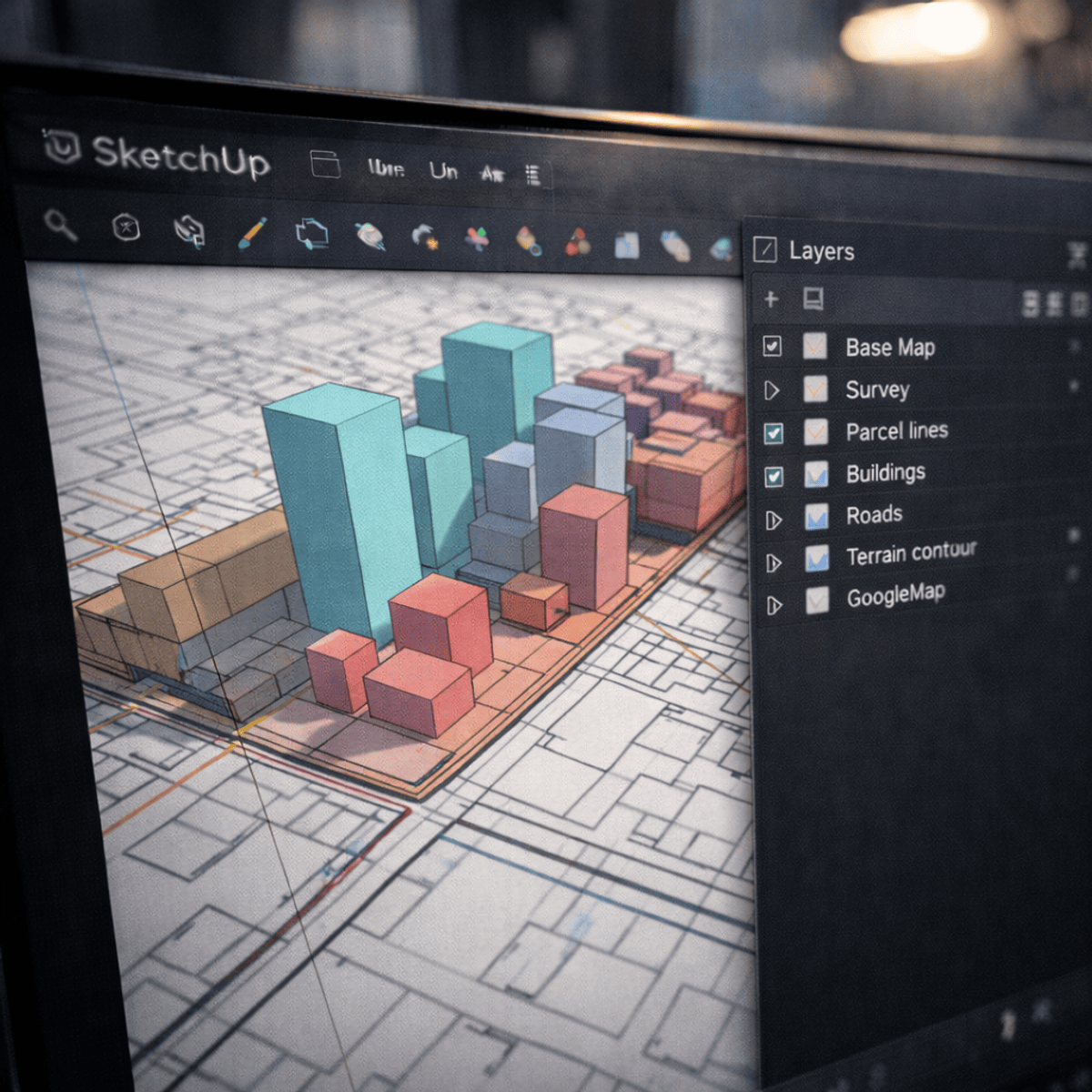
Apply Urban Scale Mapping Techniques Using SketchUp
By the end of this course, learners will be able to interpret urban survey data, prepare structured AutoCAD drawings, develop urban-scale base maps, apply efficient SketchUp mapping techniques, and communicate design outcomes through professional presentations. Learners will also be able to organize large-scale spatial data using logical layers, color hierarchies, and simplified massing strategies suitable for urban analysis and visualization. This course provides a practical, end-to-end workflow for creating urban-scale maps and presentations using industry-relevant tools such as AutoCAD, SketchUp, and PowerPoint. Learners will progress from understanding real-world survey plans to building accurate 3D urban base maps and refining them for clarity and performance. The course emphasizes scalable modeling techniques, visual hierarchy, and clear communication rather than excessive detailing, making it ideal for urban design, planning, and architectural visualization contexts. What makes this course unique is its case-study-driven approach focused specifically on urban-scale mapping, not isolated buildings. Learners gain hands-on exposure to a streamlined professional workflow that bridges technical drawing, 3D mapping, and presentation skills—enabling them to produce clear, compelling urban visualizations suitable for academic, professional, and portfolio use.

Databricks - Master Azure Databricks for Data Engineers
Learn Azure Databricks for professional data engineers using PySpark and Spark SQL with an end-to-end capstone project

Test & Debug Java ML Pipelines
This advanced course guides learners through testing and debugging Java-based ML pipelines using professional-grade tools and CI/CD workflows. You’ll write robust unit and integration tests for core ML components like EntropyCalculator and Normalizer, apply Mockito to mock file I/O, and increase test coverage from 62% to 85%. Learners will trace intermittent pipeline failures, diagnose random seed issues, and implement reproducibility (new Random(42)) to ensure stability across multiple runs. The course concludes with CI-based automation using JUnit, Tribuo, and GitHub Actions, preparing participants for real-world ML testing and DevOps environments. This course is for experienced Java developers and ML engineers looking to improve testing, debugging, and CI/CD automation in ML pipelines. It focuses on making pipelines reliable, efficient, and production-ready using tools like JUnit, Mockito, and GitHub Actions. Ideal for those in MLOps, QA, or DevOps roles. Learners should be proficient in Java and JUnit, with an understanding of ML workflows and CI/CD. By the end of this course, you’ll have the practical skills to confidently design, test, and stabilize enterprise-grade ML pipelines in Java. You’ll know how to build reproducible workflows, integrate tests into CI/CD systems, and apply modern debugging strategies to eliminate flakiness and ensure consistency in production environments — preparing you for advanced roles in ML testing, DevOps, and MLOps engineering.

Unit Testing Swift Mobile App
Apply Test-Driven Development(TDD) process to iOS mobile app development in Swift

Créer des infographies attrayantes avec Creately
Ce projet vous permet de découvrir la plateforme Creately, logiciel en ligne de conception de diagrammes. Vous comprendrez les diverses fonctionnalités de la plateforme et serez capables de créer des infographies personnalisées et professionnelles pour votre entreprise. Vous aurez toutes les compétences de base pour utiliser Creately et créer facilement et rapidement des infographies pour votre marque ou petite entreprise.

Ultimate Clean Code Masterclass for 2026
The highest-rated clean code course. Master SOLID, avoid code smells, and refactor like a pro. Any language welcome.

MEAN Stack Project 2026 - Build a Real-Time Trello Clone
This course features Coursera Coach! A smarter way to learn with interactive, real-time conversations that help you test your knowledge, challenge assumptions, and deepen your understanding as you progress through the course. In this course, you'll build a real-time Trello clone using the MEAN stack (MongoDB, Express, Angular, and Node.js). You will learn to integrate real-time communication using WebSockets, create user authentication with JWT tokens, and handle boards and tasks management seamlessly. By the end of the course, you will have a fully functional application that replicates key features of Trello, helping you grasp essential web development concepts. The course starts by setting up your development environment, guiding you through the installation of Node.js, Angular, and MongoDB. As you progress, you'll implement authentication systems, learn how to retrieve and display boards dynamically, and work with real-time updates to manage tasks and columns. With each section, you’ll get hands-on experience in building out different features of the Trello clone, from board creation to task management, and optimizing your application for deployment. The course is designed for developers who want to dive deep into full-stack development with the MEAN stack. Whether you're a beginner or have prior experience in web development, you’ll find this course comprehensive and engaging. No specific prerequisites are required, but basic knowledge of JavaScript and web development concepts will help you get the most out of the course. By the end of this course, you'll be equipped with the skills to build and deploy real-time web applications, understand full-stack development workflows, and integrate complex functionalities like user authentication and real-time data updates. You'll also gain practical experience that can be applied to other full-stack development projects.

Agent-Ready Data Platform: Semantic Layer, Text-to-SQL & MCP
Retrofit a messy warehouse for AI agents: semantic layer, text-to-SQL, evaluation, governance, MCP and production ops

Apply Modern OpenGL Vertex Buffers and Shaders
By the end of this course, learners will be able to configure vertex attributes and buffer layouts, manage shader lifecycles, implement and validate shader programs, optimize geometry rendering using index buffers, and systematically diagnose and handle OpenGL errors. Learners will also be able to structure shader code effectively and apply debugging best practices to build stable OpenGL applications. This course provides a practical, end-to-end understanding of the modern OpenGL rendering pipeline, starting from how vertex data flows from CPU memory to the GPU and progressing through shader integration, rendering validation, performance optimization, and error handling. Each module builds logically on the previous one, ensuring learners develop both conceptual clarity and applied skills. What makes this course unique is its strong emphasis on correctness, structure, and debugging, areas often overlooked in graphics training. Rather than focusing only on visual output, learners are taught how to reason about GPU data flow, shader lifecycle management, efficient geometry reuse, and systematic error diagnosis. Upon completion, learners will be well prepared to build reliable OpenGL rendering systems, debug complex graphics issues, and confidently extend their skills to larger graphics or real-time rendering projects.

Salesforce Development With AI: Cursor, Copilot & Agentforce
Vibe-code Salesforce Development with AI and become a high-impact Salesforce Developer for lightning-fast app building

Substance Painter to Unreal Engine 5 Masterclass
Updated in May 2025. This course now features Coursera Coach! A smarter way to learn with interactive, real-time conversations that help you test your knowledge, challenge assumptions, and deepen your understanding as you progress through the course. This masterclass offers an in-depth journey into the world of 3D texturing and environment creation using Substance Painter and Unreal Engine 5. You’ll start by mastering the basics of Substance Painter, learning how to import assets, navigate the interface, and utilize essential tools like UDIM workflows and texture baking. As you progress, you’ll explore advanced texturing techniques, creating intricate materials and mastering the use of layers, masks, and filters to achieve stunning, stylized effects for game assets. Moving into the second half of the course, you’ll take your completed assets into Unreal Engine 5. Here, you’ll learn to set up and optimize your game environments, importing textures and assets created in Substance Painter. You’ll delve into environment building, using foliage, lighting, and post-processing techniques to craft immersive scenes. Advanced modules will guide you through setting up animation, particle effects, and even audio integration to bring your project to life. The course concludes with a focus on rendering and cinematic presentation, showcasing your work in the best possible light. You’ll learn to create professional-quality renders and animations, perfect for a portfolio or professional presentation. By the end of this masterclass, you will have the knowledge and confidence to create visually stunning 3D environments and assets, ready for any game or cinematic project. This course is ideal for intermediate 3D artists looking to refine their skills in texturing and environment creation. A basic understanding of 3D modeling and navigation within Substance Painter and Unreal Engine is recommended but not required.

AI-Ready Data Engineering: Pipelines for RAG & Agents
Everyone is building AI features. Almost no one is building the data systems that make them actually work. That gap is the data engineer's to own — and this course teaches you exactly how. Across 25 modules and 138 lessons you build the pipelines behind real AI: retrieval, RAG, agents, and governed text-to-SQL — not toy demos, but the incremental, evaluated, secured, cost-controlled systems that survive production. You follow one engineer, Maya, whose mandate is "make our data AI-ready," and you finish by shipping the capstone — AskTheData, an end-to-end AI data platform — yourself. What makes this course different: • Data-engineering-first, not prompt-first. Embeddings, chunking, ingestion freshness, data contracts, vector stores, hybrid search — the substrate AI runs on, built properly. • Code-first with a lab every module. Every module ships runnable code and a hands-on lab; over 40% of slides are real code or demos. • Production war stories. Every hard idea lands with a story and an analogy, and real failure drills show you exactly how these systems break — and how to stop them. • Governed text-to-SQL done right. Semantic layers on Snowflake Cortex Analyst and Databricks Genie, with an evaluation harness that proves accuracy instead of hoping for it. • Agents fed safely. Context engineering, the Model Context Protocol (MCP), durable memory, and access-aware retrieval — the parts most "agent" courses skip. • Evaluate, observe, cost-control. An eval + observability harness that gates every change, plus real cost benchmarks — the discipline that separates a demo from a platform. What you'll build, module by module: embeddings demystified, ingestion + freshness + data contracts for AI, document parsing of the messy real world, chunking strategies that actually work, the embedding ETL pipeline (incremental, idempotent, model-swap-safe), vector stores with row-level security, hybrid search + reranking, text-to-SQL and its traps, semantic layers, Cortex Analyst and Databricks Genie in production, text-to-SQL evaluation + hardening, the RAG-to-agents mental model, context engineering for data agents, tools + MCP, agent memory and state, multi-source agentic retrieval, evaluation harnesses, observability + tracing, guardrails + hallucination control, cost engineering with real benchmarks, governance + lineage + access-aware retrieval, orchestration + testing + productionizing — and the AskTheData capstone that ties it all together. The capstone — AskTheData: you architect and build an end-to-end AI data platform: ingestion → embedding ETL → governed retrieval → agentic text-to-SQL → evaluation → observability — then run a production failure drill and self-score against a rubric. It's the portfolio piece that proves you can build AI data systems, not just call an API. Who this is for: • Data engineers who want to own the AI layer instead of handing it to someone else • Analytics engineers and warehouse practitioners (Snowflake / Databricks) moving into RAG, agents, and text-to-SQL • ML / platform engineers who need the data substrate behind retrieval and agents done right • Backend engineers building AI features who keep hitting data-quality, retrieval, and cost walls • Anyone who can write SQL and Python and wants to build evaluated, governed, production AI data systems By the end of this course, you will be able to architect, evaluate, secure, and cost-control an end-to-end AI data platform — retrieval, RAG, agents, and governed text-to-SQL — and prove it works before it ships. Enrol now. The AI features are easy. The data systems behind them are the moat — and they're yours to build.

Detect & Respond to Mobile AI Threats
Smartphones now run powerful on-device AI that learns from your behavior—and that means new risk. In this intermediate course, you’ll learn how AI turns phones into active attack surfaces and how adversaries weaponize deepfakes, side-channel inference, and mobile LLM agents. Through short, focused videos and scenario-based discussions, you’ll see exactly how zero-permission sensors and cache traces reveal activity, how overlays and prompt injection hijack agents, and why “permissions” alone don’t ensure privacy. Then you’ll turn knowledge into action: baseline telemetry, write simple detection rules, verify links and intents, quarantine devices, rotate tokens, and draft a one-page SOP. AI-graded labs provide hands-on practice, and a capstone project ties everything together. By the end, you can detect, respond, and harden against AI-driven mobile threats—skills you can apply immediately at home or in an enterprise. This course is designed for IT professionals, security analysts, mobile administrators, and technical learners who want to strengthen their ability to protect mobile environments from emerging AI-driven threats. It is also valuable for MDM specialists, SOC/incident response teams, and cybersecurity students looking to understand how modern AI models and agents are changing the mobile threat landscape. Learners should have a basic understanding of mobile or IT security concepts, along with some comfort navigating Android settings, ADB, or Mobile Device Management (MDM) tools. General familiarity with AI systems or LLM-based agents will also help learners follow demonstrations and better understand how modern AI features influence mobile risk. By the end of the course, learners will be able to analyze how AI-driven capabilities—such as sensors, on-device models, and autonomous agents—expand the mobile attack surface and enable scams like deepfake social engineering. They will evaluate real-world AI attack paths, including zero-permission inference and multi-layer agent exploits, and will be able to design a practical detection and response plan using clear rules, fast containment steps, and core resilience controls tailored for mobile environments.

Complete AI Architecture Bootcamp: From RAG to Agents
“This course contains the use of artificial intelligence” Artificial Intelligence is transforming every industry, but most professionals still struggle to understand how modern AI systems are actually designed, integrated, governed, and scaled. This course is designed to bridge that gap by teaching you how to think and operate like an AI Architect. Whether you are a consultant, business analyst, solution architect, technical leader, product manager, engineer, or AI enthusiast, you will learn the frameworks, patterns, and methodologies used to design enterprise-grade AI solutions that deliver real business value. In this comprehensive AI Architecture Bootcamp, you will explore the complete lifecycle of building modern AI systems, from initial discovery and requirements gathering through architecture design, deployment, governance, optimization, and long-term maintenance. You will gain a deep understanding of how Large Language Models (LLMs), AI Agents, Multi-Agent Systems, Retrieval-Augmented Generation (RAG), Vector Databases, Embeddings, Knowledge Systems, and Model Context Protocol (MCP) fit together to create intelligent business solutions. The course begins by establishing a strong foundation in AI Architecture Fundamentals, helping you understand the differences between traditional software architectures and modern AI-driven architectures. You will learn the core responsibilities of an AI architect and discover how organizations evaluate, design, and implement AI initiatives across the enterprise. From there, you will explore the building blocks of modern AI systems, including front-end interfaces, APIs, databases, integration layers, orchestration services, and cloud infrastructure. As the course progresses, you will dive into proven Enterprise AI Architecture Patterns, including AI Assistants, AI Copilots, Standalone AI Applications, Multi-Agent Architectures, and large-scale enterprise AI platforms. You will learn how to evaluate architectural trade-offs, select the right design pattern for different use cases, and build systems that are scalable, maintainable, secure, and aligned with business objectives. A major focus of the course is modern LLM Architecture and RAG Systems. You will learn how enterprise organizations build knowledge assistants capable of retrieving information from internal documents, databases, and business systems. Topics include document ingestion, chunking strategies, embedding generation, vector search, context injection, grounded response generation, and enterprise knowledge management. By the end of this section, you will understand how to design AI solutions that provide accurate, trustworthy, and context-aware responses. The course also provides extensive coverage of AI Agents and Multi-Agent Systems, one of the fastest-growing areas in artificial intelligence. You will learn how agents plan tasks, reason through problems, manage memory, utilize tools, collaborate with other agents, and execute business workflows. You will design architectures that include manager agents, worker agents, escalation mechanisms, orchestration frameworks, and collaborative agent ecosystems capable of supporting complex business operations. You will then explore the rapidly emerging world of Model Context Protocol (MCP) and enterprise integrations. Learn how AI systems communicate with external tools, APIs, SaaS applications, databases, and internal business platforms. You will understand how context sharing, resource management, and tool orchestration enable AI systems to become truly useful within enterprise environments. Beyond AI models and agents, this course teaches the broader architectural disciplines required for enterprise success. You will learn AI Automation Architecture, Workflow Orchestration, Human-in-the-Loop Systems, Data Architecture, Data Pipelines, Knowledge Repositories, Real-Time Data Platforms, and AI-Ready Enterprise Data Ecosystems. These skills will help you design solutions that integrate seamlessly with existing business operations and technology stacks. Security and governance are critical components of any production AI solution. Therefore, you will learn best practices for AI Security, Prompt Security, Model Protection, Data Privacy, Access Control, Compliance, Responsible AI, Risk Management, Model Monitoring, and AI Governance Frameworks. You will understand how organizations build trustworthy AI systems while managing operational, legal, and regulatory risks. The course also explores Cloud AI Infrastructure, Deployment Architectures, Scalability Planning, Performance Optimization, Hybrid Architectures, Edge AI, and global deployment strategies. You will gain practical knowledge of how enterprise AI solutions are deployed and managed in real-world environments. To ensure practical application, the course includes hands-on architecture workshops and design exercises where you will create enterprise AI assistants, multi-agent workflows, RAG platforms, automation systems, AI-ready data architectures, cloud infrastructure designs, and complete client-ready AI architecture proposals. These activities mirror the type of work performed by professional AI architects and consultants. Finally, you will learn how AI architecture principles are applied across industries, including Customer Support AI, Sales AI, Marketing AI, Operations AI, Executive AI Assistants, Healthcare AI, Financial AI, Manufacturing AI, Retail AI, and Government AI solutions. By studying these real-world architecture patterns, you will gain the confidence to design AI systems for virtually any business domain. By the end of this course, you will be able to design end-to-end Enterprise AI Systems, evaluate architectural options, build scalable RAG Platforms, architect AI Agent Ecosystems, integrate AI with enterprise technologies, establish governance frameworks, and communicate architecture decisions to stakeholders and executives. Most importantly, you will develop the mindset and skillset of a modern AI Architect capable of leading AI transformation initiatives in organizations of any size.

HTML & CSS Crash Course
Are you interested in delving into the realm of web development but find yourself unsure of where to start? Do you aspire to acquire the skills needed to build your own websites? Have previous attempts to grasp HTML and CSS through conventional courses left you disinterested or overwhelmed? If your response aligns with a resounding "YES" to any of these inquiries, then this course is perfectly tailored to meet your needs! What Sets Our Course Apart? Our course boasts the distinguished presence of Kevin Powell, one of YouTube's foremost and highly-regarded instructors, in conjunction with Scrimba's distinctive and interactive code-learning platform. This amalgamation offers a learning experience that stands unparalleled in the industry. Our instructional sessions are meticulously designed to both captivate and educate, as we firmly believe that engaging content accelerates the learning process, ensuring that monotony never stifles your progress.

AI901: Microsoft Azure AI Fundamentals Full Course Exam 2026
324 Practice Questions | Course + Practice Test Combo | AI 901 Microsoft Azure AI Fundamentals Practice Test Pass the Microsoft AI-901 Azure AI Fundamentals certification with a complete exam prep course, including 324 practice tests and exam-style questions covering AI workloads, responsible AI principles, generative AI, machine learning, and Microsoft Foundry. Prepare for the Microsoft AI-901: Azure AI Fundamentals Certification Exam with a comprehensive course designed to help you master Microsoft Azure AI concepts and successfully pass the AI-901 certification. This course combines clear explanations of Azure AI fundamentals with 324 exam-style practice tests and questions designed to simulate the real Microsoft Azure AI Fundamentals certification exam. Whether you are a technical beginner or an aspiring AI developer looking to validate your foundational AI skills, this course will help you learn core Microsoft AI services, generative AI and agents, responsible AI frameworks, basic Python syntax, and AI application building using Microsoft Foundry. The course is strictly aligned with the newly updated official Microsoft AI-901 exam syllabus, ensuring you are fully prepared for the 2026 certification exam. 324 Practice Tests, Mock Exams, and Exam-Style Questions Exam AI-901: Microsoft Azure AI Fundamentals This course includes 324 carefully designed Microsoft Azure AI Fundamentals AI-901 practice questions to help you prepare for the certification exam with confidence (AI-901 practice test). Each question reflects real exam-style scenarios, helping you understand how AI workloads, models, and Foundry configurations are tested in the actual certification exam. These practice tests will help you: • Simulate the real AI-901 exam preparation experience • Identify weak areas before taking the exam • Strengthen your understanding of Azure AI and Microsoft Foundry capabilities • Improve your exam readiness and confidence The practice tests are ideal for learners who want hands-on exam preparation with realistic certification questions. AI-901 Exam Domains Covered This course follows the official Azure AI Fundamentals certification AI-901 exam skills outline, ensuring complete coverage of the newly structured certification exam topics. The AI-901 exam measures your knowledge across two major domains: • Identify AI concepts and responsibilities (40–45%) • Implement AI solutions by using Microsoft Foundry (55–60%) Identify AI concepts and capabilities (40–45%) Describe principles of responsible AI • Describe considerations for fairness in an AI solution • Describe considerations for reliability and safety in an AI solution • Describe considerations for privacy and security in an AI solution • Describe considerations for inclusiveness in an AI solution • Describe considerations for transparency in an AI solution • Describe considerations for accountability in an AI solution Identify AI model components and configurations • Describe how generative AI models work • Identify an appropriate AI model, based on capabilities • Identify appropriate model deployment options and configuration parameters Identify AI workloads • Identify scenarios for common AI workloads, including generative and agentic AI, text analysis, speech, computer vision, and information extraction • Describe common text analysis techniques, including keyword extraction, entity detection, sentiment analysis, and summarization • Identify features and capabilities of speech recognition and speech synthesis • Identify features and capabilities of computer vision and image-generation models • Identify techniques to extract information from text, images, audio, and videos Implement AI solutions by using Microsoft Foundry (55–60%) Implement generative AI apps and agents by using Foundry • Create effective system and user prompts for generative AI models • Deploy a model and interact with it in the Foundry portal • Create a lightweight chat client application by using the Foundry SDK • Create and test a single-agent solution in the Foundry portal • Create a lightweight client application for an agent Implement AI solutions for text and speech by using Foundry • Build a lightweight application that includes text analysis • Respond to spoken prompts by using a deployed multimodal model • Build a lightweight application by using Azure Speech in Foundry Tools Implement AI solutions with computer vision and image-generation capabilities by using Foundry • Interpret visual input in prompts by using a deployed multimodal model • Create new visual outputs by using generative models • Build a lightweight application that includes vision capabilities Implement AI solutions for information extraction by using Foundry • Extract information from documents and forms by using Azure Content Understanding in Foundry Tools • Extract information from images by using Content Understanding • Extract information from audio and video by using Content Understanding • Build a lightweight application with information extraction capabilities by using Content Understanding Practice Set • AI-901 practice questions Take this Course and prepare for AI-901 certification Happy Learning Team Codaming

Essential Linux Training Course
This comprehensive Linux course equips you with the skills to navigate, manage, and control Linux systems with confidence. Begin by mastering Linux fundamentals—understand the differences between Linux, Unix, and Windows, explore open-source principles, and get hands-on with Ubuntu installation, terminal usage, and kernel architecture. Progress to file system and command-line essentials—learn to manage directories, permissions, and users while practicing core commands like top, uname, and lsusb. Advance to more complex tasks in text editing and package management using tools like vi, grep, and apt-get, and gain the ability to maintain and update Linux systems effectively. You should have a basic understanding of computer operations and familiarity with any graphical user interface. By the end of this course, you will be able to: - Navigate Linux: Use Ubuntu, GNOME, and CLI to operate Linux systems confidently. - Manage Systems: Handle files, directories, and user permissions with core commands. - Edit & Search Files: Use vi, grep, and egrep for efficient text handling and system queries. - Control Software: Install, update, and manage packages with apt-get, repositories, and PPAs. Ideal for aspiring system administrators, developers, and IT professionals seeking foundational Linux expertise.

Microsoft Power BI: Beginner to Advanced Intelligence
Become a Data Analyst, Data Scientist | DAX, Power Query | Real world projects | Fun and Engaging
Introduction to FastAPI framework
In this 2-hour hands-on course, you will build a web application with FastAPI. You will create routes to handle requests and responses, define request body models with validation, serve dynamic content, and run the API with Uvicorn. You will also leverage FastAPI's interactive OpenAPI docs to test endpoints and generate curl commands. By the end, you will have built and deployed a FastAPI web app using best practices for request handling, response validation, and documentation.