Cursos de IT y software
Los mismos datos para todos, vengan de Udemy o de Coursera: precio, valoración, duración e idioma. 902 cursos encontrados. Afinar la búsqueda

H2O Cloud AI Developer Services
Elevate your AI development skills with H2O Cloud AI Developer Services! This comprehensive program is designed to provide you with an in-depth understanding of H2O ai's cloud-based AI services, tailored for developers, data engineers, and AI practitioners like you. Led by H2O ai makers Audrey Létévé, Senior Customer Data Scientist, and Jon Farland, Director of Solutions Engineering, this course offers invaluable insights from real-world AI implementations. Why H2O Cloud AI? Tabular Services: Imagine effortlessly scaling your machine learning models on tabular data. We'll explore AutoML, seamless data connectivity, and advanced features that empower you to tackle real-world projects with confidence. Language Services: Customizing and deploying NLP solutions has never been easier. From Hydrogen Torch to sophisticated language models, we'll equip you with the tools to conquer enterprise use cases. Vision Services: Dive into the world of computer vision. Learn data labeling with Label Genie, harness document AI capabilities, and build robust vision models using Hydrogen Torch. AI Assistants Services: Streamline your workflow with intelligent code suggestions and automations. Say goodbye to mundane tasks—our AI assistants have your back. By the end, you will be able to create, automate, monitor, and share AI solutions using the H2O Cloud AI platform, optimizing your business use cases across different data types and domains. This course will prepare you to lead in the fields of AI and data science with confidence.

Getting Started with Linux Fundamentals
This is an introductory course intended for users and developers to acclimate to the Red Hat Enterprise Linux desktop and command-line interfaces. Course objectives: Prepare candidates for their adoption of Red Hat Enterprise Linux 9.

Managing Hybrid Storage, File Services and Network
This course features Coursera Coach! A smarter way to learn with interactive, real-time conversations that help you test your knowledge, challenge assumptions, and deepen your understanding as you progress through the course. This course focuses on managing hybrid network infrastructure and storage services in a hybrid environment. You will learn to integrate DNS with Active Directory Domain Services (AD DS), configure DNS zones and records, and manage DNSSEC and forwarding. The course also covers implementing DHCP, IP Address Management (IPAM), and remote access roles, including site-to-site VPNs and the Network Policy Server. You will explore managing Azure network solutions, such as Azure Virtual WAN, Azure AD Application Proxy, and Azure Relay. Additionally, the course delves into managing hybrid storage with Azure File Sync, configuring cloud endpoints, and monitoring file sync. It also includes migrating DFS to Azure File Sync, configuring Windows Server File Share Access, and implementing Distributed File Systems (DFS). You will learn to manage storage with tools like Storage Spaces, Storage Replica, Data Deduplication, SMB Direct, and Storage QoS, as well as configure file systems and manage branch caching. This course is ideal for IT professionals managing hybrid infrastructures and storage environments, particularly those working with Azure and Windows Server technologies. Basic knowledge of networking and storage management will be beneficial.

Microsoft SC-900 Exam Preparation and Practice
This course helps you practice your exam techniques and refresh your knowledge in all the key areas assessed in the Microsoft-certified Exam SC-900: Microsoft Security Compliance and Identity Fundamentals. You’ll test your knowledge in a series of practice exams mapped to all the main topics covered in the SC-900 exam, ensuring you’re well prepared for certification success. You’ll prepare by taking practice tests with similar formats and content. You’ll also get tips and tricks, testing strategies, and useful resources on how to sign up for the Microsoft SC-900 proctored exam. This is also a great way to prepare for the Microsoft SC-900 exam. By passing the SC-900 exam, you’ll earn the Microsoft Security, Compliance, and Identity Fundamentals Certification. Earning a Microsoft Certification is globally recognized evidence of real-world skills. After completing this course, you’ll be able to: • Describe the concepts of security, compliance, and identity • Describe the capabilities of Microsoft Azure Active Directory, part of Microsoft Entra • Describe the capabilities of Microsoft Security solutions • Describe the capabilities of Microsoft compliance solutions
Getting Started with Migration Hub Refactor Spaces
With AWS Migration Hub Refactor Spaces, you can fast-track the application refactoring of existing applications into distributed applications, typically based on microservices. In this course, you will learn the benefits and technical concepts of Refactor Spaces. If you are new to the service, you will learn how to start with Refactor Spaces through a demonstration using the AWS Management Console. You will learn about the native architecture and how the built-in features can help you focus on refactoring your applications. This means you can focus less on creating and managing the underlying infrastructure that makes refactoring possible.

Advanced Network Security and Analysis
The course "Advanced Network Security and Analysis" dives into the essential skills needed to protect and analyze complex network environments. This course covers advanced topics like anonymization techniques, mobile application security, and in-depth analysis of DNS, HTTP, SMTP, and TCP protocols. Learners will gain practical experience in recognizing vulnerabilities and analyzing network traffic to detect potential threats. Each module offers hands-on insights into industry-standard tools and techniques, equipping students to address real-world security challenges confidently. Uniquely focused on practical application, the course empowers students to work with tools like Splunk, TCPDump, and Wireshark, ensuring they can navigate and mitigate complex network security scenarios. Through interactive content, learners will gain a comprehensive understanding of network protocols, explore the mechanics of cyber-attacks, and learn how to implement effective defenses. By the end of the course, students will have developed an advanced toolkit for safeguarding modern network infrastructures, making them valuable assets in any IT security environment.
Integrated Measurement KPIs and Metrics for ITSM
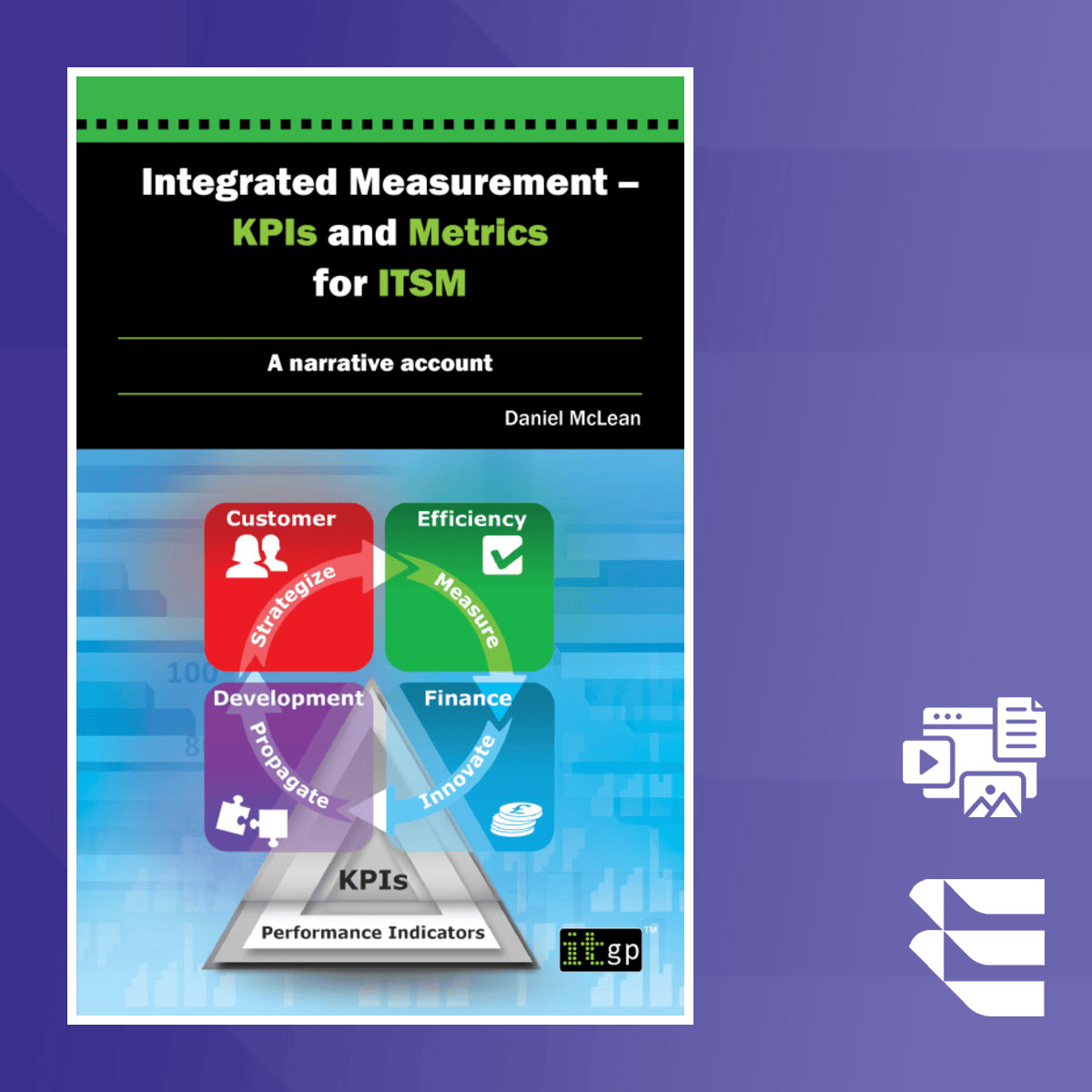
This book provides a clear, practical guide to understanding and applying Key Performance Indicators (KPIs) in IT Service Management. It simplifies complex concepts and offers actionable strategies for measuring and improving IT service performance. Designed for professionals at all levels, it helps build the skills needed to make data-driven decisions and enhance operational efficiency. You will gain the tools to effectively define and track KPIs, interpret the data to drive improvements, and enhance the value of IT service management in your organization. What sets this book apart is its emphasis on real-world examples and actionable insights, bridging theory with practice to optimize ITSM processes at every stage. Ideal for IT professionals and service managers, this book assumes basic ITSM knowledge but no prior experience with KPIs. It equips readers with the skills to measure, analyze, and improve service performance effectively. This course is based on a book published by IT Governance Publishing. © Daniel McLean 2013 The author has asserted the rights of the author under the Copyright, Designs, and Patents Act, 1988, to be identified as the author of this work. First published in the United Kingdom in 2013 by IT Governance Publishing.

Einführung in Gemini Enterprise
In diesem Kurs wird Gemini Enterprise vorgestellt, eine leistungsstarke Plattform, die KI-Agenten, Unternehmenssuche, NotebookLM und intelligenten Datenzugriff verbindet, damit Unternehmen ihre Herausforderungen lösen können. Anhand von Beispielen aus der Praxis und praktischen Übungen lernen Teilnehmer, wie sie die Funktionen von Gemini Enterprise für echte Geschäftsanforderungen nutzen, die Architektur beschreiben und erklären, wie Datenzugriff und Datenschutz in verschiedenen Aufgabenbereichen gehandhabt werden.

Design security solutions for applications and data
Welcome to Design Security Solutions for Applications and Data, a focused and practical course designed for cybersecurity professionals, cloud security architects, and Microsoft cloud administrators. This course is part of the SC-100: Microsoft Certified Cybersecurity Architect Expert specialization and equips you with the expertise to design, implement, and manage secure application and data protection strategies in Microsoft’s cloud ecosystem. You’ll explore secure cloud application development practices, enforce strong identity controls with Microsoft Entra ID, and leverage Microsoft Defender for Cloud to safeguard workloads. The course also covers encryption at rest and in transit, key management with Azure Key Vault, data residency considerations, and governance strategies using Data Lifecycle Management (DLM). The course delivers 6–7 hours of targeted video lectures that combine theoretical insights with hands-on demonstrations, demos, and real-world security design scenarios. Organized into two core modules, each includes quizzes and in-video assessments to validate understanding. Enroll in “Design Security Solutions for Applications and Data” to gain the skills required to design secure, compliant, and resilient application and data protection strategies in Microsoft’s cloud ecosystem. Who Should Take This Course? Application Security Engineers & Cloud Developers Data Protection and Compliance Specialists Microsoft 365 and Azure Security Administrators Security Architects preparing for the SC-100 exam Course Modules: Microsoft Defender for Cloud to Protect Cloud Applications Microsoft Cloud Data Protection and Governance By the end of this specialization, you will: Master secure application design aligned with Microsoft’s security frameworks Implement encryption, classification, and governance for sensitive data Integrate identity-first strategies into application and data security design Be fully prepared to take and pass the SC-100 certification exam

Vektorsuche und Einbettungen
In diesem Kurs wird die Vertex AI-Vektorsuche vorgestellt und beschrieben, wie sie beim Erstellen einer Suchanwendung mit Large Language Model-APIs (LLM) für Einbettungen genutzt werden kann. Der Kurs besteht aus konzeptionellen Lektionen über Vektorsuche und Texteinbettungen, interaktiven Demos zum Erstellen einer Vektorsuche in Vertex AI und einem praxisorientierten Lab.

Lakehouse Architecture and Delta Lake with Databricks
Design and implement production ready Lakehouse architectures using Delta Lake and Databricks. By the end of this course, you will be able to build multi layer Medallion pipelines including Bronze, Silver, and Gold layers, manage ACID transactions, enforce and evolve schemas, implement Change Data Capture, and optimize Delta tables for performance using data skipping, compaction, and Liquid Clustering. You will also learn to unify batch and streaming workloads while ensuring reliability, scalability, and recoverability in enterprise environments. This course stands out by going beyond Delta Lake syntax and focusing on end to end Lakehouse engineering, from architectural design patterns to production optimization and concurrency control. Through structured modules and hands on implementation, you will gain practical experience designing scalable data platforms that support both BI analytics and machine learning workloads. If you are a data engineer, analytics engineer, or platform architect looking to modernize legacy data warehouses or data lakes, this course provides the applied skills required to build efficient, cost effective, and future ready data infrastructure on Databricks. This is primarily aimed at first- and second-year undergraduates interested in engineering or science, along with high school students and professionals with an interest in programming.
Kubernetes in AWS: Create Cluster in EKS in your own VPC
Kubernetes in AWS: Create Cluster in EKS in your own VPC IMPORTANT: You must have or create an AWS account to work along to this course. By the end of this course, you will know the steps necessary to set up your own EKS clusters in AWS. You will configure the AWS CLI and connect your local kubectl to the cluster so you can perform direct operations to the cluster.

Reduce Costs for the Managed Service for Prometheus
This is a self-paced lab that takes place in the Google Cloud console. In this lab, you will explore cost control mechanisms when utilizing the Managed Service for Prometheus on Google Cloud. The Google Cloud Managed Service for Prometheus charges for the number of samples ingested into Cloud Monitoring and for read requests to the Monitoring API. The number of samples ingested is the primary contributor to your cost.

Google Drive 日本語版
Google ドライブは Google のクラウドベースのファイル ストレージ サービスです。Google ドライブでは、すべての作業を 1 か所にまとめ、追加のソフトウェアを必要とせずにさまざまなファイル形式を表示でき、どのデバイスからでもファイルにアクセスできます。 このコースでは、Google ドライブの操作方法を学びます。ファイルやフォルダをアップロードする方法や、ファイルの種類に関係なく作業する方法のほか、Google ドライブでファイルを簡単に表示、配置、整理、変更、削除する方法についても学びます。 Google ドライブには共有ドライブが含まれています。共有ドライブを使用して、チームでファイルを保存したり、検索したり、ファイルにアクセスしたりできます。新しい共有ドライブの作成、メンバーの追加と管理、共有ドライブのコンテンツの管理などの方法を学びます。 Google Workspace とはつまり、コラボレーションと共有機能そのものです。Google ドライブで利用できる共有オプションを確認し、さまざまなユーザー ロールや割り当て可能な権限について学びます。 また、テンプレートを使用して一貫性を確保し、時間を節約する方法についても確認します。 Google ドライブには、さまざまなツールやオプションが用意されています。このコースでは、それらのオプションの中から、オフラインで作業する方法、ドライブ ファイル ストリームを使用する方法、Google Workspace Marketplace からアプリをインストールする方法について説明します。

Container Creation and Orchestration Basics
Practice creating containers without installing anything! This course is designed for learners with no technical experience, providing a solid foundation for container creation and orchestration. Learners will gain hands-on practice on an Ubuntu system that can be easily transferred to other Unix-based operating systems. The modules in this course cover the benefits and uses of Kubernetes, the creation and building of container images, and the deployment of containers. To allow for a truly hands-on, self-paced learning experience, this course is video-free. Assignments contain short explanations with images and runnable examples with suggested edits to explore examples further, building a deeper understanding by doing. You'll benefit from instant feedback from a variety of assessment items along the way, gently progressing from quick understanding checks (multiple choice, fill in the blank, and un-scrambling code blocks) to small, approachable exercises that take minutes instead of hours.
Planning and Managing Information Systems Development Part 1
This course provides an overview of the most popular information systems needs’ assessment methodologies including portfolio analysis, stage assessment, business systems planning. Topics include utilities Information Systems strategic plan prioritization techniques of business goal alignment, architectural compatibility, and cost/benefit and risk analysis to demonstrate how businesses match needs to budgetary constraints. Describes and evaluates options for the placement of the Information Systems function within the organization and a variety of methods to manage the function.
Microsoft Entra Authentication and Identity Management
The Microsoft Entra Authentication and Identity Management course is designed for beginners, IT administrators, identity engineers, cloud professionals, and security practitioners who want to develop a comprehensive understanding of authentication, hybrid identity, and external identity management using Microsoft Entra. This course introduces learners to the core authentication and identity protection capabilities of Microsoft Entra. You’ll begin by exploring modern authentication methods, Multi-Factor Authentication (MFA), password protection, and identity security practices that help organizations secure access to applications and resources. Next, you’ll learn how Microsoft Entra supports hybrid identity by integrating on-premises Active Directory with cloud-based identity services. The course covers Password Hash Synchronization (PHS), Pass-through Authentication (PTA), Federated Authentication, Microsoft Entra Connect, directory synchronization, deployment planning, and tenant health monitoring. Finally, you’ll explore identity management for external users and organizations through Microsoft Entra External ID and B2B Collaboration. You’ll learn how to configure collaboration settings, manage guest users, assign licenses, compare identity providers, and securely collaborate across organizational boundaries. Through a combination of conceptual explanations, demonstrations, configuration walkthroughs, and real-world scenarios, you’ll gain practical knowledge of authentication, hybrid identity, identity synchronization, and external collaboration using Microsoft Entra. The course delivers approximately 9–11 hours of structured video content, organized into three modules. Each module includes quizzes and knowledge checks to reinforce learning and validate understanding. Enroll in this course to build practical skills in authentication, hybrid identity, and external identity management while preparing to administer secure Microsoft Entra environments. Course Modules Module 1: Microsoft Entra User Authentication Module 2: Implement and Manage Hybrid Identity Module 3: Manage External Identities and B2B Collaboration Explore Microsoft Entra External ID, B2B Collaboration, external identity providers, guest user management, licensing, and secure collaboration across organizations. By the End of This Course, You Will Be Able To: * Understand Microsoft Entra authentication methods * Configure Multi-Factor Authentication (MFA) * Implement password protection policies * Compare Password Hash Synchronization, Pass-through Authentication, and Federated Authentication * Plan and deploy hybrid identity solutions * Configure Microsoft Entra Connect and directory synchronization * Monitor synchronization and tenant health * Manage Microsoft 365 licensing for users * Configure Microsoft Entra External ID and B2B Collaboration * Securely manage guest users and external identities
IBM Storage Scale Remote Data Access
This course is intended for IT professionals tasked with administering a Storage Scale storage cluster consisting of Linux nodes. The course includes information on various Storage Scale features that enable remote access to data that is stored in a cluster file system. This includes: multi-cluster support, clustered NFS, cluster export services (CES) and protocol support (NFS, SMB, and Object), Active File Management (AFM), and AFM-based Asynchronous Disaster Recovery (AFM DR). The features are described in lecture materials and implemented in lab exercises.

Gemini in Google Drive - Français
Gemini pour Google Workspace est un module complémentaire qui permet aux utilisateurs d'accéder à des fonctionnalités d'IA générative. Ce cours explore les fonctionnalités de Gemini dans Google Drive au moyen de vidéos pédagogiques, d'activités pratiques et d'exemples concrets. À la fin de ce cours, vous disposerez des connaissances et des compétences nécessaires pour utiliser Gemini en toute confiance dans Google Drive afin d'améliorer vos workflows.
Tencent Cloud SysOps Associate
This course is primarily aimed at cloud professionals who are interested in learning about Tencent Cloud's system operations. It equips learners with a foundational knowledge in deploying, monitoring, and operating Tencent Cloud's basic products and prepares them to take the Tencent Cloud SysOps Associate examination. After completing this course, learners will be able to operate and maintain Tencent Cloud's basic products and deploy business on Tencent Cloud.

Dell Technologies Technical Support for Software
This course is tailored for aspiring tech support specialists. This course is designed to deepen your understanding of common operating systems, streamline installation procedures, and equip you with robust troubleshooting techniques for software issues. Throughout this course, participants will explore the intricacies of widely-used operating systems, understand their nuances, and learn to navigate and resolve common software challenges effectively. By combining theoretical knowledge with practical, hands-on exercises, this course ensures that learners are well-prepared to manage and support various operating systems in diverse computing environments. This course is ideal for individuals seeking to solidify their technical foundation, enhance their resume, and advance their careers in the IT industry. Upon completion, participants will have a greater understanding of the key features, and troubleshooting techniques for common operating systems, positioning them as valuable assets in an entry-level tech support or IT role.
Introduction to C++
This course is an introduction to the course. It presents the teacher, the tools and the content of the courses and explains why C/C++ is important. This course also covers C/C++ particularities a programmer needs to know to create secure programs using these languages.

Analyze and Visualize Data Using Splunk Statistics
By the end of this course, learners will be able to analyze large datasets using Splunk’s statistical commands, transform raw events into meaningful metrics, build time-based and categorical visualizations, and correlate related events to uncover operational insights. Learners will also be able to apply conditional logic, enhance dashboards with advanced visualizations, and interpret trends and geographic patterns using Splunk. This course provides a comprehensive, hands-on approach to mastering Splunk statistics and visualization techniques essential for data analysis, security monitoring, and operational intelligence. Through step-by-step lessons, learners explore core aggregation functions, charting and timechart commands, advanced visualizations such as gauges and cluster maps, and powerful transformation tools like eval and transaction commands. Unlike introductory Splunk courses, this program uniquely combines statistical analysis, visualization best practices, and event correlation into a single, end-to-end learning journey. Learners gain practical skills directly applicable to real-world use cases such as KPI monitoring, trend analysis, and incident investigation. Upon completion, learners will be equipped to confidently design insightful dashboards, optimize searches, and extract actionable intelligence from Splunk data, making this course ideal for aspiring Splunk analysts, administrators, and data professionals.

Hands-On Labs in Google Cloud for Security Engineers
Security is an uncompromising feature of Google Cloud services, and Google Cloud has developed specific tools for ensuring safety and identity across your projects. In this course you will get added hands-on practice understanding and securing resources with multiple Google Cloud services including Google Kubernetes Engine (GKE). This course is unlike other courses, in that it consists of one module of background videos, followed by a series of hands-on practice exercises on Google Cloud via Qwiklabs. The practice modules include no videos, lectures, or quizzes - just more practice on real Google Cloud. If you enjoyed this course, you can check out the full quest including a challenge lab that requires a solution to be built with minimal guidance. You will have an opportunity to earn a Google Cloud digital Skill Badge on completion as well! Visit - google.qwiklabs.com and look for ‘Secure Workloads in Google Kubernetes Engine’ and ‘Ensure Access & Identity in Google Cloud’.

Cloud Computing Primer: Platform as a Service (PaaS)
Explore cloud computing basics without installing anything! This course is designed for semi-technical and business learners, providing a solid foundation of cloud computing basics. Learners will build an understanding of how platform as a service (PaaS) works as well. The modules in this course cover cloud computing basics, considerations for PaaS adoption, techniques for PaaS success and growth, as well as provide an exploratory PaaS experience for learners. To allow for a truly hands-on, self-paced learning experience, this course is video-free. Assignments contain short explanations with images and suggested exploration examples, building a deeper understanding by doing. You'll benefit from instant feedback from a variety of assessment items along the way, gently progressing from quick understanding checks (multiple choice, fill in the blank, and un-scrambling answer blocks) to small, approachable exercises that take minutes instead of hours.

Deploy and Test a Visual Inspection AI Component Anomaly Detection Solution
This is a self-paced lab that takes place in the Google Cloud console. Deploy and test a visual inspection AI component anomaly detection solution.

Getting Started with Application Development - Português
Neste curso, os desenvolvedores de apps aprendem a criar e desenvolver aplicativos nativos da nuvem que se integram totalmente aos serviços gerenciados do Google Cloud. Com as apresentações, as demonstrações e os laboratórios práticos, os participantes vão aprender a aplicar as práticas recomendadas para o desenvolvimento de apps e usar os serviços do Google Cloud Storage específicos para objetos, dados relacionais, armazenamento em cache e análises de dados. É necessário concluir pelo menos uma versão de cada laboratório. Todos os laboratórios estão disponíveis em Node.js. A maioria deles também tem versões em Python ou Java. Use a linguagem que você preferir. Este é o primeiro curso da série "Developing Applications with Google Cloud". Depois de concluir este curso, inscreva-se no "Securing and Integrating Components of your Application".

AWS Cloud Practitioner (CLF-C02)
Are you ready to embark on a transformative journey into the world of cloud computing? Look no further than our comprehensive AWS Cloud Practitioner course. Designed to equip individuals from various backgrounds – whether you’re an IT professional, manager, sales representative, or business executive – with the fundamental knowledge and skills needed to excel in cloud computing, this course is your essential starting point. The course is structured to be engaging and interactive, incorporating a variety of teaching methods such as videos, demos, quizzes, and exercises to facilitate a thorough understanding of the material. The course is divided into several sections, each focusing on a specific aspect of AWS and cloud computing. Here are the key general topics covered in this course: - Introduction to Cloud Computing and AWS: This section provides an overview of cloud computing, its benefits, and why certification is important. It also introduces AWS, its billing, security, and services. - AWS Security and Compliance: This section delves into AWS’s shared responsibility model for security, AWS Cloud security and compliance concepts, and AWS Identity Access Management. - AWS Technology and Services: This part of the course covers methods of deploying and operating in the cloud, AWS’s global infrastructure, and core AWS Services including Networking, Storage, Compute, Database, Application Integration, AI/ML and Business Applications. - AWS Billing and Pricing: This section provides a detailed understanding of general billing in AWS, specific billing for various AWS services, and how account structures can affect billing. It also introduces tools for billing analysis and support, and AWS support options. - Bringing it all together: The final section of the course provides a summary of all the topics covered in the course and guides students on how to use the practice exams. It also provides insights on the road ahead on the AWS journey. AWS Certified Cloud Practitioner Exam Readiness: Upon completing this course, you’ll be thoroughly prepared to tackle the AWS Certified Cloud Practitioner exam. Our comprehensive curriculum will empower you to navigate the exam’s challenges with confidence. Once you pass the exam, you will earn the prestigious AWS Cloud Practitioner certification, validating your understanding of cloud computing concepts and your ability to leverage the AWS platform effectively. Join us on this transformative educational adventure and unlock endless possibilities in the realm of cloud computing. Don’t wait – start your AWS Cloud Practitioner journey today!

Exam Prep: Google Cloud Certified Cloud Digital Leader
Google Cloud Platform (GCP) is a leading suite of cloud computing services, empowering organizations to innovate, scale, and operate with agility. The Google Cloud Digital Leader certification validates foundational cloud knowledge and the ability to articulate the business value of GCP. This certification is a crucial stepping stone for individuals aiming to demonstrate their understanding of cloud concepts and GCP's capabilities in today's digitally transforming world. The "Exam Prep: Google Cloud Certified Cloud Digital Leader" course is meticulously designed for individuals seeking to build a robust understanding of cloud fundamentals and Google Cloud's core offerings. This course aims to provide a comprehensive overview of GCP, equipping you with the knowledge to effectively communicate the benefits and use cases of its services. Whether you are an IT professional seeking to validate your cloud acumen, a project manager involved in cloud initiatives, a business leader making strategic technology decisions, or anyone aiming to grasp the essentials of Google Cloud, this course will provide the necessary foundation. This course delivers 7:30- 8:00 hours of focused video lectures, blending conceptual explanations with key information relevant to the certification exam. The curriculum is organized into the following modules, each further divided into targeted lessons. To reinforce learning and assess comprehension, the course highlights key exam points and potential question areas, ensuring an efficient and effective preparation experience. Course Structure: Module 1: Introduction to Cloud Computing and Google Cloud Module 2: Google Cloud: Compute Essentials Module 3: Google Cloud: Storage Essentials Module 4: Google Cloud: Networking Essentials Module 5: Google Cloud: Serverless and Container Services Module 6: Google Cloud: AI/ML Fundamentals and Cloud Monitoring Module 7: Google Cloud: Security and Management Essentials This course will equip you with foundational Google Cloud knowledge, positioning you for the industry-recognized Google Cloud Digital Leader certification and demonstrating your understanding of cloud principles and GCP's potential. Enroll in our "Exam Prep: Google Cloud Digital Leader" course and accelerate your career growth in the world of data analytics.

Interact with Terraform Modules
This is a self-paced lab that takes place in the Google Cloud console. In this hands-on lab you will create and use Terraform modules to organize your cloud configuration.

PCB/CAD Design – DFM & DFT Considerations
Designing a PCB isn’t just about connecting components — it’s about ensuring the board can be manufactured reliably and tested effectively. This course focuses on Design for Manufacturability (DFM) and Design for Testability (DFT) principles, showing you how to reduce production costs, improve yield, and make debugging easier. With a hands-on, demo-driven approach in KiCAD, you will learn how to apply these practices directly to a microcontroller development board project. Through a structured curriculum, you’ll explore component placement, routing for manufacturability, applying design rules, adding test points, and performing verification checks — all while building a consistent, real-world PCB design. This course helps beginners and early-career engineers move from basic PCB layout to professional, production-ready design. Through a hands-on microcontroller project, you’ll learn essential DFM and DFT practices to create PCBs that are easy to manufacture, assemble, and test. Learners should know basic electronics—components, circuits, and simple schematics. PCB layout familiarity helps but isn’t required. Experience with KiCad or other design tools is a bonus. With guided demos, beginners can follow along. Curiosity and willingness to experiment are key. By the end, you’ll be able to create boards that are not only functional, but also ready for mass production and efficient testing. This course is ideal for beginners, hobbyists, and early-career engineers who want to move beyond basic PCB design into professional-level practices for manufacturability and testability. By following a single consistent project, you’ll see how every principle is applied in real-time — from schematic to production-ready PCB.

Advanced Network Design, IoT, and Small Business Solutions
This course features Coursera Coach! A smarter way to learn with interactive, real-time conversations that help you test your knowledge, challenge assumptions, and deepen your understanding as you progress through the course. In this course, you'll gain a comprehensive understanding of designing and implementing networks for small offices and home offices (SOHO) with an emphasis on real-world Cisco devices and solutions. From configuring routers and switches to setting up wireless networks, you’ll learn how to optimize and secure a small business network. You'll explore key topics like VLANs, NAT, QoS, DHCP, and access control to ensure seamless and secure communication across devices and platforms. The course will also cover the integration of small business devices and cloud solutions like Cisco Meraki, giving you a competitive edge in the tech industry. The learning journey begins with a deep dive into SOHO network architecture, where you will configure and manage the network infrastructure, routers, and switches. Following that, you will explore security configurations and device management, setting up everything from server roles to SSH access. The final stages of the course include configuring advanced network features like VPNs, redundancy, and network performance monitoring tools. This course is designed for individuals who are looking to deepen their knowledge of network design and configuration using Cisco small business devices. It is ideal for network administrators, IT professionals, and anyone interested in pursuing a career in network engineering. There are no specific prerequisites, though familiarity with basic networking concepts will be helpful. This is an intermediate-level course designed to enhance both theoretical and practical networking skills. By the end of the course, you will be able to design, configure, and optimize a small business network, deploy and secure Cisco devices, implement VPNs, and troubleshoot network performance to ensure business continuity.

Boost Productivity with Gemini in BigQuery - Indonesian
Kursus ini mengeksplorasi Gemini in BigQuery, yakni paket fitur yang didukung AI untuk membantu alur kerja data ke AI. Paket fitur ini meliputi eksplorasi dan persiapan data, pembuatan kode dan pemecahan masalah, serta penemuan dan visualisasi alur kerja. Melalui penjelasan konseptual, kasus penggunaan praktis, dan lab interaktif, kursus ini akan membantu para praktisi data dalam meningkatkan produktivitas mereka dan mempercepat pipeline pengembangan.

Sonido Espacial y 3D
Oímos en tres dimensiones porque la evolución nos ha dotado de esta capacidad fundamental para desenvolvernos en nuestro entorno. El oído complementa a la vista cuando las fuentes sonoras quedan fuera del alcance de esta o bien sirven para complementarla. Desde los principios de la electrónica la ingeniería a trabajado en simular estos estímulos sonoros a través de múltiples sistemas de sonido espacial, empezando desde el más simple, el estéreo. En este curso el alumno empezará familiarizándose con los mecanismos de la audición espacial humana, para pasar a estudiar los principales sistemas de reproducción de sonido espacial, siguiendo una clasificación ordenada atendiendo a criterios de ingeniería. Se estudiarán desde los sistemas más comunes como el 5.1 hasta los sistemas más modernos como la Wave-Field Synthesis o los sistemas binaurales con personalización de la HRTF.
Introducción a Gemini Enterprise
En este curso, se presenta Gemini Enterprise, una plataforma potente que incluye agentes de IA, búsqueda empresarial, NotebookLM y acceso inteligente a los datos para resolver desafíos organizacionales. A través de ejemplos del mundo real y exploración práctica, los estudiantes podrán asociar las funciones de Gemini Enterprise a necesidades empresariales reales, describir su arquitectura y explicar cómo maneja el acceso a los datos y la privacidad para distintos cargos.
Oracle SQL Exam Prep
This course is designed to help you continue learning about Oracle SQL and prepares you to take the Oracle SQL Certification Exam. We'll review methodologies and terminology that we presented in the Oracle Specialization courses, show some demos and give in-depth explanations. You'll also have the opportunity to take a practice certification exam. We recommend that you first complete the Oracle SQL Databases Specialization.

How to Build a BI Dashboard Using Google Looker Studio and BigQuery
This is a self-paced lab that takes place in the Google Cloud console. Learn how to build a BI dashboard with Looker Studio as the front end, powered by BigQuery on the back end
Google Meet
In this course, we introduce you to Google Meet, Google’s video conference software included with Google Workspace. You learn how to create and manage video conference meetings using Google Meet. You explore different ways to open Google Meet and add people to a video conference. You also learn how to join meetings from different sources like calendar events or meeting links. We discuss how Google Meet can help you better communicate, exchange ideas, and share resources with your team wherever they are. You learn how to customize the Google Meet environment to fit your needs and how to effectively use chat messages during a video conference. You also explore different ways to share resources, such as by using calendar invites or attachments. You learn about using host controls in Google Meet to manage participants and utilize interactive moderation features. You also learn how to record and live stream video conferences.

Getting started with Flutter Development
This is a self-paced lab that takes place in the Google Cloud console. Build and edit a Hello World Flutter application using a Code Server development enviornment.

Responsible AI for Developers: Interpretability & Transparency - Español
이 과정에서는 AI 해석 가능성과 투명성의 개념을 소개합니다. 개발자와 엔지니어에게 AI 투명성이 얼마나 중요한지를 설명합니다. 데이터와 AI 모델 모두에서 해석 가능성과 투명성을 구현하는 데 도움이 되는 실용적인 방법과 도구를 살펴봅니다.
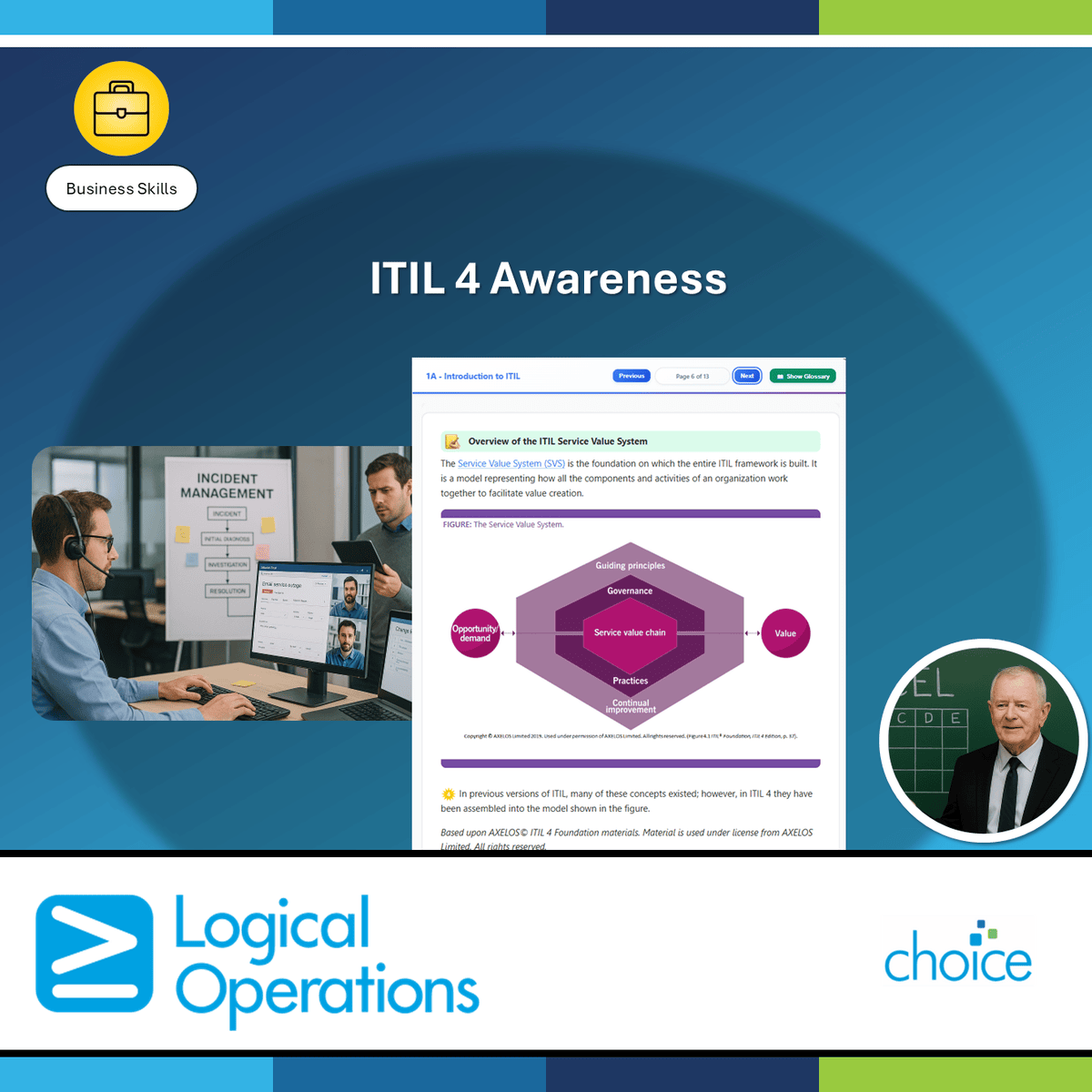
ITIL 4 Awareness
ITIL® is the world's leading best practice framework for implementing IT service management. Organizations use ITIL to plan, implement, support, and improve services and create value for their customers. In this course, you will learn the foundational knowledge and skills for adopting and adapting best practices for IT service management (ITSM) in your organization. This course is designed for anyone who would like a bird’s eye view of IT Service Management, its principles and practices, and how it will help you deliver better value to your customers. It is appropriate for all IT staff and management of organizations who work closely with IT to support business requirements. In this course, you will identify the components of the ITL 4 framework and describe key service management concepts.

Ansible and Ansible-Playbooks for Automation
Unlock the power of automation with Ansible and Ansible Playbooks in this comprehensive course designed to elevate your IT infrastructure management skills. Through step-by-step guidance, you will master Ansible's agentless architecture, efficient task execution, and powerful automation capabilities to streamline your workflows. Your journey begins with an introduction to Ansible, its core components, and environment setup, including configuring nodes and controllers. Progressively, you’ll dive into ad-hoc commands, modules for file management, and package installations across diverse OS families. Advanced sections cover playbook creation, debugging, and dynamic inventory handling, providing you with practical skills to automate real-world IT tasks. You'll explore sophisticated playbook concepts, such as variables, loops, conditional statements, and templates, to create reusable, adaptable automation scripts. Additionally, delve into error handling, privilege escalation, and integrating third-party plugins for enhanced functionality. A dedicated section on security teaches you how to use Ansible Vault to encrypt sensitive information securely. Ideal for system administrators, DevOps engineers, and IT professionals, this course equips you with the tools and knowledge to implement efficient automation practices. No prior experience with Ansible is required, but basic Linux command-line skills are recommended.

Practical Cybersecurity: Cybersecurity Fundamentals
This course is meticulously designed to equip you with the foundational knowledge and practical skills essential for navigating the complex landscape of cybersecurity. Through a series of engaging lessons, you will explore core security principles, delve into business continuity and disaster recovery strategies, and master the intricacies of network security and access control. Our expert instructors will guide you through cutting-edge topics such as software-defined networking, cryptography, and identity management, ensuring you are well-prepared to tackle real-world challenges. By the end of this course, you will have a robust understanding of security operations, network visibility, and the critical elements of AAA.

Data Storytelling with Power BI
Welcome to the Data Storytelling with Power BI course, where you'll embark on a journey to acquire practical expertise in data transformation and visualization. Leverage the potential of Power BI to create narratives through structured data, leading to the discovery of more profound insights. Throughout this course, you'll explore the industry-specific applications of Power BI and delve into its various features and functionalities. By the end of this course, you’ll be able to: - Explain essential concepts in data connectivity, transformation, and modeling using Power BI effectively. - Apply DAX formulas and functions to create measures, build relationships, and perform advanced calculations. - Design engaging and interactive visuals, reports, and dashboards to address diverse business requirements. - Evaluate Power BI Service capabilities to deploy, secure, and publish reports for scalable, data‑driven insights. This course is designed for a diverse audience: freshers, data analyst, business analysts, business intelligence analyst and IT professionals who are looking to enhance their data analysis skills through Power BI. Prior experience with Microsoft Excel or spreadsheet applications can be beneficial when working with Power BI. Embark on an educational voyage to master Microsoft Power BI and enhance your skills in creating efficient Reports and Dashboards using the Power BI ecosystem.

Introduction to Grafana Mimir for Scalable Metrics
Managing metrics at scale requires sophisticated orchestration and optimization strategies. This Short Course was created to help IT Support and Operations professionals accomplish highly available, cost-efficient metrics operations using Grafana Mimir. By completing this course, you'll be able to configure multi-cluster metric ingestion, optimize query performance, and reduce operational costs through intelligent alerting. By the end of this course, you will be able to: - Apply Mimir replication and deduplication settings to achieve highly available metrics ingestion across two Kubernetes clusters - Analyze PromQL query patterns to optimize performance and memory usage for a high-cardinality label set - Evaluate dashboard recording rules and alert thresholds to ensure accuracy and cost efficiency under variable load conditions This course is unique because it focuses on real-world scaling challenges with hands-on Kubernetes deployments and cost optimization strategies. To be successful in this course, you should have experience with Kubernetes, Prometheus basics, and observability concepts.

Cloud Deployment
Updated in May 2025. This course now features Coursera Coach! A smarter way to learn with interactive, real-time conversations that help you test your knowledge, challenge assumptions, and deepen your understanding as you progress through the course. Dive into the dynamic world of Cloud Deployment with this in-depth course designed to transform your understanding of cloud infrastructure and its deployment. Gain the expertise to identify cloud subscription services, provision resources, and configure advanced networking and compute solutions. From foundational principles to hands-on demonstrations, this course equips you with the skills to deploy robust cloud systems effectively. The course begins with an introduction to storage provisioning and its essential components, such as storage types, tiers, and protocols. Through real-world demonstrations, you’ll learn how to deploy storage resources, virtual machines, and containers using industry-best practices. Comprehensive discussions on RAID configurations, storage features, and disaster recovery scenarios ensure that you are prepared for any cloud deployment challenges. The next section focuses on networking services and virtualization, covering virtual routing, SR-IOV, and the deployment of critical services like DNS, DHCP, and IPAM. Hands-on demos will reinforce your understanding of dynamic routing, compute sizing, and software-defined storage solutions. The course concludes with an exploration of cloud migration strategies, giving you the tools to plan and execute seamless migrations. This course is tailored for IT professionals, cloud engineers, and administrators aiming to enhance their cloud deployment capabilities. With its intermediate-level difficulty, it’s suitable for those with prior knowledge of IT and networking concepts. Whether you're scaling your organization’s cloud infrastructure or embarking on your journey into cloud technologies, this course is your pathway to success.

Cost Optimization and Data Tiering with BigLake and Cloud Storage
This is a self-paced lab that takes place in the Google Cloud console. Learn to how to potentially reduce your costs by archiving data, unused tables, and partitions from BigQuery into Google Cloud Storage

Build a Certification Study Guide: PCDBE Exam Prep
Learn how to use NotebookLM to create a personalized study guide for the Professional Cloud Database Engineer certification exam. You'll get an overview of the NotebookLM essentials, learn how to add sources, and use the study guide to practice for a certification exam.

Responsible AI Ethics and Data Practice
This course focuses on the ethical and data governance dimensions of AI deployment. You’ll apply Microsoft’s six Responsible AI principles to score new use cases, detect and escalate bias in model outputs, vet third-party datasets for ethical sourcing, and classify and monitor data assets to enforce retention and quality standards. This course bridges technical controls with ethical decision-making at the managerial level. Some familiarity with AI model concepts is helpful. By the end of this course, you will be able to assess ethical AI risks, justify mitigation decisions, evaluate data quality and lineage, and produce governance documentation suitable for responsible AI review, audit preparation, and deployment approval.

Capstone and Practice Exam (AZ-500)
Capstone and Practice Exam is the seventh course in the Microsoft Azure Security Engineer Associate Professional Certificate training program. It allows you to apply the skills gained from the previous six courses and prepare for the AZ-500 exam. The course starts with a recap of courses 1 to 6, followed by a real-world capstone project. You will complete the tasks typically performed by an Azure security engineer and then submit the project for peer review. Then, you will evaluate other project submissions and discuss solutions with peers. Finally, you will take a program-level practice exam and receive guidance on enrolling in the AZ-500 Microsoft Azure security technologies exam. By the end of this course, you will be able to: - Implement multifactor authentication. - Create a resource group and a new storage account and provide access to a user. - Create a strategy for implementing Azure security using security groups. - Set up a virtual machine (VM) to host a website, allowing only HTTP and HTTPS traffic. - Enable disk encryption on the VM. - Enable database auditing for a new Azure SQL database. - Enable Microsoft Defender for Azure SQL database. - List the steps to enroll in the AZ-500 exam.